.webp)
.avif)
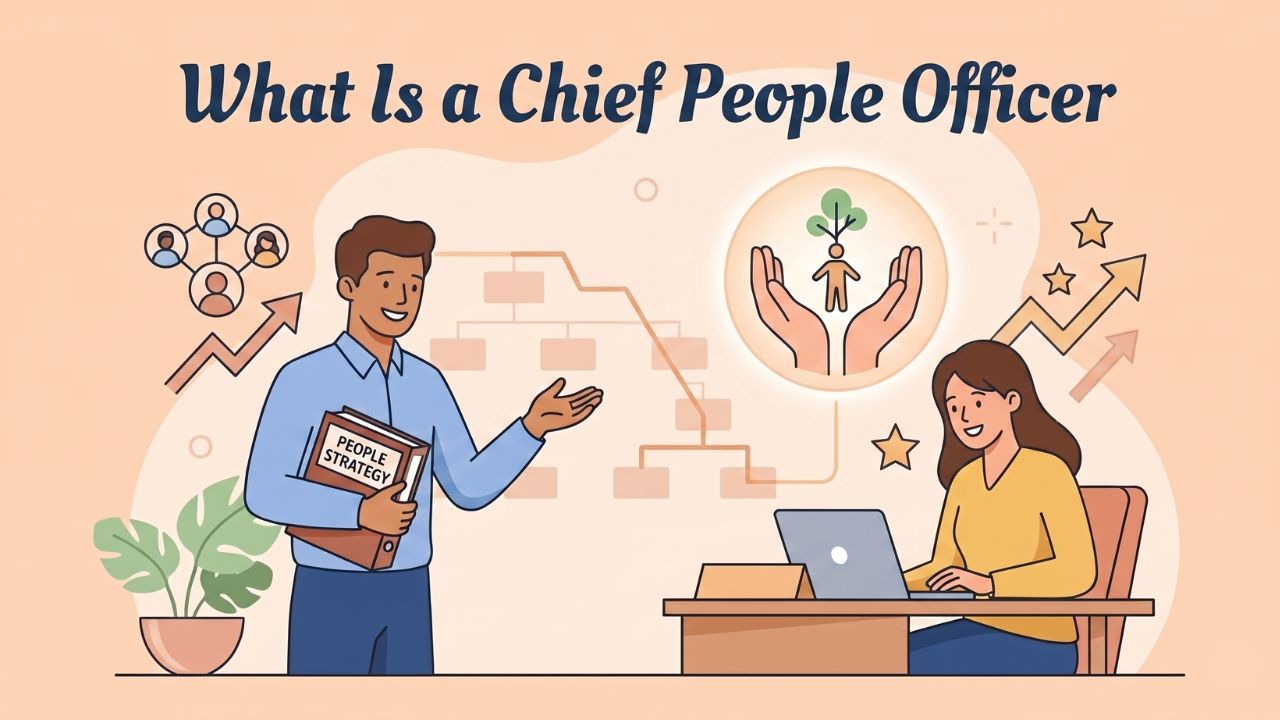
What Is a Chief People Officer?
A Chief People Officer (CPO) is the senior executive responsible for an organization's entire people function. That covers talent strategy, culture, leadership development, total rewards, organizational design, and people analytics. The CPO reports to the CEO, sits on the executive leadership team, and increasingly briefs the board of directors on human capital strategy.
In short: if a decision affects how people are hired, paid, developed, treated, or retained, it lands on the CPO's desk.
The role is sometimes called Chief Human Resources Officer (CHRO), VP of People, Head of People Operations, Chief Talent Officer, Executive Vice President of Human Resources, or simply People Lead. The titles vary by company size and culture, but the scope is similar.
CPO vs CHRO vs VP of People: Are They the Same Role?
I get this question constantly. The short answer is: mostly yes, with some nuance.
Here's how I see the differences in practice.
The CPO title became popular as companies started treating people as the most strategic asset, not just an operational expense. CHRO is the more traditional label and still common at Fortune 500 companies. VP of People is the bridge title in startups before the function justifies a full C-suite seat.
If you're hiring for the role, the title matters less than the scope. Look at what the person will actually own.
What Does a Chief People Officer Actually Do?
The job is broader than people outside HR realize. I'll break it into the seven areas I spend my time on as a CPO, ranked roughly by how much of my week each one consumes.
1. Strategic Leadership and C-Suite Advisory
This is where my role differs most from a traditional HR director. I'm not just running an HR function. I'm a peer to the CFO, CRO, and COO, and I advise the CEO on people decisions that shape the business.
C-suite advisory looks like:
- Sitting in on every major business decision that has people implications
- Aligning people strategy with company strategy quarter over quarter
- Helping the CEO think through org structure, leadership gaps, and culture risks
- Briefing the board of directors on talent, succession, and human capital strategy
Business acumen for HR is non-negotiable here. If I can't read a P&L, model the cost of a layoff, or speak to revenue per employee, I have no business at the executive table.
Stakeholder management is also half the job. I'm constantly aligning between the CEO, the board, the executive team, and the workforce. Each group needs different framing of the same story.
2. Company Culture and Employee Experience
Culture used to be a soft topic. Now it's a board-level issue tied directly to retention, recruiting, and brand.
My work here includes:
- Leading company culture transformation when the business model or scale shifts
- Owning the employee experience (EX) strategy across the full lifecycle
- Driving values-led leadership at every management layer
- Building workplace innovation that makes the company a destination, not a default
Values-led leadership is the part most companies get wrong. Values written on a wall mean nothing. Values that show up in promotion decisions, comp adjustments, and termination calls mean everything. My job is to make sure the second one happens.
3. Talent Strategy and Workforce Planning
Strategic workforce planning is how I make sure the company has the right people in the right roles 18 to 36 months out, not just this quarter.
That covers:
- Talent acquisition strategy for both leadership and high-volume hiring
- Succession planning for every critical role, especially the C-suite
- Leadership development programs for current managers and emerging leaders
- Upskilling and reskilling initiatives as the business and technology evolve
- High-potential (HiPo) identification so we know who to invest in deeply
- Employee retention strategies for the people we cannot afford to lose
Succession planning gets the least attention until it's urgently needed. I treat it as a standing quarterly review with the CEO, not an annual checkbox.
4. Organizational Design and Change Management
Every time the company grows, contracts, restructures, or pivots, the org chart has to change. Organizational design is the work of figuring out the right shape, spans of control, reporting lines, and decision rights.
Change management leadership is the work of getting people through the change without losing trust, talent, or momentum. Most reorgs fail not because the design was wrong, but because the change wasn't managed.
I've learned the hard way that the announcement is 5% of the work. The follow-through is the other 95%.
5. Total Rewards and HR Operations
I oversee the operational backbone, even though I rarely do the hands-on work anymore. That includes:
- Total rewards strategy across base pay, bonuses, equity, and benefits
- Compensation and benefits benchmarking against the right talent market
- Performance management systems that actually drive performance
- Employee relations and mediation for the cases that escalate to me
- Global HR management when the company operates across multiple countries
- People success (the modern reframing of HR as enabling, not policing)
Total rewards strategy is where I see the most CPO mistakes. Companies either underpay and bleed talent, or they overpay early and can't sustain it. Benchmarking against the right peer set, not aspirational comps, is the discipline.
6. People Analytics and HR Technology
The job has gotten dramatically more data-driven. I run the people function the way a CFO runs finance: with dashboards, leading indicators, and clear ROI math.
That includes:
- People analytics tied to business outcomes (revenue per employee, regrettable attrition, time to productivity)
- HRIS management and strategy as the system of record
- Data-driven decision making on everything from comp to org design
- HR tech stack optimization across HRIS, ATS, LMS, performance, and engagement tools
- Workforce productivity metrics that actually mean something
- ROI of HR initiatives, because every program has to defend its budget
If I can't show the ROI of an HR initiative in dollars or days or basis points, I expect it to get cut. So do my CFO and CEO. That's fair.
7. Diversity, Compliance, and Risk
This is the part of the job that doesn't make headlines unless something goes wrong. Then it makes only headlines.
I own:
- Diversity, Equity, Inclusion, and Belonging (DEIB) strategy and execution
- Employment law compliance across every jurisdiction we operate in
- People-related risk mitigation (harassment, discrimination, wage and hour, classification)
- Labor relations when we have union representation
- ESG (Environmental, Social, and Governance) reporting on the social pillar
- Workplace ethics and integrity, from the top down
ESG reporting is the newest addition to the list. Public companies have to disclose human capital metrics now. Private companies whose investors care about ESG do too. The CPO usually owns the social and governance portions, and that work is only growing.
What Skills Does a Chief People Officer Need?
I'll be direct about what separates a strong CPO from a senior HR director who got the title.
Business acumen. You have to read financials, understand the business model, and connect every people decision to a business outcome. If you can't, you'll be tolerated but never trusted.
Executive presence. You're in the room with the CEO and the board. You have to communicate with clarity, hold your position under pressure, and make complex topics simple. Executive presence is learned, not born. But you do have to learn it.
Strategic thinking. Operators run the function. Strategists shape where the function is going. The CPO has to be the second one.
Data literacy. Not data science. But you should be able to look at a workforce analytics dashboard and ask the right next question.
Emotional intelligence at scale. You're going to mediate the worst conflicts, deliver the hardest news, and absorb the most pressure from the most directions. EQ is the survival skill.
Change leadership. Every CPO I respect has personally led at least one major transformation. The repeatable lesson: communicate ten times more than you think you need to.
Who Does a Chief People Officer Report To?
Almost always the CEO. Anything else is a red flag.
If the CPO reports to the COO or CFO, the people function is being treated as overhead. That structure works for some early-stage companies, but at scale it limits what the CPO can do.
The CPO also has a direct relationship with the board of directors, usually through the compensation committee. Board of directors reporting typically covers executive compensation, succession, culture risk, ESG metrics on the social pillar, and any major people-related risk.
When Does a Company Need a Chief People Officer?
This is the question founders and CEOs ask me most often. Here's the rough guide I give them.
- Under 50 employees: A People Lead or Head of People Operations is enough. You need someone to build the foundation.
- 50 to 200 employees: A VP of People makes sense. The function needs to scale and the founder can't run it anymore.
- 200 to 500 employees: This is where I'd hire the CPO. Org complexity, comp decisions, and leadership development all require executive-level ownership.
- 500+ employees: You should already have a CPO. If you don't, you're behind.
The trigger isn't headcount alone. It's complexity. If you're entering new countries, going public, navigating a merger, or fighting a culture problem, the right CPO is worth more than the role costs.
How Much Does a Chief People Officer Make?
Compensation varies widely. The biggest drivers are company size, stage, industry, and whether it's public or private.
Rough ranges I see in 2026:
Public company CPOs at large enterprises can earn well into eight figures when equity vests. Private company CPOs often take less cash for more upside.
Frequently Asked Questions
What is the difference between a CPO and a CHRO?
In practice they're nearly identical roles. CHRO is the older, more traditional title common at Fortune 500 companies and tends to emphasize HR operations, compliance, and total rewards. CPO is the newer title popularized by tech and growth companies and tends to emphasize culture, employee experience, and strategic people leadership. The scope is usually the same.
Does a CPO need an HR background?
Most do, but not all. The strongest CPOs I know came up through HR or talent acquisition. But I've also seen excellent CPOs come from consulting, operations, or general management. The non-negotiables are business acumen, executive presence, and the willingness to learn the regulatory side fast.
Who does a Chief People Officer report to?
Almost always the CEO. The CPO also has direct exposure to the board of directors, typically through the compensation committee, on topics like executive comp, succession planning, and culture risk.
What's the difference between a CPO and a VP of People?
Mostly scope and seat. A VP of People runs the function but reports into another executive (often the COO) and may not sit on the executive team. A CPO is a C-suite executive who reports to the CEO and is a peer to the CFO, CRO, and COO.
When should a startup hire a Chief People Officer?
Usually between 200 and 500 employees, or earlier if the company is going through a major transformation (international expansion, IPO prep, merger, major culture challenge). Below 50 employees, a Head of People Operations is usually enough.
How is the CPO role changing in 2026?
Three big shifts: people analytics is now table stakes (not a nice-to-have), ESG reporting on human capital metrics has expanded the CPO's compliance scope, and AI in HR (recruiting, performance, learning) is forcing every CPO to become fluent in the technology decisions, not just the people decisions.
Is the CPO role recession-proof?
No role is. But CPOs who can demonstrate clear ROI of HR initiatives, lead workforce restructuring with humanity and discipline, and protect the company through compliance and culture risk tend to be among the last cuts. The ones doing only soft work get cut first.
Final Thoughts
The CPO job is harder than it looks from the outside and more strategic than it looks from inside HR.
If you're a CEO hiring one, look for business acumen first, executive presence second, and HR depth third. You can teach the HR depth. You usually can't teach the other two.
If you're an HR leader aspiring to the role, the gap to close is rarely your HR knowledge. It's your ability to think like a business operator, present like a board-level executive, and translate people decisions into financial language.
The companies that win the next decade will be the ones with great products, great capital, and great people leadership. The CPO is the person responsible for the third.
.jpg)
.png)

.webp)