.webp)


Are you tired of the costly cycle of hiring for skills only to discover a mismatch in attitude or cultural fit months down the line? This is a common and frustrating challenge for many organizations, often leading to decreased productivity, team morale issues, and significant financial losses.
The reality is that a strong resume tells you what a candidate can do. It rarely tells you who they truly are, how they prefer to work, or why they are driven.
I've spent years immersed in the evolving landscape of HR technology, and one strategy consistently emerges as a powerful solution: psychographic recruiting.
This innovative approach helps you delve deeper into candidates' motivations, values, and personality traits, enabling you to build a team that not only excels technically but also thrives culturally.

With a comprehensive platform like Recooty, you can seamlessly integrate these profound insights into every stage of your talent acquisition process, ensuring a more aligned and successful workforce from day one.
The traditional hiring model, focused heavily on experience and qualifications, often overlooks the crucial human element.
It’s a bit like buying a car purely based on its engine specifications, without considering its fuel efficiency, safety features, or how it feels to drive.
In today’s dynamic work environment, hiring a resilient, engaged, and highly effective workforce demands a more nuanced approach.
This is where candidate personality targeting becomes your strategic advantage, allowing you to identify individuals whose intrinsic traits and drivers align perfectly with your organizational needs.
Furthermore, the power of this approach is amplified when paired with robust tools that facilitate collaborative hiring, enabling your entire team to contribute their perspectives on a candidate's holistic fit.
This blog post is your definitive, action-oriented guide. It will walk you through a step-by-step framework for implementing psychographic recruiting, transforming your hiring from a gamble into a science.
By the end of this detailed guide, you will possess a clear roadmap to define your ideal candidate's personality profile.
You will learn actionable strategies to attract these individuals, and gain the tools to assess them accurately.
You will discover how to move beyond superficial evaluations to build a team that is not just skilled, but also deeply aligned with your company’s core values and long-term vision.
We will address common pitfalls, explore cutting-edge technologies, and ensure you are equipped to foster a workplace where every hire contributes meaningfully and thrives.
What is a psychographic approach in hiring? It is a method of understanding candidates based on their psychological attributes, including their personality, values, interests, and lifestyle choices, moving beyond basic demographics.
What are the 5 Fs of recruiting? The "Five Fs" that significantly influence a candidate's decision-making are Fit, Fortune, Family, Flexibility, and Fun.
Understanding these intrinsic motivators is key to crafting compelling job offers and fostering long-term employee satisfaction.
Understanding the Foundation of Psychographic Recruiting
Before we dive into the "how," let's solidify our understanding of "what" psychographic recruiting entails and its transformative potential in the modern talent landscape.
This isn't just a buzzword; it's a fundamental shift in how we perceive and evaluate potential employees.
What is Psychographic Recruiting?
At its core, psychographic recruiting is a sophisticated strategy that focuses on the intrinsic characteristics of individuals.
Unlike demographics, which categorize people by external, quantifiable attributes such as age, gender, income, education, and location, psychographics delve into the deeper, psychological dimensions that shape human behavior.
It seeks to understand why people make certain choices, what drives their actions, and how they perceive the world around them.
Specifically, psychographic recruiting assesses candidates based on:
- Personality Traits: Are they naturally introverted or extroverted? Do they exhibit high levels of conscientiousness, openness, or agreeableness? These fundamental aspects influence how they interact, problem-solve, and adapt within a team.
- Values: What core principles do they hold dear? Do they prioritize innovation, collaboration, integrity, social impact, or stability? Alignment of personal values with organizational values is a critical predictor of job satisfaction and retention.
- Attitudes and Beliefs: How do they view their work, leadership styles, teamwork dynamics, and challenges? Their disposition towards these elements directly impacts their engagement and productivity.
- Lifestyle Choices: What are their hobbies, interests, and daily routines outside of work? While not directly work-related, these can offer clues about their discipline, creativity, social engagement, and work-life balance preferences.
- Interests and Opinions (AIOs): What topics are they passionate about? What are their strong opinions on industry trends, societal issues, or problem-solving approaches? These reveal their intellectual curiosity, critical thinking, and potential for thought leadership.
Consider this scenario: Demographics might help you identify a software engineer in their late 20s, living in a specific city, with a computer science degree.
This information is valuable, but it's largely superficial in predicting success beyond technical competence.
Psychographic recruiting, however, enables you to find that same engineer who is also a proactive problem-solver, thrives in highly collaborative agile environments, and is motivated by challenging, impactful projects, and values continuous learning.
This deeper understanding is what truly enables you to select individuals who will not only perform their duties but also genuinely enjoy their work, contribute positively to the team, and grow with your organization for the long term.
Why Psychographics are Essential in Modern Hiring
The limitations of traditional, resume-focused hiring practices are becoming increasingly apparent in today's fast-paced and interconnected professional world.
While technical skills and past experience remain vital, they are often insufficient predictors of long-term job success and employee retention.
Many organizations have learned the hard way that a candidate with impeccable qualifications can still be a poor fit due to a misalignment of personality, values, or work style.
A brilliant coder who struggles with team communication or clashes with company culture can inadvertently create more problems than their technical prowess solves.
Psychographic recruiting transcends these limitations by adding a critical layer of depth to the assessment process.
It acknowledges that soft skills, such as communication skills, adaptability, resilience, and emotional intelligence, are frequently superior indicators of a candidate's potential to integrate, perform, and thrive within a specific organizational context.
It represents a more holistic and human-centric approach to talent acquisition, recognizing that a candidate's intrinsic traits are as important as, if not more important than, their extrinsic qualifications.
Here's a detailed comparison to highlight the difference:
- Traditional Recruiting Primarily Focuses On:
- Quantifiable Experience: Number of years in a role, specific companies worked for.
- Formal Education: Degrees, certifications, institutions attended.
- Hard Skills: Proficiency in specific software, programming languages, technical procedures.
- Past Achievements: Tangible results, metrics, and project outcomes.
- Job Titles: Hierarchical progression and assumed responsibilities.
- Psychographic Recruiting Broadens the Focus to Include:
- Intrinsic Motivation: What genuinely drives a candidate's work ethic and enthusiasm.
- Collaboration Style: Their preferred methods of teamwork, conflict resolution, and contribution.
- Problem-Solving Approach: Are they analytical, intuitive, creative, or methodical in tackling challenges?
- Learning Agility: Their capacity and desire for continuous learning and adaptation to new situations.
- Cultural Alignment: How well their personal values and preferred work environment match the company's existing culture.
- Leadership Potential: Their innate ability to influence, guide, and inspire others, even in non-managerial roles.
By thoughtfully integrating these psychographic elements with traditional skill assessments, organizations gain a far more comprehensive and accurate picture of each candidate.
This dual perspective ensures you're not just hiring someone who can do the job, but someone who will love doing it, genuinely contributing to the team's success and flourishing within your unique company environment.
The result is a significant improvement in crucial HR metrics, particularly employee retention through psychographics.
The Unrivaled Benefits: A Deeper Dive into ROI
Adopting a psychographic framework is not merely a modern HR trend; it is a strategic imperative that delivers profound and measurable business results.
Organizations that successfully integrate this approach consistently report improvements across various key performance indicators.
My experience in analyzing HR systems and consulting with diverse businesses reaffirms that these benefits translate directly into a substantial return on investment (ROI).
1. Dramatically Reduced Employee Turnover and Higher Retention: The most immediate and impactful benefit of psychographic recruiting is its effect on employee loyalty.
When you prioritize personality fit alongside skills, you hire individuals who are inherently more satisfied with their roles and work environment.
They feel a stronger sense of belonging and purpose because their values align with the company's mission and their personality thrives within the team dynamics.
Happy, engaged employees are significantly less likely to seek opportunities elsewhere.
- Actionable Impact: Reduced turnover directly translates into substantial cost savings.
Research consistently shows that the cost of replacing an employee can range from 50% to 200% of their annual salary, encompassing recruitment fees, onboarding time, lost productivity, and training expenses.
By reducing turnover by even a small percentage, psychographic recruiting can save your organization thousands, if not millions, of dollars annually.
For example, if your average employee salary is $60,000, and you reduce turnover by 10%, you could save between $3,000 and $12,000 per employee in replacement costs.
2. Building a Stronger, More Cohesive Company Culture: Organizational culture is the backbone of any successful business, influencing everything from innovation to customer service.
Hiring individuals who share or complement your core values naturally strengthens this culture.
When team members are aligned on fundamental principles, collaboration becomes more fluid, communication more effective, and conflicts are resolved constructively.
This shared understanding fosters an environment of mutual respect and psychological safety.
- Actionable Impact: A strong, positive culture leads to improved employee engagement, higher job satisfaction, and a more attractive employer branding.
This virtuous cycle makes your company a magnet for other like-minded professionals, further enhancing your talent pool and reinforcing your unique organizational identity.
3. Enhanced Team Performance and Productivity: A team isn't just a collection of individuals; it's a synergistic entity.
When individuals with complementary recruiting personality traits are brought together, their collective output far exceeds the sum of their individual contributions.
Candidate personality targeting allows you to strategically assemble teams that possess the right mix of creative thinkers, meticulous implementers, diplomatic communicators, and resilient problem-solvers.
- Actionable Impact: Imagine a marketing team where a highly analytical, data-driven individual is paired with a highly creative, visionary strategist.
This combination leads to campaigns that are both innovative and meticulously executed.
These synergistic teams achieve goals faster, produce higher-quality work, and innovate more effectively, directly boosting overall organizational productivity and competitive advantage.
4. Attracting Higher-Quality Candidates and Stronger Employer Branding: When your job descriptions, recruitment marketing materials, and interview processes are infused with psychographic insights, they begin to speak directly to the values, interests, and aspirations of your ideal candidates.
This targeted messaging resonates deeply, attracting applicants who are genuinely passionate about your company's mission and culture, not just the paycheck.
- Actionable Impact: You shift from receiving a large volume of generic applications to a smaller, yet significantly more qualified pool of candidates.
This dramatically reduces the time recruiters spend sifting through unsuitable resumes, allowing them to focus their efforts on engaging truly promising individuals.
This targeted approach is a hallmark of innovative recruitment strategies, enhancing your reputation as an employer who genuinely understands and values its people.
Step-by-Step Guide to Crafting Your Psychographic Candidate Persona
The foundation of a successful psychographic recruiting strategy lies in developing a detailed and accurate candidate persona.
This isn't just a hypothetical exercise; it's a living, breathing profile of your ideal hire for a specific role, designed to guide every aspect of your recruitment efforts.
By following these structured steps, you will move beyond generic job descriptions to create compelling narratives that attract precisely the talent you need.
Step 1: Analyze Your Current Top Performers (The Internal Audit)
Action: Your initial and most crucial step is to look inward and identify the traits that drive success within your own organization.
Select 3-5 of your highest-performing employees currently in or closely related to the role you are hiring for.
Crucially, ensure this group represents a diverse cross-section of your workforce across demographics, backgrounds, and tenures, to actively mitigate unconscious bias from the outset.
Why it matters: Your top performers are the living blueprints of success within your unique company culture.
Their behaviors, motivations, and work styles offer invaluable, real-world data that should form the bedrock of your candidate persona.
This approach grounds your persona in actual observed success, rather than assumptions or wishful thinking, providing a data-driven foundation for your psychographic recruiting framework.
How to do it: Conduct structured, informal interviews with these selected top performers.
Frame these conversations as an opportunity to understand what makes them thrive and to learn from their experiences.
Focus on open-ended questions that encourage storytelling and reveal their intrinsic drivers.
Always probe for the "why" behind their answers to uncover deeper insights.
- Motivation Questions (to understand their drive):
- "What initially attracted you to this company and this specific role? What aspects of the work keep you engaged and excited on a daily basis?"
- "Can you describe a project where you felt most energized and fulfilled? What specific elements of that experience resonated deeply with you?"
- "Beyond salary or title, what are your most significant long-term career aspirations, and how do you see this role contributing to them?"
- Work Style Questions (to understand their approach):
- "When faced with a complex problem, do you prefer to tackle it individually or brainstorm with a team? Describe your ideal collaborative environment."
- "How do you typically prioritize tasks when you have multiple competing deadlines? What strategies do you employ to maintain focus and productivity?"
- "Describe your preferred method for receiving feedback, both positive and constructive.
How do you integrate feedback into your work?"
- Values Questions (to understand their core beliefs):
- "In your opinion, what is the single most important value or principle that our company genuinely upholds and practices?"
- "Beyond professional achievements, what does 'success' personally look like to you in your overall life and career journey?"
- "If you could change one thing about our team or company culture to make it even better, what would it be and why?"
- Interests and Opinions (AIO) Questions (to understand their broader engagement):
- "What resources (books, podcasts, industry blogs, communities) do you regularly engage with for professional development or personal enrichment?"
- "Outside of work, what hobbies or passions occupy your time? How do these activities influence your approach to your professional life?"
- "What are your strong opinions or insights regarding current trends, challenges, or innovations within our industry or your field?"
Action: Meticulously document their responses.
Look for recurring themes, shared values, and consistent behavioral patterns across your top performers.
Do they all value autonomy, or collaboration? Are they driven by impact, or intellectual challenge? These common threads will become the foundational pillars of your candidate persona, helping you to pinpoint the critical recruiting personality traits that truly matter.
Step 2: Define and Articulate Core Company Values (Your Cultural Compass)
Action: Before you can identify candidates who fit your culture, you must have an unequivocally clear understanding of what that culture is.
Gather your leadership team and relevant stakeholders for a dedicated workshop to either establish or critically review your company's core values.
This is an exercise in defining your organizational culture in tangible, behavioral terms.
Why it matters: A candidate can have the perfect personality for the job's tasks but still be a terrible fit if their fundamental values clash with your company's deeply ingrained ethos, they will likely struggle to thrive and ultimately depart.
For instance, a highly competitive individual might find a consensus-driven, highly collaborative culture stifling, irrespective of their technical brilliance.
Clearly defined values ensure you are hiring for genuine cultural fit – or, even better, "culture add" – which is distinct from merely hiring for skill.
This step is crucial for preventing mismatches that lead to employee turnover through psychographics.
How to do it: If your company already has a set of stated values, begin by questioning their current relevance and clarity.
Ask:
- "Are these values genuinely reflected in our daily operations and decision-making processes, or are they merely aspirational statements?"
- "For each stated value, what are 2-3 specific, observable behaviors that demonstrate it in action?" For example, if "Innovation" is a value, observable behaviors might include "proactively seeking new solutions," "respectfully challenging the status quo," or "experimenting with unconventional approaches."
- "Conversely, what behaviors would be considered directly contrary to our stated values?" This helps clarify the boundaries and expectations.
If your company has not formally defined its values, initiate this process by discussing:
- "What are the non-negotiable principles that guide our business, even in challenging times?"
- "If our company were a person, what would its defining personality traits be? How would it act in a crisis?"
- "What stories do we tell about our proudest moments or significant achievements as a team? What values underpinned these successes?"
Action: Synthesize these discussions into 3-5 clear, concise, and actionable value statements.
These should be more than just words; they should represent the living principles that govern your workplace.
Examples could include: "We Own Our Work," "We Win and Lose as a Team," or "We Are Insatiably Curious." These will serve as a critical filter for evaluating candidates and will be a direct input into your candidate persona, helping you screen for desired recruiting personality traits.
Step 3: Map Activities, Interests, and Opinions (AIO) – Understanding Their World
Action: Based on the insights from your top performer analysis and your clearly articulated company values, brainstorm and document the activities, interests, and opinions that would likely characterize your ideal candidate.
This step leverages the classic "AIO" framework, a powerful tool in psychographic segmentation, to build a richer picture of their entire life experience, not just their professional one.
Why it matters: AIO data provides invaluable context, helping you understand a candidate's broader lifestyle, passions, and intellectual curiosity.
This information is incredibly useful for several reasons: It allows you to craft more resonant and targeted recruitment marketing campaigns, predict how a candidate might engage with and contribute to your work environment, and even identify non-traditional sourcing channels.
Understanding where your ideal candidate "hangs out"—both online and offline—is critical for effectively reaching them and making your employer branding irresistible.
How to do it: Systematically fill out the AIO profile for your ideal candidate persona:
- Activities (What do they do in their spare time? How do they spend their non-work hours?):
- Example for a Senior Software Developer: Attends local or virtual tech meetups, actively contributes to open-source projects on platforms like GitHub, participates in coding challenges, enjoys strategy-based games (board games, video games), volunteers to mentor junior developers, or perhaps coaches a youth robotics club.
- Example for a Marketing Manager: Regularly attends industry webinars or conferences, is an active member of professional marketing associations, writes personal blogs or thought pieces on marketing trends, takes online courses in digital analytics, or participates in a book club focused on business strategy.
- Example for a Customer Success Specialist: Engages in community volunteer work, participates in online forums related to customer service best practices, is involved in local networking groups, or enjoys teaching new skills to others.
- Interests (What are they genuinely curious or passionate about? What topics consume their attention?):
- Example for a Senior Software Developer: Deeply interested in new programming languages or frameworks, fascinated by artificial intelligence ethics, passionate about efficient system architecture, or enjoys learning about cognitive science and human-computer interaction.
- Example for a Marketing Manager: Follows prominent industry thought leaders on LinkedIn and X (formerly Twitter), listens to multiple podcasts on brand development and consumer psychology, has a keen interest in behavioral economics, or enjoys analyzing data visualization trends.
- Example for a Customer Success Specialist: Passionate about user experience design, interested in psychology and human behavior, enjoys learning about different business models, or keeps up with trends in customer relationship management (CRM) software.
- Opinions (What are their beliefs, perspectives, and strong viewpoints on their work, industry, or related topics?):
- Example for a Senior Software Developer: Strongly believes in the principles of clean code and robust testing, advocates for agile and iterative development methodologies, holds firm opinions on the best practices for cybersecurity, or believes in knowledge sharing within a development team.
- Example for a Marketing Manager: Believes that authentic storytelling is paramount in brand building, is convinced that data-driven decisions outperform intuition alone, has strong opinions on the future of social media marketing, or champions ethical advertising practices.
- Example for a Customer Success Specialist: Firmly believes that proactive customer support is always superior to reactive problem-solving, is convinced that empathy is the most crucial skill in client interactions, or has well-reasoned opinions on how technology can enhance customer relationships.
Action: Crucially, translate this AIO profile into "Watering Holes" – specific platforms, communities, events, or publications where you can directly find and engage with candidates who fit this profile.
If your ideal developer is a GitHub contributor, ensure your sourcing efforts extend there, not just LinkedIn.
If your marketing manager follows specific podcasts, consider advertising on those platforms or tailoring your messaging to reflect their content.
This level of detail empowers you to develop highly effective recruitment marketing strategies and optimize your hiring efforts.
Step 4: Uncover Core Motivations (The "Five Fs" Deep Dive)
Action: To truly connect with and attract your ideal candidate, you must understand what fundamentally drives them.
Utilize the "Five Fs" framework to define the primary motivators for your candidate persona.
The Five Fs are: Fit, Fortune, Family, Flexibility, and Fun.
Why it matters: Every candidate, regardless of their skills or experience, makes career decisions based on a unique combination and prioritization of these five factors.
Understanding which of these "Fs" are most important to your target persona allows you to tailor your job descriptions, interview conversations, and ultimately, your job offer, in the most compelling and persuasive way.
This insight is a fundamental aspect of effective candidate personality targeting, moving beyond generic appeals to truly speak to individual desires.
How to do it: For your specific candidate persona, rank the Five Fs in order of importance from 1 (most important) to 5 (least important).
Then, provide a brief explanation for each ranking based on your earlier analysis of top performers and company values.
- Fit (Alignment with Purpose, Role, and Culture):
- Description: How crucial is the alignment of the role with their skills, long-term career goals, intellectual challenges, and the company's overall mission and values? Does the work itself provide meaning?
- Scenario: A candidate high on Fit seeks projects that challenge them, a role where they can make a tangible impact, and a company whose values resonate with their own.
They might prioritize a smaller, impactful role over a higher-paying but less meaningful position.
- Fortune (Financial Compensation and Security):
- Description: How significant are salary, bonuses, equity, retirement plans, and other financial incentives? Is financial stability or wealth accumulation a primary driver?
- Scenario: A candidate prioritizing Fortune will carefully scrutinize the compensation package, aiming for industry-leading salaries, robust bonus structures, or significant equity potential.
This doesn't mean they ignore other factors, but financial reward is a key decision-maker.
- Family (Work-Life Integration and Support for Personal Life):
- Description: How important are benefits such as comprehensive health insurance, parental leave, childcare support, pet insurance, and a generally family-friendly work environment? Does the company respect personal commitments?
- Scenario: This candidate often seeks employers with strong benefits packages that support their dependents, robust leave policies, and an understanding culture that accommodates family needs and commitments.
- Flexibility (Autonomy, Work-Life Balance, and Work Arrangements):
- Description: How important are options for remote work, hybrid models, flexible working hours, compressed workweeks, or generous vacation policies? Is autonomy in managing their schedule and location a key desire?
- Scenario: A candidate valuing Flexibility thrives on autonomy.
They might seek roles that allow them to set their own hours, work from different locations, or manage their workflow without constant micromanagement, believing this optimizes their personal productivity and well-being.
- Fun (Enjoyable Work Environment, Culture, and Social Aspects):
- Description: How crucial is a positive, engaging, and enjoyable work environment? Do they seek strong camaraderie with colleagues, engaging team events, office perks, or a vibrant social scene at work?
- Scenario: This candidate is highly influenced by the social dynamics and atmosphere of the workplace.
They thrive in environments where humor, teamwork, and social connection are valued, and where there are opportunities for engaging team activities or celebrations.
- Example Persona Ranking: "Senior UX Designer"
- Fit (Very High): This designer is deeply driven by solving meaningful design problems and wants to work on a product that genuinely improves users' lives.
They seek impact and purpose over prestige.
- Flexibility (High): As an experienced professional, they expect a high degree of autonomy in managing their projects and schedule, including flexible hours and hybrid remote options, to optimize their creative flow.
- Fortune (Medium-High): They expect competitive pay commensurate with their expertise but are ultimately more motivated by the quality and impact of the work itself than being the highest-paid.
- Fun (Medium): They value working with smart, collaborative, and respectful colleagues, but are less concerned with extravagant office perks or constant social events, preferring focused work time.
- Family (Medium): Standard, solid benefits are important, but these are not their primary drivers for choosing a role.
Action: This granular understanding directly informs your outreach and negotiation strategies.
For the "Senior UX Designer" persona, you would lead with discussions about the product's impact, the design challenges, and the team's autonomy, rather than initially emphasizing just the salary.
This tailored approach enhances the candidate experience and significantly improves your chances of attracting and securing the right talent.
Step 5: Synthesize and Document Your Candidate Persona (The Living Profile)
Action: Now, gather all the rich data and insights you've collected from analyzing top performers, defining company values, mapping AIOs, and understanding motivations.
Synthesize this information into a concise, easily digestible, one-page document.
This is your definitive candidate profile template.
Why it matters: A well-crafted, tangible persona document serves as a critical single source of truth for your entire hiring team.
It ensures complete alignment among recruiters, hiring managers, and interviewers on who you are truly looking for.
This consistency reduces subjectivity, streamlines decision-making, and maintains focus throughout the entire recruitment lifecycle, from the initial job advertisement to the final offer.
It transforms abstract notions of an "ideal candidate" into a concrete, shared vision, effectively embodying your psychographic recruiting framework.
How to do it: Create a template with the following essential sections.
Keep it clear, visually appealing, and succinct.
- Persona Name: Give your persona a descriptive and memorable name.
E.g., "Alex the Agile Developer," "Maria the Marketing Maverick," "Sam the Supportive Specialist."
- Role Title: Clearly state the specific job title this persona represents.
E.g., Senior Software Developer (Frontend), Product Marketing Manager, Customer Success Lead.
- Key Personality Traits: List 3-5 dominant personality traits derived from your top performer analysis.
E.g., Proactive, Collaborative, Detail-Oriented, Curious, Resilient, Empathetic, Analytical.
- Core Values: List the 2-3 most critical company values that this persona must align with.
E.g., Team Player, High Ownership, Continuous Learner, Customer-Centric, Integrity.
- Motivators (The 5 Fs Ranked): Clearly rank the Five Fs (Fit, Fortune, Family, Flexibility, Fun) from 1 to 5, providing a brief justification for the top 2-3.
- Activities, Interests, Opinions (AIO) Profile:
- Activities: Summarize key activities (e.g., Contributes to GitHub, attends industry events, volunteers).
- Interests: Summarize key interests (e.g., AI ethics, behavioral psychology, sustainable tech).
- Opinions: Summarize key opinions (e.g., Believes in clean code, values data-driven decisions, champions user empathy).
- Goals & Aspirations: What are their short-term and long-term career ambitions? (e.g., "Wants to grow into a tech lead role within 2-3 years," "Aspirates to manage a small team," "Seeks to become an industry thought leader").
- Frustrations & Pain Points: What would make them unhappy or disengaged in a role or workplace? (e.g., "Hates bureaucratic red tape and slow decision-making," "Dislikes micromanagement," "Frustrated by lack of autonomy or impact").
- "Watering Holes" (Where to Find Them): List specific online platforms, professional communities, social media channels, events, or publications where this persona is most likely to be active and engaged.
(e.g., GitHub, Stack Overflow, specific Slack/Discord communities, Hacker News, industry-specific forums, LinkedIn groups).
Action: Once this document is complete, distribute it widely to every member of your hiring team, including HR, recruiters, and hiring managers.
Conduct a dedicated session to review the persona, answer questions, and ensure everyone understands its purpose and application.
Emphasize that this is a dynamic document that may be refined over time.
This collaborative understanding is vital for achieving incredible alignment and accelerating your hiring efforts while attracting top talent.
Actionable Strategies for Assessing Candidate Personality Traits
Crafting a precise candidate persona is an excellent start, but the real challenge lies in accurately assessing whether your candidates actually embody those desired recruiting personality traits.
This requires moving beyond superficial interview questions and implementing a more sophisticated, multi-faceted approach to psychographic recruiting techniques.
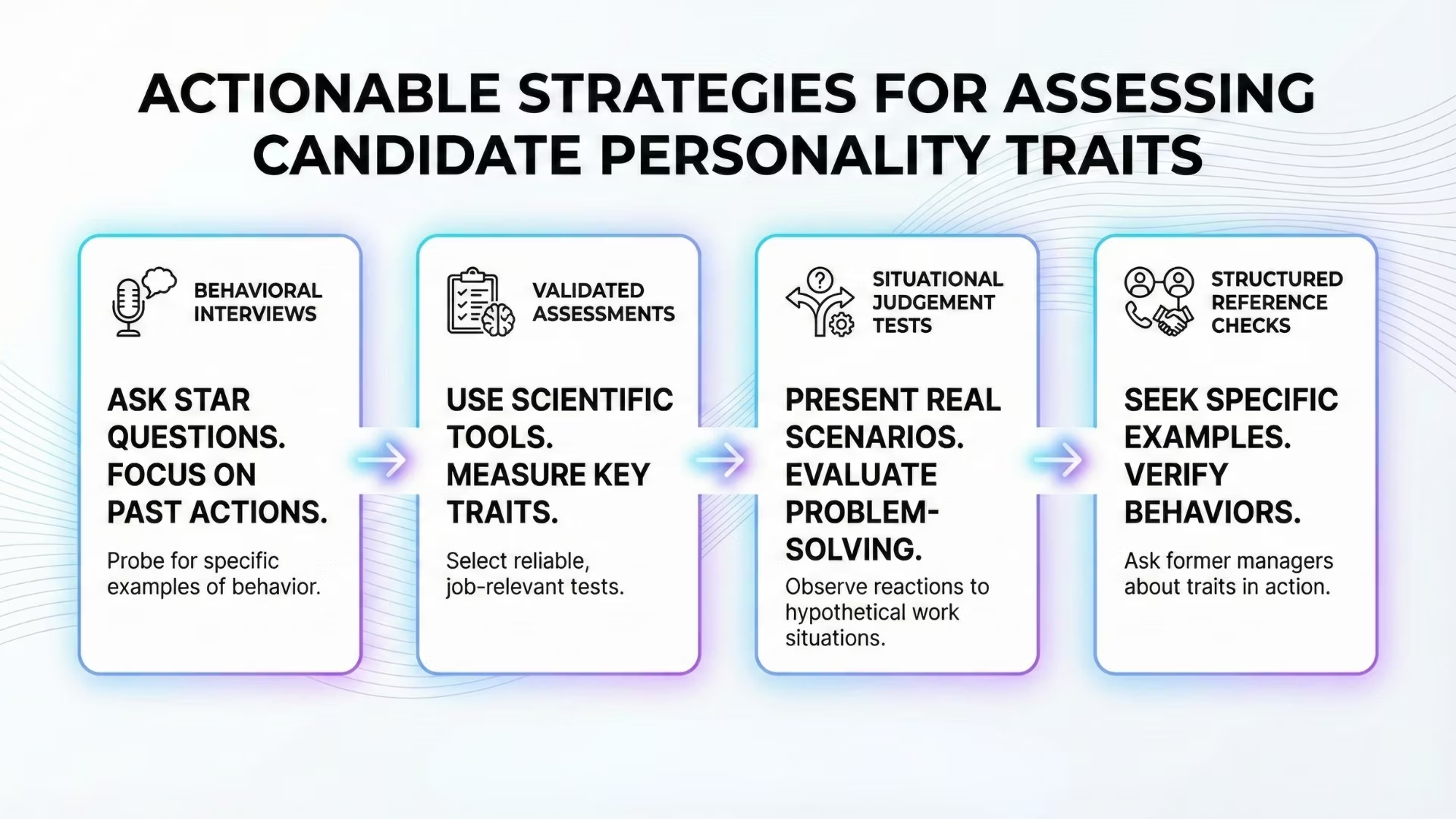
Strategy 1: Master Behavioral Interview Questions (The STAR Method in Practice)
Action: Design targeted interview questions that compel candidates to describe specific past behaviors and experiences.
The underlying principle here is that a candidate's past actions are the most reliable predictors of their future performance and behavior in similar situations.
Why it matters: Unlike hypothetical questions ("How would you handle X?"), which often elicit generic or rehearsed answers, behavioral interview questions demand concrete examples.
This makes it significantly harder for candidates to give answers they think you want to hear, instead providing genuine insights into their actual personality, problem-solving abilities, and work style.
This method forms a critical component of any effective behavioral assessment in recruitment.
How to do it: Utilize the STAR method as your framework for both crafting questions and evaluating responses:
- Situation: Ask the candidate to describe a specific event or situation they encountered.
- Task: What was the objective they were trying to achieve or the problem they needed to solve?
- Action: What specific steps did they take? Focus on "I" statements, not "we."
- Result: What was the outcome of their actions, and what did they learn?
For each key personality trait or value outlined in your candidate persona, develop 2-3 specific behavioral questions.
To Assess "Collaboration" & "Teamwork":
- "Tell me about a time you had to work with a difficult colleague or a team member with a very different working style.
Describe the situation, your approach, and the result."
- "Give an example of when you had to put the team's goals ahead of your own individual preferences.
What did you do, and what was the impact?"
To Assess "Adaptability" & "Resilience":
- "Describe a specific instance where a significant project plan or a client's requirements changed unexpectedly at a critical stage.
What immediate actions did you take to adjust, and what was the final outcome?"
- "Share an experience where you faced a major professional setback or failure.
How did you process it, what steps did you take next, and what did you learn that you now apply?"
To Assess "Ownership" & "Initiative":
- "Walk me through a project or task where you identified a problem that wasn't officially part of your responsibilities but took the initiative to address it.
What was the situation, your actions, and the positive impact you achieved?"
- "Tell me about a time you made a mistake at work.
What was the situation, how did you handle the error, and what steps did you take to ensure it didn't happen again?"
To Assess "Communication Skills" (both verbal and written):
- "Describe a time you had to explain a complex technical concept to a non-technical audience.
What was your strategy, and how did you ensure they understood?"
- "Give an example of a time you had to deliver difficult feedback to a colleague or a superior.
How did you prepare, what did you say, and what was their reaction?"
Action: During the interview, actively listen for all four components of the STAR method in the candidate's answers.
Pay particular attention to the "Action" phase; this reveals their actual behavior.
If a component is missing, use targeted follow-up questions: "Can you elaborate on the specific steps you took?" or "What was the ultimate outcome of that situation?" This systematic approach to evaluating interview questions provides concrete evidence of desired candidate personality traits.
Strategy 2: Leveraging Personality Assessment Tools (Beyond Gut Feeling)
Action: Integrate standardized personality assessment tools as one valuable data point within your multi-faceted hiring process.
These scientifically validated instruments can offer objective insights into a candidate's intrinsic traits, cognitive abilities, and likely behavioral tendencies.
Why it matters: While interviews are crucial, they are susceptible to unconscious biases and a candidate's ability to "perform." Personality assessments provide an objective, standardized measure, helping to level the playing field and offer a common framework for your hiring team to discuss a candidate's profile.
However, it is paramount that these tools are used responsibly: they should serve as a sophisticated guide for deeper questioning, not as an automatic pass/fail filter.
My firm recommendation is to view them as a conversation starter and a risk mitigator, rather than a definitive verdict on a candidate's potential.
This is especially relevant given the growing discussion around ethical implications and potential biases in AI-driven hiring.
How to do it: There are several reputable and scientifically robust assessment models available:
The Big Five Personality Traits (OCEAN Model):
This is the most widely accepted and scientifically validated model in psychological research.
It measures five broad dimensions:
- Openness to Experience: (Curiosity, imagination, intellect, creativity, willingness to try new things).
- Conscientiousness: (Organization, dependability, discipline, goal-directedness, thoroughness).
- Extraversion: (Sociability, assertiveness, energy levels, talkativeness, outgoingness).
- Agreeableness: (Cooperation, empathy, kindness, trust, compassion for others).
- Neuroticism: (Emotional stability, tendency towards anxiety, moodiness, worry, anger – lower scores indicate higher emotional stability).
- Application: Different roles benefit from different Big Five profiles.
A sales role might thrive with high Extraversion and Agreeableness, while a researcher might benefit from high Openness and Conscientiousness.
DiSC Assessment:
This tool categorizes behavioral styles into four primary dimensions: Dominance, Influence, Steadiness, and Conscientiousness (note: this "Conscientiousness" differs slightly from the Big Five).
- Application: Excellent for understanding communication preferences, team dynamics, and conflict resolution styles.
It helps predict how individuals will interact within a team and with clients.
Hogan Assessments:
A suite of assessments including Hogan Personality Inventory (HPI), Hogan Development Survey (HDS), and Motives, Values, Preferences Inventory (MVPI).
- Application: Often used for leadership development and predicting career derailment.
Provides insights into both bright-side (strengths) and dark-side (potential challenges under stress) personality traits.
Action: When selecting an assessment, choose one that is validated for employment purposes and aligns with the specific traits you identified in your candidate persona.
After candidates complete the assessment, integrate the results directly into your subsequent interviews.
For instance, if a candidate scores lower on "Conscientiousness" but your role demands high attention to detail, you might ask: "Your assessment suggests you tend to thrive in dynamic environments where structure is flexible.
Can you give me an example of a time you managed a project requiring meticulous organization and how you ensured all details were covered?" This approach helps validate or challenge the assessment findings and encourages a deeper conversation.
Remember, assessments are not designed to be the sole determinant but rather a powerful lens through which to enhance your understanding of potential hires, a key aspect of evaluating personality traits in interviews.
Strategy 3: Conducting Insightful Reference Checks (Unlocking Third-Party Perspectives)
Action: Elevate your reference checks from a perfunctory confirmation of employment to a strategic, psychographic assessment tool.
This requires a shift in mindset and a more intentional approach to questioning.
Why it matters: Most reference checks are notoriously ineffective, often yielding generic praise that provides little actionable insight.
However, by asking targeted, behavioral-focused questions rooted in your candidate persona, you can uncover invaluable third-party perspectives on a candidate's personality, work habits, and cultural alignment that they might not reveal themselves.
This method provides critical external validation for the recruiting personality traits you've identified.
How to do it:
- Set the Stage: When contacting a reference, begin by briefly explaining the role you're hiring for and highlighting 2-3 key personality traits or values that are most critical for success in that position and within your company culture.
For example: "We're hiring for a Senior Project Manager, and we're particularly looking for someone who demonstrates exceptional resilience under pressure and strong collaborative leadership.
I'd appreciate your insights on [Candidate Name] in these areas."
- Ask Behavioral Questions: Mirror the behavioral questions you used in your candidate interviews.
This provides a consistent framework for comparison.
- For "Resilience": "Can you recall a specific instance where [Candidate Name] faced a significant professional setback, a major project failure, or unexpected negative feedback? How did they react initially, what steps did they take to recover, and what was the ultimate outcome?"
- For "Collaboration" & "Teamwork": "Describe how [Candidate Name] typically functions within a team environment.
Can you give me an example of a time they went above and beyond to support a team member, or mediated a conflict effectively?"
- For "Initiative" & "Proactivity": "Tell me about a time you observed [Candidate Name] proactively identify a problem that wasn't officially part of your responsibilities but took the initiative to address it.
What was the situation, and what was the result?"
- For "Adaptability": "In today's fast-changing environments, how quickly would you say [Candidate Name] adapts to new technologies, processes, or organizational shifts? Could you provide a specific example?"
- Use Rating Scales with Justification: Incorporate quantitative elements to elicit more nuanced feedback.
- "On a scale of 1 to 10, with 10 being exceptional, how would you rate [Candidate Name]'s ability to handle constructive criticism and grow from it? Could you explain the score you gave?"
- "Considering a scale of 1 to 10, how well does [Candidate Name] embody the value of 'high ownership' in their work? What makes you say that?"
- Inquire about "Development Areas" (The "What Would You Do Differently" Question): This is a powerful question for eliciting honest, constructive feedback.
- "If you were to offer [Candidate Name] one piece of advice for their professional development, or if you could train them further in one area, what would it be?"
- "Are there any areas where you believe [Candidate Name]'s personality or work style might present a challenge in a fast-paced, highly autonomous environment?"
Action: Document the responses meticulously.
Look for consistency across references, but also note any significant discrepancies that might warrant further investigation.
The goal is to build a rich, 360-degree view of the candidate's psychographic profile, enabling a more informed and confident hiring decision.
This is an essential practice for ensuring you hire top talent that truly fits.
Strategy 4: Utilizing Work Samples and Simulations (Real-World Behavior)
Action: Design practical work samples or simulated tasks that directly reflect the core responsibilities of the role, but crucially, also reveal the desired personality traits and work styles identified in your candidate persona.
Why it matters: While interviews and assessments provide valuable data, nothing beats observing a candidate in a context that closely mimics the actual job.
Work samples are strong predictors of job performance because they require candidates to demonstrate skills and behaviors relevant to the role.
By designing these tasks to also highlight specific personality traits, you gain tangible evidence of how a candidate operates under real-world conditions.
How to do it:
- For a Collaborative Trait:
- Example: For a team lead role, provide a simulated scenario of a team conflict or a complex problem requiring input from multiple stakeholders.
Ask the candidate to facilitate a discussion, propose solutions, and demonstrate their ability to listen, mediate, and drive consensus.
- What it reveals: Their communication style, empathy, leadership in group settings, and conflict resolution skills.
- For an Independent Problem-Solving Trait:
- Example: For a data analyst, provide a messy dataset and an ambiguous business question.
Ask them to clean the data, perform analysis, and present actionable insights.
- What it reveals: Their analytical thinking, attention to detail, initiative in structuring a problem, and ability to work autonomously.
- For Adaptability and Creativity:
- Example: For a marketing specialist, provide a scenario where an initial campaign strategy needs to pivot due to unexpected market changes.
Ask them to outline a revised strategy and justify their creative choices.
- What it reveals: Their flexibility, innovative thinking, and ability to perform under pressure with incomplete information.
- For Attention to Detail/Conscientiousness:
- Example: For a quality assurance engineer, provide a mock software module with subtle bugs and ask them to identify and document all issues according to specific (and sometimes ambiguous) guidelines.
- What it reveals: Their thoroughness, methodical approach, and commitment to quality.
Action: Ensure these work samples are fair, job-related, and provide clear instructions.
Develop a standardized rubric for evaluation that includes not only task completion but also observations of how the candidate approached the task (e.g., did they ask clarifying questions? Did they seek feedback? Were they organized in their submission?). These observations provide invaluable insights into their recruiting personality traits and work ethic.
Strategy 5: Observing During Informal Interactions (The Power of the Unscripted)
Action: Incorporate brief, unstructured, yet ethically guided, informal interactions throughout the interview process.
These can include casual chats before or after formal interviews, brief office tours, or even a virtual coffee break with team members.
Why it matters: Formal interviews, by their nature, can be stiff and may not always reveal a candidate's true demeanor or how they interact in a less structured setting.
Informal interactions provide a window into a candidate's natural communication style, their social comfort, and their potential cultural fit within your existing team dynamics.
This strategy focuses on observing genuine soft skills for recruiters to identify, such as natural curiosity and ease of interaction.
How to do it:
- Pre-Interview Chat: A brief, unscripted chat with the hiring manager or a team member before the formal interview begins can often reveal a lot.
Ask casual questions about their commute, their interests, or their initial impressions of the office.
- Office Tour/Team Meet-and-Greet: If feasible, have candidates take a quick tour of the office or meet a few potential colleagues for an informal chat.
- What to observe (ethically and objectively):
- Engagement: Do they seem genuinely curious about the environment or team? Do they ask thoughtful questions?
- Social Comfort: How do they interact with various team members? Do they make eye contact, engage in small talk, or seem at ease?
- Energy Levels: Do they seem enthusiastic or reserved?
- Communication Style: Is their communication clear, respectful, and open in an unpressured setting?
- Virtual Coffee/Watercooler Chat: For remote roles, organize a short, informal video call with a few team members, specifically not focused on the job itself.
The goal is to simulate a casual "watercooler" conversation.
Action: It is crucial that these observations are ethical, respectful, and not used as the sole basis for a hiring decision.
Instead, they should inform a broader understanding of the candidate's personality and how they might integrate into the team.
Document your observations objectively, focusing on specific behaviors rather than subjective interpretations.
For example, instead of "seemed nervous," write "maintained limited eye contact and gave one-word answers during the casual chat." These informal insights contribute to a richer understanding of a candidate's true candidate personality targeting profile.
Advanced Psychographic Recruiting: Ethics, Technology, and Training
Implementing psychographic recruiting is a significant leap forward, but its success hinges on careful navigation of ethical considerations, strategic adoption of technology, and thorough training for your recruitment team.
As a technical writer specializing in HR tech, I've observed that the most effective organizations prioritize these advanced aspects to maximize benefits while minimizing risks.
Navigating Ethical Considerations and Bias Mitigation
Action: Proactively embed diversity, equity, and inclusion (DEI) principles into every single stage of your psychographic recruiting process, from the initial persona creation to the final hiring decision.
This is not an optional add-on; it's a fundamental requirement for ethical and effective modern hiring.
Why it matters: The very nature of psychographics—understanding preferences and behaviors—carries an inherent risk of reinforcing existing biases or unintentionally excluding diverse talent.
If your "top performer" analysis is based on a homogenous group, or if your persona inadvertently favors certain demographic groups, you risk perpetuating a lack of diversity.
This undermines the goal of building a robust and innovative workforce, and can also lead to legal challenges.
Addressing ethical implications and potential biases is paramount.
How to do it:
- Mandate Diverse Top-Performer Analysis: As highlighted in Step 1, explicitly require the selection of a diverse group of top performers for analysis.
Ensure representation across gender, ethnicity, age, background, and even diverse working styles within that high-performing cohort.
Actively seek out examples of success that challenge traditional norms.
- Focus on Inclusive Traits in Personas: When defining personality traits and values for your persona, prioritize inclusive language and behaviors.
Instead of "is an extrovert and loves social events," phrase it as "is an effective communicator in diverse settings (both written and verbal) and contributes positively to team morale through various engagement channels." This creates DEI job descriptions and persona profiles that welcome a broader range of individuals.
- Conduct Regular Bias Audits of Your Process: Implement a systematic review process for your candidate personas, job descriptions, assessment tools, and interview questions.
Have a diverse group (ideally including individuals not directly involved in the hiring for that role) critically review these materials.
- Action: Ask specific questions during the audit: "Could this language or trait unintentionally favor one demographic over another?" "Does this assessment question have cultural nuances that might disadvantage certain groups?" "Is there any implicit bias in how we interpret certain 'AIO' factors?" Be prepared to revise based on this feedback.
- Prioritize "Culture Add" over "Culture Fit": While cultural alignment is important, actively shift your mindset to "culture add." Instead of seeking candidates who are simply mirrors of your existing team, look for individuals who bring new perspectives, experiences, and thought processes that enrich and challenge your existing culture in a constructive way.
This fosters cognitive diversity, which is a powerful driver of innovation and problem-solving.
- Ensure Legal Compliance with Assessments: If using personality assessments, consult with legal counsel and HR experts to ensure they are validated for employment purposes, non-discriminatory, and comply with all relevant labor laws and equal opportunity guidelines in your region.
Transparency with candidates about the purpose of assessments is also crucial.
Action: Make bias mitigation an ongoing conversation and a core competency for your entire hiring team.
Regular training and open dialogue are key to fostering an inclusive and fair psychographic recruiting process.
Training Your Recruitment Team: The Human Element
Action: Invest significantly in comprehensive training programs for your entire recruitment team, including recruiters, hiring managers, and anyone involved in interviewing or candidate assessment.
The most sophisticated tools and personas are only as effective as the people wielding them.
Why it matters: Psychographic recruiting demands a different set of skills than traditional hiring.
Interviewers need to be adept at behavioral questioning, discerning true motivators, interpreting assessment data, and identifying nuanced personality traits.
Without proper training, even the best framework can fall short, leading to misinterpretations, inconsistent evaluations, or a return to gut-feel decision-making.
This addresses the content gap regarding training recruiters to effectively identify and assess personality traits.
How to do it:
Psychographic Principles & Persona Deep Dive:
- Action: Provide in-depth training on the fundamentals of psychographics, including the Big Five personality traits, AIOs, and the Five Fs.
Explain why these elements are crucial and how they link to job performance.
- Action: Conduct interactive workshops where the team collectively reviews and internalizes each candidate persona.
Discuss specific examples of how the persona translates into real-world behaviors.
Mastering Behavioral Interviewing (Advanced STAR):
- Action: Deliver intensive training on constructing effective behavioral interview questions, focusing on drawing out the STAR method from candidates.
- Action: Implement role-playing exercises where recruiters practice asking questions and interviewers practice active listening and probing follow-up questions.
Provide constructive feedback on their ability to elicit detailed, behavioral examples.
Bias Awareness & Mitigation Training:
- Action: Conduct mandatory, regular training sessions on unconscious bias in hiring.
Cover topics like affinity bias, confirmation bias, halo/horn effect, and how these biases can inadvertently influence psychographic assessments.
- Action: Discuss practical strategies to counteract bias, such as structured interviews, diverse interview panels, and objective documentation of candidate responses.
Assessment Tool Interpretation:
- Action: If using personality assessments, provide specialized training on how to correctly interpret the reports.
Focus on understanding the nuances of scores, recognizing what they do and do not measure, and how to integrate these insights into interview questions without over-relying on them.
- Action: Emphasize that scores are a guide for conversation, not a definitive judgment.
Ethical Interviewing & Candidate Experience:
- Action: Train recruiters on the ethical considerations of discussing personality traits, ensuring respect for candidate privacy and avoiding intrusive questioning.
- Action: Emphasize the importance of maintaining a positive candidate experience throughout the psychographic assessment process, providing clear communication and feedback where appropriate.
Action: Foster a culture of continuous learning and feedback within your recruitment team.
Regularly review interview feedback, calibration sessions, and hiring outcomes to identify areas for further training and refinement.
This iterative approach ensures your team consistently improves its ability to identify critical recruiting personality traits and make superior hiring decisions.
Leveraging Emerging Technologies and AI Tools
Action: Embrace and strategically implement emerging technologies and AI-powered tools to scale and enhance your psychographic recruiting efforts.
While the human element remains irreplaceable, technology can act as a powerful accelerator, bringing data, efficiency, and objectivity to the process.
Why it matters: Manually analyzing psychographic data for hundreds of applicants is impractical.
Modern HR technology, particularly AI tools, can process vast amounts of unstructured data (like open-ended responses, resumes, or public digital footprints – with strict ethical and privacy guidelines) to identify patterns, sentiments, and behavioral indicators that align with your candidate personas.
This addresses the content gap regarding emerging technologies and AI tools for psychographic analysis.
How to do it:
AI-Powered Applicant Tracking Systems (ATS):
- Action: Invest in a modern ATS that integrates AI and machine learning capabilities.
Platforms like Recooty's AI Candidate Matching can analyze a candidate's entire profile – not just keywords on their resume but also their responses to psychographically-informed screening questions, cover letters, and even potentially public professional activities (e.g., GitHub contributions).
It then compares this against your ideal candidate persona to identify strong alignments, saving immense manual effort.
- Action: Utilize AI Candidate Ranking features.
An advanced ATS can automatically score and stack-rank applicants based on their alignment with both hard skills requirements and the cultural values/personality traits defined in your job descriptions and persona.
This allows recruiters to focus their time on the most promising individuals, dramatically improving efficiency.
- Action: Implement psychographically-informed screening questions directly within your ATS application process.
For example: "Describe a project where you had to adapt quickly to unforeseen changes.
What did you learn?" or "Which of our company's core values resonates most deeply with you, and how have you demonstrated it in your past roles?" The AI can then analyze these open-ended responses for sentiment, keyword frequency, and alignment with your persona's traits and values.
Advanced Sentiment Analysis & Natural Language Processing (NLP):
- Action: Explore specialized AI tools that use NLP to analyze the language used in candidate applications, cover letters, and even recorded video interviews (with consent).
These tools can identify indicators of optimism, analytical thinking, collaboration focus, or leadership potential embedded in a candidate's communication style.
- Caveat: Always use such tools with extreme caution, ensuring they are validated for fairness and do not introduce algorithmic bias.
Human oversight and ethical review are non-negotiable.
Predictive Analytics for Retention and Performance:
- Action: Once you have sufficient data from your psychographic recruiting efforts, explore predictive analytics.
AI can learn which psychographic profiles lead to the highest retention rates, strongest performance, and best cultural integration within your organization.
- Action: Use these insights to continuously refine your candidate personas and hiring criteria, creating a self-improving recruitment loop.
This allows you to measure the ROI of psychographic recruiting more precisely by correlating specific personality traits with long-term success metrics.
Action: Remember that technology is a tool, not a replacement for human judgment.
Always maintain human oversight and critical thinking when using AI in psychographic recruiting.
Leverage these tools to augment your team's capabilities, reduce administrative burden, and provide data-driven insights that empower more informed, less biased, and ultimately, more successful hiring decisions.
Your Blueprint for a Smarter Hiring Future
We have embarked on a comprehensive journey, exploring the profound impact of psychographic recruiting in today's competitive talent landscape.
You now understand that building truly exceptional teams goes far beyond the surface-level details of a resume or a list of technical skills.
It is about intimately understanding the whole person – their values, their intrinsic motivations, their preferred work styles, and their underlying personality.
This deeper level of insight is not merely advantageous; it is the cornerstone of fostering enduring success and a vibrant organizational culture.
You are now equipped with a clear, actionable roadmap.
You've learned how to meticulously craft a detailed candidate persona by conducting an internal audit of your top performers, authentically defining your core company values, mapping their activities, interests, and opinions, and dissecting their core motivators through the "Five Fs" framework.
You possess a robust toolkit of psychographic recruiting techniques designed for accurate assessment, including mastering behavioral interview questions (using the STAR method), strategically leveraging personality assessment tools, conducting insightful reference checks that go beyond basic confirmation, designing revealing work samples, and making ethical observations during informal interactions.
Crucially, we've navigated the essential ethical considerations, emphasized bias mitigation strategies, highlighted the importance of comprehensive recruiter training, and explored how cutting-edge AI technologies can intelligently amplify your efforts.
The future of hiring unequivocally belongs to organizations that can build the strongest, most aligned, and cognitively diverse teams.
By diligently implementing a strategy rooted in candidate personality targeting, you are not just refining your recruitment process; you are actively building a sustainable competitive advantage.
You are cultivating a workplace where talented individuals don't just perform their tasks; they thrive, innovate, and contribute their best work for years to come, leading to unparalleled long-term growth and success.
Are you ready to stop guessing and start hiring with confidence?
A hiring process that exclusively focuses on skills is a process that is, fundamentally, only seeing half of the picture.
It is time to evolve beyond outdated methodologies and embrace a holistic strategy that genuinely sees the whole candidate.
The modern Applicant Tracking System is no longer just an administrative tool; it is the intelligent foundation of any forward-thinking recruitment effort.
Discover firsthand how Recooty’s powerful AI-driven capabilities and intuitive collaborative tools can empower you to seamlessly integrate deep psychographic insights into every step of your hiring journey.Take the decisive step towards recruitment excellence.Sign up for a free demo today and unlock the potential to transform your recruitment from a game of chance into a predictable, highly effective science of success.

.png)
.png)

.webp)