.webp)
.avif)
AI is no longer just an HR tool; it’s the future architect of smart, efficient hiring. As noted in recent AI Overview research, using AI in the hiring process can dramatically improve speed, scalability, and fairness in recruiting.
In this blog post, I’ll walk you through how I’ve used AI in hiring process tasks like resume screening, AI-led video interviews, bias-free job descriptions, and AI recruitment automation tools that streamline every step of the funnel, all while improving the quality of hires.
Why Use AI in Hiring Today?
Like many recruiters, I used to spend hours sorting resumes, scheduling interviews, and crafting role descriptions with no clear way to measure results.
According to research on AI in recruitment, intelligent algorithms now automate repetitive tasks and assess candidates based on skill relevance, not just keywords.
With tools like Recooty, I’ve seen firsthand how AI hiring automation reduces manual tasks, making space for real, human connections with candidates.
How Recooty Streamlines the Process
One of my favorite tools is Recooty, an all-in-one AI recruitment platform focused on small and mid-sized companies. With it, you can:
- Build custom, bias-free job descriptions powered by AI
- Automate resume screening and shortlist creation
- Set up automated interview scheduling and tracking
- Publish jobs to 250+ platforms with one click
- Get analytics on hiring speed, productivity, and funnel efficiency
Recooty’s strength lies in combining ease of use with powerful automation, helping even solo recruiters scale hiring efforts.
Quick Facts:
What are the top use cases of AI in hiring?
AI helps screen candidates, schedule interviews, analyze video responses, and reduce hiring bias.
What’s the risk of AI in recruitment?
You must check tools for potential AI hiring bias examples and ensure transparency.
How to pick the right AI recruitment tool?
Look for GDPR/EEOC-compliant vendors with audit logs, like Recooty.
Are there free AI tools for recruitment?
Yes. Tools like Recooty offer free plans, and others like Textio or myInterview can supplement.
What This Guide Covers
In the full tutorial, I’ll show you exactly how to:
- Use AI screening and schedule automation to cut your hiring time in half.
- Conduct AI-powered video interviews using platforms like HireVue or Recooty-integrated interview tools.
- Write unbiased, inclusive job descriptions using AI text editors.
- Connect and automate your full recruitment pipeline from job ad to onboarding.
- Keep your workflow fair, compliant, and transparent.
This guide is packed with real-world AI recruitment examples, proven results, and the exact
steps I used to build a high-converting hiring funnel.
You’ll also discover powerful AI hiring tools, compliance best practices from the latest legislation, and techniques to customize the process to your company’s size.
Let’s Get Started!
Ready to remove hiring headaches and make faster, bias-free hiring decisions? Dive into the step-by-step guide and learn how AI recruitment automation can transform your business from day one.
If there’s one thing I’ve learned, it’s this: with smart AI applied the right way, you can hire better, faster, and fairer, without losing the human touch.
Step-by-Step Guide: How to Use AI in the Hiring Process — From Candidate Screening to Recruitment Automation
Hiring the right people isn’t easy, and it’s definitely not fast. That's why, when I first started optimizing our recruitment workflow, I turned to artificial intelligence.
Today, I’ll walk you step-by-step through using AI in the hiring process, from screening resumes and running interviews to writing unbiased job descriptions and automating the entire recruitment pipeline.
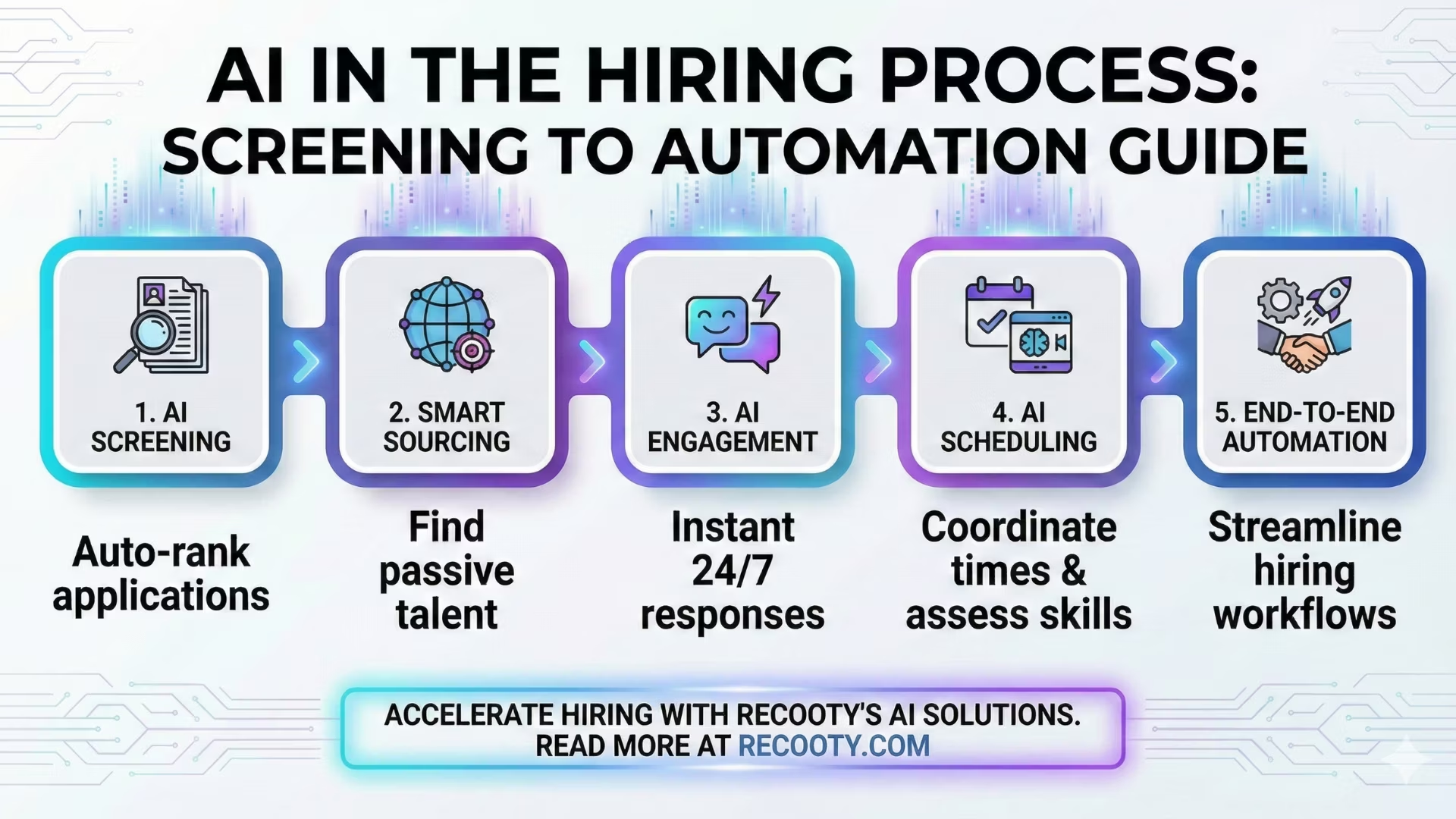
AI isn’t just a buzzword anymore. According to this Harvard Business Review article on AI in hiring, companies are seeing substantial gains in speed, objectivity, and hire quality by embracing AI Recruitment Automation and AI Hiring Automation.
After testing several tools myself, including Recooty, which I highly recommend for small and growing businesses, here’s what I’ve learned.
Let’s dive in.
Step 1: Define Your Hiring Goals and Stages
Before jumping into AI tools, take time to sketch out your full recruitment process from job posting to onboarding. Why? AI works best when it's mapped to specific actions in your current funnel.
Questions to ask yourself:
- How many applications do you receive per role?
- Where do bottlenecks happen- sourcing, screening, interviews?
- Are biased outcomes, high turnover, or slow time-to-hire issues?
Once these pain points are clear, you'll know where AI can help.
Tip: Document your hiring pipeline stages in a simple flowchart. Tools thrive off clean workflows.
Step 2: Write Unbiased Job Descriptions with AI
AI can help you craft inclusive and effective job ads fast. Language models trained on DEI standards spot problem phrasing and recommend improvements for clarity and tone.
Try tools like:
- Textio for inclusive language suggestions
- Recooty’s AI Job Description Generator
- Ongig’s Job Description Scanner
Why this matters: According to Ongig, biased descriptions reduce female applicants by 29%. And in my experience, once we swapped to AI-assisted job descriptions, we saw a clear improvement in applicant diversity.
Step 3: Automate Candidate Sourcing and Resume Screening
This is where AI in the hiring process really shines.
How I automated screening:
I connected incoming resumes to Recooty’s AI engine. It instantly ranked candidates by skill match, flagged top talent, and filtered out those without basic qualifications. The best part? This saved me hours every week.
Other great AI tools for resume parsing:
- Recooty for passive candidate sourcing
- SeekOut for diversity and skill insights
- Recooty for AI matchmaking and email outreach
This automation is a classic example of AI recruitment automation in practice.
Bonus: AI recruitment tools like these don’t just save time; they also are less likely to rely on "gut instinct," helping reduce subconscious bias.
Step 4: Run AI-Powered Video Interviews
AI-led interviews evaluate candidates using computer vision, body language analysis, and NLP.
Platforms to explore:
- HireVue offers facial expression + speech analysis
- myInterview helps with asynchronous video interviews
- Recooty now supports calendar integration and structured interview kits
AI video interviews are especially helpful for scaling early-stage hiring when you can’t interview everyone manually.
Note: Be mindful of AI hiring bias examples where video analysis models favored certain demographics. Choose providers with transparent standards, audit logs, and DEI compliance features.
Step 5: Automate Interview Scheduling & Communication
This is one of the easiest wins. Let your virtual recruiting assistant handle back-and-forth messages.
Key tools:
- Recooty’s built-in calendar & email sync
- Paradox (Olivia) for SMS-based recruiter chatbots
- Calendly + ATS integration for self-scheduling
You can even create conditional logic (e.g., “If candidate passes coding test → auto-schedule interview”) using Zapier + ATS workflow triggers.
This is exactly what recruiting automation workflows were designed for.
Step 6: Integrate Pre-Employment Assessments & Skills Tests
To reduce human error and bias in decisions, structure your assessments.
Recommended AI-compatible testing suites:
- Codility for technical hiring
- Pymetrics for gamified cognitive testing
- TestGorilla or Vervoe for general skills/psychometrics
Use structured interview scorecards and multi-rater panels to finalize top candidates and improve consistency.
Check out these AI hiring platform examples for implementation guidance.
Step 7: Automate Offer Letters and Onboarding
By this point, your shortlist is ready.
Final touches I automated:
- Auto-generated offer letters with Recooty’s customizable templates
- E-sign tools like DocuSign
- Onboarding software that triggers training and form collection
Fully automating your recruitment pipeline isn't fiction anymore. It's a real use case of AI hiring automation examples.
How Recooty Can Help (And Pricing Info)
I personally rely on Recooty because it brings all of this together at a startup-friendly price.
Top benefits of Recooty:
✅ Free AI job description tool
✅ ATS with AI-powered resume ranking and screening
✅ Automated interview scheduling
✅ Job posting to 250+ job boards
✅ Onboarding templates & offer management
Pricing: Recooty starts free, with premium plans from $79/month, much more affordable than similar AI hiring companies.
Sign up here for Recooty’s latest features.
Final Tips and Best Practices
- Always audit for AI hiring discrimination with fairness tools
- Balance AI automation with human checks (“human-in-the-loop”)
- Track quality-of-hire and cost-per-hire metrics
- Stay GDPR & EEOC compliant
- Keep up with model governance in HR
Conclusion
Using AI in the hiring process isn’t about replacing humans; it’s about empowering recruiters to make faster, fairer, and smarter decisions.
With tools like Recooty and purpose-built automation workflows, you can completely streamline your hiring pipeline.
Now that you know every step, from job description to onboarding, it’s time to put AI to work in your organization.
Ready to get started? Explore Recooty’s AI features and sign up for a trial today.
Let AI do the heavy lifting, so you can focus on building the best team possible.
Customization Tips to Personalize the AI Hiring Process
After integrating AI into my recruitment funnel, I quickly realized that out-of-the-box setups weren’t always the perfect fit.
Customization played a huge role in tailoring the benefits of AI in the hiring process to meet our specific needs, especially when scaling, reducing bias, and improving candidate experience.
Below are practical and research-backed customization tips you can apply at every stage, from setting up AI-powered candidate screening to refining interview workflows and job descriptions.
Customize AI in Hiring Process Based on Your Recruitment Needs
1. Tailor Resume Screening Algorithms to Brand-Specific Skill Sets
One of the first things I customized in our AI screening tool was the resume parser’s keyword logic.
Most tools, such as Recooty and HireEZ, allow you to define which skills, certifications, and experience are most important for your roles.
How to customize it:
- Adjust ranking algorithms to prioritize soft skills or domain-specific experience.
- Add synonyms to keyword search (e.g., “JavaScript” can also be searched for as “JS” or “React”).
- Use Boolean-free sourcing with semantic candidate search tools like SeekOut.
Why it works:
Tuning algorithms ensures candidates aren’t filtered out due to terminology differences, and it supports more inclusive hiring, an essential component when discussing AI hiring bias examples.
2. Train AI to Screen for Values & Culture Fit
While AI can't fully measure personality, platforms like HireVue let you score behavioral competencies based on pre-set ideal responses.
Customization tips:
- Input benchmark answers for cultural values (e.g., collaboration, agility).
- Use AI to assess tone and behavioral traits from video replies in structured interviews.
- Combine automated scoring with internal panel reviews for fairness.
Pro Tip: Reference your company’s core values in every job description and interview scorecard so AI models can inform human decisions instead of replacing them.
Customize AI Recruitment Automation Workflows
3. Automate Interview Schedules Based on Candidate Behavior
I used dynamic interview scheduling to increase our show rates and reduce friction. Tools like Recooty, integrated with Google Calendar, allow triggers like “Candidate completes assessment → send interview invite.”
Tips to implement:
- Set conditional interview scheduling by candidate score or availability.
- For high-volume hiring, activate text-based self-scheduling with tools like Paradox’s chatbot Olivia.
- Segment communication templates by persona (entry-level vs. executive).
Why it matters:
Candidates feel seen, and recruiters stay focused on qualified leads.
4. Personalize Candidate Nurture Campaigns
I didn’t want to lose good-fit candidates who weren’t ready to move forward. That’s when I built nurture campaigns using our ATS, automated SMS touchpoints, personalized job follow-ups, and even webinar invites.
How you can do this:
- Use email/SMS drips from platforms like Beamery or Recooty.
- Segment engagement based on application status, create a workflow that keeps “silver medalists” warm.
- Aim for personalization at scale by integrating with CRMs or LinkedIn Recruiter.
Result: Higher re-approach rates and improved employer branding.
AI Hiring Automation Tools That Enable Customization
Here are a few highly customizable AI hiring tools I’ve tested and recommend:
Recooty
Best for: Small to mid-sized teams automating job descriptions, screening, and scheduling
- Customize screening questions
- Role-based workflows
- Schedule automation based on actions
HireVue
Best for: AI-driven structured interviews and behavioral analysis
- Tailor questions by team or role
- Set scoring parameters
- Integrate assessments
SeekOut
Best for: Diversity hiring and precision sourcing
- Configure filters for underrepresented groups
- Custom talent pools
- Semantic search improvements
TestGorilla / Vervoe
Best for: Pre-employment testing
- Build role-specific tests
- Automate score-driven decisions
- Plug assessments into ATS
Real-World Example: Customizing for DEI Outcomes
A Fortune 500 company implemented AI job description tools like Textio to identify exclusionary terms.
After customizing job postings for inclusivity, the company saw a 31% increase in applications from women and minority candidates within six months.
How you can replicate this:
- Use AI to highlight jargon and gendered language in postings.
- Integrate DEI performance benchmarks into your AI vendor’s output checks.
- Set up alerts if the AI model starts to drift or underperform on diversity metrics.
Conclusion: Personalization Makes AI in Hiring Work Smarter
Customizing your AI recruitment automation workflows isn’t just a nice-to-have; it’s essential. I’ve seen better hires, more inclusive pipelines, and smoother candidate experiences just by tweaking the default logic and integrating AI thoughtfully.
Whether you're building your pipeline with Recooty, testing skills with Vervoe, or optimizing listings with Textio, make customization central to your AI hiring automation strategy.
Common Issues & Troubleshooting: Solving Challenges in AI-Powered Hiring Workflows
Even after customizing our AI recruitment workflows, hiccups were inevitable. Whether it was resume screening glitches, failed video interview assessments, or incompatible API setups, I encountered and solved multiple issues along the way.
In this section, I’ll walk you through the most common problems teams face in the AI hiring process and how to troubleshoot them effectively.
This will help you get the best out of your AI Hiring Automation tools while ensuring your pipeline doesn’t stall due to avoidable tech bugs or process misalignments.
Issue 1: AI Resume Screening Overfilters or Misses Top Candidates
AI tools can sometimes rank resumes incorrectly or filter out qualified applicants due to overly rigid keyword logic or poor resume parsing accuracy.
Why it happens:
- Lack of semantic understanding in basic parsers
- Over-reliance on keyword matching without context
- Missing job-specific customizations (like synonyms for role titles)
How to fix it:
1. Enable semantic search in your AI recruitment software. Tools like Recooty, SeekOut, or HireEZ support skill-based, Boolean-free sourcing.
2. Adjust keyword match rules, include related terms (e.g., “DevOps Engineer” = “Site Reliability”).
3. Use resume parsing audit tools or request corrections from vendors.
4. Review a sample of rejected resumes weekly to refine AI filters manually.
Example: I set up “people analytics” as a preferred skill, but the AI overlooked “employee data analyst.” After expanding keyword logic, top candidates reappeared.
Issue 2: AI Video Interviews Flag Diverse Candidates Unfairly
This is one of the most reported AI hiring bias examples. Misinterpretations in tone, facial expressions, or linguistic accents can skew AI assessments unfairly.
Why it happens:
- Machine learning models are trained on limited or non-diverse datasets
- Lack of explainable hiring AI features
- Non-calibrated scoring systems for diverse candidate backgrounds
Troubleshooting steps:
1. Choose vendors that offer transparency and fairness metrics (e.g., HireVue, Harver).
2. Opt-in for human-in-the-loop (HITL) review options. Let recruiters review AI-rejected candidates.
3. Run periodic bias audits per the four-fifths rule or NYC AEDT guidelines.
4. Use structured interview guides instead of open-ended conversations where tone can be misjudged.
Expert Tip: Always use platforms that allow transparency logs and provide model audit documentation.
Issue 3: Interview Scheduling Automation Fails or Sends Wrong Time Slots
After automation, one issue I hit was mismatched or double-booked interview slots due to API sync lapses or timezone misconfigurations.
Why it happens:
- Outdated calendar syncs between ATS and the scheduling tool
- Conflicting rules across workflows
- Incorrect timezone mapping in email templates
Troubleshooting guide:
1. Check calendar integration settings (Google/Outlook) in your AI hiring platform.
2. Use buffers between time slots to prevent overlap (e.g., 15-minute blocks).
3. Apply conditional logic: If candidate is from X time zone → send Y calendar block.
4. Sync calendars daily or push real-time triggers (Zapier or Recooty automations).
Example: I added calendar syncs via Zapier; this fixed abnormal invites caused by flaky webhook setups.
Issue 4: Job Descriptions Lack SEO or Attract Irrelevant Candidates
Despite using AI job description tools, I learned the hard way that default templates often miss keywords useful for job board SEO.
Why it happens:
- AI-generated content lacks market-optimized phrasing
- No use of skills taxonomy or job architecture tags
- Poor alignment between description and AI ranking logic
Solutions:
1. Use JD optimization tools like Recooty, Textio, or Ongig to revise content.
2. Analyze job role visibility using Google for Jobs markup testing.
3. Run A/B tests on titles, switch from “Engineer III” to “Mid-Level Software Engineer.”
4. Apply structured fields like location, skill, and department in ATS to enrich the schema.
Sample Fix: We replaced “high EQ” with “collaborative team player” and got a 34% increase in relevant applications.
Issue 5: ATS & AI Integration Failures
Sometimes the AI recruitment automation pipeline breaks when an ATS update or third-party plugin fails, halting resume processing or candidate movement.
Why it happens:
- Incompatible API versions across platforms
- Lack of webhook stability
- Missing API authorization or expired integrations
How to troubleshoot:
1. Check status pages of each platform for recent outages (e.g., Lever, Greenhouse, Recooty).
2. Re-authenticate API tokens via settings panels.
3. Connect via Open API or webhook platforms (like Make, Zapier) for error logging.
4. Test webhook triggers using “Test Candidate → Apply” and follow the journey manually.
Preventative: Set alerts for failed data pushes so errors don’t go unnoticed.
Issue 6: GDPR/Compliance Red Flags in AI Hiring Automation
One hidden risk I encountered was non-compliant data storage or tracking in some AI tools, especially when storing candidate facial data or behavioral logs.
Why this matters:
- AI hiring tools must align with GDPR, EEOC, and local privacy regulations (NYC AEDT, Illinois Video Interview Act).
- Violation = legal risk and reputational loss
Troubleshooting checklist:
1. Confirm your AI vendor has GDPR-ready frameworks and SOC 2/ISO 27001 controls.
2. Use anonymized scoring when legally necessary.
3. Store only necessary candidate data (data minimization policy).
4. Log candidate consent separately from general T&Cs.
Conclusion: Troubleshooting Makes AI Work Human Again
Using AI in the hiring process is powerful, but it’s not failproof. I’ve learned through trial, technical audits, and error logs how to anticipate problems before they impact our brand or candidate experience.
From misjudged interviews to broken applicant tracking syncs, getting your system error-proofed is just as important as setting it up. Keep this troubleshooting guide handy as you scale up your AI hiring automation, because smoother systems mean stronger hires.
Next step? Run quarterly audits on all your AI integrations, because the smartest automation is the one that still makes room for human oversight.
Conclusion: Harnessing AI to Transform Your Hiring Process
In this blog, we've explored how integrating AI in the hiring process can revolutionize your recruitment strategy.
By leveraging AI recruitment automation, you can streamline candidate screening, conduct insightful video interviews, craft unbiased job descriptions, and automate your entire recruitment pipeline.
.png)
.png)

.webp)