.webp)


GDPR compliance for recruiters is crucial for handling personal data of EU/EEA residents.
It requires a lawful basis for processing, data minimization, transparent privacy notices, and robust security measures.
Recruiters must understand candidate rights (access, erasure, objection) and ensure proper data handling, storage, and international transfer protocols to avoid significant fines and build trust.
In today's digital age, data is currency.
For recruiters, that currency is the personal information of candidates.
From resumes and contact details to interview notes and assessment results, you handle a vast amount of sensitive data daily.
But with this power comes immense responsibility, especially when recruiting individuals from the European Union (EU) or European Economic Area (EEA).
Enter the General Data Protection Regulation (GDPR).
This landmark privacy law, enacted by the EU, has transformed how personal data is collected, stored, processed, and protected globally.
For recruiters, understanding and complying with GDPR isn't just a legal necessity; it's a cornerstone of ethical practice and a critical factor in maintaining trust with candidates and safeguarding your organization's reputation.
Tools like Recooty can even help streamline these compliant processes.
They make it easier to manage applications fairly.
Ignoring GDPR can lead to severe consequences, including hefty fines that can cripple a business, reputational damage that makes attracting top talent nearly impossible, and a complete erosion of candidate trust.
Conversely, a strong commitment to data privacy can become a competitive advantage, positioning you as a responsible and trustworthy employer.
Recooty's applicant tracking system (ATS) simplifies data management and ensures your processes align with GDPR principles.
This comprehensive guide is meticulously designed to be your ultimate resource.
We will peel back the layers of GDPR, offering a deep dive into its principles, definitions, and practical implications specifically for recruiters.
You'll gain:
- A comprehensive understanding of GDPR's core requirements.
- A practical, actionable checklist to ensure your recruitment processes are compliant.
- Insights into common pitfalls and how to avoid them.
- Strategies to build a data privacy-aware recruiting function.
By the end of this guide, you will be equipped to navigate the complex landscape of data protection, becoming a champion of privacy and trust in your recruitment efforts.

Understanding the Foundation: What is GDPR?
To effectively comply with GDPR, recruiters must first grasp its fundamental principles and key definitions.
This regulation reshaped data protection law, putting individuals (data subjects) firmly in control of their personal information.
A. Core Principles of GDPR
GDPR is built on seven foundational principles.
These aren't just rules; they are the guiding philosophy behind every data processing activity.
- Lawfulness, Fairness, and Transparency:
- Lawfulness: You must have a valid legal basis for processing any personal data.
This means you can't just collect data without a reason justified by GDPR.
We'll delve into these lawful bases later.
- Fairness: Data must be processed in a way that the individual would reasonably expect and without any detrimental effects.
This means no hidden agendas or misuse of information.
- Transparency: Individuals must be informed about how, why, and by whom their data is being processed.
This is typically achieved through clear and accessible privacy notices.
For recruiters, this means clearly explaining how candidate data will be used, stored, and shared from the very first interaction.
- Purpose Limitation:
- You must collect personal data for specified, explicit, and legitimate purposes.
- Once collected for a specific purpose, you cannot process it for another purpose that is incompatible with the original one.
For instance, data collected for a specific job application cannot automatically be used for marketing purposes without additional legal grounds.
Recruiters need to be clear about the purpose – e.g., "to assess your suitability for X role and similar future roles, with your consent."
- Data Minimization:
- You should only collect data that is adequate, relevant, and limited to what is necessary in relation to the purposes for which it is processed.
- This is a critical principle for recruiters.
It means you shouldn't ask for information you don't genuinely need for a hiring decision or to fulfill a legal obligation.
For example, asking for marital status or full date of birth (beyond confirming legal working age) is usually not necessary and would violate this principle.
- Accuracy:
- Personal data must be accurate and, where necessary, kept up to date.
- Every reasonable step must be taken to ensure that personal data that is inaccurate, having regard to the purposes for which they are processed, are erased or rectified without delay.
For recruiters, this means having mechanisms for candidates to update their information, especially if their qualifications or contact details change.
- Storage Limitation:
- Personal data should be kept in a form which permits identification of data subjects for no longer than is necessary for the purposes for which the personal data are processed.
- This principle directly impacts talent pooling and data retention policies for recruiters.
You cannot keep candidate data indefinitely "just in case." You must define clear retention periods based on the lawful basis and purpose of processing.
- Integrity and Confidentiality (Security):
- Personal data must be processed in a manner that ensures appropriate security of the personal data.
This includes protection against unauthorized or unlawful processing and against accidental loss, destruction, or damage.
- This requires implementing appropriate technical or organisational measures.
For recruiters, this means secure Applicant Tracking Systems (ATS), encrypted communications, restricted access to candidate files, and employee training on data security.
- Accountability:
- The data controller (your organization) is responsible for, and must be able to demonstrate compliance with, the other six principles.
- This is a cornerstone principle.
It means you must keep detailed records of your data processing activities, policies, and decisions.
This includes documentation of consent, legitimate interest assessments, data protection impact assessments (DPIAs), and training records.
Recruiters need to be able to show how they comply.
B. Key Definitions for Recruiters
Understanding GDPR's specific terminology is crucial for practical application.
- Personal Data: Any information relating to an identified or identifiable natural person (a 'data subject').
This is a broad definition and includes things like names, addresses, email addresses, phone numbers, IP addresses, location data, online identifiers, and even factors specific to the physical, physiological, genetic, mental, economic, cultural, or social identity of that natural person.
For recruiters, virtually all information on a resume or application is "personal data."
- Special Categories of Personal Data (Sensitive Data): This refers to personal data revealing racial or ethnic origin, political opinions, religious or philosophical beliefs, trade union membership, genetic data, biometric data for the purpose of uniquely identifying a natural person, data concerning health, or data concerning a natural person's sex life or sexual orientation.
GDPR imposes stricter conditions for processing this type of data.
Recruiters must be extremely cautious; generally, you should not collect this data unless absolutely necessary and with explicit consent or another strong lawful basis (e.g., to ensure reasonable accommodations for disability, which is health data, but only after an offer).
- Data Subject: The identified or identifiable natural person to whom the personal data relates.
In the context of recruitment, this is primarily the job candidate.
- Data Controller: The natural or legal person, public authority, agency, or other body which, alone or jointly with others, determines the purposes and means of the processing of personal data.
Your organization is the Data Controller, as it decides why and how candidate data is processed.
Recruiters act on behalf of the Data Controller.
- Data Processor: A natural or legal person, public authority, agency, or other body which processes personal data on behalf of the controller.
This would include your ATS provider, background check vendor, payroll company, or any other third-party service that handles candidate data at your direction.
- Consent: Freely given, specific, informed, and unambiguous indication of the data subject's wishes by which he or she, by a statement or by a clear affirmative action, signifies agreement to the processing of personal data relating to him or her.
For GDPR, "silence, pre-ticked boxes, or inactivity" does not constitute consent.
It must be explicit and verifiable.
C. Territorial Scope: Who Does GDPR Apply To?
This is a critical point often misunderstood by non-EU organizations.
GDPR's reach extends far beyond the borders of the EU.
- EU/EEA Residents (Data Subjects): GDPR protects the personal data of individuals located within the European Union and European Economic Area (which includes Iceland, Liechtenstein, and Norway), regardless of their nationality.
- Organisations processing data of EU/EEA residents, regardless of where the organisation is located:
- If your organization is based within the EU/EEA, GDPR applies to all data processing activities, regardless of where the data subject is located.
- If your organization is based outside the EU/EEA (e.g., in the US, Canada, Asia), GDPR still applies if you:
- Offer goods or services to data subjects in the EU/EEA (even if free).
- Monitor the behavior of data subjects in the EU/EEA, as far as their behavior takes place within the EU/EEA.
This typically includes online tracking and profiling.
- Implications for global recruiters: If you actively recruit candidates who reside in the EU/EEA, or if you maintain a talent pool that includes EU/EEA residents, you must comply with GDPR.
It doesn't matter if your company's headquarters are in New York or Singapore.
If you interact with EU candidate data, GDPR applies.
This means your recruitment processes, ATS, and third-party vendors must all be GDPR-compliant when dealing with such data.
The Recruitment Process: A GDPR Lens
Every stage of the recruitment lifecycle, from initial sourcing to onboarding, involves processing personal data.
Recruiters must apply a GDPR lens to each step, ensuring that data handling is always lawful, fair, and transparent.
A. Lawful Basis for Processing Candidate Data
Before collecting or using any personal data, you must identify and document a lawful basis.
This is a non-negotiable requirement of GDPR.
Here are the most relevant bases for recruiters:
- Consent:
- When it is appropriate: Consent is suitable when processing is truly optional and not a fundamental part of the recruitment process.
For example, collecting additional demographic data for diversity reporting (beyond what's legally mandated) or adding a candidate to a talent pool for future roles that are not yet defined.
- How to obtain: Consent must be:
- Freely given: Candidates should not feel pressured.
- Specific: Clearly state what data you're collecting and for what specific purpose.
- Informed: Provide enough information (via a privacy notice) so the candidate understands what they are agreeing to.
- Unambiguous: Requires a clear affirmative action (e.g., ticking an unchecked box, signing a form).
Pre-ticked boxes are not valid.
- How to manage and withdraw: You must keep records of when and how consent was given.
Data subjects must be able to withdraw consent as easily as they gave it.
If consent is withdrawn, you must cease processing that data (unless another lawful basis applies).
- Challenge: Relying solely on consent for core recruitment activities (like processing an application for a specific job) is often problematic.
If a candidate withdraws consent, you can no longer process their application.
This is why "Legitimate Interest" is often preferred for core activities.
- Legitimate Interest:
- The most common basis for recruiters: For most core recruitment activities, such as receiving and reviewing applications for a specific role, conducting interviews, and performing necessary pre-employment checks, "legitimate interest" is often the most appropriate lawful basis.
- The balancing test: To rely on legitimate interest, you must perform a Legitimate Interest Assessment (LIA).
This involves a three-part test:
- Purpose Test: Is there a legitimate interest in processing the data? (e.g., filling a vacant position with the best candidate, maintaining a competitive workforce).
- Necessity Test: Is the processing necessary to achieve that legitimate interest? (e.g., collecting resume data to evaluate skills).
- Balancing Test: Do the individual's rights and freedoms override your legitimate interest? (e.g., are you collecting excessive data? Is the processing overly intrusive?).
- Documentation: You must document your LIA for accountability.
This demonstrates you have carefully considered the impact on the data subject.
- Transparency: Even with legitimate interest, you must still inform candidates about this basis in your privacy notice.
- Contractual Necessity (rare in pre-employment):
- This basis applies when processing is necessary for the performance of a contract to which the data subject is a party or in order to take steps at the request of the data subject prior to entering into a contract.
- For recruiters, this typically kicks in after a job offer has been accepted and before formal employment begins (e.g., processing data for onboarding documents).
It generally doesn't cover the initial application and interview stages.
- Legal Obligation (e.g., anti-discrimination checks):
- This applies when processing is necessary for compliance with a legal obligation to which the controller is subject.
- For example, collecting certain demographic data (e.g., for EEO-1 reporting in the US, if applicable) might fall under a legal obligation, though GDPR still requires explicit consent for special categories of data, even if collected for a legal obligation.
Another example might be checking right-to-work status, which is a legal requirement.
B. Data Minimisation: What Data Do You Really Need?
This principle directly challenges the traditional "collect everything" approach.
For recruiters, it means a disciplined approach to information gathering.
- Collecting only relevant and necessary information: Review every field on your application forms, every question in your interview guides, and every piece of data you save from resumes.
Ask: Is this absolutely necessary for the specific job or for a legitimate, documented purpose?
- Example: Do you need a candidate's full social security number before a conditional job offer? Likely not.
Do you need their date of birth, beyond confirming they are of legal working age? Generally no (to avoid age discrimination).
- Avoiding intrusive or irrelevant questions: During interviews, stick to job-related questions.
Avoid probing into personal life, family plans, health, or religion.
If a candidate volunteers such information, redirect the conversation back to their qualifications and the role.
- Reviewing application forms and initial screening processes: Regularly audit your existing forms and processes.
Eliminate unnecessary fields.
If using an applicant tracking system (ATS), ensure its default settings adhere to data minimization.
C. Transparency: Informing Candidates About Data Use (Privacy Notice)
Transparency is paramount.
Candidates have a right to know what's happening with their data.
This is achieved through a clear and easily accessible Privacy Notice (sometimes called a Candidate Privacy Policy or Data Protection Statement).
- When and how to provide a privacy notice:
- You must provide the privacy notice at the point of data collection.
If you collect data directly from the candidate (e.g., via an application form), link to the privacy notice prominently.
- If you obtain data indirectly (e.g., from a recruiting agency or LinkedIn profile), you must provide the privacy notice within a reasonable period (typically one month), or at the first communication, or before the data is used for another purpose.
- What information must be included (as a minimum):
- Identity and contact details of the data controller (your organization).
- Contact details of your Data Protection Officer (DPO), if you have one.
- The purposes for which the personal data are processed.
- The lawful basis for the processing (e.g., legitimate interest, consent).
- The legitimate interests pursued by your organization (if relying on this basis).
- The categories of personal data concerned (e.g., contact info, employment history, education).
- The recipients or categories of recipients of the personal data (e.g., hiring managers, HR team, ATS provider, background check vendor).
- Details of any international data transfers (outside the EU/EEA) and the safeguards in place.
- The retention periods for different categories of personal data (or the criteria used to determine them).
- The existence of the data subject's rights (access, rectification, erasure, restriction, objection, portability).
- The right to withdraw consent (if processing is based on consent).
- The right to lodge a complaint with a supervisory authority.
- Whether the provision of personal data is a statutory or contractual requirement, or a requirement necessary to enter into a contract, and whether the data subject is obliged to provide the personal data and the possible consequences of failing to provide such data.
- The existence of automated decision-making, including profiling, and meaningful information about the logic involved, as well as the significance and the envisaged consequences of such processing for the data subject.
- Accessible and clear language: The privacy notice must be concise, transparent, intelligible, and easily accessible.
Avoid legal jargon where possible.
It should be easy for a candidate to understand without needing a law degree.
D. Data Accuracy: Keeping Information Up-to-Date
Inaccurate data can lead to poor hiring decisions and violate GDPR.
- Regular checks and updates: Encourage candidates to update their profiles in your ATS or with your recruiting team.
Establish internal processes to periodically review and verify data accuracy.
- Candidate's right to rectification: Ensure you have a clear process for handling requests from candidates to correct inaccurate personal data.
You must respond to such requests without undue delay.
Candidate Rights Under GDPR: Empowering Data Subjects
GDPR gives individuals significant control over their personal data.
Recruiters must understand and be prepared to facilitate these "data subject rights." Failing to do so is a major compliance risk.
A. Right to Information: (Covered in Transparency section, but reinforce here as a right)
This is the cornerstone.
Candidates have the right to be informed about the collection and use of their personal data.
Your privacy notice is the primary tool for fulfilling this right, ensuring that all aspects of data processing are laid out clearly and proactively.
B. Right of Access (SARs - Subject Access Requests):
- What a SAR is: A Subject Access Request (SAR) is a request from a data subject for a copy of their personal data that your organization holds.
They also have the right to supplementary information about how that data is processed.
- How to handle a SAR (timeframes, scope, verification):
- Timeframe: You must respond to a SAR within one month of receipt.
This can be extended by two further months if the request is complex or numerous, but you must inform the data subject within the first month and explain the delay.
- Scope: The request can cover any personal data you hold about the individual.
This includes application forms, resumes, interview notes, assessment results, emails, and even internal communications where personal data is discussed.
- Verification: You must verify the identity of the person making the request to ensure you are not disclosing data to an unauthorized individual.
Ask for reasonable proof of identity.
- Format: You must provide the data in a commonly used electronic format (e.g., PDF, Word).
- Challenges for recruiters (e.g., interview notes): Interview notes often contain subjective opinions and assessments.
While these are usually considered personal data about the candidate, they may also contain personal data about the interviewer.
Be prepared to redact information that is not personal data of the requester or relates to other individuals.
The core principle is transparency about the candidate's data.
C. Right to Rectification:
- How candidates can correct inaccurate data: Candidates have the right to request that inaccurate personal data be corrected, or incomplete data be completed.
- Your obligation to amend: You must respond to a rectification request without undue delay and inform any third parties to whom the data was disclosed (e.g., an ATS provider) to update their records as well.
D. Right to Erasure (Right to Be Forgotten):
- When it applies (e.g., data no longer necessary, consent withdrawn): Candidates can request the deletion or removal of their personal data where there is no compelling reason for its continued processing.
This applies, for example, when:
- The personal data is no longer necessary for the purpose for which it was collected.
- The data subject withdraws consent (if consent was the lawful basis).
- The data subject objects to the processing, and there are no overriding legitimate grounds for the processing.
- The personal data has been unlawfully processed.
- When you can refuse (e.g., legal obligation): You can refuse an erasure request if the processing is necessary for:
- Compliance with a legal obligation (e.g., retaining data for tax purposes or to meet anti-discrimination reporting requirements).
- The establishment, exercise, or defense of legal claims.
- Implications for talent pools: If you maintain a talent pool based on consent, and a candidate withdraws consent or requests erasure, you generally must remove their data.
If your talent pool is based on legitimate interest, you would need to justify continued retention and processing, which becomes harder as time passes.
Define clear retention policies from the outset.
E. Right to Restriction of Processing:
- When candidates can request data to be stored but not processed: Data subjects have the right to request the restriction or suppression of their personal data in certain circumstances.
This means you can store the data, but you can't process it further.
This right applies when:
- The accuracy of the personal data is contested by the data subject (for a period enabling the controller to verify the accuracy).
- The processing is unlawful, and the data subject opposes the erasure of the personal data and requests the restriction of its use instead.
- The controller no longer needs the personal data for the purposes of the processing, but it is required by the data subject for the establishment, exercise, or defense of legal claims.
- The data subject has objected to processing (pending the verification whether the legitimate grounds of the controller override those of the data subject).
- Impact on active recruitment: If processing is restricted, you cannot use that candidate's data to assess them for roles or contact them.
Your ATS should have features to mark candidate profiles as "processing restricted."
F. Right to Data Portability:
- When it applies (data provided by consent or contract): This right allows individuals to obtain and reuse their personal data for their own purposes across different services.
It applies only to data:
- Which a data subject has provided to a controller.
- Where the processing is based on consent or for the performance of a contract.
- Where processing is carried out by automated means.
- Providing data in a structured, commonly used, machine-readable format: If applicable, you must provide the data in an easily transferable format (e.g., a CSV file, not a proprietary format).
This is less common for recruiters but could arise if a candidate wants their application data from your ATS.
G. Right to Object:
- When it applies (e.g., processing based on legitimate interest): Candidates have the right to object to processing based on legitimate interests (or public interest).
- Impact on direct marketing/future contact: If a candidate objects to processing based on legitimate interest (e.g., being contacted for future roles from a talent pool), you must stop processing their data for that purpose unless you can demonstrate compelling legitimate grounds for the processing which override the interests, rights, and freedoms of the data subject, or for the establishment, exercise, or defense of legal claims.
You must stop if they object to direct marketing.
H. Rights in Relation to Automated Decision Making and Profiling:
- Use of AI in recruitment (screening, personality tests): Automated decision-making (ADM) involves decisions made solely by automated means without any human involvement.
Profiling is any form of automated processing of personal data to evaluate certain personal aspects relating to a natural person.
Many modern recruitment tools, including AI-powered screening, resume parsing, and psychometric assessments, fall under this.
- Safeguards required (human intervention, right to challenge): GDPR generally prohibits ADM (including profiling) that produces legal effects concerning the data subject or similarly significantly affects them, unless it's necessary for a contract, authorized by law, or based on explicit consent.
Even then, safeguards apply:
- The data subject has the right to obtain human intervention.
- They have the right to express their point of view.
- They have the right to challenge the decision.
- Recruiters using AI or automated screening tools must be transparent about their use and ensure human oversight is always available.
A candidate should always be able to request a human review of a decision made by an algorithm.
For advanced matching, tools like AI candidate matching require careful configuration to remain compliant.
Data Security and Integrity: Protecting Candidate Information
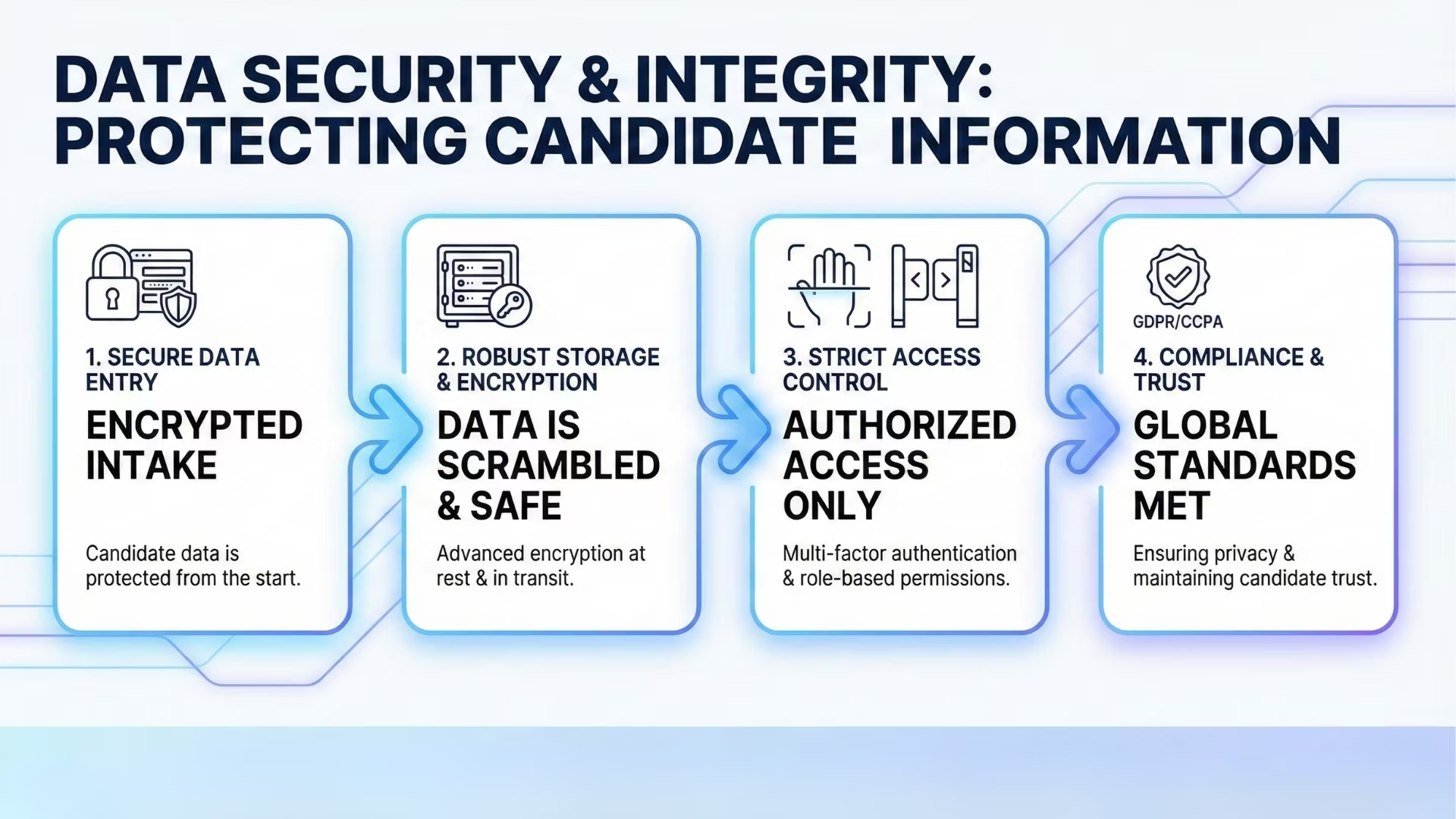
GDPR’s "Integrity and Confidentiality" principle requires robust data security.
Recruiters are on the front line, responsible for ensuring candidate data doesn't fall into the wrong hands.
A. Data Protection by Design and Default:
This is a proactive approach to privacy, requiring it to be built into your processes from the ground up.
- Building privacy into recruitment systems and processes:
- By Design: When designing a new recruitment process, selecting an ATS, or implementing a new candidate assessment tool, privacy must be a core consideration.
For example, choose an ATS that supports data minimization by default, allows easy management of candidate rights, and has strong security features.
- By Default: Ensure that, by default, only the necessary personal data is processed for each specific purpose.
This means settings should be configured to protect privacy automatically, requiring active steps to lessen protection, not the other way around.
- Privacy Impact Assessments (PIAs/DPIAs) for new technologies:
- A Data Protection Impact Assessment (DPIA) is a process designed to help you identify and minimize the data protection risks of a project.
You must conduct a DPIA when a type of processing is likely to result in a "high risk" to the rights and freedoms of individuals.
- For recruiters, this is particularly relevant when deploying new technologies like AI-powered screening tools, advanced psychometric tests, or new video interviewing platforms.
If a DPIA reveals high risks that cannot be mitigated, you might need to consult your supervisory authority before proceeding.
B. Technical and Organisational Measures:
These are the practical steps you take to secure data.
- Technical Measures:
- Encryption: Encrypting personal data, especially when it's stored or transmitted, protects it if unauthorized access occurs.
Your ATS and email providers should use strong encryption.
- Pseudonymisation: This is a technique that replaces identifying information with artificial identifiers.
While not full anonymization, it makes it harder to identify a data subject without additional information.
- Access controls: Implement strong password policies, multi-factor authentication (MFA), and role-based access controls.
Only individuals who need to access candidate data for their job function should have it.
For instance, a hiring manager might see resumes, but not all personal details collected for HR purposes.
- Secure storage: Ensure candidate data, whether digital or physical, is stored securely.
Digital data should be in secure, GDPR-compliant cloud environments or on protected servers.
Physical documents (rare in modern recruiting) must be locked away.
- Secure communication: Use secure, encrypted channels for communicating sensitive candidate data (e.g., secure email portals, encrypted file sharing).
Avoid sending sensitive data via unencrypted email.
- Organisational Measures:
- Employee training: Regular and mandatory training for all staff involved in recruitment (recruiters, hiring managers, HR) on GDPR principles, data handling procedures, and security best practices.
This includes awareness of phishing attempts and social engineering.
- Internal policies and procedures: Clear, documented policies on data handling, data access, data retention, and incident response.
- Physical security of data: If you still handle physical documents (e.g., signed offer letters), ensure they are stored in locked cabinets in secure offices.
C. Data Breach Notification:
Despite best efforts, data breaches can happen.
GDPR has strict rules for responding.
- What constitutes a data breach: A personal data breach is a breach of security leading to the accidental or unlawful destruction, loss, alteration, unauthorized disclosure of, or access to, personal data transmitted, stored, or otherwise processed.
This could be a lost laptop, a phishing attack, a ransomware incident, or simply sending an email with candidate data to the wrong person.
- Reporting obligations to supervisory authorities (within 72 hours):
- If a breach occurs and it is likely to result in a risk to the rights and freedoms of individuals, you must report it to the relevant data protection supervisory authority without undue delay and, where feasible, not later than 72 hours after becoming aware of it.
- This is a strict deadline, so your organization needs a clear incident response plan.
- Notifying affected data subjects: If the breach is likely to result in a high risk to the rights and freedoms of individuals, you must also notify the affected data subjects directly without undue delay.
- Recruiters' role in identifying and reporting breaches: Recruiters are often the first to notice a potential breach (e.g., an email sent to the wrong candidate, a lost USB drive).
They must know their immediate steps: who to inform internally, and the critical importance of speed in reporting.
International Data Transfers: Recruiting Across Borders
Recruiting is global.
But transferring personal data outside the EU/EEA (to countries not deemed "adequate" by the EU Commission) is one of GDPR's most complex areas.
Recruiters must understand the rules if their candidates are in the EU/EEA and their operations (or tech stack) are outside.
A. Transfers Outside the EU/EEA:
- The general prohibition: Personal data can only be transferred to a third country (outside the EU/EEA) or an international organization if the conditions laid down in GDPR are complied with.
The fundamental rule is that data should only be transferred if the level of protection for the data is not undermined.
- Mechanisms for lawful transfer:
- Adequacy Decisions: The European Commission has the power to determine that a third country, a territory, or one or more specified sectors within that third country, or an international organisation ensures an adequate level of data protection.
Transfers to such countries (e.g., UK, Japan, South Korea, Canada for commercial organizations) can take place without any further safeguard being required.
- Standard Contractual Clauses (SCCs): These are pre-approved model data protection clauses adopted by the European Commission.
They are legally binding agreements that an exporter and importer of personal data sign, committing them to protect the data.
SCCs are widely used but require ongoing assessment of the receiving country's laws to ensure the SCCs can be effectively upheld in practice.
- Binding Corporate Rules (BCRs): These are internal codes of conduct for multinational corporations.
They set out a company's global policy for international transfers of personal data within the same corporate group.
BCRs must be approved by supervisory authorities and are a strong, but resource-intensive, compliance tool.
- Derogations (Specific Situations): These are exceptions to the general prohibition and apply only in specific, limited circumstances:
- Explicit Consent: The data subject has explicitly consented to the proposed transfer, after having been informed of the possible risks of such transfers for the data subject due to the absence of an adequacy decision and appropriate safeguards.
This must be truly explicit and informed.
- Contractual Necessity: The transfer is necessary for the performance of a contract between the data subject and the controller or the implementation of pre-contractual measures taken at the data subject's request.
- Important Public Interest: The transfer is necessary for important reasons of public interest.
- Legal Claims: The transfer is necessary for the establishment, exercise, or defense of legal claims.
B. Implications for Global Recruiters and ATS:
- Choosing compliant ATS providers (e.g., cloud-based systems): Many ATS and HR tech vendors are cloud-based, meaning data may be stored or processed in different geographical locations.
If your ATS stores or processes EU/EEA candidate data outside the EU/EEA, you must ensure they have a valid transfer mechanism (e.g., SCCs) and that they adhere to GDPR.
- Ensuring third-party vendors (data processors) comply: Any vendor you use that processes EU/EEA candidate data (e.g., background check providers, assessment tools, video interview platforms) must also have appropriate international data transfer mechanisms in place if they operate outside the EU/EEA.
You are responsible for ensuring your processors are compliant.
- Due diligence: Before engaging any new vendor, especially cloud-based ones, ask about their data storage locations, their GDPR compliance measures, and their international data transfer mechanisms.
A Data Processing Agreement (DPA) will be required (see Section VI.D).
Accountability and Governance: Demonstrating Compliance
GDPR's accountability principle is central: your organization must not only comply but also be able to demonstrate its compliance.
This requires a robust internal governance framework.
A. Record Keeping of Processing Activities:
This is a fundamental aspect of accountability.
- Maintaining records of how and why you process data: You must document your data processing activities.
This record (often called a Record of Processing Activities or ROPA) is not just internal; supervisory authorities can request it.
- What records should be kept (as a minimum for data controllers):
- The name and contact details of the controller and, where applicable, the joint controller, the controller’s representative, and the data protection officer.
- The purposes of the processing.
- A description of the categories of data subjects (e.g., job applicants, talent pool candidates) and the categories of personal data (e.g., contact details, employment history, qualifications).
- The categories of recipients to whom the personal data have been or will be disclosed (e.g., hiring managers, HR team, ATS vendor, background check provider).
- Where applicable, transfers of personal data to a third country or international organisation, including the identification of that third country or international organisation and the documentation of suitable safeguards.
- Where possible, the envisaged time limits for the erasure of the different categories of data (retention periods).
- Where possible, a general description of the technical and organisational security measures.
- For recruiters, this means having detailed documentation on:
- Your lawful bases for different types of data processing.
- Your privacy notices and where/when they are provided.
- Your data retention schedules for different types of candidate data.
- Records of consent obtained (if applicable).
- Records of data subject requests (SARs, erasure requests) and how they were handled.
- DPIAs conducted for new recruitment technologies.
B. Data Protection Officer (DPO):
The DPO plays a crucial role in advising and monitoring GDPR compliance.
- When a DPO is required:
- If your organization is a public authority or body.
- If your core activities consist of processing operations which, by virtue of their nature, scope, and/or purposes, require regular and systematic monitoring of data subjects on a large scale.
- If your core activities consist of processing on a large scale of special categories of data or data relating to criminal convictions and offenses.
- Many large global recruitment firms or companies with extensive data processing operations will likely require a DPO.
- Role and responsibilities of a DPO:
- To inform and advise the controller (your organization) and employees about their obligations under GDPR.
- To monitor compliance with GDPR, including advising on DPIAs.
- To cooperate with the supervisory authority.
- To be the contact point for the supervisory authority and for data subjects on all issues related to processing of their personal data and to the exercise of their rights under GDPR.
C. Training and Awareness:
Human error is a leading cause of data breaches and non-compliance.
- Ongoing training for all staff involved in recruitment: This includes internal recruiters, agency recruiters, hiring managers, and anyone else who handles candidate personal data.
Training should be mandatory, regularly updated (at least annually), and tailored to the specific roles and responsibilities within the recruitment process.
- Cultivating a data privacy-aware culture: GDPR compliance isn't just an HR or legal responsibility; it's everyone's.
Foster a culture where data privacy is respected, and employees feel empowered to flag concerns or seek clarification without fear.
Regular reminders, internal communications, and accessible resources are vital.
D. Supplier Management (Data Processors):
You are responsible for your data processors.
- Due diligence for ATS, background check providers, etc.: Before engaging any third-party vendor (e.g., Applicant Tracking Systems, background check services, psychometric assessment providers, video interviewing platforms, recruitment marketing platforms) that will process personal data on your behalf, conduct thorough due diligence.
Verify their GDPR compliance, security measures, and international data transfer policies.
- Data Processing Agreements (DPAs) requirements: GDPR mandates that when a data controller uses a data processor, a legally binding contract (a Data Processing Agreement or DPA) must be in place.
This DPA must specify:
- The subject matter and duration of the processing.
- The nature and purpose of the processing.
- The type of personal data and categories of data subjects.
- The obligations and rights of the controller.
- It must also commit the processor to:
- Only process data on the controller's documented instructions.
- Ensure personnel are committed to confidentiality.
- Implement appropriate security measures.
- Obtain prior authorization for using sub-processors.
- Assist the controller in responding to data subject rights.
- Assist the controller in meeting breach notification obligations.
- Delete or return all personal data at the end of the contract.
- Provide information to demonstrate compliance.
GDPR Compliance Checklist for Recruiters (Actionable Steps)
Here's your practical, step-by-step checklist to ensure your recruitment practices are GDPR compliant.
This isn't a one-time task but an ongoing commitment.
Step 1: Understand Your Data
- Inventory personal data: List all personal data you collect from candidates (e.g., name, email, phone, address, employment history, education, skills, references, interview notes, assessment results, salary expectations, demographic data).
- Identify sources: Where does this data come from? (e.g., direct applications, LinkedIn, job boards, recruitment agencies, referrals).
- Map data flow: Trace where the data goes (e.g., ATS, hiring manager, assessment tool, background check provider).
- Determine storage locations: Where is the data stored (e.g., cloud server, local drives)?
Step 2: Establish Lawful Basis
- Document lawful basis: For each type of data processing (e.g., receiving application, conducting interview, running background check, adding to talent pool), clearly identify and document your lawful basis (e.g., legitimate interest, consent, legal obligation).
- Perform LIAs: If relying on legitimate interest, conduct and document a Legitimate Interest Assessment (LIA) for each specific processing activity.
- Review consent practices: If using consent (e.g., for talent pools or optional demographic data), ensure it is freely given, specific, informed, unambiguous, and verifiable.
Step 3: Create a Comprehensive Privacy Notice
- Develop a clear Privacy Notice: Draft an easy-to-understand privacy notice specifically for candidates.
- Include all mandatory information: Ensure it covers identity, DPO contact, purposes, lawful bases, recipients, retention periods, data subject rights, international transfers, and automated decision-making.
- Ensure accessibility: Make the privacy notice readily available at the point of data collection (e.g., link on application form, career page) and accessible from your website.
Step 4: Implement Data Minimisation
- Audit application forms: Review all application forms (internal and external) and online fields.
Remove any questions that are not strictly necessary for the hiring decision or a legal/contractual obligation.
- Review interview guides: Ensure interview questions focus solely on job-related skills, experience, and qualifications.
Eliminate irrelevant personal questions.
- Minimize data collection from third parties: Instruct recruitment agencies to only provide necessary and relevant candidate data.
Step 5: Facilitate Data Subject Rights
- Establish clear procedures: Develop documented procedures for handling all data subject requests (SARs, rectification, erasure, restriction, objection, portability).
- Define internal roles: Assign clear responsibilities for who receives and processes these requests within your organization.
- Implement tracking: Create a system to log all requests, track their progress, and ensure they are responded to within the one-month (or extended) timeframe.
- ATS configuration: Ensure your ATS allows for easy implementation of these rights (e.g., flagging a profile for deletion, restricting processing).
Step 6: Ensure Data Security
- Conduct risk assessments: Identify potential security risks to candidate data and implement measures to mitigate them.
- Implement technical controls: Ensure encryption, pseudonymisation, strong access controls (passwords, MFA, role-based access), and secure storage solutions are in place.
- Physical security: Securely store any physical documents containing candidate data.
- Data breach plan: Develop a robust data breach response plan, including clear roles, responsibilities, and notification procedures to supervisory authorities (within 72 hours) and affected individuals (if high risk).
Step 7: Manage International Data Transfers
- Identify transfer points: Determine if candidate data from the EU/EEA is transferred to countries outside the EU/EEA (e.g., your HQ, cloud server locations, third-party vendors).
- Implement valid safeguards: For each transfer, ensure a valid GDPR transfer mechanism is in place (e.g., adequacy decision, Standard Contractual Clauses, Binding Corporate Rules).
- Due diligence for vendors: Verify that all third-party processors involved in international transfers also comply with GDPR and have appropriate transfer mechanisms.
Step 8: Document Everything
- Maintain ROPA: Keep a detailed Record of Processing Activities (ROPA) for all recruitment-related data processing.
- Document policies and procedures: Have clearly written policies for data retention, data security, data breach response, data subject rights, and DPA templates.
- Log training: Maintain records of all GDPR and data privacy training undertaken by staff.
- Record LIAs and DPIAs: Keep records of all Legitimate Interest Assessments and Data Protection Impact Assessments.
Step 9: Train Your Team
- Mandatory training: Implement mandatory, regular (e.g., annual) GDPR and data privacy training for all recruiters, hiring managers, and relevant HR staff.
- Role-specific training: Tailor training to specific roles, highlighting relevant risks and best practices (e.g., interviewers on illegal questions and data minimization, ATS users on data subject rights).
Also, emphasize the importance of collaborative hiring to ensure everyone understands their role in data protection.
- Foster awareness: Promote an ongoing culture of data privacy vigilance.
Step 10: Review and Update Regularly
- Periodic audits: Schedule regular (e.g., annual) internal audits of your recruitment processes and systems to check for GDPR compliance.
- Stay informed: Monitor changes in GDPR guidance, legal rulings, and related data protection laws.
- Update policies: Revise your policies, procedures, and privacy notices as needed to reflect changes in law, technology, or business practice.
GDPR compliance is an ongoing journey, not a destination.
Common Pitfalls and How to Avoid Them
Even with the best intentions, recruiters can fall into common GDPR traps.
Awareness is the first step to avoidance.
A. Relying Solely on Consent
- The Pitfall: Believing "consent" is the universal solution for all data processing.
Often, consent isn't freely given in an employment context (due to power imbalance) and can be withdrawn, halting essential processes.
- How to Avoid: Understand that consent is usually best for optional processing (e.g., joining a talent pool for future, unspecified roles, or collecting optional diversity data).
For core recruitment activities (applying for a specific job, interviewing), Legitimate Interest or Contractual Necessity (after an offer) are often more appropriate lawful bases.
Always document your chosen lawful basis.
B. Over-Collecting Data
- The Pitfall: Asking for too much information on application forms or during interviews – data that isn't strictly necessary for the job.
This violates the data minimization principle.
Examples include asking for marital status, full date of birth (beyond legal working age), or health conditions pre-offer.
- How to Avoid: Scrutinize every data field and interview question.
If you can't articulate a clear, job-related, and lawful reason for collecting a piece of information, don't collect it.
"Just in case" is not a valid GDPR justification.
C. Poor Data Security
- The Pitfall: Storing resumes on unsecured local drives, sharing sensitive candidate data via unencrypted email, using weak passwords, or allowing unauthorized access to candidate files.
This is a direct violation of the integrity and confidentiality principle.
- How to Avoid: Invest in a GDPR-compliant ATS.
Implement strong access controls (MFA, role-based access).
Encrypt data at rest and in transit.
Train all staff on data security best practices, including phishing awareness and secure communication methods.
Have a clear data breach response plan.
D. Inadequate Privacy Notices
- The Pitfall: Having no privacy notice, burying it in lengthy terms and conditions, or using generic, unclear language that doesn't fully inform candidates about how their data is used.
This violates the transparency principle.
- How to Avoid: Create a dedicated, concise, and easy-to-understand Candidate Privacy Notice.
Ensure it contains all mandatory GDPR information.
Provide it prominently at every point of data collection and make it easily accessible on your career page.
Regularly review and update it.
E. Ignoring Data Subject Rights
- The Pitfall: Not having a process for handling Subject Access Requests (SARs), struggling to delete data when an erasure request comes in, or failing to respond to requests within the one-month timeframe.
- How to Avoid: Develop and document clear, efficient procedures for handling all data subject rights.
Train staff on these procedures.
Utilize your ATS to manage and track requests.
Ensure you can verify the identity of the requester.
F. Lack of Vendor Due Diligence
- The Pitfall: Assuming your ATS, background check provider, or assessment tool is automatically GDPR compliant without verifying their practices or having a Data Processing Agreement (DPA) in place.
- How to Avoid: Conduct thorough due diligence on all third-party vendors that process candidate data.
Ask for their GDPR policies, security certifications, and data storage locations.
Always ensure a robust, GDPR-compliant DPA is signed before sharing any personal data.
G. Keeping Data Indefinitely (Talent Pools)
- The Pitfall: Retaining candidate data indefinitely in a "talent pool" without a clear lawful basis or defined retention periods.
This violates the storage limitation principle.
- How to Avoid: Define strict, justifiable data retention periods for all candidate data, even for talent pools.
For talent pools based on consent, ensure re-permissioning (refreshing consent) occurs periodically.
For those based on legitimate interest, regularly review whether the legitimate interest still applies.
Implement automated deletion protocols in your ATS.
Conclusion
GDPR is not merely a bureaucratic hurdle; it is a fundamental shift in how organizations, and specifically recruiters, must interact with personal data.
Navigating the GDPR compliance checklist for recruiters requires diligence, continuous effort, and a deep-seated commitment to data privacy.
By embracing GDPR's core principles – lawfulness, fairness, transparency, data minimization, accuracy, storage limitation, and accountability – you do more than avoid punitive fines.
You build a foundation of trust with every candidate.
You demonstrate a profound respect for their personal information, fostering a positive employer brand that attracts top talent globally.
Your role as a recruiter places you at the very heart of this responsibility.
By systematically implementing the strategies and adhering to the checklist outlined in this guide, you transform compliance from a burden into a powerful competitive advantage.
Be the champion of data privacy within your organization.
Be the recruiter candidates trust.
Call to Action
Is your recruitment process truly GDPR compliant?
Take the next step with Recooty.
Our Applicant Tracking System is designed with robust data protection features, helping you manage candidate data compliantly, simplify consent, and streamline your GDPR workflows.
Visit Recooty.com today to request a demo and discover how our platform can empower your team to recruit efficiently and ethically, safeguarding candidate data with confidence.

.png)
.png)

.webp)