.webp)


The world of hiring has changed forever. Gone are the days of just posting a job and waiting. Today's top talent is online, and you need to meet them there.
This is where a powerful social recruiting strategy comes in. It’s no longer an option; it’s essential for growth.
By leveraging platforms where candidates spend their time, you can build a powerful employer brand and a pipeline of incredible talent.
This shift requires more than just new tools; it demands a new mindset, supported by modern recruitment solutions like Recooty.
I’ve spent years helping companies navigate this shift.I’ve seen firsthand how a well-executed plan for recruiting on social media can transform a company's hiring success.
It’s about building connections, not just filling positions. This guide will walk you through every step of creating a winning strategy.
We'll cover everything from defining your goals and choosing the right platforms to creating compelling content and measuring your return on investment.
With tools that enable streamlined hiring processes, you can turn your social media presence into your most powerful recruiting asset.
What is Social Recruiting? A Modern Imperative
So, what exactly is social media recruitment?
At its core, it is the process of using social media platforms to find, attract, engage, and hire talent.
This goes far beyond simply posting job ads on your company’s Facebook page.
It's a holistic approach that has evolved from the simple "post and pray" methods of the past.
Traditional recruitment relied on job boards and career fairs. Social recruiting, however, is a dynamic, ongoing conversation.
I see it as having three key components that work together:
- Employer Branding: This is how you tell your company’s story.
You use social media to showcase your culture, values, and what makes your workplace unique.
It’s about making people want to work for you before they even see a job opening.
- Candidate Engagement: This is the active part.
It involves interacting with potential candidates, answering their questions, and building relationships.
You join conversations in relevant groups and become a trusted voice in your industry.
- Talent Sourcing: This involves proactively finding both active and passive candidates.
You can use platform search tools, hashtags, and industry groups to identify skilled professionals who might be a perfect fit for your team, even if they aren’t actively looking for a new job.
Why a Robust Social Recruiting Strategy is Non-Negotiable
Still not convinced you need a dedicated strategy? Let’s look at why it’s absolutely critical in today’s hiring market.
A well-planned approach to recruiting on social media isn't just a nice-to-have; it delivers tangible business results.
Increased Reach and Visibility Think about the numbers. Billions of people use social media every day.
A single job post on a traditional job board reaches only those actively looking.
A strategic share on social media, however, can be seen by thousands—or even millions—of people.
Your reach expands exponentially, putting your opportunities in front of a massive, diverse audience.
Access to Passive Candidates This is a game-changer. The best talent is often already employed and not actively browsing job sites.
These are "passive candidates." Where are they? They’re on LinkedIn, Twitter, and other platforms, networking and staying current with their industry.
A social recruiting strategy allows you to connect with this untapped talent pool, building relationships so that when the time is right, your company is their first choice.
Enhanced Employer Branding Your social media profiles are a window into your company's soul.
You have the power to control the narrative.
By sharing authentic stories, employee testimonials, and behind-the-scenes content, you build a powerful employer brand.
A strong brand attracts better candidates who are aligned with your values.
This makes the entire hiring process smoother and more effective.
Cost-Effectiveness Let’s be practical—recruiting can be expensive.
Job board fees, recruiter commissions, and advertising costs add up quickly.
While paid social media ads are an option, much of social recruiting can be done organically at a very low cost.
It offers a significantly higher ROI compared to many traditional methods.
You can achieve amazing results without a massive budget.
Improved Candidate Quality and Fit When you showcase your true company culture, you attract people who genuinely want to be a part of it.
This leads to a better culture fit, which is a huge predictor of long-term employee success and retention.
By engaging with candidates before the interview, you get a better sense of their personality and professional interests.
Modern tools with features like AI-powered candidate ranking can then help you sort through this higher-quality pool of applicants more efficiently.
You’re not just hiring for a skill set; you’re hiring for the future of your team.
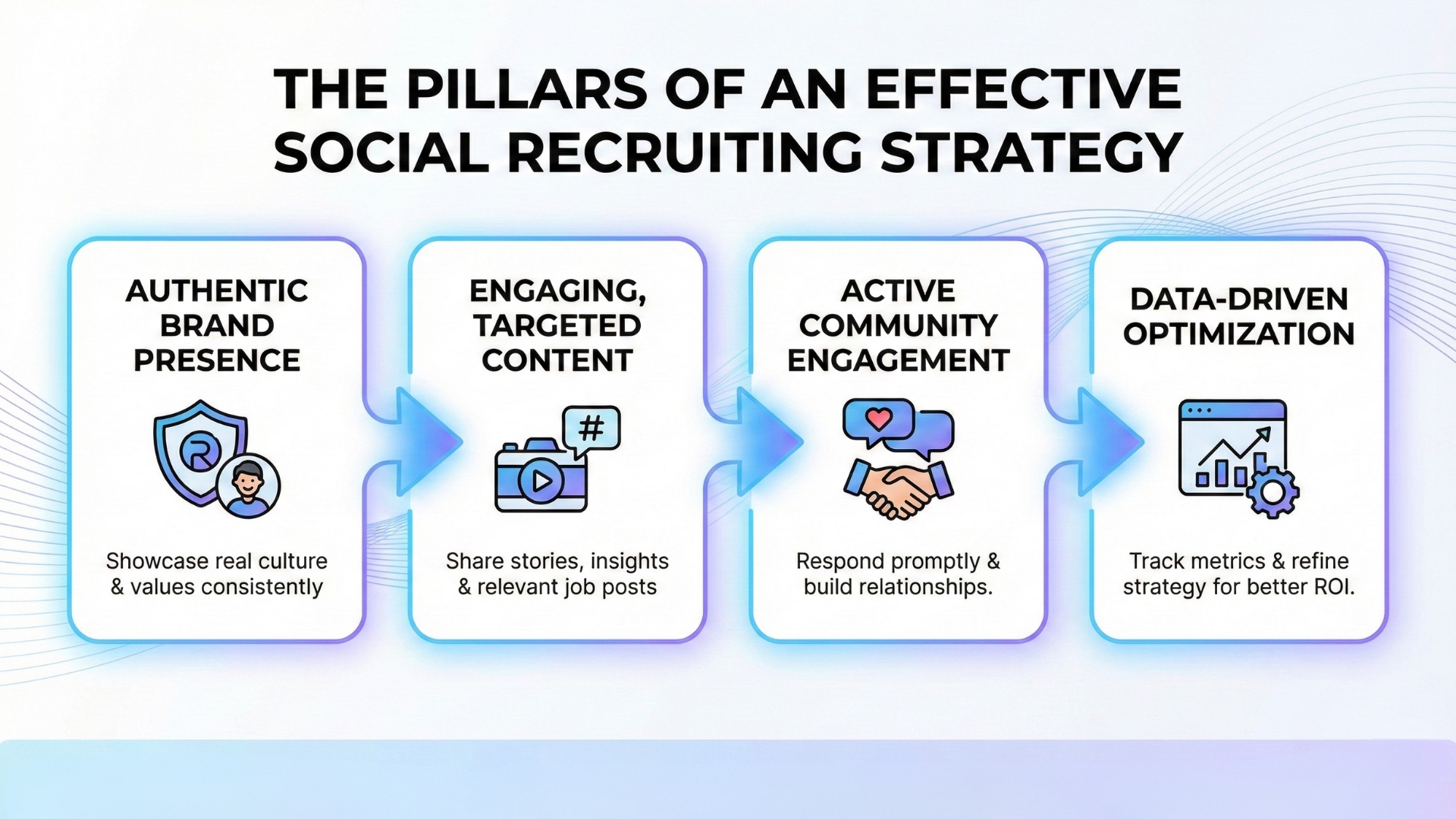
The Pillars of an Effective Social Recruiting Strategy
A house needs a strong foundation, and so does your strategy. You can't just start posting randomly and hope for the best.
I've built dozens of these strategies, and they all rest on the same fundamental pillars. Let's break them down step-by-step.
1. Defining Your Goals and Target Audience
What do you want to achieve? Before you do anything else, you must set clear, measurable objectives.
A vague goal like "hire more people" isn't helpful.
Instead, get specific.
- Are you trying to reduce time-to-hire by 20%?
- Do you want to increase the number of qualified applicants for tech roles by 50%?
- Is your goal to improve employer brand awareness, measured by a 30% increase in social media engagement?
These specific goals will guide every decision you make. Who are you trying to reach? Next, you need to know exactly who you're talking to. Creating ideal candidate personas is essential. A persona is a semi-fictional representation of your ideal hire.
Think about:
- Their job title and experience level.
- Their skills and qualifications.
- Their career goals and motivations.
- Their daily habits and pain points.
Where do they hang out online? Once you have your personas, you need to figure out where they spend their time online.
A software engineer is likely very active on LinkedIn and maybe even Reddit or GitHub. A graphic designer might be found on Instagram and Behance. Don't assume everyone is on Facebook.
Do your research to ensure your efforts are focused on the right platforms.
2. Crafting a Compelling Employer Brand on Social Media
How do you want candidates to see you? Your employer brand is your reputation as a place to work.
On social media, you have a golden opportunity to shape this reputation.
Authenticity and Transparency: The New Currency Today's candidates can spot fake corporate messaging a mile away.
They crave authenticity. Be honest about your company culture—both the good and the challenging.
Share real stories from real employees. If you made a mistake, own it. This level of transparency builds trust, which is invaluable.
Showcasing Company Culture: Beyond Perks and Benefits A ping-pong table is not a culture.
Your culture is how your team works together, solves problems, and supports one another.
Use social media to show this, not just tell it.
- Post photos from team-building events.
- Share videos of brainstorming sessions.
- Highlight employee achievements and work anniversaries.
- Talk about your company’s mission and values in action.
Employee Advocacy: Turning Your Team into Recruiters Your employees are your most credible brand ambassadors.
A message from a current employee is far more powerful than a post from a corporate account.
Create an employee advocacy program:
- Encourage (but don't force) employees to share company news and job openings.
- Make it easy for them by providing pre-written posts and branded graphics.
- Recognize and reward employees who help bring in successful hires.
- Their networks are a goldmine of potential talent.
3. Choosing the Right Social Media Recruitment Platforms
Where should you focus your energy? You don't need to be on every single platform.
In fact, that's a recipe for burnout.
Focus your efforts where they will have the most impact, based on your target audience research.
LinkedIn: The Professional Powerhouse This is the undisputed king of professional networking and recruiting.
I’ve found more high-quality candidates on LinkedIn than anywhere else.
- What to do: Optimize your company page with compelling content.
Encourage employees to complete their profiles.
Post jobs directly on the platform.
- How to do it: Use LinkedIn Recruiter for advanced searches to find passive candidates with specific skills.
Engage in relevant industry groups. Publish articles from your company leaders to establish thought leadership.
- Advanced Tip: Use LinkedIn’s search filters to find alumni from specific universities or former employees of competitor companies.
It’s a powerful way to target your sourcing.
Facebook & Instagram: Broad Reach and Visual Storytelling These platforms are perfect for showcasing your employer brand and reaching a massive, diverse audience.
- What to do: Focus on visual content that tells a story about your company culture.
Share photos and videos of your team, office, and events.
- How to do it: Use Facebook Jobs to post openings. Run highly targeted ad campaigns to reach specific demographics, interests, and locations.
Use Instagram Stories for "day-in-the-life" takeovers by different employees.
- Overcoming Challenges: The audience is less formal.
Avoid corporate jargon. Keep your tone conversational and authentic to maximize engagement.
Twitter (X): Real-time Engagement and Industry Insights Twitter is fast-paced and great for connecting with people in specific industries, especially tech and media.
- What to do: Share company news, blog posts, and quick job alerts.
Participate in industry-specific conversations and Twitter chats.
- How to do it: Use relevant hashtags like #Hiring, #JobOpening, and industry-specific ones (e.g., #FinTech, #HealthIT).
Follow and interact with industry influencers and potential candidates.
- Pro Tip: Create lists of target candidates or companies to monitor their activity and find organic opportunities to engage.
TikTok & YouTube: Engaging Younger Generations with Video If you’re hiring for entry-level roles or targeting Gen Z, video is non-negotiable.
- What to do: Create short, authentic video content.
Think office tours, employee interviews, or fun team challenges.
- How to do it: On TikTok, leverage trending sounds and formats to make your content more discoverable.
On YouTube, create a "Careers" playlist with in-depth videos about your company culture and different roles.
- Remember: Authenticity beats high production value here.
A genuine video shot on a phone will often perform better than a slick corporate ad.
Niche Platforms & Professional Communities (Reddit, Glassdoor, etc.) Don’t overlook the power of niche communities.
- What to do: Identify subreddits, professional forums, or online groups where your ideal candidates gather.
- How to do it: On Reddit, for example, don't just post jobs.
Become a helpful member of the community first.
Answer questions and offer value.
On Glassdoor, respond to all reviews (both positive and negative) to show you are engaged and listening.
- Platform-Specific Challenge: Each niche community has its own rules and etiquette.
Lurk before you leap.
Understand the culture before you start posting to avoid being seen as a spammer.
Content is King: Fueling Your Social Media Recruitment Efforts
Your strategy is the blueprint, but content is the building material. Without compelling, consistent content, even the best strategy will fail. It’s what grabs attention and starts the conversation.
Types of Engaging Content
You need a healthy mix of content to keep your audience interested. Relying only on job postings is the fastest way to get unfollowed. In my experience, a balanced content mix is crucial.
Video Content: The Engagement Magnet Video is the most engaging format on social media.
- Employee Testimonials: Short clips of employees sharing what they love about their job.
- A Day-in-the-Life: Follow an employee through their day to give a real look at a role.
- Virtual Office Tours: Show off your workspace, especially important for hybrid or in-office roles.
Employee Spotlights & Success Stories Celebrate your people.
- Spotlights: Introduce a team member with a photo and a short Q&A.
- Success Stories: Highlight an employee's career growth within the company.
This shows potential candidates that there are opportunities for advancement.
Behind-the-Scenes Glimpses Pull back the curtain and show the human side of your business.
- Photos from a team lunch or volunteer day.
- A short video from an all-hands meeting.
- This content builds authenticity and trust.
Interactive Content: Get Your Audience Involved
- Polls: Ask fun questions related to your industry or workplace.
- Q&As: Host a live session with a hiring manager or a team lead.
- Ask Me Anything (AMA): Let your audience ask questions directly to your CEO or a senior leader.
Job Postings with a Twist When you do post a job, make it stand out.
- Instead of a dry list of requirements, start with a compelling hook.
- Use an eye-catching graphic or a short video.
- Focus on what the candidate will gain, not just what you need.
Content Strategy & Planning
Great content doesn't happen by accident. It requires planning.
Create an Editorial Calendar Plan your content a month or a quarter in advance.
This ensures a consistent posting schedule and a good mix of content types.
It also reduces the daily stress of figuring out what to post.
Consistency is key to building an audience.
Tailor Content for Each Platform A post that works on LinkedIn won't necessarily work on Instagram.
- LinkedIn: More professional tone, focus on career advice and industry insights.
- Instagram: Highly visual, focus on culture and people.
- Twitter: Short, snappy updates and real-time conversation.
- Recycle concepts, but always adapt the format and tone.
Call to Action (CTA) Best Practices Every post should have a purpose.
Tell your audience what you want them to do next.
- Be clear and direct (e.g., "Apply Now," "Learn More," "Visit Our Career Page").
- Create a sense of urgency when appropriate ("We're hiring for this role now!").
- A post without a CTA is a missed opportunity.
Mastering Candidate Engagement and Relationship Building
Posting great content is only half the battle.
The "social" part of social media is about interaction.
This is where you turn passive followers into active candidates.
Proactive Engagement vs. Reactive Responses
Don't wait for candidates to come to you.
- Proactive Engagement: Seek out and start conversations. Comment on a potential candidate's LinkedIn post.
Join a discussion in a relevant Facebook group.
- Reactive Responses: When someone comments on your post or sends you a message, respond quickly.
A prompt, helpful response shows that you are attentive and value their interest.
I recommend a rule of responding within 24 hours, but sooner is always better.
Building a Talent Community
Think of this as long-term relationship building.
A talent community is a group of people who are interested in your company, even if they aren't ready to apply for a job today.
- How to do it: Create a dedicated LinkedIn or Facebook group for people interested in careers at your company.
Share exclusive content, career advice, and early access to job openings.
- Why it matters: When a position does open up, you have a pre-vetted, engaged pool of talent to draw from.
This drastically reduces your time-to-hire.
Personalization in Outreach
When you do reach out to a candidate directly, avoid generic, copy-and-paste messages.
- Mention something specific from their profile that caught your eye.
- Explain exactly why you think they would be a great fit for the role and the company.
- Personalization shows you’ve done your homework and dramatically increases your response rate.
Essential Tools and Technologies for Social Recruiting
To execute a modern social recruiting strategy at scale, you need the right tech stack.
These tools automate tedious tasks, provide valuable data, and help you stay organized.
Applicant Tracking Systems (ATS) Integration An ATS is the central nervous system of your recruitment efforts.
It's crucial that it integrates with your social media activities.
This allows you to easily track where candidates are coming from and manage their journey from applicant to employee.
An advanced applicant tracking system like Recooty ensures that no candidate gets lost in the shuffle.
Social Media Management Tools Tools like Buffer, Hootsuite, or Sprout Social are essential for managing multiple social media accounts.
- What they do: They allow you to schedule posts in advance, monitor conversations and brand mentions, and analyze performance from a single dashboard.
- Why they matter: They save an incredible amount of time and ensure your content strategy is executed consistently, even when you're busy.
AI-Powered Candidate Ranking and Matching.
The volume of applicants from social media can be overwhelming.
This is where Artificial Intelligence becomes a recruiter's best friend.
Sophisticated AI candidate matching algorithms can scan resumes and profiles to rank applicants based on their fit for a specific role.
This technology helps you focus your time on the most qualified candidates first.
Analytics and Reporting Platforms How do you know if your strategy is working? Data.
- Native Analytics: All social media platforms have built-in analytics (e.g., Facebook Insights, LinkedIn Analytics) that provide valuable data on reach and engagement.
- Third-Party Tools: For more in-depth analysis, tools like Google Analytics can track how much traffic and how many applications are coming from each social channel.
Programmatic Advertising for Recruitment This is a more advanced tactic.
Programmatic advertising uses AI to automate the buying of ad space, targeting specific audiences across the web, including social media.
For recruitment, it can place your job ads in front of the right people at the right time, optimizing your ad spend for the best results.
Measuring Your Success: KPIs and ROI in Social Recruiting
You can't improve what you don't measure.
Tracking the right metrics is the only way to know if your social media recruitment efforts are paying off and where you need to adjust your strategy.
Key Performance Indicators (KPIs) to Track
Here are the essential metrics I always recommend tracking:
- Reach and Impressions: How many people are seeing your content? This is your top-of-funnel brand awareness metric.
- Engagement Rates: This includes likes, shares, comments, and clicks.
A high engagement rate means your content is resonating with your audience.
- Click-Through Rates (CTR) to Career Pages: How many people are clicking the links in your posts to visit your career page or a specific job description?
- Application Completion Rates: Of those who click, how many actually complete an application? This is a key conversion metric.
- Cost-Per-Hire (CPH) and Time-to-Hire (TTH): Are your social media efforts reducing your hiring costs and speeding up the process compared to other channels?
- Quality of Hire: This is the ultimate metric.
Are the employees you hire through social media performing well and staying with the company? You can measure this through performance reviews and retention rates.
Calculating Social Recruiting ROI
Calculating the Return on Investment (ROI) can seem complex, but it doesn't have to be.
A simple way to think about it is:
ROI = (Value of Hires - Cost of Social Recruiting) / Cost of Social Recruiting
- Value of Hires: This can be estimated based on the average revenue an employee generates or the cost you would have paid a recruiting agency.
- Cost of Social Recruiting: This includes money spent on ads, tools, and the time your team spends on social media activities.
Practical Example: Let's say you spent $5,000 on social recruiting in a quarter (ads + tools + time).
You hired two engineers, which would have cost you $40,000 in agency fees.
- Value = $40,000
- Cost = $5,000
- ROI = ($40,000 - $5,000) / $5,000 = 7.
Your ROI is 700%.
This kind of data is powerful for getting buy-in from leadership.
Benchmarking Your Performance
How do your results stack up? Compare your KPIs against:
- Your own performance from previous quarters.
- Industry benchmarks (you can often find these in reports from HR tech companies or marketing firms).
- Your other recruitment channels (e.g., job boards, referrals).
Navigating the Challenges: Legal, Ethical, and Practical Considerations
A social recruiting strategy isn't without its potential pitfalls.
Being aware of these challenges and planning for them is crucial for long-term success and for protecting your company.
Data Privacy and Compliance (GDPR, CCPA, etc.) When you’re sourcing candidates, you are handling personal data. You must be compliant with regulations like GDPR in Europe and CCPA in California.
- What to do: Develop a clear social media policy for your recruiting team.
Ensure you have consent before storing a candidate's information.
Be transparent about how you use their data.
- This is non-negotiable and protects you from serious legal trouble.
Avoiding Bias and Ensuring Fair Hiring Practices Social media profiles can reveal a lot about a person, including protected characteristics like age, religion, or family status. This creates a risk of unconscious bias influencing hiring decisions.
- How to prevent it: Provide unconscious bias training for all recruiters and hiring managers.
Create a standardized process for reviewing profiles that focuses only on job-relevant information, like skills and experience listed on LinkedIn.
- Your goal is to build a diverse team, and that starts with a fair and unbiased process.
Reputation Management Social media is a two-way street. Not all feedback will be positive.
- How to handle it: Have a plan for responding to negative comments or reviews on platforms like Glassdoor.
A prompt, professional, and empathetic response can often turn a negative situation around.
Ignoring criticism can make it worse.
- Acknowledge the feedback, take it offline if necessary, and show that you are committed to improving.
Time Commitment and Resource Allocation Effective social recruiting takes time.
It’s not something you can do for an hour a week and expect great results.
- Be realistic: You need to dedicate resources—either a person's time or a budget for tools and advertising—to make it work.
- Start small: If your resources are limited, focus on mastering one or two platforms before trying to be everywhere at once.
Consistency on one platform is better than inconsistency on five.
Advanced Strategies and Future Trends in Social Recruiting
Once you’ve mastered the fundamentals, you can start exploring more advanced tactics to stay ahead of the curve.
The world of recruitment is always evolving.
Social Recruiting for Niche Industries and Roles Recruiting for a highly specialized software engineer is different from recruiting for a sales representative.
- The Strategy: For niche roles, you need to go where the experts are.
This might mean becoming an active, respected member of a specific subreddit, a specialized Slack community, or a professional forum for that field.
- It’s about deep, targeted engagement rather than broad reach.
Comprehensive Employee Training for Advocacy Programs A successful employee advocacy program requires more than just an email asking people to share a post.
- What to do: Provide formal training to employees.
Teach them the best practices for sharing on social media, what to say, and how to represent the company professionally.
- Give them the tools and confidence to be great ambassadors.
Emerging Technologies and the Future Landscape
What’s next for social recruiting?
- Augmented/Virtual Reality (AR/VR): Imagine conducting virtual office tours or first-round interviews in the metaverse.
This technology will make the candidate experience more immersive.
- Predictive Analytics: AI will go beyond matching keywords.
It will start to predict which candidates are most likely to succeed in a role based on vast datasets of past performance.
- The Metaverse: While still in its early days, some companies are already experimenting with hosting virtual career fairs and building a presence in metaverse platforms to connect with the next generation of talent.
Conclusion
Developing a comprehensive social recruiting strategy is no longer a luxury; it is a fundamental component of modern talent acquisition.
By moving beyond simple job postings and embracing a holistic approach that includes robust employer branding, proactive candidate engagement, and smart use of technology, you can attract the top talent that will drive your company forward.
Remember, the key is to be authentic, strategic, and consistent.
Define your goals, know your audience, create valuable content, and measure your results.
The world of social media is constantly changing, so a willingness to adapt and innovate will be your greatest asset.
By implementing the strategies outlined in this guide, you can build a powerful, sustainable talent pipeline that sets you apart from the competition.
Ready to transform your hiring process? Explore how Recooty’s all-in-one recruiting software can help you streamline your efforts and find the best candidates faster.
.png)
.png)

.webp)