.webp)


Contract staffing, at its core, represents a highly adaptable employment arrangement where a company engages an individual on a temporary or contract basis to fulfill a specific need or project requirement.
This strategic talent acquisition model empowers businesses with unparalleled flexibility, allowing for rapid scalability of teams and direct access to specialized skills without the enduring financial commitment tied to a permanent hire.
Specialized staffing agencies act as crucial intermediaries, managing these placements; their fees for temporary or project-based roles typically range from a 20-75% markup on the contractor's pay rate, while direct-hire permanent placements usually incur a fee of 10-20% of the employee's first-year annual salary.
This dynamic approach sharply contrasts with traditional permanent staffing, which prioritizes long-term stability and employee integration, and differentiates itself from mere temporary staffing, often reserved for short-term, less specialized operational gaps.
Effectively managing this complex, yet highly beneficial, hiring ecosystem demands modern tools, making a robust applicant tracking system indispensable for streamlining candidate pipelines, contract management, and overall recruitment efficiency.
Are you grappling with the twin challenges of securing specialized talent for critical projects while maintaining organizational agility and fiscal prudence? Many businesses today find themselves at this crossroads, caught between the urgent need for expertise and the strategic imperative to avoid overburdening their permanent headcount.
This comprehensive guide is meticulously crafted to illuminate every facet of contract staffing, serving as your definitive playbook for navigating this cornerstone of modern hiring solutions.
By delving into its definitions, benefits, operational mechanics, legal intricacies, and future trends, you will gain the knowledge and confidence to cultivate an agile, highly skilled, and cost-effective workforce, empowering your business to make strategic talent decisions that drive innovation and sustained growth.
Fundamental Distinctions at a Glance:
- What is the difference between contract staffing and permanent staffing? Permanent staffing focuses on long-term organizational stability, fostering employee loyalty, and significant investment in career development.
In contrast, contract staffing prioritizes immediate flexibility, rapid scalability, and on-demand access to specialized skills for defined periods.
- What is the difference between temporary and contract staffing? Contract roles are strategically aligned with specific, often longer-term, projects that demand expert skills for a clear outcome.
Temporary roles, conversely, address immediate, short-term operational gaps, typically for less specialized tasks or to cover absences.

Understanding Contract Staffing: The Foundational Principles of Agile Talent Acquisition
To truly harness the power of contract staffing, a deep understanding of its foundational principles is paramount.
It transcends being a mere stop-gap measure; it represents a sophisticated, strategic business decision capable of profoundly reshaping a company's talent strategy and overall market responsiveness.
The Core Definition: Deconstructing the Three-Party Employment Arrangement
At its very core, contract staffing is a distinct three-party employment arrangement meticulously structured to connect a client company with skilled professionals through the intermediation of a specialized staffing agency.
This intricate relationship ensures both operational efficiency and legal clarity for all involved.
Here’s a breakdown of how this triangular relationship typically operates:
- The Client Company: This is your organization, identifying a specific business need that requires external talent.
This could range from completing a critical project within a tight deadline, addressing an unforeseen skill gap within your existing team, or managing seasonal peaks in demand.
The key characteristic here is a finite requirement for specialized expertise or additional capacity.
- The Staffing Agency (Employer of Record): This is your strategic partner.
The agency undertakes the crucial tasks of sourcing, thoroughly vetting, and ultimately hiring the professional as their own employee.
Critically, the staffing agency becomes the Employer of Record for the contractor.
This means they assume full legal and administrative responsibility for the contractor's employment.
- The Contractor (Skilled Professional): This individual is the expert talent who will execute the specific tasks or project.
They are formally employed (typically W-2 status) by the staffing agency.
While working at your company, they perform their duties under the day-to-day direction and supervision of your managers, but their official employer remains the staffing agency.
This carefully constructed employment arrangement effectively creates a contingent workforce that offers both unparalleled flexibility and robust legal compliance.
By leveraging this model, your company gains swift access to the expert talent it needs, precisely when required, all while sidestepping the significant long-term investment and intricate administrative burdens traditionally associated with direct, permanent hiring.
In essence, it functions as a highly efficient "talent-as-a-service" model.
A Brief History: From Clerical Temps to Strategic Workforce Solutions
The concept of externalizing labor is not new, tracing its roots back to the mid-20th century with the emergence of "temporary help" services.
Initially, these services primarily focused on providing clerical support, administrative assistants, or light industrial workers to cover short-term absences, maternity leaves, or handle predictable busy periods.
The "temp" was largely a tactical solution for a temporary headcount problem, typically in less specialized, easily replaceable roles.
However, the late 20th and early 21st centuries ushered in an era of profound transformation.
The rapid advancements in technology, particularly the internet and digital infrastructure, profoundly reshaped global economies and labor markets.
Projects grew exponentially in complexity, demanding highly specialized skills that were often scarce internally.
Companies found themselves struggling to hire permanent staff quickly enough to keep pace with accelerating technological innovation and dynamic market demands.
In response, contract staffing dramatically evolved from a simple gap-filler into a sophisticated, strategic tool for talent acquisition and workforce planning.
Today, businesses routinely engage contractors for mission-critical, high-impact roles spanning software development, cybersecurity, advanced engineering, high-level financial analysis, and strategic project management.
This evolution underscores its central role in modern workforce solutions.
For deeper insights into global labor trends, authoritative resources like reports from the International Labour Organization provide valuable context.
The Modern Shift: Unpacking the Explosive Growth of Contract Staffing
The meteoric rise of contract staffing is not a mere passing fad; it is a direct, enduring response to the seismic shifts occurring in the contemporary business landscape.
Several powerful interconnected factors are fueling its exponential growth and solidifying its position as an indispensable talent strategy.
- The Relentless Pursuit of Speed and Agility: In an era defined by disruptive innovation and intense competition, organizational agility is no longer a luxury but a core survival imperative.
Business cycles have compressed dramatically, and market opportunities can emerge and vanish in the blink of an eye.
Contract staffing offers the ultimate flexibility to rapidly scale a workforce up or down, enabling companies to quickly assemble expert teams for new initiatives and then efficiently redeploy resources once projects conclude.
This dynamic responsiveness is virtually unattainable with a purely permanent workforce.
- The Ascendancy of the Project Economy: Modern work is increasingly fragmented into discrete projects, each with specific objectives, defined timelines, and measurable deliverables.
This project-based operational model aligns perfectly with the inherent structure of contract employment, where professionals are engaged for the duration of a specific project rather than an open-ended role.
This structural congruence makes contract staffing the ideal mechanism for project-driven organizations.
- The Intensifying War for Specialized Talent: Globally, there exists a profound and worsening scarcity of professionals possessing highly specialized skills in critical domains such as Artificial Intelligence, Data Science, advanced cybersecurity, specific cloud platforms (e.g., AWS, Azure), and cutting-edge engineering disciplines.
Traditional permanent staffing often falls short in this competitive arena, struggling to attract and retain these elusive experts.
A well-established contract staffing agency, however, maintains an extensive, pre-vetted, and continually updated global pool of these in-demand specialists, offering businesses a lifeline to otherwise inaccessible expertise.
- A Paradigm Shift in Worker Preferences (The New Worker Mindset): The burgeoning "gig economy" and evolving cultural values have profoundly reshaped what professionals seek from their careers.
An increasing number of highly skilled individuals actively prefer the autonomy, diverse challenges, and often significantly higher contract staffing salary potential offered by contract work.
They opt to construct portfolio careers—a series of distinct projects across various companies and industries—rather than committing to a single, traditional full-time position.
This growing pool of discerning professionals further fuels the growth of the contract staffing model.
You can read more about changing worker expectations in reports from organizations like the World Economic Forum on the Future of Work.
The Hiring Spectrum: Strategically Positioning Contract Staffing Among Employment Models
Effective talent management hinges on understanding the nuances of different employment models and discerning which is best suited for a particular need.
Each approach offers distinct advantages and disadvantages.
Accurately positioning contract staffing within this broader spectrum is crucial for making informed, strategic hiring decisions.
Contract Staffing vs.
Permanent Staffing: The Ultimate Showdown in Talent Strategy
This foundational comparison represents one of the most critical strategic decisions in human resources: the choice between building a long-term, integrated team and acquiring targeted, temporary expertise.
The optimal path depends entirely on the nature of the role, the business objective, and your organizational culture.
Permanent Staffing (Direct Hire) This represents the quintessential, traditional employment model where an individual is hired directly onto your company's payroll with the mutual expectation of an indefinite, long-term relationship.
- Why It Matters: Permanent hiring is fundamentally about cultivating a core foundation for your organization.
It necessitates significant long-term investment in the employee's development, fostering deep stability, and nurturing loyalty.
These individuals become the institutional memory of your company, embodying its values, driving its culture, and contributing directly to its sustained, long-term strategic vision.
They are integral to developing and safeguarding proprietary knowledge and processes.
- Best For: Roles that are intrinsic to your core business operations (e.g., key leadership, product ownership, core engineering, sales, marketing leadership).
Positions requiring deep institutional knowledge accumulation and transfer.
Building and reinforcing your unique company culture.
Critical functions where stability and continuity are paramount.
Contract Staffing This model is a strategic engagement for acquiring specific skills or capacity for a clearly defined duration, typically tied to a project or a time-bound need.
- Why It Matters: Contract staffing is the embodiment of organizational agility.
It provides unmatched flexibility in workforce management and offers precise control over budgeting by converting fixed labor costs into variable project expenditures.
You gain immediate access to highly specialized skills for specific projects without incurring the substantial financial overhead (benefits, taxes, long-term salary commitments) and administrative burden associated with a permanent hire.
It allows for quick reaction to market demands without over-committing resources.
Best For: Projects with unequivocally clear start and end dates.Covering for extended employee leaves (e.g., maternity leave, long-term disability, sabbatical).Rapidly acquiring niche expertise for innovation or urgent problem-solving.Managing predictable or unpredictable seasonal peaks in workload.Testing new markets or initiatives without permanent commitment.
Contract vs.
Temporary Staffing: Clarifying the Nuances for Precision Hiring
While often conflated, "contract staffing" and "temporary staffing" serve distinct purposes driven by differing strategic intents, project durations, and required skill levels.
Understanding these nuances is vital for precise talent deployment.
Temporary Staffing (Short-Term, Operational Gaps) Think of temporary staffing as a rapid, tactical solution engineered to address immediate, often unforeseen, operational gaps or to manage predictable, but less specialized, workload fluctuations.
- What It Is: This model involves hiring individuals to cover for sudden absences (e.g., sick leave, vacations), manage brief surges in administrative tasks, or provide additional support for routine operations.
The duration is typically very short—ranging from a few days to a few weeks, rarely exceeding a couple of months.
Roles are generally less specialized, such as administrative assistants covering vacations, data entry clerks for a backlog, or extra hands in a warehouse during a holiday season.
- Why It Matters: Temporary staffing is crucial for ensuring the uninterrupted continuation of basic business operations during minor disruptions.
It provides a quick, straightforward fix for a temporary headcount problem, preventing burnout among permanent staff and maintaining essential service levels.
- Recooty's Role: For managing a pool of temporary staff, Recooty's ATS can help quickly onboard candidates, track their availability, and manage their short-term assignments, even integrating with time-tracking features.
Contract Staffing (Project-Based, Specialized Expertise) In contrast, contract staffing represents a more strategic, project-oriented solution, focused on acquiring specific, often high-level, expertise for a defined and typically longer period.
- What It Is: This model entails engaging highly skilled professionals for specific, complex projects or initiatives.
The contract can extend for several months, a year, or even longer, intrinsically tied to the lifecycle of the project itself.
The work demands specialized skills and experience, such as hiring a senior software developer to build a new mobile application, a finance expert for a merger and acquisition due diligence, or an experienced project manager to oversee a critical system implementation.
- Why It Matters: Contract staffing enables your organization to execute high-value, complex projects that your existing permanent staff may lack the specific skills, time, or specialized expertise to handle.
You are not merely filling a seat; you are strategically acquiring a particular capability to achieve a specific, outcome-driven result.
It allows for advanced workforce solutions that drive innovation without permanent overhead.
In essence: Temporary staffing primarily addresses immediate headcount needs for routine tasks.
Contract staffing strategically fills critical skill gaps for complex, time-bound initiatives.
The New Workforce Paradigm: Contract Staffing vs.
Freelancers & Gig Workers (Navigating the 1099 vs.
W-2 Divide)
The expansive growth of the gig economy has blurred traditional employment lines, necessitating a clear understanding of the crucial legal and operational distinctions between directly engaging a freelancer (a 1099 worker) and utilizing a contract staff professional provided through an agency (a W-2 worker).
This distinction carries significant legal and financial implications for your organization.
For a comprehensive overview, the U.S. Department of Labor offers guidelines on employee vs.
independent contractor classification.
Freelancers / Independent Contractors (1099 Workers) These individuals are typically self-employed business owners who offer their services to multiple clients, operating with a high degree of autonomy.
- How It Works: Your company contracts directly with the freelancer for a specific service or deliverable.
They submit invoices for their work, and you pay them directly.
Crucially, freelancers are responsible for managing their own taxes (self-employment taxes), securing their own insurance (health, liability), providing their own equipment, and determining their own methods of work.
From a legal standpoint, they are not your employees.
- Pros for Businesses: Can sometimes present a lower upfront cost as there is no agency markup or direct employer-paid taxes/benefits.
Offers direct, unmediated communication with the talent.
- The Massive Legal Risk for Businesses: Worker Misclassification: This is the primary and most significant danger.
The IRS and various state labor departments have stringent, multi-factor tests (e.g., behavioral control, financial control, type of relationship) to determine whether an individual is genuinely an independent contractor or, in reality, an employee.
If regulators determine that a freelancer should have been classified as an employee (e.g., if you dictate their working hours, provide extensive training, supply their tools, or control the specifics of how they perform the work), your company could face severe penalties, including substantial back taxes, fines, interest, and potential legal fees.
This is a common and costly compliance pitfall.
Contract Staffing (W-2 Employees of an Agency) These professionals are formally employed by a specialized staffing agency, which then deploys them to work on projects at client companies.
- How It Works: The staffing agency assumes the critical role of the legal Employer of Record.
This means the agency places the contractor on its W-2 payroll, meticulously withholds and pays all required federal, state, and local taxes (including Social Security, Medicare, federal and state unemployment taxes).
The agency also provides workers' compensation insurance and, in many cases, offers a competitive benefits package (health insurance, 401k plans) to its contract employees.
Your company simply pays a single, all-inclusive invoice to the staffing agency for the contractor's services.
- Why It Matters: Powerful Legal Safe Harbor & Administrative Relief: This model significantly transfers the complexities and liabilities of employment from your company to the staffing agency.
The agency is responsible for ensuring full compliance with labor laws, payroll regulations, and benefit mandates, dramatically reducing your company's risk exposure to worker misclassification penalties and co-employment claims.
Furthermore, the agency handles the entire administrative burden of HR, payroll, and benefits, freeing your internal resources to focus on core business operations.
This provides robust workforce solutions with built-in compliance.
If your need is for a one-off deliverable like a quick logo design or a single blog post, directly engaging a freelancer might be appropriate.
However, if you require a dedicated project manager to lead a six-month initiative, or a team of developers who will integrate closely with your permanent staff for 40 hours a week, utilizing a contract staffing agency for W-2 contract employees offers a significantly safer, more compliant, and ultimately more scalable solution, mitigating critical risk.
The Unbeatable Advantages of Contract Staffing: Driving Business Agility and Professional Growth
The pervasive adoption of contract staffing across diverse industries is not coincidental; it is a direct testament to the powerful, multifaceted benefits it delivers.
This model creates a symbiotic, win-win relationship, empowering businesses with unparalleled agility and offering skilled professionals a dynamic, rewarding, and balanced career trajectory.
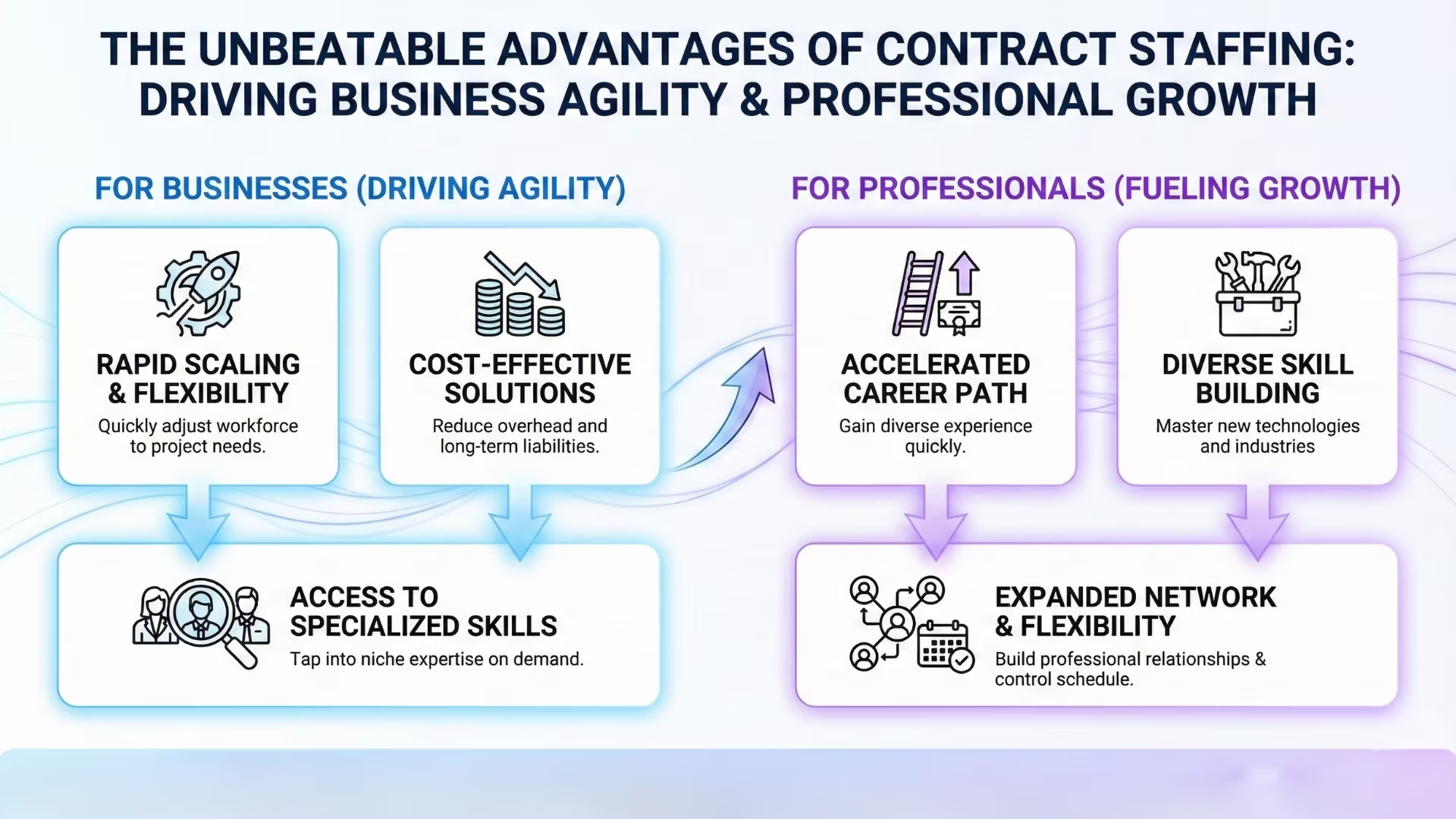
The Business Advantage: Supercharging Your Organizational Performance
For employers, strategically leveraging a contingent workforce through contract staffing is a transformative strategy that directly impacts the bottom line, accelerates innovation, and fortifies competitive positioning in today's demanding market.
Unparalleled Flexibility and Dynamic Scalability
This stands as the quintessential benefit of contract staffing.
The modern business environment is characterized by relentless change, unforeseen market shifts, and emergent opportunities.
Contract staffing furnishes your organization with a supremely flexible workforce capable of expanding or contracting like an accordion, precisely in sync with your evolving demands.
Need to rapidly double the size of your development team for an urgent product launch? A proficient contract staffing agency can mobilize and deploy a qualified team within weeks, rather than the months typically required for permanent staffing.
Once the project culminates, you can efficiently scale back down, bypassing the painful and costly processes associated with layoffs.
This inherent agility is not merely advantageous; it represents a critical competitive advantage, allowing your business to adapt, pivot, and capitalize on opportunities with unprecedented speed.
On-Demand Access to a Global Pool of Highly Specialized Skills and Niche Expertise
Many high-value projects, particularly in tech, healthcare, and engineering, necessitate a confluence of rare and highly specialized skills that are notoriously difficult and prohibitively expensive to recruit and retain as permanent employees.
Consider the elusive expertise of a cybersecurity architect specializing in specific zero-trust frameworks, or a data scientist proficient in advanced machine learning algorithms for a niche industry.
A leading staffing agency actively cultivates and rigorously maintains an extensive, continuously updated network of these elite experts.
This enables your company to precisely pinpoint and rent the exact expertise required, for the precise duration it is needed, effectively democratizing access to top-tier global talent that might otherwise be beyond your reach.
According to a recent report by a prominent global consulting firm, companies leveraging contingent workers report a 25% faster access to specialized skills compared to traditional hiring.
Smart Cost-Efficiency and Optimized Budget Allocation
The true cost of a permanent employee extends far beyond their base fixed salary.
It encompasses a complex array of direct and indirect expenses, including comprehensive benefits packages (health, dental, vision insurance; 401k match), the employer's share of payroll taxes, accrued paid time off (PTO), training and development budgets, and various overheads associated with long-term employment.
With a contract employee, virtually all these costs are consolidated and bundled into a single, transparent, and predictable hourly bill rate paid to the agency.
This drastically simplifies budgeting, converts often variable and hidden fixed labor costs into predictable project-specific expenditures, and frequently results in a significantly lower overall total cost for project-specific or time-bound work.
You effectively pay only for productive engagement and avoid the substantial long-term investment and overheads associated with indefinite employment.
Significant Risk Mitigation and Enhanced Project-Based Solutions
Every permanent hire inherently involves a degree of risk.
The financial and operational fallout of a bad hire can be staggering, potentially exceeding 30% of the employee's first-year gross annual salary in wasted recruitment costs, training, lost productivity, and potential severance.
The very nature of the employment arrangement in contract staffing—being for a defined period or project—intrinsically lowers this risk.
Should the fit prove less than ideal, or project needs shift, the contract simply concludes at its pre-determined end date, bypassing the often lengthy, legally complex, and emotionally taxing processes involved in termination.
Moreover, by outsourcing the employer-of-record responsibilities to the staffing agency, your company significantly offloads compliance and administrative risk.
Accelerate Your Time-to-Hire and Bolster Organizational Agility
The traditional hiring process for permanent roles can be painstakingly slow, often consuming 45 to 90 days from initial job posting to final offer acceptance.
In today's hyper-competitive and rapidly evolving markets, such delays can translate into missed opportunities and significant competitive disadvantage.
Reputable staffing agencies, however, maintain dynamic pipelines of pre-vetted, highly qualified, and readily available talent.
This allows your company to onboard a highly skilled contractor and achieve productivity in a matter of days or weeks, rather than months.
This accelerated time-to-hire is critical for seizing fleeting market opportunities, reacting swiftly to competitive pressures, and maintaining an agile operational posture.
The "Try Before You Buy" Power of the Temp-to-Hire Model
Many contract staffing jobs are structured with a temp-to-hire (or contract-to-hire) option, offering businesses the ultimate risk-reduction strategy for direct hire placements.
In this model, you initially engage a professional for a predetermined contract period (typically 3-6 months).
This serves as an invaluable, extended, real-world job interview, allowing your team to thoroughly evaluate their technical skills, work ethic, and most importantly, their cultural fit within your organization.
At the culmination of the contract period, if the professional proves to be an exceptional match, you can seamlessly convert them to a permanent employee by paying a pre-arranged conversion fee to the agency.
This mechanism virtually eliminates the risk of making a costly bad hire for permanent roles, optimizing your recruitment services and ensuring a higher quality long-term investment in human capital.
The Professional's Edge: Crafting a Dynamic and Rewarding Career
Contract staffing is not solely a corporate advantage; it offers a profoundly liberating and often more lucrative career trajectory for skilled professionals.
It allows them to sculpt a career path defined by choice, continuous growth, and a sought-after work-life balance.
Gain Diverse Career Experience and Rapidly Enhance Skills
As a contract employee, a professional is immersed in a continuous learning environment.
Each new project exposes them to fresh challenges, novel technologies, varied industry best practices, and distinct company cultures.
For instance, a software developer might contribute to projects at a financial institution, a healthcare provider, and an e-commerce giant within a span of two years.
This unrelenting exposure to diverse environments acts as a potent accelerator for skill development, fostering adaptability, problem-solving capabilities, and building an exceptionally robust and versatile resume that is highly attractive to a wide range of future employers.
This model enables professionals to quickly upskill and remain at the forefront of their fields.
Unlock Higher Earning Potential and a Competitive Contract Staffing Salary
A compelling incentive for many skilled professionals is the potential for a significantly higher hourly rate compared to their permanent counterparts.
This is largely because the contract staffing salary often compensates for the absence of traditional benefits packages (which may be provided by the agency, but are typically factored into the overall rate) and paid time off.
For experts in high-demand fields, especially those facing talent shortages, the contract staffing salary can be substantially more lucrative, offering a direct financial reward for their specialized expertise, willingness to adapt, and project-based flexibility.
According to a recent analysis by a prominent talent solutions firm, contract professionals in tech can command rates up to 20-30% higher than equivalent fixed salary permanent positions.
Redefine Your Work-Life Balance and Cultivate Autonomy
One of the most appealing aspects of contract work is the profound sense of autonomy and control it affords over one's career and personal life.
Contractors gain greater agency in selecting projects that align with their interests, desired work schedules, and personal commitments.
When a contract concludes, they have the freedom to choose to take time off for travel, personal development, or family, before embarking on their next assignment.
This inherent flexibility empowers professionals to actively design a career that seamlessly integrates with and supports their desired lifestyle, rather than being dictated by a rigid corporate structure.
Expand Your Professional Network Exponentially
Every new contract assignment serves as an invaluable opportunity to forge new professional relationships and significantly expand one's network.
Contractors routinely collaborate with diverse teams, managers, and executives across various organizations and industries.
This continuous exposure rapidly builds a robust and diverse professional network, which is a critical asset for future contract staffing jobs, permanent job offers, collaborative ventures, and gaining valuable industry insights.
A strong network also enhances visibility for new workforce solutions.
A Strategic Gateway into Desired Companies and Industries
Gaining entry into highly competitive, top-tier companies or transitioning into a new, desired industry can often be challenging through traditional direct hire channels.
Many leading organizations strategically utilize contractors to fill immediate skill needs and, importantly, as a mechanism to vet potential permanent staff without immediate long-term investment.
Taking on a contract role at a dream company can serve as an excellent, lower-stakes opportunity to showcase one's skills, work ethic, and cultural fit from within.
Demonstrating exceptional performance on a contract is frequently one of the most effective pathways to receiving a permanent offer, making it a powerful strategic move for career advancement.
The Engine Room: Navigating the Operations and Logistics of Contract Placements with Staffing Agencies
The seamless operation of contract staffing relies heavily on the specialized expertise and logistical capabilities of the contract staffing agency.
These agencies serve as the indispensable linchpin, connecting companies with the precise talent they need and managing the intricate employment arrangement.
Understanding their comprehensive functions is paramount for any business looking to effectively leverage this model.
What Does a Contract Staffing Agency Do? A Comprehensive Overview
A specialized contract staffing agency is far more than just a recruitment vendor; it functions as a full-service provider of recruitment services and workforce solutions for your contingent workforce.
Their responsibilities span the entire talent lifecycle, from initial sourcing to ongoing contractor management and compliance.
Core Functions and Responsibilities of a Staffing Agency:
- Proactive Talent Sourcing and Cultivation: Agencies continuously build and maintain extensive networks of highly skilled professionals across various industries and specializations.
This involves active headhunting, leveraging professional platforms, referrals, and often nurturing long-term relationships with top talent.
They are always sourcing talent, ensuring a ready pipeline.
- Rigorous Candidate Screening and Vetting: This is a critical value-add.
Agencies employ multi-layered screening processes that include in-depth interviews, technical assessments (e.g., coding tests, skills evaluations), comprehensive reference checks, verification of credentials and licenses, and thorough background checks.
Their aim is to present you with only highly qualified and thoroughly vetted candidates who meet your specific skill and experience requirements.
- Employer of Record & HR/Payroll Administration: The agency acts as the legal employer of record for the contractor.
This pivotal role involves handling all aspects of payroll processing (including hourly wage payment), meticulously withholding and remitting all required federal, state, and local payroll taxes, and managing complex benefits administration.
This includes health, dental, and vision insurance, 401(k) plans, and often paid time off or sick leave as part of their comprehensive workforce solutions.
- Compliance and Risk Management Expertise: Agencies are experts in navigating the intricate landscape of labor laws and regulations.
They ensure full compliance with critical legislation such as the Fair Labor Standards Act (FLSA), the Affordable Care Act (ACA), Equal Employment Opportunity (EEO) laws, and Workers' Compensation mandates.
By assuming these employer liabilities, they significantly mitigate risk for the client company, providing a crucial legal safe harbor against issues like worker misclassification or co-employment claims.
- Assignment Management & Relationship Management: The agency serves as the primary point of contact for both the client company and the contractor throughout the assignment.
This includes onboarding support, performance monitoring (often in collaboration with the client), handling any HR-related issues or disputes, and facilitating seamless communication.
Their goal is to ensure a smooth, productive engagement for all parties, optimizing profitability for themselves and value for the client.
In essence, a contract staffing agency functions as an experienced, flexible, and fully compliant extension of your internal HR and recruitment services department, allowing you to focus on your core business objectives while they manage the complexities of your contingent workforce.
Decoding the Agreement: How Staffing Agency Contracts Work (Client-Agency Perspective)
When your company decides to engage a contract staffing agency, a formal client service agreement or master services agreement (MSA) is executed.
This legally binding document is the blueprint for your partnership, meticulously outlining the terms and conditions of engagement.
Understanding its key components is paramount.
For general contract best practices, resources like the American Bar Association's contract law guides can be helpful.
Key Components of a Client-Agency Contract:
- Scope of Services: This section precisely defines the recruitment services the agency will provide, including the types of roles (e.g., IT, finance, engineering), the typical experience levels, and the agency's process for identifying, screening, and submitting candidates.
It also outlines the expectations for the quality and responsiveness of candidate submissions.
- Bill Rate Structure: This critical component specifies the all-inclusive hourly rate your company will pay to the agency for each contractor's services.
It's crucial to understand that this bill rate encompasses the contractor's actual pay rate (their hourly wage) plus the agency's markup.
Transparency regarding these components builds trust.
- Payment Terms: This section clearly articulates the invoicing frequency (e.g., weekly, bi-weekly) and the payment due dates (e.g., Net 30 days from invoice receipt).
It also details any penalties for late payments.
- Contractor Conversion Fee (Temp-to-Hire Fee): If the contract allows for a temp-to-hire option, this clause outlines the specific fee (often a percentage of the permanent employee's first-year annual salary or a flat fee) that your company will pay the agency should you choose to convert a contractor to a permanent employee within a specified timeframe.
- Liability and Insurance: This vital section delineates each party's responsibilities regarding insurance coverage.
The agency typically provides Workers' Compensation insurance, general liability insurance, and professional liability insurance for its contract employees.
The contract specifies your company's obligations regarding site safety and any indemnification clauses.
- Confidentiality and Intellectual Property (IP): Given that contractors often handle sensitive information, the contract will include robust confidentiality clauses (Non-Disclosure Agreements or NDAs) protecting your company's proprietary data.
Crucially, it must also clearly state that all work products, inventions, and intellectual property created by the contractor during their assignment for your project belong exclusively to your company.
- Termination Clauses: This outlines the conditions under which either party can terminate the agreement, including required notice periods and any penalties for early termination.
- Indemnification: This clause protects each party from liabilities or losses incurred due to the other party's actions or negligence.
It is important to remember that the agency has a separate, legally distinct employment agreement with the contractor itself.
This agreement outlines the contractor's specific pay rate, the duration of their assignment, their detailed job responsibilities, benefits (if any), and the terms and conditions of their employment with the agency.
The Price of Talent: Understanding Staffing Agency Fees and Markup
One of the most frequently asked questions by employers considering this model is, "What is the average fee for a staffing agency?" The cost structure, while appearing as a single bill rate, is transparent and built upon a clear formula.
The Core Formula: Bill Rate = Contractor's Pay Rate + Agency Markup
The markup is the percentage that the staffing agency adds on top of the actual hourly wage (the pay rate) that they pay to the contractor.
For illustrative purposes:
- Contractor's Direct Pay Rate: $70 per hour
- Agency Markup Percentage: 50% (which equals $35)
- Your Company's All-Inclusive Bill Rate to the Agency: $105 per hour ($70 + $35)
The average markup for contract or temporary employees can fluctuate significantly, typically ranging from 40% to 75% or even higher, depending on several factors: the specialized skills required, the industry (IT vs.
administrative), the geographic location, the duration of the contract, and the volume of placements.
For permanent placements (where the agency finds a candidate for direct hire by your company), the fee structure is different: it's usually a one-time charge, ranging from 15% to 25% of the permanent employee's gross annual salary.
What Does the Agency Markup Cover? It's Not Pure Profit.
The markup is a critical component that allows the staffing agency to cover a multitude of direct and indirect costs, while also generating profitability to sustain its operations and recruitment services:
- Employer-Paid Payroll Taxes: This includes the employer's legally mandated contributions for Social Security and Medicare (FICA), as well as federal and state unemployment insurance taxes.
These collectively add a significant percentage (often 7-10%+) to the contractor's gross wages.
- Workers' Compensation Insurance: A mandatory insurance policy that covers contractors in case of work-related injuries or illnesses.
Rates vary significantly by job function and industry, but this is a substantial cost.
- Cost of Employee Benefits: Many reputable agencies offer benefits packages to their W-2 contract employees, which can include health, dental, and vision insurance, 401(k) retirement plans, and sometimes paid time off or holiday pay.
These are significant expenses for the agency.
- Agency Operational Overhead: This encompasses the cost of running the agency itself: salaries and benefits for their internal recruiters, account managers, and administrative staff; office rent and utilities; marketing and advertising costs to attract talent; and investments in recruitment technology (like an ATS).
- Professional Liability Insurance: Coverage for potential claims arising from the contractor's work.
- Agency Profit Margin: After covering all expenses, a portion of the markup contributes to the agency's profitability, essential for business growth and reinvestment.
It's crucial for employers to exercise caution with agencies offering unusually low markups.
While seemingly attractive, this often indicates they may be cutting corners on benefits for contractors, potentially offering insufficient workers' compensation coverage, or operating with reduced compliance efforts.
Such practices can make it challenging to attract and retain top-tier talent and may expose your company to unforeseen risk.
Finding Your Perfect Match: Strategic Considerations for Choosing the Right Staffing Partner
Selecting the optimal contract staffing agency is arguably the most critical step in a successful flexible workforce strategy.
It's about forging a true, collaborative partnership, not merely engaging a vendor to supply resumes.
Key Qualities and Criteria to Meticulously Evaluate:
- Industry and Skill Specialization: Does the agency possess deep expertise and a proven track record in your specific industry (e.g., IT, Healthcare, Finance & Accounting, Engineering) and for the specialized skills you require? An agency with a laser focus on, for instance, AI and Data Science talent will invariably have a superior network and vetting process compared to a generalist agency.
- Rigorous Vetting and Screening Process: Inquire thoroughly about their candidate evaluation methodology.
How do they verify skills (technical tests, portfolio reviews)? What is their process for conducting reference checks, background checks, and drug screenings? A robust multi-step process ensures higher quality talent.
- Exceptional Communication and Responsiveness: A great recruiter and account manager acts as a true strategic advisor.
Look for partners who are proactive, highly responsive to your queries, transparent in their communication, and provide regular updates throughout the hiring process.
- Strong Talent Network and Retention Strategies: How extensive and current is their network of contract employees? Do they actively engage and nurture their talent pool? What strategies do they employ to keep their contractors satisfied and reduce turnover during assignments? Happy contractors are more productive and committed.
- Commitment to Compliance and Ethical Practices: Confirm their unwavering adherence to all labor laws, payroll tax regulations, and worker classification guidelines.
Ask about their insurance coverage and indemnification clauses.
Ethical practices ensure a low-risk partnership.
- Positive Candidate Experience (EEAT Factor): A respectable agency values its job seekers.
Ask about their candidate experience programs, benefits offerings, and professional development opportunities for contractors.
An agency that treats its talent well will attract and retain the best.
The Tech Advantage: Modernizing the Contract Recruitment Process with Recooty
In today's competitive talent landscape, the most effective staffing agencies and client companies leverage advanced recruitment technology to gain a significant edge.
This is precisely where an applicant tracking system (ATS) like Recooty becomes an indispensable tool.
How Recooty Enhances Contract Staffing Operations:
- Streamlined Candidate Pipeline Management: Recooty provides a centralized platform to manage all contract staffing jobs, applications, and candidate profiles.
This allows agencies and internal HR teams to efficiently track candidates through various stages of the hiring process, from initial application to placement and contract completion.
- Enhanced Collaborative Hiring: For complex projects requiring input from multiple stakeholders (hiring managers, project leads, HR), Recooty's collaborative hiring features are invaluable.
Teams can share candidate feedback, schedule interviews, and make collective decisions on contractor placements seamlessly, accelerating the selection process.
- Automated Communication and Engagement: Recooty automates routine communication with candidates (e.g., application acknowledgments, interview invitations, status updates), ensuring a positive candidate experience and freeing up recruiters to focus on high-value tasks like sourcing talent and relationship building.
- Contract Lifecycle Management: The platform can be customized to track specific contract details, including start and end dates, bill rates, pay rates, and conversion eligibility.
This ensures administrative accuracy and prevents oversight, critical for maintaining profitability and compliance.
- Data-Driven Insights: Recooty generates analytics on time-to-hire for contract roles, candidate source effectiveness, and conversion rates, providing valuable data to optimize recruitment strategies and improve future talent acquisition efforts.
Furthermore, advanced features powered by Artificial Intelligence are revolutionizing how agencies identify and match contract talent.
Platforms with AI candidate ranking capabilities are a game-changer.
Imagine needing a Python developer with specific experience in both AWS cloud architecture and financial algorithmic trading.
AI can instantaneously sift through thousands of job seeker profiles, analyze the intricate context of their experience, and algorithmically rank the top candidates who are the absolute best fit for the role.
This intelligent talent assessment dramatically saves recruiters countless hours of manual screening, ensuring you receive qualified candidates in front of you much sooner.
This tech-driven approach is no longer a luxury but an essential component for staffing agencies and employers striving to remain competitive in the relentless hunt for specialized talent.
Staying Compliant: Navigating the Complex Legal Landscape of Contract Staffing
While contract staffing offers immense operational benefits and a crucial legal safe harbor compared to the inherent risks of directly hiring freelancers, it is by no means an unregulated free-for-all.
Both client companies and staffing agencies must meticulously navigate a complex web of labor laws, tax regulations, and contractual obligations.
Understanding this legal framework is not merely a best practice; it is absolutely non-negotiable to protect your business from potentially severe legal and financial repercussions.
For detailed legal guidance, it's always advisable to consult with legal professionals specializing in labor and employment law, or refer to authoritative government resources like the U.S. Department of Labor.
Key Legal Considerations for Employers (Client Companies)
As the client company engaging contract staff through an agency, you implicitly share certain responsibilities and remain exposed to specific legal risks.
Proactive understanding and rigorous compliance are paramount.
The Critical Question: Worker Classification and the Peril of Co-Employment
This is arguably the most significant legal minefield in flexible staffing.
As extensively discussed, partnering with a reputable staffing agency that employs its contractors as W-2 employees significantly mitigates risk for your company.
This structure ensures that the agency, as the employer of record, handles all payroll tax withholdings, benefits, and compliance, thereby shielding you from the severe penalties associated with misclassifying a 1099 independent contractor who should legally be an employee.
However, your company must also remain acutely aware of the risk of "co-employment." This legal doctrine arises when a client company exerts such a substantial degree of control over an agency's contractor that the law perceives both the staffing agency and the client company as joint employers.
In a co-employment scenario, your company could become jointly liable for various employment-related obligations, including wages, payroll taxes, benefits, discrimination claims, and severance pay.
To robustly mitigate this risk:
- Delegate HR Functions to the Agency: Ensure the staffing agency retains primary responsibility for all traditional HR functions: hiring decisions (ultimately), setting pay rates, administering benefits, handling disciplinary actions, and conducting formal performance reviews.
- Focus Management on Project Outcomes: Your role should primarily be to manage the contractor's day-to-day tasks, deliverables, and project objectives.
Avoid dictating how the work is performed, managing their schedules rigorously (beyond project deadlines), or providing extensive internal training.
- Maintain Clear Distinctions: Avoid integrating contractors too deeply into your company's hierarchy or treating them identically to permanent employees.
Do not provide them with company business cards, list them on organizational charts as permanent staff, or give them responsibility for managing other permanent employees.
- The IRS 20-Factor Test (and State Equivalents): Be familiar with the general principles of worker classification tests, such as the IRS's traditional 20-factor test (and particularly the 3 common law factors: behavioral control, financial control, and type of relationship).
Many states also have their own "ABC" tests, which are often more stringent.
Compliance 101: Navigating Essential Labor and Employment Regulations
While the staffing agency is the primary responsible party, your company must ensure your chosen partner is fully compliant and that your operational practices do not inadvertently violate key regulations:
- Fair Labor Standards Act (FLSA): This federal law governs minimum wage, overtime pay, recordkeeping, and child labor standards.
The staffing agency is directly responsible for ensuring its contractors are paid correctly (e.g., proper classification as exempt or non-exempt, accurate overtime calculation).
Your practices must not cause the contractor to be illegally denied overtime.
- Affordable Care Act (ACA): Large employers (including staffing agencies that meet certain headcount thresholds) are legally required to offer affordable health coverage to their eligible full-time employees.
Your agency partner should confirm their ACA compliance for contract employees.
- Equal Employment Opportunity (EEO) Laws: Federal laws prohibiting discrimination (e.g., Title VII of the Civil Rights Act, Age Discrimination in Employment Act, Americans with Disabilities Act) apply to contract workers just as they do to permanent employees.
Both your company and the agency are prohibited from discriminating against any job seeker or contractor based on protected characteristics like race, gender, age, religion, national origin, or disability.
- Occupational Safety and Health Administration (OSHA): Both the staffing agency and the client company often share responsibility for providing a safe working environment for contract employees.
You must ensure contractors receive appropriate safety training and operate in a compliant manner within your facilities.
Protecting Your Valuable Assets: Intellectual Property (IP) and Confidentiality Agreements
Contractors frequently access and contribute to a company's sensitive data, trade secrets, customer lists, and proprietary technology.
Establishing airtight agreements before any work commences is absolutely critical to safeguard your valuable assets.
- Intellectual Property (IP) Assignment: Your client service agreement with the staffing agency (and ideally, a direct agreement with the contractor if permitted by the agency) must unequivocally state that all work products, inventions, software, designs, reports, and any other intellectual property created by the contractor during their assignment for your project are fully and exclusively assigned to, and owned by, your company.
- Confidentiality Agreements (NDAs): The contractor should sign a robust Non-Disclosure Agreement (NDA) with the staffing agency that specifically prohibits them from disclosing or utilizing your company's confidential and proprietary information.
It is also a common and advisable practice to have contractors sign your company's own standard NDA as part of their initial onboarding process, reinforcing their legal obligations.
Key Legal Considerations for Contract Workers (Professionals)
If you are a professional contemplating or actively engaged in contract staffing jobs, understanding your legal standing, rights, and responsibilities is essential for protecting your career and financial well-being.
Read the Fine Print: Meticulously Understanding Your Employment Contract
Your formal employment agreement is with the staffing agency, not the client company where you perform the work.
It is imperative to read this document with extreme care before you sign it.
Do not hesitate to seek legal counsel if any clauses are unclear or concerning.
Pay close attention to:
- Your Exact Pay Rate and Payment Schedule: Ensure clarity on your hourly wage and how frequently you will be paid.
- The Duration of the Assignment: Understand the expected start and end dates, and any conditions for extension.
- Process for Early Termination: Understand the terms and conditions under which you or the staffing agency can terminate the contract early, including notice periods or potential penalties.
- Non-Compete and Non-Solicitation Clauses: Be aware of any restrictions that might prevent you from working for competitors or soliciting clients/employees of the client company after your contract concludes.
- Job Responsibilities: Ensure the outlined duties align with your expectations and skills.
Benefits, Insurance, and Legal Protections for W-2 Contractors
One of the most significant distinctions and advantages for W-2 contractors through an agency, as opposed to 1099 freelancers, is access to crucial benefits and legal protections.
- Benefits Packages: Many reputable, larger staffing agencies offer competitive benefits packages to their W-2 contract employees.
These can include comprehensive health, dental, and vision insurance options, as well as 401(k) retirement plans (sometimes with a company match) and potentially paid time off or holiday pay after a certain tenure.
Always inquire specifically about the benefits available to you.
- Workers' Compensation Insurance: As a W-2 employee of the agency, you are covered by the agency's Workers' Compensation insurance.
This provides financial protection and medical coverage if you suffer a work-related injury or illness during your assignment.
This is a critical safety net unavailable to most freelancers.
- Unemployment Insurance: The staffing agency makes contributions to state unemployment insurance funds on your behalf.
If your contract ends through no fault of your own and you meet state eligibility requirements, you may be eligible to receive unemployment benefits during the transition to your next assignment.
- Legal Protections: As a W-2 employee of the staffing agency, you are afforded the full protections of federal and state labor laws, including EEO laws prohibiting discrimination, FLSA regulations regarding wages and overtime, and other employee rights.
Where Contract Staffing Shines Brightest: A Sector-by-Sector Breakdown
Contract staffing is a remarkably versatile workforce solution, its flexibility making it invaluable across a broad spectrum of industries.
However, certain sectors, by their very nature of project-driven work, rapid evolution, or fluctuating demand, have strategically embraced contract staffing as an absolutely essential component of their talent acquisition and operational strategies.
This section dives deep into specific industries where contract staffing jobs and placements consistently thrive.
Technology & IT: The Original Pioneers of the Flexible Workforce
The technology and IT sectors are arguably the earliest and most enthusiastic adopters of contract staffing, a trend driven by their inherent characteristics: constant innovation, project-based development, and a perpetually evolving skill landscape.
For insights into IT labor market trends, reports from organizations like CompTIA provide useful data.
- Why It Works So Well:
- Project-Driven Nature: Software development, system integrations, infrastructure upgrades, and cybersecurity initiatives are almost exclusively project-based, with defined scopes and timelines.
- Rapid Technological Change: Technologies emerge and become obsolete at a blistering pace.
Companies need to rapidly acquire expertise in new programming languages, cloud platforms, or AI frameworks without making long-term investment in skills that might quickly depreciate.
- Skill Scarcity: There's a chronic, intense shortage of highly specialized skills in areas like AI, Machine Learning, DevOps, blockchain, and advanced cybersecurity.
Contract staffing provides immediate access to this scarce talent.
- Startup Scaling: Tech startups often need to scale development or IT support rapidly after funding rounds or during critical product development phases, without the overhead of permanent staff.
- Common Contract Staffing Jobs:
- Software Developer (Frontend, Backend, Full Stack, Mobile - e.g., Python, Java, JavaScript, iOS, Android)
- DevOps Engineer / Cloud Architect (AWS, Azure, GCP)
- Cybersecurity Analyst / Security Engineer
- UI/UX Designer
- Data Scientist / Machine Learning Engineer
- IT Project Manager / Scrum Master
- Network Engineer / Systems Administrator
- Example: A burgeoning Artificial Intelligence startup, having secured Series B funding, needs to accelerate the development of its core AI platform to meet investor milestones.
Their internal team is strong but lacks the bandwidth and specific expertise in natural language processing (NLP) for their next module.
They engage an IT contract staffing agency to bring in a team of three senior NLP engineers and a specialized AI Project Manager for a 12-month contract.
This allows them to hit their development targets without diluting equity or making permanent hires for skills they might only need for a finite phase.
Healthcare: Filling Critical Gaps with Precision and Agility
The healthcare sector faces unique challenges, including fluctuating patient loads, geographic disparities in talent availability, and chronic shortages in specialized medical roles.
Contract staffing has become an indispensable workforce solution here.
For relevant data, the Bureau of Labor Statistics provides comprehensive employment projections.
- Why It Works So Well:
- Demand Volatility: Hospitals and clinics experience seasonal demand spikes (e.g., flu season), unexpected patient surges, or regional health crises.
Contract staff allows them to rapidly scale nursing or medical support.
- Specialized Medical Roles: Attracting permanent staff for highly specialized roles (e.g., locum tenens physicians in rural areas, critical care nurses) can be exceedingly difficult and time-consuming.
Contract staffing fills these vital gaps.
- System Implementations: Large-scale IT projects, such as implementing new Electronic Health Record (EHR) systems, require specialized talent for finite periods of design, migration, and training.
- Covering Absences: Extended leaves for permanent staff (e.g., maternity, long-term illness) can be covered by qualified contract professionals, ensuring continuity of patient care.
- Common Roles:
- Traveling Nurse (RNs, NPs, specializing in ER, OR, ICU)
- Locum Tenens Physician (temporary doctors filling in for permanent staff)
- Medical Technologist / Lab Scientist
- Healthcare IT Specialist (EHR implementation, system support)
- Medical Biller / Coder (for managing claims backlogs)
- Physical Therapist / Occupational Therapist
- Example: A major urban hospital system experiences a sudden, severe shortage of experienced Operating Room (OR) nurses due to a combination of retirements and unexpected long-term leaves.
This threatens to delay elective surgeries and increase patient wait times.
Partnering with a specialized healthcare staffing agency, they bring in five Traveling Nurses with specific OR experience on 13-week contracts.
This immediate influx of talent stabilizes their OR schedule, reduces overtime for their permanent staff, and provides critical breathing room for their direct hire recruitment efforts.
Finance & Accounting: Precision for Peaks, Projects, and Compliance
The finance and accounting sectors are characterized by predictable busy seasons, stringent regulatory compliance, and frequent project-based initiatives like mergers and acquisitions.
Contract staffing provides crucial support during these high-stakes periods.
- Why It Works So Well:
- Seasonal Peaks: Annual tax season, quarterly reporting, and year-end closing create immense, yet predictable, surges in workload.
Contract accountants or tax specialists provide essential temporary capacity.
- Regulatory Changes: New financial regulations often require specialized talent for short-term compliance reviews, system adjustments, and implementation projects.
- Mergers & Acquisitions (M&A): Due diligence, integration planning, and post-merger accounting necessitate highly skilled financial analysts and accountants for finite periods.
- System Implementations: Upgrading ERP or financial reporting systems requires project-specific talent skilled in these complex transitions.
- Common Roles:
- Senior Accountant / Staff Accountant
- Financial Analyst
- Internal Auditor / Compliance Officer
- Tax Specialist / Tax Preparer
- Bookkeeper / Payroll Specialist
- SEC Reporting Specialist
- Example: A fast-growing technology company plans to go public within the next 18 months.
They need to dramatically upgrade their internal financial reporting and compliance capabilities to meet SEC requirements, but their existing accounting team lacks Public Company Accounting Oversight Board (PCAOB) audit experience.
They hire a contract SEC Reporting Specialist and a contract Internal Auditor for a 15-month contract through a finance staffing agency.
These experts work alongside the permanent staff, transferring invaluable knowledge and ensuring the company is fully prepared for its IPO.
Engineering & Manufacturing: Powering Innovation and Production Flexibility
Large-scale engineering and manufacturing projects are often broken into distinct phases, each demanding specific technical skills.
Contract staffing offers the agility to bring in highly specialized engineers and technicians for these crucial phases without adding long-term investment to headcount.
- Why It Works So Well:
- Project-Based Development: Designing new products, developing new manufacturing processes, or executing large infrastructure builds are all project-based endeavors requiring fluctuating talent pools.
- Niche Engineering Expertise: Companies need specialized engineers (e.g., aerospace, electrical, mechanical, civil, chemical) for specific R&D phases, product testing, or quality control initiatives.
- Production Volume Fluctuation: Manufacturing facilities can use contract technicians or line supervisors to adapt quickly to changes in production demand.
- New Facility Setup: Establishing a new manufacturing plant or R&D lab often requires a temporary surge of engineering and technical talent.
- Common Roles:
- Mechanical Engineer / Electrical Engineer / Civil Engineer
- Quality Engineer / QA Technician
- CAD Designer / Drafter
- Manufacturing Process Engineer
- Controls Engineer / Automation Specialist
- Project Engineer
- Example: A global automotive parts manufacturer wins a significant new contract to supply components for an emerging electric vehicle platform.
This requires them to rapidly design and implement new specialized production lines.
They engage an engineering staffing agency to hire a team of six contract Manufacturing Process Engineers and two Automation Specialists for a one-year contract.
This infusion of specialized talent enables them to meet the aggressive production timeline without over-hiring their permanent staff for a project that will eventually stabilize.
Marketing & Creative: On-Demand Creativity and Campaign Execution
The marketing and creative sectors are inherently dynamic, driven by campaigns, product launches, and evolving digital landscapes.
Contract staffing provides the perfect model for accessing diverse creative skills on an as-needed basis.
- Why It Works So Well:
- Campaign-Driven Work: Marketing is largely campaign-based.
Companies need copywriters, designers, and digital specialists for the duration of a specific campaign, rather than continuously.
- Brand Launches & Relaunches: Major branding initiatives, product launches, or website redesigns require a concentrated burst of creative talent for a finite period.
- Niche Digital Skills: The digital marketing landscape is constantly changing, requiring specialized skills in SEO, SEM, social media analytics, content strategy, or video production.
- Content Volume: Generating a high volume of content (blogs, videos, social posts) for specific periods can be supported by contract content creators.
- Common Roles:
- Digital Marketing Specialist (SEO, SEM, Social Media)
- Graphic Designer / Web Designer
- Content Writer / Copywriter
- Video Producer / Editor
- Social Media Manager
- Brand Strategist
- Example: A major consumer packaged goods company is preparing for the national launch of a new product line.
This requires a massive, integrated marketing campaign.
They engage a creative staffing agency to hire a contract Digital Marketing Manager (specializing in paid social), a contract Senior Copywriter for packaging and website content, and two contract Graphic Designers for a six-month project.
This allows them to execute a high-impact launch without increasing their permanent marketing headcount after the initial intense campaign period.
Project Management: Leadership for Defined Timelines and Strategic Initiatives
In an increasingly projectized world, the need for expert project management leadership is constant, yet often tied to specific, strategic initiatives.
Contract Project Managers are ideal for these roles.
- Why It Works So Well:
- System Implementations: Implementing new ERP, CRM, or other enterprise software systems requires dedicated, experienced Project Managers for the duration of the roll-out.
- Strategic Initiatives: Leading organizational change initiatives, new business unit launches, or turnaround projects benefit from external project management expertise.
- Interim Leadership: Covering for a permanent Project Manager on leave or while a direct hire search is underway.
- Avoiding Organizational Strain: Bringing in a contract Project Manager allows permanent staff to focus on their core responsibilities while a complex initiative is expertly guided.
- Common Roles:
- Project Manager (often PMP certified)
- Program Manager (for overseeing multiple related projects)
- Scrum Master / Agile Coach
- Change Management Consultant
- Example: A large financial services firm decides to undergo a complete overhaul of its CRM system, a multi-departmental project expected to last 18 months.
Recognizing the complexity and the need for specialized CRM implementation expertise, they hire a contract Senior Project Manager through a staffing agency.
This individual, with extensive experience in similar CRM rollouts, provides the dedicated leadership and expertise needed to guide the project to a successful conclusion without disrupting the firm's permanent management structure.
The Other Side of the Coin: Navigating the Challenges and Crafting Effective Solutions in Contract Staffing
While the myriad benefits of contract staffing are undeniably compelling, a candid assessment requires acknowledging and proactively addressing the inherent challenges.
Both client companies and contractors can encounter hurdles.
By anticipating these potential roadblocks and implementing robust solutions, organizations can maximize the success of their flexible workforce strategy, and professionals can cultivate a more stable and rewarding contract career.
This deep dive into challenges and solutions is crucial for sustained profitability and loyalty.
Common Hurdles and Strategic Solutions for Businesses
Bringing external talent into your organization, even for defined projects, necessitates thoughtful management and a proactive approach to potential friction points.
Failure to manage these aspects can undermine the very flexibility and efficiency that contract staffing aims to provide.
The Integration Puzzle: Ensuring Seamless Assimilation
Contractors, by definition, are not permanent employees.
However, if they are treated as peripheral outsiders, it can significantly dampen morale, hinder communication, and ultimately impair productivity within the team.
A lack of proper integration can lead to contractors feeling disengaged and less committed to project success.
- The Proactive Fix: Develop and implement a standardized, welcoming onboarding process specifically tailored for contractors.
This should include:
- Formal Introductions: Ensure they are formally introduced to their immediate team, relevant stakeholders, and project leadership.
- Clear Expectations: Provide detailed project briefs, access to necessary tools and systems, and clear lines of communication.
- Team Inclusion: Integrate them into relevant team meetings, communication channels (e.g., Slack, Teams), and even appropriate social gatherings (e.g., team lunches, virtual happy hours).
- Designated Point Person: Assign a permanent employee as a "buddy" or internal guide to help them navigate company culture and processes.
- Recooty's Help: Utilize Recooty's applicant tracking system to create a templated, automated onboarding checklist for contractors.
This ensures all essential steps – system access, introductions, project documentation – are consistently covered, fostering a sense of inclusion from day one.
You can also leverage Recooty's collaborative hiring features to share essential internal resources and team contact information with new contractors efficiently.
Preserving Your Distinct Company Culture Amidst a Blended Workforce
Your company's unique culture is meticulously built and sustained by your core, long-term investment in permanent employees.
A significant reliance on a rotating cast of contractors can, if not actively managed, dilute this culture or create a bifurcated workforce where contractors feel distinct and separate.
- The Proactive Fix:
- Cultural Ambassadors: Designate permanent employees to act as cultural ambassadors or mentors for contractors, helping to subtly transmit company values and norms.
- Intentional Communication: Be explicit and consistent in communicating your company's mission, values, and strategic goals to all members of your blended workforce, reinforcing a shared purpose.
- Inclusive Activities (Appropriate Level): Where appropriate, invite contractors to company-wide informational sessions, town halls, or team-building activities that foster a sense of shared community without blurring the legal obligations of their employment arrangement.
- Focus on Shared Project Goals: Emphasize the shared objectives and the critical role each individual, permanent or contract, plays in achieving them.
The Administrative Burden of Juggling Multiple Contracts and Dynamic Timelines
As your reliance on contract staffing grows, managing numerous contracts with varying start and end dates, diverse bill rates, and different deliverables can quickly evolve into a significant administrative headache, consuming valuable HR or project management resources.
- The Proactive Fix:
- Centralized Management Platform: Implement a dedicated Vendor Management System (VMS) or leverage robust features within your existing ATS (like Recooty) to serve as a single source of truth for all contract details.
This includes contractor names, staffing agency contacts, skill sets, project assignments, start/end dates, bill rates, and key performance indicators.
- Automated Reminders: Set up automated alerts for contract expiration dates, renewal opportunities, or temp-to-hire conversion windows.
- Standardized Templates: Utilize standardized templates for contract requests, performance reviews, and offboarding procedures for contractors to ensure consistency and efficiency.
- Recooty's Help: Recooty's applicant tracking system can be configured to manage contractor profiles, track contract durations, set reminders for renewals or conversions, and centralize all communication and documentation related to contingent workers, significantly reducing administrative overhead.
Preventing Knowledge Drain: Safeguarding Institutional Expertise
One of the significant potential challenges is the loss of critical institutional knowledge when a highly skilled contractor concludes their assignment.
If not proactively managed, the departure of a contractor who has developed a key system or process can leave a detrimental knowledge gap within your organization.
- The Proactive Fix: Integrate knowledge transfer as a mandatory deliverable within every contract.
- Structured Documentation: Require contractors to meticulously document their work, processes, code, and insights throughout their assignment.
This could involve creating user manuals, technical specifications, process flowcharts, or detailed reports.
- Formal Hand-off Sessions: Mandate formal hand-off sessions where the contractor trains one or more permanent employees on the systems, tools, or processes they have developed or managed, well before their contract ends.
- Designated Knowledge Repository: Ensure all documentation and relevant files are stored in a centralized, accessible knowledge repository (e.g., SharePoint, Confluence, internal wikis) that permanent staff can easily access.
- Reverse Mentoring: Encourage contractors to mentor permanent employees on their specialized skills or new technologies, embedding the knowledge directly within your team.
Common Roadblocks and Strategic Solutions for Contract Workers
While the contract lifestyle offers unparalleled flexibility and autonomy, it also presents its own unique set of challenges that skilled professionals must learn to anticipate and strategically manage to build a sustainable and thriving career.
Managing the "Feast or Famine" Cycle: Navigating Income Inconsistency
The inherent project-based nature of contract work can lead to periods of high demand ("feast") interspersed with quieter times ("famine") between assignments.
This income inconsistency can create significant financial uncertainty and stress if not effectively managed.
- The Proactive Fix: Aggressive financial planning and proactive career management are absolutely critical.
- Build a Robust Financial Reserve: Maintain a substantial emergency fund (ideally 6-12 months of living expenses) to comfortably cover expenses during periods of downtime between contracts.
- Proactive Job Search: Begin actively seeking your next contract staffing job 4-6 weeks before your current contract is scheduled to end.
Do not wait until the last day.
- Cultivate Strong Recruiter Relationships: Develop deep, trusting relationships with 2-3 specialized recruiters in your field.
Keep them updated on your availability and skill sets.
They are your primary pipeline for new opportunities.
- Diversify Your Client Base: Avoid relying too heavily on a single client for too long, as this can increase risk and potentially impact worker classification.
The Benefits Gap: Navigating Healthcare, Retirement, and Paid Time Off
One of the most significant differences between permanent and contract work (even as a W-2 contractor through an agency) can be the scope and generosity of benefits.
While many agencies offer benefits, they may not always be as comprehensive as those provided by large corporations for permanent employees.
Managing your own healthcare and retirement planning is a major personal responsibility.
- The Proactive Fix:
- Thoroughly Evaluate Agency Benefits: Before accepting an assignment, meticulously review the benefits package offered by the staffing agency.
Understand what's covered, your out-of-pocket costs, and eligibility requirements.
- Explore Private Options: If agency benefits are insufficient, research private health insurance options through state marketplaces (e.g., healthcare.gov) or professional organizations.
- Proactive Retirement Planning: Work with a qualified financial advisor who has experience with contractors or self-employed individuals.
Establish tax-advantaged retirement accounts like a SEP IRA or a Solo 401(k) to maximize your savings.
Be disciplined about consistently contributing a portion of your higher contract staffing salary to these accounts.
- Factor Benefits Costs into Rate: Ensure your desired hourly rate or fixed salary for contract work adequately accounts for any personal benefits expenses you incur.
The "Outsider" Feeling: Building Relationships and Navigating Corporate Culture
Consistently moving from company to company on short-term assignments can make it challenging to build deep, enduring professional relationships and foster a strong sense of belonging that often comes with permanent employment.
Contractors can sometimes feel like an "outsider" within the client company's culture.
- The Proactive Fix:
- Be Proactive and Approachable: Make a conscious effort to introduce yourself, participate in team activities (when appropriate and permitted), and contribute actively to team discussions.
- Focus on Value Contribution: Consistently demonstrate your value by delivering high-quality work, meeting deadlines, and being a collaborative, positive team member.
- Leverage Networking Opportunities: View each project as a new networking opportunity.
Connect with colleagues on LinkedIn, attend relevant industry events, and seek out informational interviews.
- Build Your Personal Brand: Your reputation for professionalism, skill, and reliability will follow you from contract to contract, opening doors to future opportunities.
Navigating Complex Tax Responsibilities and Estimated Payments
Even as a W-2 employee of a staffing agency, your tax situation as a contractor can be more complex than that of a traditional permanent employee.
You might have multiple W-2s from different agencies in a single year, or you may incur significant work-related expenses that are deductible.
- The Proactive Fix:
- Maintain Meticulous Records: Keep precise records of all income, work-related expenses (e.g., home office deductions, professional development, equipment), and any benefits paid.
- Engage a Specialized CPA: It is highly recommended to work with a Certified Public Accountant (CPA) who has extensive experience advising contractors, freelancers, or self-employed individuals.
They can help you navigate complexities, maximize legitimate deductions, and ensure compliance.
- Understand Estimated Taxes: If you operate as a 1099 independent contractor (even if part-time), or if your W-2 withholdings are insufficient, you will likely need to make quarterly estimated tax payments to the IRS and state tax authorities to avoid penalties.
A good CPA can guide you on this.
Contract Staffing in Action: Real-World Case Studies and Success Stories
Theory is foundational, but observing how contract staffing directly addresses and solves tangible business challenges brings its immense value into sharp focus.
These realistic case studies illustrate how organizations leverage this model to achieve strategic objectives and how professionals forge dynamic, successful careers.
These stories highlight how workforce solutions translate into real-world profitability and growth.
Case Study 1: The Tech Startup Scaling for a Critical Product Launch
- The Company: "InnovateFlow," a rapidly expanding SaaS startup comprising 75 permanent employees, has just secured a significant Series C funding round.
Their immediate goal is to launch a revolutionary new feature set for their flagship product within an aggressive six-month timeline to preempt a new market entrant.
- The Challenge: InnovateFlow boasts a highly capable core engineering team, but they are already operating at full capacity.
To hit the ambitious launch deadline, they require an additional eight senior-level backend developers, specializing in specific cloud-native architectures, for precisely six months.
The traditional permanent hiring process is too slow, and adding eight permanent employees represents an unsustainable long-term investment in terms of fixed salary and benefits for a temporary surge in demand.
- The Strategic Solution: InnovateFlow partners with "TechTalent Solutions," a highly specialized IT contract staffing agency.
- Agency Action: TechTalent Solutions leverages its deep talent pool and an advanced applicant tracking system (like Recooty) to swiftly identify and pre-screen a pipeline of highly qualified backend developers.
Within two weeks, InnovateFlow's hiring managers have conducted focused technical interviews and selected a team of eight elite contract developers.
- Integration and Management: The contractors are onboarded rapidly, receive necessary system access, and are seamlessly integrated into the existing permanent development team.
They utilize the same collaborative hiring features within the project management software and participate in daily stand-up meetings, working under the direct supervision of InnovateFlow's project leads.
- The Measurable Outcome: The blended team, comprising permanent staff and contractors, successfully meets the aggressive development deadlines, delivering the new feature set ahead of schedule.
The product launch is a resounding success, effectively solidifying InnovateFlow's market position.
Following the culmination of the six-month contract period, InnovateFlow is so impressed with the performance and cultural fit of three of the contract developers that they exercise their temp-to-hire option, converting them into permanent employees.
This strategic approach allowed InnovateFlow to achieve their critical project goal without the significant risk, cost, and time-to-hire associated with eight permanent hires, demonstrating exceptional scalability and profitability.
Case Study 2: The Experienced Professional Building a Diverse Portfolio Career
- The Professional: "Elena," a highly accomplished Marketing Manager with 15 years of experience in the consumer goods sector, feels her career has plateaued.
She yearns for more diverse industry exposure, an accelerated path to skill enhancement in digital transformation, and greater autonomy over her work schedule to achieve a better work-life balance.
- The Challenge: Elena's current permanent role offers limited opportunities for cross-industry experience.
Transitioning directly into a new, high-level permanent position in a different sector proves difficult due to perceived lack of specific industry experience, despite her transferable skills.
- The Strategic Solution: Elena makes the strategic decision to transition to contract work.
She partners with "CreativeConnect Staffing," an agency specializing in marketing and creative talent.
- Agency Action: Her dedicated recruiter at CreativeConnect understands Elena's goals and leverages the agency's network to identify suitable contract staffing jobs.
Elena's first assignment is a nine-month project managing a digital transformation initiative for a mid-sized healthcare technology company.
After successfully completing this, she takes a one-month break for personal travel.
Her next contract is a six-month brand strategy engagement with a FinTech startup.
- The Measurable Outcome: Over a span of three years, Elena successfully completes five major projects across four distinct industries (consumer goods, healthcare tech, FinTech, and e-commerce).
Her skill set in digital marketing, project management, and brand strategy has expanded exponentially, making her a highly sought-after expert.
Her hourly earning potential has increased by 40% compared to her previous fixed salary permanent role.
She has achieved the desired work-life balance by strategically choosing projects and taking planned breaks.
Elena is now a recognized leader in contract marketing solutions, frequently sought for high-impact projects, and is even exploring opportunities for interim marketing leadership roles, demonstrating how contract staffing fostered her long-term investment in her own professional growth.
What's Next? The Future of Contract Staffing in a Rapidly Evolving Global Economy
Contract staffing is demonstrably not a fleeting trend but a fundamental, enduring, and increasingly vital component of the future of work.
The powerful forces driving its growth—technological acceleration, globalization, and shifting worker expectations—are only gaining momentum, fundamentally reshaping how talent is acquired, managed, and deployed globally.
Accelerating Market Growth and the Pervasive Rise of the Blended Workforce
The trajectory for the contingent workforce is one of sustained and significant expansion.
Leading HR research firms and global consulting firms predict that a substantial portion—potentially nearly half—of the total global workforce will be engaged in non-traditional work arrangements, including contract roles, freelancing, and gig work, within the next decade.
This demographic and economic shift is irreversible.
In response, forward-thinking organizations are no longer simply "tolerating" contractors; they are strategically embracing a sophisticated "blended workforce" model.
This involves a deliberate and optimized combination of a core group of permanent employees (who embody the company culture and institutional knowledge) with a flexible, on-demand outer layer of contractors, freelancers, and consultants.
This hybrid workforce strategy provides unparalleled agility, resilience, and access to specialized skills, enabling companies to adapt swiftly to market fluctuations and capitalize on emergent opportunities.
This strategic approach to talent management is rapidly becoming the new standard for competitive and resilient organizations globally.
For more detailed market growth projections, consult reports from leading industry analysts like Staffing Industry Analysts (SIA) or Gartner.
The Transformative Impact of Artificial Intelligence in Contract Recruitment
Artificial Intelligence (AI) is no longer a futuristic concept; it is already profoundly revolutionizing how companies identify, engage, and manage contract talent, making the recruitment process faster, more precise, and significantly less biased.
- Smarter Sourcing and Enhanced Candidate Ranking: AI-powered tools can intelligently scan and analyze millions of online profiles, resumes, and professional networks (including passive job seekers) to identify candidates who possess the exact specialized skills and project experience required.
Platforms with advanced AI candidate ranking capabilities go far beyond simple keyword matching.
They utilize sophisticated algorithms to assess the context, depth, and relevance of a candidate's experience, providing recruiters with an intelligent talent assessment and a prioritized list of the absolute best-fit individuals.
This dramatically reduces time-to-hire and improves the quality of hire for contract roles.
- Precision Candidate Matching for Optimal Fit: This is where AI truly shines in optimizing workforce solutions.
Advanced AI candidate matching technology can analyze the nuanced requirements of a specific project (including technical skills, soft skills, industry experience, and even potential cultural alignment) and accurately match them against a contractor's entire professional history and competencies.
It moves beyond superficial data points to understand the underlying capabilities, ensuring a superior fit between the project's demands and the professional's expertise.
For businesses, this translates into higher quality talent and faster project completion.
For contractors, it means being connected with roles where their skills are optimally utilized, leading to greater job satisfaction and more successful assignments.
- Automated Administrative Efficiency: AI and automation are increasingly streamlining the more mundane and time-consuming administrative tasks in recruitment.
This includes automated resume screening, initial chatbot-driven candidate interactions, scheduling interviews, and even generating preliminary candidate assessments.
By automating these processes, human recruiters are freed from repetitive tasks, allowing them to focus on high-value activities such as building deeper relationships with talent, strategic sourcing, and providing expert consultation to hiring managers.
This enhances the overall profitability of recruitment services.
The Remote Revolution and the Unbounded Global Talent Pool
The widespread and now normalized acceptance of remote work, profoundly accelerated by recent global events, has permanently dismantled traditional geographic barriers in talent acquisition.
This paradigm shift has created an unprecedented global playing field for contract staffing.
- Unprecedented Access to Global Talent: A company headquartered in New York can now seamlessly hire a highly specialized contract software developer from Colorado, a data scientist from London, or a UI/UX designer from Lisbon.
This geographical agnosticism provides organizations with unparalleled access to the absolute best talent in the world, unconstrained by local market limitations or relocation challenges.
This profoundly impacts scalability and access to specialized skills.
- Expanded Opportunities for Professionals: For contractors, the remote revolution signifies an explosion of opportunities.
They are no longer limited to contract staffing jobs within their commutable distance.
They can now pursue exciting projects for leading companies located anywhere on the globe, all from the comfort and convenience of their home office.
This significantly enhances the flexibility, autonomy, and earning potential that makes contract work an increasingly attractive career path, further contributing to their long-term investment in their own career.
This globalized talent ecosystem reshapes competitive landscapes for both employers and job seekers.
Frequently Asked Questions About Contract Staffing: Your Quick Reference Guide
To consolidate your understanding and address common queries, here are direct answers to the most frequently asked questions regarding contract staffing.
What is the difference between contract staffing and permanent staffing?
The fundamental distinction lies in the nature and duration of the employment arrangement.
Permanent staffing entails hiring individuals for long-term roles that are considered core to a company's ongoing operations.
The primary organizational goal is to foster stability, cultivate employee loyalty, and make a long-term investment in the individual's growth within the company culture.
In contrast, contract staffing involves engaging professionals for short-term, project-based needs or for a defined period.
The core objective is to gain immediate flexibility, rapid scalability, and on-demand access to specialized skills without the open-ended commitment of permanent employment.
What is the difference between temporary and contract staffing?
This differentiation hinges on the scope of the work, the required skill level, and the strategic intent behind the hire.
Temporary staffing is typically utilized for very short-term needs (ranging from days to a few weeks) to cover routine operational gaps, manage seasonal workload fluctuations, or cover absences for less specialized roles.
Examples include administrative support or general labor.
Conversely, contract staffing is a more strategic engagement for longer-term projects (extending for months or even years) that demand a specific, often high-level, skill set and expertise to achieve a clear, outcome-driven business objective.
What is the average fee for a staffing agency?
Staffing agency fees are typically structured in two primary ways, depending on the type of placement.
For temporary employees or contract employees, agencies charge a markup on the contractor's hourly pay rate.
This markup generally ranges from 40% to 75% of the contractor's wage, covering payroll taxes, benefits, workers' compensation, and the agency's operational costs and profitability.
For permanent placements (or direct hire roles), the fee is usually a one-time charge, calculated as 15% to 25% of the permanent employee's gross annual salary for their first year of employment.
How do staffing agency contracts work?
A staffing agency contract (specifically, the client service agreement between the agency and your company) is a formal legal agreement that meticulously outlines the terms and conditions of the partnership.
It specifies the scope of services (types of talent provided), the bill rates, payment terms, responsibilities of each party (e.g., liability and insurance), confidentiality clauses, and intellectual property ownership.
This document ensures legal clarity and mutual understanding regarding the engagement of contract employees.
Separately, the staffing agency maintains an employment contract directly with the contractor, detailing their pay rate, specific job responsibilities, duration of assignment, and benefits as an employee of the agency.
Your Next Strategic Move in the Dynamic World of Contract Staffing
Having journeyed through the intricate landscape of contract staffing, you are now equipped with a comprehensive, nuanced understanding of its definitions, its powerful role in modern workforce solutions, its distinctive advantages over other employment models, the operational intricacies of staffing agencies and their fees, and the critical legal considerations for both employers and job seekers.
We've delved into the specific industries where it shines brightest, candidly examined its challenges, and peered into the transformative future of work driven by AI and remote capabilities.
It is unequivocally clear that contract staffing is far more than a transient hiring tactic; it is a strategic imperative for any organization striving for agility, resilience, and sustained innovation in the 21st century.
For businesses, it unlocks the ability to dynamically adapt to market shifts, rapidly access specialized talent, and optimize budget allocation.
For skilled professionals, it offers a compelling pathway to a more dynamic, autonomously driven, and financially rewarding career built on diverse experience and continuous skill enhancement.
By strategically embracing this flexible model and partnering with the right experts and advanced recruitment technology, you can confidently build a workforce that is not only ready for the future but actively shaping it.
Take Control of Your Hiring Process: Empower Your Workforce Strategy with Recooty
Are you ready to transcend the limitations of traditional hiring, cultivate an agile workforce, and efficiently find the specialized talent you need to maintain your competitive edge? The first and most critical step is to empower your talent acquisition strategy with a powerful, centralized, and intelligent hiring platform.
Stop letting disorganized spreadsheets, fragmented communication, and overflowing email inboxes hinder your ability to recruit strategically.
Discover precisely how Recooty's cutting-edge Applicant Tracking System can comprehensively streamline your entire recruitment cycle, from intelligently sourcing talent and managing contract candidates to efficiently administering assignments and collaborative hiring efforts.
Sign up for a free demo today and experience firsthand how Recooty can transform your hiring process, enabling you to build your optimal contingent workforce smarter, faster, and with unparalleled strategic effectiveness.

.png)
.png)

.webp)