.webp)


In the fiercely competitive talent landscape of today, merely posting job openings and hoping for the best is a strategy destined for obsolescence.
Recruitment marketing has emerged as the indispensable bridge between human resources and marketing, fundamentally transforming how organizations find, attract, engage, and ultimately hire top talent.
This proactive approach views potential candidates not just as applicants, but as valued customers, guiding them through a carefully curated journey.
It's about building a robust, sustainable talent pipeline long before a specific vacancy even arises, continuously promoting your organization's unique value proposition.
As a seasoned Senior HR and marketing Expert, I’ve witnessed firsthand how a well-executed recruitment marketing plan can dramatically elevate a company's hiring prowess, reducing time-to-fill and improving candidate quality.
The traditional "post and pray" methodology no longer suffices. Modern enterprises require a dynamic, forward-thinking approach that not only reaches qualified individuals but also genuinely resonates with their career aspirations and values.
This comprehensive guide will equip you with 15 actionable strategies, providing step-by-step implementation, customization tips for diverse organizational needs, and critical troubleshooting advice, ensuring you can attract candidates who are not just a good fit, but an exceptional one.
We will delve into how cutting-edge technologies, such as AI Recruiting software or applicant tracking system advanced AI candidate matching, are revolutionizing the way we identify and rank talent, leading to significant time savings and a marked improvement in the caliber of new hires.
Understanding the Bedrock of Recruitment Marketing
To truly master marketing in recruitment, it’s crucial to grasp its foundational elements. This begins with a clear understanding of your Employer Brand and your Employee Value Proposition (EVP). These aren't just buzzwords; they are the core identity of your organization as a workplace.
What is Employer Brand?
Your employer brand is the reputation and perception your company has in the job market, both among your current employees and external candidates. It encompasses everything from your company culture and values to your public image, employee reviews, and how you communicate your mission.
A strong employer brand acts as a magnet, drawing in high-quality applicants organically. Conversely, a weak or negative employer brand can deter even the most qualified talent, regardless of how attractive your compensation packages might be.
What is Employee Value Proposition (EVP)?
The Employee Value Proposition (EVP) is the unique set of benefits, rewards, and experiences that employees receive in return for the skills, capabilities, and experience they bring to your organization.
It answers the fundamental question: "Why should a talented individual choose to work here over somewhere else?" Your EVP is a promise to your employees, covering aspects like compensation, benefits, career development, work environment, culture, and social impact. A compelling EVP is the heart of your recruitment marketing message, differentiating you from competitors and attracting candidates who align with your core values and growth opportunities.
Why a Recruitment Marketing Strategy is Indispensable Today
In today's candidate-driven market, top talent holds significant leverage. They are no longer passive recipients of job offers; they are discerning consumers who meticulously research potential employers. Your recruitment marketing strategy directly influences their perception and decision-making process.
- Access to Passive Candidates: The vast majority of highly skilled professionals are not actively searching for jobs. A robust recruitment marketing strategy allows you to reach and engage these passive candidates where they already spend their time – social media, industry forums, and content platforms – nurturing their interest long before they consider a career change.
-
- Enhanced Employer Brand: Consistent and authentic marketing in recruitment efforts actively build and reinforce a positive employer reputation. This not only attracts more candidates but also improves the quality and cultural fit of applicants, as they are pre-disposed to your company's values and mission.
- Reduced Time-to-Hire and Cost-per-Hire: By proactively cultivating a talent pipeline and enhancing your brand, you significantly reduce the need for last-minute, expensive recruitment efforts. When a role becomes available, you already have a pool of engaged, pre-qualified candidates, leading to faster fills and lower recruitment costs.
- Improved Quality of Hire and Retention: A strategic approach attracts candidates who are genuinely aligned with your company's culture and values, not just those seeking a paycheck. This leads to better long-term performance, higher employee satisfaction, and improved retention rates, directly impacting organizational productivity and success.
The 4 P’s of Recruitment Marketing: A Strategic Framework
Drawing parallels from traditional marketing, applying the 4 P's framework to recruitment provides a clear lens through which to evaluate and optimize your hiring efforts. This model forces a candidate-centric perspective, ensuring your "offer" is truly appealing.

1. Product: The Job Itself and the Work Experience
In recruitment marketing, the "Product" is more than just a job description; it's the entire work experience you offer. This encompasses the specific responsibilities of the role, the team dynamics, the overall company culture, opportunities for professional growth, and the impact the role has on the organization and wider community. You are essentially selling a career opportunity and a place within your organizational ecosystem.
Customization Tips:
- Startups/Small Businesses: Emphasize autonomy, direct impact, and the opportunity to shape the company's future. Highlight a tight-knit, collaborative culture.
- Large Enterprises: Focus on career progression paths, access to vast resources, global impact, and stability. Detail structured training and mentorship programs.
- Tech Roles: Showcase exciting projects, innovative tech stack, learning opportunities, and contribution to open-source communities.
- Creative Roles: Highlight creative freedom, portfolio-building opportunities, and a vibrant, inspiring work environment.
Issues & Troubleshooting:
- Vague Job Descriptions: Leads to mismatched candidates. Troubleshooting: Collaborate with hiring managers to articulate precise responsibilities, required skills, and growth potential. Use concrete examples of daily tasks.
- Unrealistic Expectations: Over-glamorizing a role can lead to early attrition. Troubleshooting: Balance aspirations with reality. Be honest about challenges and typical workloads, showcasing how employees overcome them.
- Internal Inconsistency: Discrepancies between the marketed "product" and the actual employee experience. Troubleshooting: Regularly audit your EVP against employee feedback. Ensure internal communications align with external messaging.
2. Price: Compensation, Benefits, and Overall Value Proposition
"Price" in recruitment extends beyond just the salary figure. It represents the total compensation package and the comprehensive value an employee receives. This includes base salary, bonuses, equity, health benefits, retirement plans, paid time off, flexible work arrangements, professional development budgets, and unique perks (e.g., gym memberships, tuition reimbursement, free meals).
Customization Tips:
- Startups/Small Businesses: If cash compensation is limited, emphasize equity, rapid career growth, and unique benefits like unlimited PTO or flexible hours.
- Large Enterprises: Offer competitive salaries and comprehensive benefits packages, including strong health plans, extensive retirement matching, and structured professional development.
- Entry-Level Roles: Focus on training, mentorship, and a clear path for advancement, along with a fair starting salary.
- Senior/Executive Roles: Highlight equity, performance-based bonuses, leadership development, and high-impact decision-making opportunities.
Issues & Troubleshooting:
- Uncompetitive Compensation: High candidate drop-off after salary discussion. Troubleshooting: Conduct regular market research (e.g., using Glassdoor, Salary.com, industry-specific reports) to ensure your offers are competitive. Be transparent about your salary ranges where possible.
- Undervalued Benefits: Candidates may not recognize the full value of your benefits. Troubleshooting: Clearly articulate the monetary value and impact of your benefits package. Provide examples (e.g., "Our health plan saves employees an average of $X per year").
- Lack of Transparency: Hesitation to discuss salary upfront. Troubleshooting: Consider including salary ranges in job postings, as this attracts more qualified applicants and saves time for both parties. A SHRM report highlights the significant costs of a bad hire, reinforcing the need to get "Price" right from the start.
3. Place: The Work Environment, Location, and Flexibility
"Place" refers to where and how the work is done, as well as the overall physical and cultural environment. This includes the physical office location (or lack thereof), the office design, the tools and technology provided, and the degree of flexibility (remote, hybrid, in-office). The "place" significantly impacts an employee's daily life and productivity.
Customization Tips:
- Remote-First Companies: Emphasize a strong virtual culture, communication tools, and a focus on asynchronous work. Detail support for home office setups.
- Hybrid Models: Clearly define the balance between in-office and remote work, highlighting collaborative office spaces and flexibility benefits.
- On-Site Roles (e.g., Manufacturing, Healthcare): Showcase state-of-the-art facilities, safety protocols, team camaraderie, and the unique advantages of the physical environment.
- Creative Agencies: Highlight vibrant, open-plan offices, breakout spaces, and a culture that encourages spontaneous collaboration.
Issues & Troubleshooting:
- Mismatch in Expectations: Candidates expecting remote work are surprised by office requirements. Troubleshooting: Be explicit about the work arrangement (remote, hybrid, in-office) in job descriptions and initial communications. Provide virtual tours or photos of the actual workspace.
- Outdated Technology/Environment: Leads to frustration and lower productivity. Troubleshooting: Invest in modern tools and a comfortable work environment. Highlight these improvements in your recruitment marketing.
- Geographic Limitations: Difficulty attracting talent to less desirable locations. Troubleshooting: Focus on unique local benefits, community involvement, or offer relocation packages. Emphasize growth opportunities that might not be available in larger markets.
4. Promotion: How You Reach, Attract, and Engage Candidates
"Promotion" encompasses all the strategies and tactics used to communicate your "Product," "Price," and "Place" to your target candidates.
This is the heart of your recruitment marketing strategy, utilizing various channels to build awareness, generate interest, and drive applications. This includes your career site, social media, email campaigns, job boards, events, and employee referrals.
Customization Tips:
- Startups/Small Businesses: Focus on grassroots efforts, local community events, and leveraging employee networks. Be highly personalized in outreach.
- Large Enterprises: Utilize programmatic advertising, global social media campaigns, and partnerships with universities or industry associations. Maintain consistent brand messaging across all channels.
- High-Volume Hiring (e.g., Retail, Customer Service): Focus on mobile optimization, quick-apply options, and wide reach on popular job boards and social media.
- Niche Roles (e.g., AI Research, Rare Engineers): Employ targeted passive candidate outreach, specialized industry events, and deep content marketing to showcase thought leadership.
Issues & Troubleshooting:
- Low Reach/Visibility: Your jobs aren't being seen by enough candidates. Troubleshooting: Diversify your channels. Invest in SEO, programmatic ads, and optimize social media presence.
- Low Conversion Rates: Candidates see your promotions but don't apply. Troubleshooting: Improve your candidate experience (CX), simplify the application process, and refine your messaging to align with candidate needs.
- Inconsistent Messaging: Different channels portray different employer brands. Troubleshooting: Develop clear brand guidelines for all recruitment marketing materials. Train recruiters and hiring managers on consistent messaging.
1. Career Site Optimization & SEO: Your Digital Talent Hub
Your career site is arguably your most critical recruitment marketing asset. It serves as your primary information hub, where interested candidates dive deep into your company culture, values, and available opportunities. A poorly optimized or user-unfriendly career site can quickly derail all your other recruitment efforts.
Step-by-Step Guide:
- Conduct Comprehensive Keyword Research:
- Action: Use tools like Google Keyword Planner, Ahrefs, or SEMrush to identify the exact search terms candidates use to find jobs in your industry and region. Include variations like "software engineer jobs," "tech careers," "remote developer positions," or "marketing specialist roles in [City]."
- Customization: For niche roles, explore industry-specific forums or communities to uncover specialized keywords. For international companies, research keywords in different languages and local dialects.
- Optimize On-Page Elements for Every Job Posting:
- Action: Treat each job posting as a unique landing page. Ensure the job title is clear and keyword-rich (e.g., "Senior Full Stack Developer" not "Code Ninja"). Incorporate primary and secondary keywords naturally throughout the job description, H1 tags, H2 subheadings, meta descriptions, and image alt-text.
- Customization: For creative roles, allow for more evocative language, but still embed relevant keywords. For compliance-heavy roles, ensure clarity and industry-specific terminology are prominent.
- Implement Job Posting Schema Markup:
- Action: Add structured data (Schema.org/JobPosting) to your job listings. This code helps search engines like Google understand the content of your job postings, making them eligible for enhanced visibility in Google for Jobs results.
- Customization: Ensure all required properties (title, description, hiring organization, base salary, employment type, location) are accurately filled.
- Prioritize Page Speed and Core Web Vitals:
- Action: Use Google's PageSpeed Insights, GTmetrix, or Lighthouse to regularly audit and improve your career site's loading speed, interactivity, and visual stability. Compress images, minify CSS/JavaScript, and leverage browser caching.
- Issues & Troubleshooting: Problem: High bounce rate on career pages. Troubleshooting: Slow loading times (audit server response, image sizes), confusing layout (simplify navigation), irrelevant content (re-evaluate keyword targeting and job description clarity).
- Ensure Flawless Mobile-Friendliness:
- Action: Regularly test your entire career site and application process on various mobile devices and screen sizes. Use Google's Mobile-Friendly Test. Ensure text is readable, buttons are easily tappable, and forms are simple to complete without zooming or excessive scrolling.
- Issues & Troubleshooting: Problem: Candidates abandoning applications on mobile. Troubleshooting: Simplify application forms (e.g., one-click apply, LinkedIn integration), reduce required fields, test form functionality rigorously on mobile.
- Design an Intuitive User Experience (UX) and Navigation:
- Action: Make it easy for candidates to find jobs using clear navigation, filtering options (by location, department, keyword), and a prominent search bar. The journey from landing on the site to submitting an application should be logical and straightforward.
- Customization: Provide clear categories for different career levels or specific departments relevant to your organization's structure.
- Issues & Troubleshooting: Problem: Candidates struggling to find relevant jobs. Troubleshooting: Re-evaluate your site's information architecture. Use heatmaps and user recordings to identify navigation pain points.
Measuring ROI for Career Site Optimization & SEO:
- Organic Traffic Growth: Track the number of visitors coming from search engines to your career site using Google Analytics.
- Application Conversion Rate (Organic): Monitor the percentage of organic visitors who complete an application.
- Time on Page / Bounce Rate: Higher time on page and lower bounce rate suggest engaged users finding relevant content.
- Source of Hire (Organic): Directly attribute hires to organic search, demonstrating long-term value.
- Cost Savings: Calculate how much you save on paid advertising by attracting candidates organically.
Budgeting Considerations:
- Low Cost: Internal team time for keyword research, content optimization. Free SEO tools (Google Search Console, Google Analytics).
- Medium Cost: Subscription to advanced SEO tools (Ahrefs, SEMrush – $100-$400/month). Hiring a freelance SEO specialist for an audit or implementation.
- High Cost: Full career site redesign (tens of thousands of dollars) or ongoing engagement with a specialized recruitment marketing agency.
2. High-Impact Content Marketing: Storytelling Your Workplace
Generic job descriptions are no longer sufficient to captivate today’s discerning talent. High-impact content marketing transcends basic information, telling your company's story, showcasing its unique culture, and providing genuine insights into the employee experience.
This strategy builds trust, demonstrates authenticity, and differentiates your organization as an attractive employer.
Step-by-Step Guide:
- Develop a Candidate-Centric Content Calendar:
- Action: Plan content themes and formats based on your candidate personas and the stages of their journey (awareness, consideration, decision). Consider seasonal hiring peaks or major company announcements.
- Customization: For tech companies, topics might include "Our Latest Open-Source Contribution" or "A Day in the Life of a Software Engineer." For healthcare, "Innovations in Patient Care" or "Meet Our Nursing Leadership."
- Create Engaging Blog Posts:
- Action: Write articles that address common candidate questions, share industry insights, highlight employee achievements, or explain your company values. Examples: "5 Reasons Why [Your Company Name] is a Great Place to Grow Your Career," "Understanding Our Engineering Culture."
- Issues & Troubleshooting: Problem: Low blog readership. Troubleshooting: Ensure topics are relevant to your personas, optimize for SEO keywords, promote aggressively on social media and in newsletters.
- Produce Authentic Video Content:
- Action: Record "Day in the Life" videos featuring diverse employees, quick Q&A sessions with hiring managers, or short clips showcasing office events and team activities. Authenticity trumps high production value.
- Customization: For remote teams, "A Day in My Home Office" videos can be powerful. For service industries, short videos of employee interactions with customers (with consent) can highlight impact.
- Issues & Troubleshooting: Problem: Low video views/engagement. Troubleshooting: Keep videos short (under 2-3 minutes), add captions, optimize thumbnails, distribute on YouTube, LinkedIn, Instagram, and your career site.
- Showcase Compelling Employee Testimonials and Stories:
- Action: Interview employees from various departments and levels about their career journey, what they love about working at your company, and challenges they’ve overcome. Turn these into written features, short videos, or quotes on your career site.
- Customization: For a company with a strong mission, focus on how employees contribute to that mission. For a company known for growth, highlight career progression stories.
- Utilize Diverse Content Formats:
- Action: Go beyond blogs and videos. Create infographics explaining your benefits, host podcasts with team leaders, share "behind-the-scenes" photo galleries, or develop interactive quizzes about your company culture.
- Issues & Troubleshooting: Problem: Inconsistent brand voice across content. Troubleshooting: Develop clear content guidelines and provide examples. Train content creators on brand tone and messaging.
Measuring ROI for High-Impact Content Marketing:
- Website Traffic (Content-Driven): Track unique visitors to your blog, video pages, and employee story sections.
- Engagement Metrics: Monitor views, shares, comments, likes on content across all platforms.
- Lead Generation: If you have gated content (e.g., an industry report), track how many candidates download it and enter your nurture funnel.
- Application Referrals: Use UTM parameters in your content links to track how many applications originate from specific content pieces.
- New Hire Feedback: Survey new hires on what content influenced their decision to apply.
Budgeting Considerations:
- Low Cost: Employee-driven content creation (blogs, simple videos with smartphones). Free content creation tools (Canva for graphics).
- Medium Cost: Freelance writers ($50-$200 per article), professional video editing software/services ($50-$500 per video), stock photography/videography subscriptions.
- High Cost: Hiring a full-time content marketer, engaging a specialized recruitment marketing agency for content strategy and production.
3. Strategic Social Media Recruiting: Engaging Where Talent Lives
Social media is no longer a fringe tool for recruiting; it’s a central pillar of modern recruitment marketing.
It's where your target candidates spend significant portions of their time, offering unparalleled opportunities to build brand awareness, engage with talent, and showcase your company culture authentically. However, success demands a strategic approach, not just random job postings.
Step-by-Step Guide:
- Identify Your Core Platforms:
- Action: Don't try to be everywhere. Focus your efforts on the platforms where your candidate personas are most active. LinkedIn is paramount for professional roles. Instagram and TikTok are excellent for visual employer branding and reaching younger demographics. Twitter can be great for tech or media roles.
- Customization: For manufacturing, Facebook Groups or industry-specific forums might yield better results. For design roles, platforms like Dribbble or Behance are crucial.
- Optimize Your Company Profiles:
- Action: Ensure all company profiles are complete, visually appealing, and consistently reflect your employer brand. Use high-quality cover photos, compelling "About Us" sections, and clear links back to your career site.
- Issues & Troubleshooting: Problem: Inconsistent brand image across platforms. Troubleshooting: Develop a comprehensive social media brand guideline. Centralize content creation or approve all posts through a single team.
- Implement a Diverse Content Strategy (80/20 Rule):
- Action: Adopt the 80/20 rule: 80% of your content should be engaging, valuable, and non-promotional (e.g., employee spotlights, company news, industry insights, behind-the-scenes glimpses). Only 20% should be direct job postings.
- Customization: Use platform-specific content formats (e.g., LinkedIn articles, Instagram Reels, Twitter threads, TikTok challenges demonstrating culture).
- Issues & Troubleshooting: Problem: Low engagement on posts. Troubleshooting: Experiment with different content types (polls, questions, user-generated content). Post at optimal times for your audience.
- Foster Employee Advocacy:
- Action: Encourage and empower your employees to share company content and job openings on their personal networks. Provide them with easy-to-share links, pre-written captions, and relevant hashtags.
- Customization: Implement a recognition program for employees who actively share and refer. Offer training on how to be a professional brand ambassador on social media.
- Issues & Troubleshooting: Problem: Employees reluctant to share. Troubleshooting: Ensure employees feel genuinely positive about their workplace. Highlight the benefits of sharing (e.g., helping a friend find a job, personal branding).
- Utilize Targeted Social Media Advertising:
- Action: Leverage the advanced targeting capabilities of platforms like LinkedIn Ads or Facebook Ads. Target candidates based on skills, job titles, education, demographics, and interests. Run campaigns for specific roles or general employer branding.
- Customization: For hard-to-fill roles, create lookalike audiences based on profiles of your current top performers. Test different ad creatives and calls-to-action (CTAs).
- Issues & Troubleshooting: Problem: High ad spend, low-quality applicants. Troubleshooting: Refine your targeting parameters. A/B test ad copy and visuals. Ensure your landing page (career site) is optimized for conversion.
- Actively Engage with Your Audience:
- Action: Don't just broadcast; participate. Respond promptly and professionally to comments, messages, and mentions. Engage in relevant industry conversations using hashtags.
- Issues & Troubleshooting: Problem: Negative comments or misinformation spreading. Troubleshooting: Have a clear social media response plan. Address concerns empathetically and move sensitive discussions to private channels.
Measuring ROI for Strategic Social Media Recruiting:
- Follower Growth & Engagement Rate: Track the growth of your audience and the average engagement (likes, comments, shares) on your posts.
- Website Referral Traffic: Monitor the number of clicks from social media posts to your career site or specific job openings.
- Applicants from Social Media: Use your ATS to track how many applications list social media as the source.
- Cost-per-Application (Paid Social): For paid campaigns, divide the total ad spend by the number of applications generated.
- Brand Sentiment: Use social listening tools to gauge the overall perception of your employer brand.
Budgeting Considerations:
- Low Cost: Organic social media activity (time and creativity). Free social media scheduling tools.
- Medium Cost: Social media management tools (Hootsuite, Buffer – $50-$300/month). Moderate ad spend on targeted campaigns ($100-$1000/month).
- High Cost: Dedicated social media recruiter, specialized social media agency, significant ad spend for large-scale campaigns.
4. AI-Driven Candidate Ranking & Matching: The Smart Revolution
Artificial Intelligence (AI) is no longer a futuristic concept; it’s a game-changer in recruitment marketing. It empowers organizations to move beyond manual, time-consuming processes, leveraging intelligent algorithms to swiftly identify, rank, and match the best-fit candidates, dramatically enhancing efficiency and effectiveness.
Step-by-Step Guide:
- Define Clear Job Requirements and Success Criteria:
- Action: Before implementing AI, ensure your job descriptions are meticulously detailed, outlining essential skills, experiences, and cultural fit indicators. AI models learn from the data you provide, so "garbage in, garbage out" applies here.
- Customization: For technical roles, specify exact programming languages and frameworks. For sales roles, highlight specific CRM experience or sales methodologies.
- Select and Integrate an AI-Powered Tool:
- Action: Choose an Applicant Tracking System (ATS) or a standalone recruitment AI platform (like Recooty with its AI candidate ranking capabilities) that offers resume parsing, skills matching, and predictive analytics. Ensure it integrates seamlessly with your existing HR tech stack.
- Issues & Troubleshooting: Problem: Integration failures with existing systems. Troubleshooting: Work closely with your IT department and the vendor's support team. Conduct thorough testing in a sandbox environment before full deployment.
- Train and Calibrate the AI Model:
- Action: Initially, the AI will learn from your historical hiring data. Continuously provide feedback to the AI (e.g., marking certain candidates as "good fit" or "bad fit") to refine its matching accuracy over time.
- Customization: Tailor the AI's weighting for specific criteria based on role importance (e.g., for a senior role, experience might be weighted higher than education).
- Utilize AI for Initial Screening and Shortlisting:
- Action: Allow the AI to automatically screen incoming applications and rank candidates based on defined criteria. This generates a prioritized shortlist, enabling recruiters to focus on the most promising profiles.
- Issues & Troubleshooting: Problem: AI recommending irrelevant candidates. Troubleshooting: Review the initial criteria, adjust weighting, and provide more explicit feedback to retrain the model. Ensure the AI is not just keyword matching but understanding context.
- Leverage AI-Powered Chatbots for Candidate Interaction:
- Action: Deploy chatbots on your career site to answer frequently asked questions, guide candidates through the application process, and even conduct preliminary screening questions 24/7.
- Customization: Design chatbots to have a conversational tone that aligns with your brand. Provide options for candidates to speak with a human recruiter if needed.
- Issues & Troubleshooting: Problem: Chatbots providing unhelpful or frustrating responses. Troubleshooting: Regularly review chatbot conversations for common queries it fails to answer. Continuously update its knowledge base and refine its natural language processing.
- Implement Continuous Bias Monitoring and Auditing:
- Action: While AI can reduce human bias, it can also inherit bias from historical data. Regularly audit the AI's recommendations for any demographic disparities. Work with your vendor to understand their bias mitigation strategies.
- Ethical Considerations: Transparency is paramount. Inform candidates that AI is part of your screening process. Ensure your AI system is designed for fairness and equity, continuously evaluating its impact on diversity outcomes.
Measuring ROI for AI-Driven Candidate Ranking & Matching:
- Reduction in Time-to-Fill: Track the average time taken to fill roles before and after AI implementation.
- Improved Quality of Hire: Measure the performance ratings of hires sourced through AI compared to other channels (e.g., 6-month or 1-year performance reviews).
- Increased Recruiter Productivity: Quantify the time saved by recruiters on manual screening tasks, allowing them to focus on candidate engagement.
- Reduced Cost-per-Hire: Calculate the cost savings from decreased reliance on external sourcing, agency fees, or extensive manual labor.
- Application-to-Interview Conversion Rate: An improvement indicates the AI is effectively identifying suitable candidates.
Budgeting Considerations:
- Medium Cost: AI features integrated into modern ATS platforms (often part of a subscription, starting at a few hundred to thousands per month depending on features and scale).
- High Cost: Standalone, advanced AI recruitment platforms or custom AI development, which can be a significant investment but offer highly tailored solutions.
5. Employee Advocacy and Referral Programs: Your Best Marketers
Your existing employees are your most authentic and powerful brand ambassadors. An effective employee advocacy and referral program transforms your entire workforce into a proactive recruitment team, leveraging their trusted networks to bring in high-quality candidates. This strategy consistently yields some of the best hires in terms of cultural fit, retention, and cost-effectiveness.
Step-by-Step Guide:
- Formalize and Clearly Define the Program:
- Action: Create a clear, written policy for your employee referral program. Outline eligibility criteria, the referral process, the types of roles eligible, and the reward structure. Make it easily accessible to all employees (e.g., on your intranet).
- Customization: For high-growth companies, consider a "always on" program. For companies with specific hiring spikes, implement limited-time, enhanced bonus programs for critical roles.
- Offer Compelling and Meaningful Incentives:
- Action: Determine a referral bonus that is significant enough to motivate employees. Cash bonuses are common, but also consider extra vacation days, professional development stipends, gift cards, or even charitable donations in the employee’s name.
- Customization: Vary bonus amounts based on role seniority or difficulty to fill. For startups with limited cash, offer a mix of smaller cash bonuses and unique perks.
- Streamline the Referral Submission Process:
- Action: Make it incredibly easy for employees to refer candidates. Use a dedicated online portal within your ATS/HRIS, a simple form, or an internal communication tool. Provide employees with tools like pre-written social media posts, email templates, and direct links to job openings.
- Issues & Troubleshooting: Problem: Low referral volume. Troubleshooting: Simplify the submission process. Ensure employees know how to refer. Promote the program more frequently and highlight successful referrals.
- Maintain Transparent Communication and Feedback:
- Action: Keep the referrer informed about the status of their referred candidate at every stage (application received, interview scheduled, offer extended, hired, or not a fit). A timely "thank you for the referral" and status updates are crucial.
- Issues & Troubleshooting: Problem: Employees feel their referrals "go into a black hole." Troubleshooting: Implement automated status updates. Assign a dedicated HR or recruiting contact for referral program inquiries.
- Actively Promote the Program Internally:
- Action: Don't just launch and forget. Regularly remind employees about the program through internal newsletters, company-wide meetings, Slack channels, and prominent intranet banners. Celebrate successful referrals publicly (e.g., in team meetings, company emails).
- Customization: Highlight the success stories of referred employees and the referrers. Create friendly internal competitions for referrals among departments.
- Foster a Positive Employee Experience:
- Action: The most effective employee advocacy stems from genuine employee satisfaction. Focus on creating a workplace where employees are happy, feel valued, and are proud to recommend their friends and former colleagues. This is the ultimate long-term driver of referrals.
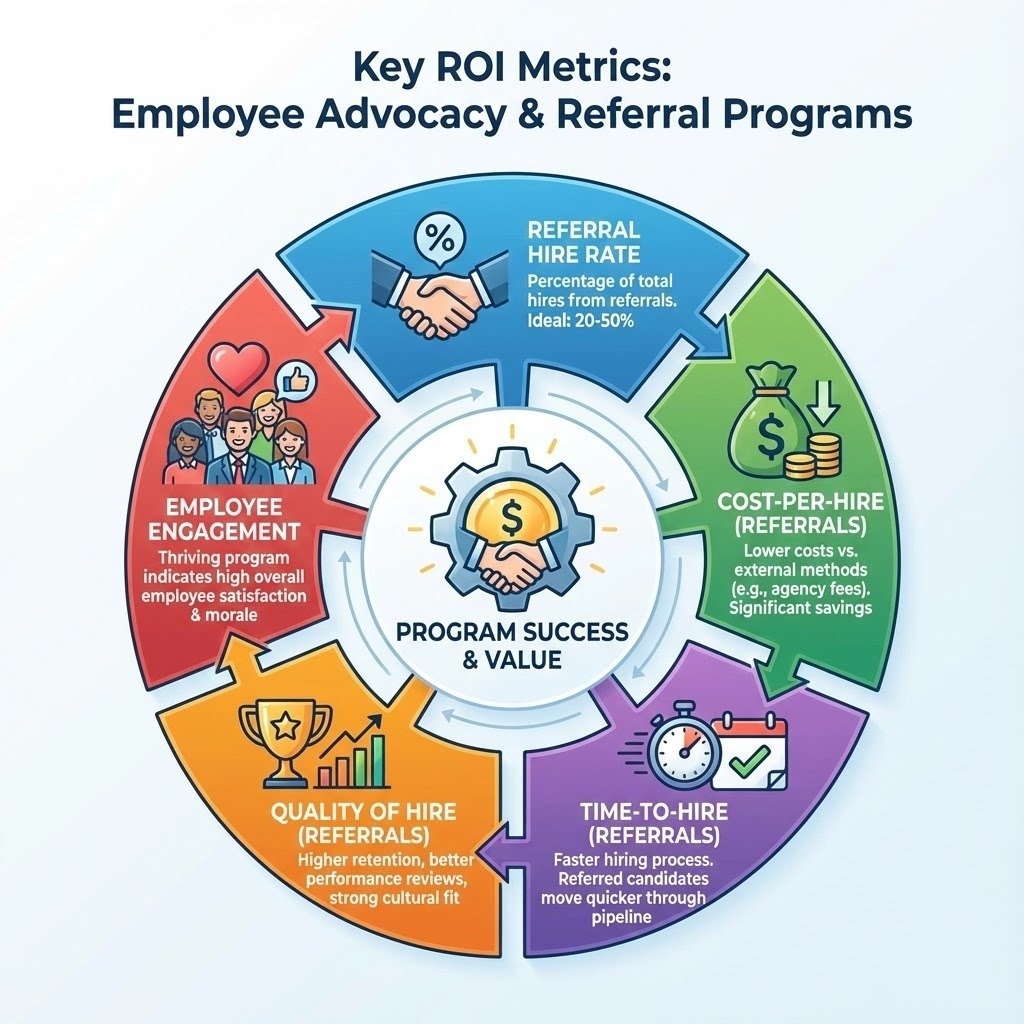
Measuring ROI for Employee Advocacy and Referral Programs:
- Referral Hire Rate: Track the percentage of total hires that come from employee referrals (a high rate, often 20-50%, is ideal).
- Cost-per-Hire (Referrals): Compare the cost (referral bonus + administrative costs) to external hiring methods (agency fees, job board spend), demonstrating significant savings.
- Time-to-Hire (Referrals): Referred candidates often move faster through the pipeline, so track this reduction.
- Quality of Hire (Referrals): Monitor the retention rates, performance reviews, and cultural fit scores of referred employees. They typically have higher scores.
- Employee Engagement: A thriving referral program can be a strong indicator of overall employee satisfaction and engagement.
Budgeting Considerations:
- Low Cost: Internal team time for program setup and management.
- Medium Cost: Dedicated budget for referral bonuses (ranging from a few hundred to several thousand dollars per hire, depending on role and industry). Subscription to referral management software.
- High Cost: Developing an integrated, gamified employee advocacy platform, potentially with external consultants for launch and ongoing promotion.
6. Programmatic Job Advertising: Smart Spending, Smarter Hires
In a crowded digital landscape, simply posting jobs on a few boards is no longer enough to reach the right talent efficiently. Programmatic job advertising leverages AI and automation to revolutionize your job ad spending, ensuring your vacancies are seen by the most relevant candidates at the optimal time and cost. It’s a data-driven approach that eliminates guesswork and maximizes return on investment.
Step-by-Step Guide:
- Define Clear Campaign Objectives and Target Audience:
- Action: Before launching, clearly articulate your goals (e.g., maximize applications for high-volume roles, secure niche talent for hard-to-fill positions, reduce cost-per-applicant). Precisely define your target audience based on skills, experience, location, and desired demographics.
- Customization: For high-volume entry-level roles, the objective might be broad reach at the lowest CPA. For executive roles, it’s about hyper-targeted visibility on premium sites, even if CPA is higher.
- Select a Programmatic Advertising Platform:
- Action: Research and choose a programmatic vendor (e.g., Appcast, Joveo, PandoLogic, Talent.com) that integrates with your ATS and offers the features you need. Platforms vary in sophistication, targeting capabilities, and cost models.
- Issues & Troubleshooting: Problem: Platform doesn't integrate with existing ATS. Troubleshooting: Verify integration capabilities during vendor selection. Inquire about APIs or custom integrations if standard options aren't available.
- Upload Job Feeds and Set Bid Strategies:
- Action: Provide the programmatic platform with a clean, XML-formatted feed of your job openings. Configure your bidding strategy (e.g., Cost-Per-Click (CPC), Cost-Per-Application (CPA)) and daily/monthly budget caps for each job or campaign. The platform's algorithms will then automatically distribute ads across its network.
- Customization: Implement higher bids for hard-to-fill, critical roles and lower bids for high-volume, easier-to-fill positions.
- A/B Test Ad Copy and Creatives:
- Action: Don't just set and forget. Continuously test different versions of your job ad copy, headlines, and visual elements (if applicable) to see which resonates best with your target audience and drives higher engagement or conversions.
- Issues & Troubleshooting: Problem: High click-through rate but low application rate. Troubleshooting: This suggests a mismatch between ad messaging and the landing page (job description/career site). Optimize the landing page for clarity and ease of application.
- Monitor Performance and Optimize Continuously:
- Action: Regularly review the campaign performance dashboards provided by the platform. Analyze metrics like CPA, CPC, application volume, and quality of applicants from different sources. Work with your vendor or internal team to adjust targeting, bids, and ad placements based on results.
- Customization: Pause campaigns for roles that are performing poorly or are no longer a priority. Allocate more budget to campaigns delivering high-quality hires.
- Issues & Troubleshooting: Problem: Receiving too many unqualified applicants. Troubleshooting: Refine your targeting criteria (add more specific skills, experience levels). Review job description clarity. Increase your bid for higher-quality placements.
Measuring ROI for Programmatic Job Advertising:
- Cost-per-Application (CPA): The most direct metric, showing the cost to generate one application. A primary optimization goal.
- Cost-per-Click (CPC): Measures the cost of each click on your job ad. Important for initial campaign efficiency.
- Application Volume and Quality: Track the number of applications and, more importantly, how many progress to interviews and offers.
- Source of Hire Analytics: Identify which specific job boards and channels within the programmatic network deliver the best hires.
- Reduced Time-to-Fill: By efficiently generating a pool of relevant candidates, programmatic can contribute to faster hiring.
Budgeting Considerations:
- Medium Cost: Programmatic platforms typically charge a monthly fee or a percentage of ad spend. Initial ad spend budget can start from a few hundred dollars per month for a few roles.
- High Cost: Large-scale campaigns for high-volume hiring across multiple regions or for numerous hard-to-fill roles will require substantial ad spend, potentially thousands per month.
7. Candidate Experience (CX) Optimization: Making Every Interaction Count
In a world where talent has choices, the candidate experience (CX) is your ultimate differentiator. It encompasses every single interaction a job seeker has with your organization throughout the hiring process, from the moment they first encounter your brand to their onboarding (or rejection). A positive CX not only secures top talent but also turns rejected candidates into potential brand advocates.
Step-by-Step Guide:
- Map the End-to-End Candidate Journey:
- Action: Conduct a workshop with recruiters, hiring managers, and recent hires to map out every touchpoint a candidate experiences (e.g., job search, website visit, application, email confirmations, screening calls, interviews, assessments, offer, rejection). Identify "moments of truth" and potential friction points.
- Customization: Create different journey maps for entry-level vs. senior roles, as their expectations and touchpoints may vary.
- Simplify and Streamline the Application Process:
- Action: Review your application form. Eliminate unnecessary fields. Enable "one-click apply" features (e.g., via LinkedIn, Google). Ensure the form is fully mobile-optimized and allows candidates to save progress.
- Issues & Troubleshooting: Problem: High application drop-off rate. Troubleshooting: Reduce the number of required fields. Allow resume parsing to auto-fill information. Offer alternative application methods.
- Implement Proactive and Personalized Communication:
- Action: Send automated, yet personalized, acknowledgments immediately after application submission. Provide regular, clear status updates throughout the process (e.g., "Your application is under review," "We've moved forward with other candidates"). Never leave candidates in the dark.
- Customization: Use candidate's name, refer to the specific role they applied for. For candidates in later stages, offer more detailed feedback if they are rejected.
- Issues & Troubleshooting: Problem: Candidates feel "ghosted." Troubleshooting: Set up automated triggers in your ATS for communication at key stages. Train recruiters on prompt follow-up. Even a generic rejection is better than no communication.
- Train and Prepare Your Interviewers:
- Action: Ensure all interviewers are well-trained on interview techniques, company values, and the importance of a positive candidate experience. Provide them with the candidate's resume and relevant information beforehand. Emphasize showing up on time, being engaged, and treating candidates respectfully.
- Customization: Develop an "interviewer toolkit" with behavioral questions, company talking points, and guidelines for cultural assessment.
- Issues & Troubleshooting: Problem: Inconsistent or unprofessional interviews. Troubleshooting: Implement mandatory interviewer training. Conduct mock interviews. Collect candidate feedback on the interview experience.
- Gather and Act on Candidate Feedback:
- Action: Implement mechanisms to collect feedback from candidates at various stages, especially those who were interviewed but not hired. Use short surveys (e.g., via SurveyMonkey, Google Forms) or direct email.
- Customization: For high-value candidates, consider offering a brief phone call to provide personalized feedback if appropriate.
- Issues & Troubleshooting: Problem: Negative feedback but no action. Troubleshooting: Treat candidate feedback as a critical data point. Regularly review feedback with hiring teams and leadership, and implement improvements based on common themes.
Measuring ROI for Candidate Experience Optimization:
- Candidate Net Promoter Score (cNPS): Survey candidates asking, "How likely are you to recommend applying to our company to a friend?"
- Offer Acceptance Rate: A higher acceptance rate often correlates with a positive candidate experience.
- Application Completion Rate: An improvement indicates a less frustrating application process.
- Glassdoor/Indeed Reviews: Monitor improvements in your employer ratings, particularly comments related to the hiring process.
- Recruiter Efficiency: Less time spent managing candidate queries or complaints due to proactive communication.
Budgeting Considerations:
- Low Cost: Process improvements (simplifying forms, establishing communication protocols), internal training time. Free survey tools.
- Medium Cost: Subscription to advanced survey platforms, CX mapping software, professional development for hiring managers on interviewing skills.
- High Cost: Comprehensive re-platforming of ATS/career site for enhanced CX, engaging CX design consultants.
8. Building and Nurturing Talent Communities: Your Future Pipeline
A talent community is a strategic asset for any modern recruitment marketing strategy. It's a curated network of individuals who have expressed interest in your organization – whether they’re past applicants, event attendees, or simply curious professionals – but aren't necessarily ready to apply for an immediate role. Nurturing this community allows you to build relationships with passive candidates over time, creating a ready pipeline for future openings.
Step-by-Step Guide:
- Create a Compelling "Join Our Talent Community" Call-to-Action (CTA):
- Action: Design a prominent and inviting sign-up form on your career site, blog, and social media channels. Ask for essential information: name, email, and areas of interest (e.g., "Engineering," "Marketing," "Sales").
- Customization: Tailor the CTA to specific departments or geographic regions if your company has diverse hiring needs.
- Implement a Candidate Relationship Management (CRM) System:
- Action: A dedicated recruitment CRM or robust ATS with CRM capabilities is essential. This tool allows you to store candidate profiles, segment your community based on interests and skills, and track interactions.
- Issues & Troubleshooting: Problem: Disorganized candidate data. Troubleshooting: Invest in a CRM early. Establish clear data entry protocols. Regularly clean and update candidate profiles.
- Develop a Value-Driven Content Nurture Stream:
- Action: Send regular, personalized newsletters or email sequences that provide genuine value, rather than just job alerts. Share company news, employee spotlights, industry insights, career development tips, or invitations to webinars.
- Customization: Segment your community by interest (e.g., send tech-focused content to engineers, business-focused content to sales professionals).
- Issues & Troubleshooting: Problem: High unsubscribe rates. Troubleshooting: Ensure content is highly relevant to specific segments. Review email frequency. A/B test subject lines for better engagement.
- Host Exclusive Events or Content for Community Members:
- Action: Make community members feel special by offering exclusive access to webinars, virtual coffee chats with team leaders, or early access to new content. This deepens engagement and fosters a sense of belonging.
- Customization: Partner with internal Employee Resource Groups (ERGs) to host diversity-focused events for specific community segments.
- Re-engage and Re-market Strategically:
- Action: Periodically send targeted communications to specific segments of your talent community when relevant job openings arise. Refer to past interactions or content they’ve engaged with to make the message highly personalized.
- Issues & Troubleshooting: Problem: Community members become "cold." Troubleshooting: Implement re-engagement campaigns (e.g., a special offer, a direct message from a recruiter). Regularly prune inactive contacts to maintain list quality.
Measuring ROI for Building and Nurturing Talent Communities:
- Community Growth Rate: Track the number of new members joining your community each month.
- Engagement Metrics: Monitor email open rates, click-through rates, and attendance at exclusive events.
- Hires from Talent Community: This is the ultimate metric. Track how many hires originate directly from your nurtured pipeline.
- Time-to-Fill (Community Sourced): Compare the time-to-fill for roles filled from the talent community versus other sources (it should be significantly lower).
- Cost Savings: Calculate the reduction in external sourcing or advertising costs due to having an internal talent pool.
Budgeting Considerations:
- Low Cost: Utilizing free tiers of email marketing platforms or basic CRM functionalities within your ATS. Internal time for content creation.
- Medium Cost: Subscription to a dedicated recruitment CRM (prices vary widely, from hundreds to thousands per month depending on features and scale).
- High Cost: Custom development of a branded talent community platform, significant investment in high-quality exclusive content.
9. Personalization through Candidate Personas: Targeting with Precision
Just as product marketers develop customer personas, recruitment marketing thrives on candidate personas. These detailed, semi-fictional representations of your ideal hires allow you to move beyond generic outreach, tailoring your messaging, channels, and benefits to deeply resonate with the specific motivations and aspirations of your target talent segments.
Step-by-Step Guide:
- Identify Key Roles for Persona Development:
- Action: Start with your most critical, high-volume, or hard-to-fill roles. Developing a persona for every single role isn't practical; focus on broader archetypes (e.g., "Experienced Software Engineer," "Early Career Marketer," "Senior Sales Leader").
- Conduct In-Depth Research to Gather Insights:
- Interview Top Performers: Talk to your current best employees in these roles. Ask about their career journey, what they value in a job, what attracted them to your company, their professional goals, and their preferred information sources.
- Interview Hiring Managers: Understand their expectations, the challenges of finding talent, and the key traits of successful team members.
- Analyze Exit Interviews (Anonymously): Understand why people leave, as this can reveal common frustrations your personas might share.
- Review Market Data: Look at industry reports, salary surveys, and competitor profiles to understand broader trends.
- Customization: For startups, founders can provide initial insights. For large enterprises, leverage existing market research teams or external consultants.
- Synthesize Data and Create Detailed Persona Profiles:
- Action: Compile your research into a concise, actionable document for each persona. Include:
- Demographics: Age range, experience level, education.
- Professional Background: Key skills, past roles, career aspirations.
- Motivations & Goals: What drives them? What do they want to achieve? (e.g., work-life balance, challenging projects, leadership, impact).
- Pain Points & Frustrations: What problems are they trying to solve in their current role or job search?
- Information Sources: What websites, social media platforms, blogs, or events do they frequent?
- Quotes: Actual quotes from your interviews to make the persona feel real.
- Customization: Give each persona a name and even a photo to make them relatable (e.g., "Analytics Alex," "Creative Chloe").
- Action: Compile your research into a concise, actionable document for each persona. Include:
- Integrate Personas into All Recruitment Marketing Activities:
- Action: Use your candidate personas as a guide when:
- Writing Job Descriptions: Tailor language, highlight relevant benefits, and address specific pain points.
- Creating Content: Develop blog posts, videos, or social media campaigns that speak directly to their interests.
- Selecting Channels: Choose job boards and social platforms where your personas are active.
- Crafting Outreach Messages: Personalize initial messages in passive candidate outreach efforts.
- Issues & Troubleshooting: Problem: Personas are created but not used. Troubleshooting: Regularly review personas in team meetings. Make them easily accessible. Link persona characteristics to specific recruitment marketing actions.
- Action: Use your candidate personas as a guide when:
- Regularly Review and Update Personas:
- Action: The job market and candidate expectations evolve. Review your personas annually or whenever there are significant shifts in your hiring needs or industry trends.
- Issues & Troubleshooting: Problem: Outdated or inaccurate personas. Troubleshooting: Re-conduct research periodically. Incorporate feedback from new hires and exit interviews.
Measuring ROI for Personalization through Candidate Personas:
- Improved Quality of Applications: Track the percentage of applicants who closely match your persona's ideal profile.
- Higher Conversion Rates: Monitor if targeted content and personalized outreach lead to higher click-throughs and application completions.
- Reduced Time-to-Hire: By attracting better-fit candidates upfront, the hiring cycle should shorten.
- Higher Offer Acceptance Rates: Messaging that truly resonates should lead to more accepted offers.
- Better Retention of Hired Candidates: Candidates whose motivations align with your EVP are more likely to stay long-term.
Budgeting Considerations:
- Low Cost: Primarily involves internal team time for research, interviews, and documentation. Free templates for persona creation are widely available.
- Medium Cost: Engaging a freelance market researcher or HR consultant to facilitate persona workshops or conduct external research.
- High Cost: Partnering with a specialized employer branding agency for extensive market research and persona development.
10. Email Marketing & Nurture Sequences: Building Lasting Connections
Even in an age of diverse digital channels, email remains one of the most powerful and personal tools in your recruitment marketing arsenal. Email marketing and nurture sequences allow you to build and maintain relationships with potential candidates over time, delivering valuable content and keeping your organization top-of-mind until they are ready to explore new opportunities.
Step-by-Step Guide:
- Segment Your Audience Effectively:
- Action: Don't send the same email to everyone. Segment your talent community based on factors like:
- Area of Interest: (e.g., Software Development, Marketing, Sales).
- Experience Level: (e.g., Entry-level, Mid-career, Executive).
- Source: (e.g., Website sign-up, Event attendee, Past applicant).
- Engagement Level: (e.g., Highly engaged, Low engagement).
- Customization: Your ATS/CRM should facilitate this segmentation.
- Action: Don't send the same email to everyone. Segment your talent community based on factors like:
- Design Thoughtful Nurture Sequences:
- Action: Create automated series of 3-7 emails to be sent over several weeks or months, triggered by specific actions (e.g., joining talent community, starting but not finishing an application, attending a webinar). Each email should have a clear purpose and offer value.
- Customization: Different sequences for different personas or career stages.
- Issues & Troubleshooting: Problem: Irrelevant emails leading to unsubscribes. Troubleshooting: Double-check your segmentation logic. Personalize content.
- Craft Compelling Email Content for Each Step:
- Email 1 (Welcome & Introduction): Thank them for their interest, introduce your company's mission, and share a key piece of employer brand content (e.g., a "why work here" video).
- Email 2 (Value & Insight): Share a blog post about industry trends, employee spotlight, or career development advice relevant to their interests.
- Email 3 (Behind the Scenes): Provide a glimpse into daily life, team projects, or a unique company perk.
- Email 4 (Call to Action - Soft): Invite them to follow you on social media, attend a future event, or connect with a recruiter for an informational chat.
- Email 5 (Call to Action - Direct): Highlight relevant open positions or encourage them to set up a job alert.
- Customization: Use dynamic content to pull in specific job titles or employee names.
- Issues & Troubleshooting: Problem: Low open rates. Troubleshooting: A/B test subject lines. Ensure sender name is recognizable. Improve email deliverability (avoid spam triggers).
- Leverage a Recruitment CRM or Email Marketing Platform:
- Action: Utilize a robust platform (e.g., Recooty, HubSpot, Mailchimp, Greenhouse CRM) that allows for automation, personalization, and detailed analytics. This is crucial for managing scale.
- Issues & Troubleshooting: Problem: Emails landing in spam folders. Troubleshooting: Authenticate your sender domain (SPF/DKIM). Maintain a clean email list. Avoid overly promotional language in subject lines.
- Monitor Performance and Optimize Continuously:
- Action: Track key metrics like open rates, click-through rates (CTR), conversion rates (applications generated from emails), and unsubscribe rates. A/B test different subject lines, CTAs, and content variations to improve performance.
- Issues & Troubleshooting: Problem: High unsubscribe rates. Troubleshooting: Analyze content relevance, email frequency, and ensure an easy unsubscribe process.
Measuring ROI for Email Marketing & Nurture Sequences:
- Open Rate: Percentage of recipients who open your emails, indicating initial interest.
- Click-Through Rate (CTR): Percentage of recipients who click on a link within your email, showing engagement with your content.
- Conversion Rate: The percentage of email recipients who ultimately apply for a job.
- Hires from Nurtured Leads: Track how many hires can be directly attributed to your email nurture campaigns.
- Cost-per-Acquisition (Email): Calculate the cost (platform + content creation) to acquire a hire via email.
- Talent Community Engagement: Email engagement directly contributes to a more active talent community.
Budgeting Considerations:
- Low Cost: Free tiers of email marketing platforms (e.g., Mailchimp for small lists). Internal time for content writing.
- Medium Cost: Paid subscriptions to email marketing platforms or recruitment CRMs (hundreds to thousands per month). Freelance content writers for email copy.
- High Cost: Advanced CRM solutions with sophisticated automation and personalization capabilities, dedicated email marketing specialist for recruitment.
11. Mobile-First Recruitment Strategies: Meeting Candidates Where They Are
With smartphones becoming the primary device for accessing the internet, a mobile-first recruitment strategy is no longer a luxury—it’s a necessity. The majority of job seekers initiate their search and even complete applications on their mobile devices. If your recruitment process isn't seamlessly optimized for mobile, you're creating unnecessary friction and losing out on a significant pool of talent.
Step-by-Step Guide:
- Conduct a Thorough Mobile Audit of Your Entire Process:
- Action: Personally go through your entire candidate journey on various mobile devices (iOS, Android, different screen sizes). Test every touchpoint: career site, job search, application form, email confirmations, assessment links.
- Issues & Troubleshooting: Problem: Slow loading times on mobile. Troubleshooting: Utilize Google's PageSpeed Insights for mobile. Compress images, optimize code, and leverage Accelerated Mobile Pages (AMP) for static content where appropriate.
- Ensure a Responsive and Intuitive Career Site:
- Action: Your career site must be built with responsive design principles, automatically adapting its layout and content to fit any screen size. Text should be legible, buttons tappable, and navigation straightforward on mobile.
- Customization: Consider a dedicated "mobile careers app" for large enterprises with frequent, high-volume hiring or a complex application flow.
- Simplify Mobile Application Forms:
- Action: Drastically reduce the number of required fields on your application. Offer "one-click apply" options using LinkedIn or indeed profiles. Allow candidates to easily upload resumes from cloud storage (Google Drive, Dropbox) rather than local phone storage.
- Issues & Troubleshooting: Problem: High mobile application abandonment rate. Troubleshooting: Implement progress savers. Break long forms into multiple, smaller steps. Test different form field types for mobile usability (e.g., dropdowns vs. free text).
- Optimize All Recruitment Content for Mobile Consumption:
- Action: All content – job descriptions, blog posts, videos, and email newsletters – must be easily digestible on a small screen. Use short paragraphs, clear headings, bullet points, and high-quality, responsive images/videos.
- Customization: For visual roles, create short, engaging video snippets specifically designed for mobile social feeds.
- Leverage SMS/Text Messaging for Key Communications:
- Action: Obtain explicit consent from candidates to send SMS messages. Use text messages for critical, time-sensitive communications like application acknowledgments, interview reminders, or status updates. SMS has a much higher open rate than email.
- Customization: For high-volume roles (e.g., retail, logistics), SMS can be an efficient tool for broadcasting new openings or inviting candidates to rapid-fire interviews.
- Issues & Troubleshooting: Problem: Low SMS engagement or opt-outs. Troubleshooting: Ensure messages are concise and provide clear value. Avoid spamming. Offer an easy opt-out option.
- Ensure Mobile-Friendly Assessment Tools:
- Action: If your hiring process includes online assessments or skills tests, verify that these tools are fully functional and user-friendly on mobile devices.
- Issues & Troubleshooting: Problem: Candidates unable to complete assessments on mobile. Troubleshooting: Partner with vendors whose assessment platforms are natively mobile-responsive.
Measuring ROI for Mobile-First Recruitment Strategies:
- Mobile Application Completion Rate: Track the percentage of candidates who start and finish applications on mobile, comparing it to desktop rates.
- Mobile Conversion Rate: Monitor the overall conversion of mobile visitors to applicants.
- Time Spent on Mobile Career Site: Higher engagement suggests a better mobile experience.
- SMS Open and Response Rates: Track the effectiveness of your text message communications.
- Candidate Feedback (Mobile-Specific): Include questions about mobile experience in candidate surveys.
Budgeting Considerations:
- Low Cost: Internal team time for mobile testing and content optimization. Leveraging responsive design features already present in your ATS.
- Medium Cost: Investing in a more robust ATS/career site platform with excellent native mobile functionality. Subscription to an SMS marketing platform (varies based on volume).
- High Cost: Custom mobile app development for recruitment (only for very large enterprises with specific needs).
12. Online Reputation Management: The Silent Influencer
In today's transparent digital world, your company's online reputation as an employer is a powerful, often silent, influencer in attracting or deterring top talent. Candidates actively research companies on review sites, social media, and forums long before they apply. Proactive online reputation management is thus an essential component of your recruitment marketing strategy, shaping perceptions and building trust.
Step-by-Step Guide:
- Claim and Optimize Your Profiles on Key Review Sites:
- Action: Ensure you have claimed and fully optimized your company profiles on major employer review sites like Glassdoor, Indeed, Comparably, and Google My Business. Fill out all sections completely, including company descriptions, photos, and benefits.
- Customization: Also identify and monitor niche industry review sites relevant to your sector (e.g., G2 for tech, Yelp for service industries).
- Implement Robust Social Listening and Monitoring:
- Action: Set up alerts (e.g., Google Alerts, social listening tools) to be notified whenever your company name or relevant keywords are mentioned online. Regularly check review sites and social media platforms for new comments.
- Issues & Troubleshooting: Problem: Missing important mentions or negative reviews. Troubleshooting: Use dedicated monitoring tools. Train your team to proactively search for brand mentions.
- Develop a Clear and Empathetic Response Strategy:
- Action: Create guidelines for responding to all reviews, both positive and negative.
- Positive Reviews: Thank the employee/candidate genuinely, reinforcing your appreciation.
- Negative Reviews: Respond professionally, empathetically, and without defensiveness. Acknowledge their concerns, apologize if appropriate, and outline what steps you are taking to address the issues. Offer to take the conversation offline.
- Customization: Responses can be personalized, but ensure they align with your overall brand voice and legal guidelines. For highly sensitive negative reviews, consult legal counsel.
- Issues & Troubleshooting: Problem: Inconsistent or unprofessional responses. Troubleshooting: Provide mandatory training for anyone responding to reviews. Have a clear approval process for sensitive responses.
- Action: Create guidelines for responding to all reviews, both positive and negative.
- Actively Encourage Authentic Employee Reviews:
- Action: After positive employee events (e.g., successful project completion, promotion announcements, annual reviews, onboarding a new hire), gently encourage satisfied employees to share their experiences on review sites. Never pressure or incentivize positive reviews, as this can lead to distrust and penalties.
- Customization: Focus on specific teams or departments that have strong positive sentiment.
- Issues & Troubleshooting: Problem: Lack of new, positive reviews. Troubleshooting: Create internal campaigns reminding employees about the importance of reviews. Make it easy for them to find the review sites.
- Leverage Positive Reviews in Your Recruitment Marketing:
- Action: Showcase your positive reviews and high ratings on your career site, in job descriptions, and on social media. Use quotes from happy employees in your content marketing.
- Customization: Create infographics or short videos highlighting your overall ratings or specific positive themes in reviews (e.g., "90% of employees recommend working here for career growth").
Measuring ROI for Online Reputation Management:
- Average Company Rating: Track your overall score on sites like Glassdoor and Indeed. An upward trend is a clear indicator of success.
- Sentiment Analysis: Beyond the score, analyze the themes and keywords in reviews. Are negative themes diminishing? Are positive themes becoming more prominent?
- Candidate Feedback: Ask candidates during interviews if they consulted online reviews and what their impressions were.
- Reduced Time-to-Hire/Cost-per-Hire: A strong reputation can attract more qualified applicants, reducing sourcing time and costs.
- Employee Retention: A positive internal perception, reflected online, can contribute to lower voluntary turnover.
Budgeting Considerations:
- Low Cost: Manual monitoring, internal team time for response.
- Medium Cost: Subscription to reputation management software (e.g., Brandwatch, Mention – typically hundreds to thousands per month depending on features and volume).
- High Cost: Engaging a PR firm or specialized reputation management agency for a comprehensive audit and ongoing strategy.
13. Data Analytics & Measuring Recruitment ROI: The Strategic Imperative
In the past, recruitment was often seen as a cost center, with little measurable impact beyond filling seats. Today, data analytics transforms recruitment into a strategic business function. By meticulously tracking, collecting, and analyzing data related to your hiring processes, you gain invaluable insights to optimize your recruitment marketing strategy, justify investments, and continuously improve hiring outcomes. You can't improve what you don't measure.
Step-by-Step Guide:
- Define Key Recruitment Marketing Performance Indicators (KPIs):
- Action: Don't drown in data; focus on the metrics that directly impact your business goals. Essential KPIs include:
- Time-to-Fill: The number of calendar days from when a job requisition is approved to when an offer is accepted.
- Cost-per-Hire: The total internal and external recruitment expenditures divided by the number of hires in a given period.
- Source of Hire: Which specific channels (e.g., career site, LinkedIn, referrals, job board X, internal talent community) lead to accepted offers.
- Quality of Hire: The long-term performance and impact of new hires, often measured by performance reviews, retention rates, and hiring manager satisfaction (e.g., 6-month or 1-year performance ratings, ramp-up time).
- Applicant-to-Hire Conversion Rate: The percentage of applicants who ultimately become hires. Break this down by stage (applicant-to-interview, interview-to-offer).
- Candidate Experience Score: Via cNPS or direct survey feedback.
- Customization: For high-volume roles, focus on Time-to-Fill and Cost-per-Hire. For niche, senior roles, prioritize Quality of Hire and Source of Hire.
- Action: Don't drown in data; focus on the metrics that directly impact your business goals. Essential KPIs include:
- Leverage Your Applicant Tracking System (ATS) and CRM for Data Collection:
- Action: Ensure your ATS (e.g., Recooty) is configured to automatically capture and track key data points throughout the candidate journey. Standardize data entry and source tracking across all recruiters. Integrate your CRM to track nurture campaign engagement.
- Issues & Troubleshooting: Problem: Data silos or inconsistent data. Troubleshooting: Invest in a unified HR tech stack. Provide mandatory training on data entry protocols. Regularly audit data for accuracy.
- Build and Utilize Custom Dashboards and Reports:
- Action: Create easy-to-understand dashboards that visualize your key recruitment marketing KPIs. Share these regularly with your recruitment team, hiring managers, and senior leadership. Focus on trends and actionable insights, not just raw numbers.
- Customization: Build tailored dashboards for different stakeholders (e.g., a high-level summary for executives, a detailed funnel breakdown for recruiters).
- Calculate Recruitment Marketing ROI:
- Action: While complex, even a simplified ROI calculation is powerful.
- ROI = (Monetary Value of Hires - Cost of Recruitment Marketing) / Cost of Recruitment Marketing
- Monetary Value of Hires: This can be difficult to quantify precisely. Proxies include average revenue per employee, increased productivity, or reduced employee turnover costs. A simpler, more direct approach is to focus on the cost savings achieved (e.g., by reducing agency fees due to a strong talent community) and the impact on critical business metrics (e.g., faster time to market due to quicker tech hires).
- Issues & Troubleshooting: Problem: Difficulty in quantifying "value of hires." Troubleshooting: Focus on proxy metrics that leadership understands (e.g., reducing operational costs, accelerating revenue-generating hires, improving retention). Present a compelling business case based on these savings and efficiencies.
- Action: While complex, even a simplified ROI calculation is powerful.
- Perform Regular Deep-Dive Analysis and Optimization:
- Action: Don't just report numbers; analyze them. Identify patterns, bottlenecks, and opportunities for improvement. For example, if you see high drop-off rates at the interview stage for a specific source, investigate that source or your interview process.
- Customization: Conduct A/B testing on job descriptions, ad copy, or email subject lines, and use data to determine winning variations.
Measuring ROI for Data Analytics & Measuring Recruitment ROI:
- Demonstrated Cost Savings: Quantify reductions in agency fees, advertising spend, or recruiter overtime.
- Improved Efficiency Metrics: Reductions in Time-to-Fill, faster movement through the recruitment funnel.
- Enhanced Quality of Hire: Higher retention rates, better performance reviews, increased hiring manager satisfaction, and positive impact on business outcomes.
- Justified Budget Increases: Presenting clear, data-backed evidence for the value of recruitment marketing initiatives to secure more resources.
- Strategic Decision-Making: More confident and data-informed decisions regarding channel allocation, process changes, and technology investments.
Budgeting Considerations:
- Low Cost: Utilizing built-in analytics of your ATS/CRM. Basic Google Analytics setup. Internal team time for analysis.
- Medium Cost: Subscription to advanced ATS/CRM with robust reporting, business intelligence tools (e.g., Tableau, Power BI) for custom dashboards.
- High Cost: Hiring a dedicated Recruitment Data Analyst or a People Analytics team. Investing in predictive analytics platforms.
14. Strategic Use of Events and Webinars: Connecting Beyond the Screen
In an increasingly digital world, the human touch remains incredibly powerful. Strategic use of events and webinars in recruitment marketing offers a unique opportunity to connect with potential candidates on a more personal level, showcase your company culture dynamically, and position your organization as a thought leader. These platforms allow for direct engagement, fostering stronger relationships than static web pages.
Step-by-Step Guide:
- Define Clear Goals and Target Audience for Each Event:
- Action: Before planning, ask: What do we want to achieve? (e.g., increase brand awareness, generate leads for specific roles, promote diversity initiatives). Who are we trying to reach? (e.g., recent graduates, experienced professionals, specific technical talent).
- Customization: For a tech startup, the goal might be to attract senior engineers by showcasing innovative projects. For a healthcare provider, it could be a virtual career fair to meet a high volume of nurses.
- Choose the Right Event Format:
- Virtual Webinars/Info Sessions:
- Action: Ideal for sharing thought leadership, deep dives into company projects, or broad informational sessions. They allow for global reach and easy recording for evergreen content. Use platforms like Zoom Webinars, GoToWebinar.
- Issues & Troubleshooting: Problem: Low attendance or engagement. Troubleshooting: Promote heavily across all channels. Keep presentations interactive (polls, Q&A). Ensure strong audio/visuals.
- Virtual Career Fairs/Networking Events:
- Action: Efficient for screening a large volume of candidates or facilitating one-on-one chats. Utilize platforms that allow for virtual booths, direct messaging, and video calls.
- Customization: Host "office hours" for specific departments.
- In-Person Meetups/Tech Talks/Open Houses:
- Action: Excellent for building deep local relationships, showcasing your physical environment, and allowing informal networking. Host at your office or a local venue.
- Issues & Troubleshooting: Problem: Low turnout. Troubleshooting: Promote locally. Offer compelling content (e.g., a keynote speaker). Provide refreshments and a welcoming atmosphere.
- Virtual Webinars/Info Sessions:
- Develop Engaging Content and Feature Your Employees:
- Action: Your employees should be the stars. Have them present on topics they are passionate about, participate in panel discussions, or host virtual "coffee chats." Their authenticity is your biggest asset.
- Customization: For a company focused on diversity and inclusion, host panels featuring employees from various backgrounds.
- Execute a Multi-Channel Promotion Strategy:
- Action: Market your events aggressively across all your recruitment marketing channels: your career site, email newsletters (to your talent community), social media (organic and paid), relevant industry forums, and internal communications.
- Issues & Troubleshooting: Problem: Event marketing is not reaching the right audience. Troubleshooting: Refine your targeting on paid social ads. Partner with relevant industry associations or university career centers.
- Implement Robust Pre- and Post-Event Engagement:
- Action:
- Pre-Event: Send reminders, provide agendas, and encourage questions.
- Post-Event: Send a thank-you email to all attendees (and registrants who didn't attend), share recordings or follow-up resources, and invite them to join your talent community. Encourage attendees to connect with your recruiters on LinkedIn.
- Action:
Measuring ROI for Strategic Use of Events and Webinars:
- Registration & Attendance Rates: Measures the effectiveness of your promotion and content appeal.
- Lead Generation: Track how many new candidates (who weren't already in your ATS/CRM) register and attend.
- Applications from Event Attendees: Use unique tracking codes or a specific "how did you hear about us?" question on applications.
- Hires from Events: The ultimate metric – how many attendees ultimately become successful hires.
- Candidate Engagement (Post-Event): Monitor email open rates, social media mentions, and LinkedIn connections from attendees.
- Brand Sentiment: Collect feedback on the event experience and overall perception of your company.
Budgeting Considerations:
- Low Cost: Virtual webinars (using existing video conferencing tools like Zoom, Google Meet). Internal employee time for presentations.
- Medium Cost: Professional webinar platforms (e.g., GoToWebinar, Webex Events – hundreds to thousands per month), marketing spend for event promotion, small honorariums for external speakers.
- High Cost: Sponsoring major industry conferences (thousands to tens of thousands), hosting large-scale in-person events (venue, catering, A/V, marketing materials).
15. Passive Candidate Outreach Techniques: Hunting for Hidden Gems
The most talented individuals are often not actively looking for a new job. They are happily employed, performing well, and not browsing job boards. Passive candidate outreach is a proactive recruitment marketing strategy focused on identifying and engaging these "hidden gems," building relationships, and gently persuading them that your organization offers a uniquely compelling next step in their career journey.
Step-by-Step Guide:
- Develop a Hyper-Targeted Sourcing Strategy:
- Action: Go beyond basic LinkedIn searches. Use advanced Boolean search strings, X-ray searches on Google (e.g., site:linkedin.com/in "software engineer" "Python" "artificial intelligence"), industry-specific platforms (e.g., GitHub for developers, Dribbble for designers), and alumni networks.
- Customization: For niche technical roles, look for individuals who contribute to open-source projects or present at industry conferences. For leadership roles, identify those with significant achievements in similar companies.
- Conduct Thorough Pre-Outreach Research:
- Action: Before sending any message, deeply research the candidate. Look at their LinkedIn profile, personal website, publications, social media activity, and recent projects. Understand their career trajectory, interests, and potential motivations.
- Issues & Troubleshooting: Problem: Generic messages getting ignored. Troubleshooting: The research step is critical. Identify a specific project, article, or skill to reference in your initial outreach.
- Craft Highly Personalized, Value-Driven Initial Messages:
- Action: Your first message should NOT be a job pitch. It should be a genuine, respectful, and highly personalized introduction that references your research. Focus on starting a conversation and offering value.
- Good Example: "Hi [Candidate Name], I was really impressed by your recent work on [specific project/article/patent]. We're tackling a similar challenge at [Your Company] involving [related tech/problem]. I'd love to hear your insights or share a bit about our approach if you're open to a brief, informal chat."
- Bad Example: "Hi [Candidate Name], I have a great job for you. Are you looking?"
- Customization: Adjust tone and formality based on the platform and candidate's industry.
- Issues & Troubleshooting: Problem: Low response rates. Troubleshooting: Ensure your message is concise, clearly states why you're reaching out to them specifically, and offers a low-commitment next step.
- Action: Your first message should NOT be a job pitch. It should be a genuine, respectful, and highly personalized introduction that references your research. Focus on starting a conversation and offering value.
- Implement a Multi-Touch Outreach Cadence:
- Action: Don't stop at one message. If you don't receive a response, send 1-2 follow-up messages over a few weeks. The follow-ups should add new value (e.g., link to a relevant blog post, invite to a webinar). Respect if they decline interest.
- Customization: Different cadences for highly sought-after talent vs. broader talent pools.
- Issues & Troubleshooting: Problem: Candidates feel spammed or harassed. Troubleshooting: Space out your messages appropriately (e.g., 3-5 days between touches). Limit your total number of touches. Always offer an easy way for them to opt out.
- Focus on Relationship Building and Long-Term Nurturing:
- Action: The goal of passive outreach is often to initiate a relationship that can lead to a future hire. Even if there isn't an immediate fit, invite them to join your talent community or connect on LinkedIn to stay in touch.
- Customization: For highly valuable candidates, consider assigning a dedicated recruiter to nurture that relationship over months or even years.
- Ethical Considerations: Be respectful of privacy. Do not circumvent privacy settings. Always offer a clear way for candidates to decline further communication.
Measuring ROI for Passive Candidate Outreach Techniques:
- Response Rate: Percentage of candidates who respond to your initial outreach messages.
- Conversion to Informational Call/Screen: How many initial conversations turn into deeper engagements.
- Conversion to Interview: How many sourced candidates progress to formal interviews.
- Hires from Sourced Candidates: Track the number of hires directly attributed to proactive outreach efforts.
- Time-to-Fill (Sourced Roles): Often, highly targeted passive outreach can significantly reduce time-to-fill for niche positions.
- Quality of Hire (Sourced Roles): Passive candidates often represent top talent, leading to higher quality hires and better retention.
Budgeting Considerations:
- Low Cost: Internal recruiter/sourcer time for manual sourcing and personalized outreach.
- Medium Cost: Subscription to advanced sourcing tools like LinkedIn Recruiter ($800-$1000+/month per license).
- High Cost: Engaging specialized external sourcing firms or recruitment agencies for hard-to-fill passive talent.
What Common Problems Will You Face in Recruitment Marketing?
Even with the most meticulously planned strategies, the dynamic world of recruitment marketing presents its share of challenges. Being proactive in identifying and troubleshooting these common hurdles is crucial for sustained success.
How Do I Solve a Lack of Budget?
Issue: Many organizations, especially startups or smaller businesses, face significant budget constraints for recruitment marketing. This often leads to relying solely on free, yet less effective, methods.
Troubleshooting & Customization:
- Leverage Organic Power: Double down on strategies with high organic potential: Employee Advocacy and Referral Programs (cost-effective, high ROI), High-Impact Content Marketing (employee-driven blogs, smartphone videos), and Career Site SEO (improves organic visibility).
- Focus on Process: Many improvements in Candidate Experience (CX) Optimization are about refining processes and communication, which are time investments, not monetary ones.
- Free Tools: Utilize free tiers of email marketing platforms, social media scheduling tools, and Google's free SEO tools (Search Console, Analytics, Keyword Planner).
- Internal Resources: Tap into your internal marketing or HR teams for content creation support, graphic design, or social media management.
How Do I Get Buy-in from Leadership?
Issue: Senior leadership may view recruitment marketing as an overhead cost rather than a strategic investment, especially if they are accustomed to traditional recruitment methods.
Troubleshooting & Customization:
- Start Small, Prove ROI: Select a critical, hard-to-fill role or a department with significant hiring needs. Implement 2-3 targeted recruitment marketing strategies (e.g., targeted content, specific social media ads, refined CX).
- Track and Present Key Metrics: Meticulously track and present clear, quantifiable results. Focus on improvements in Time-to-Fill, Cost-per-Hire, and Quality of Hire from your pilot project. Translate these into tangible business outcomes (e.g., "Reducing time-to-fill for engineering roles by 20% means our product launches 1 month faster, generating an estimated $X revenue increase").
- Speak Their Language: Frame your proposals in terms of business impact, competitive advantage, and long-term talent sustainability, rather than just "HR initiatives."
- Educate and Involve: Share market trends and competitor analysis (like the insights from Rally Recruitment or BuiltIn) that highlight the necessity of modern recruitment marketing. Involve leaders in discussions about candidate personas to show a strategic approach to talent.
What if I'm Not a Marketer?
Issue: Many HR professionals feel overwhelmed by the "marketing" aspect of recruitment marketing, lacking formal training in content creation, SEO, or social media strategy.
Troubleshooting & Customization:
- Think Like a Candidate: Your greatest asset is your understanding of candidates' needs and pain points. Use this to inform your messaging. What would you want to see or hear from an employer?
- Collaborate with Marketing: Partner closely with your internal marketing department. They possess expertise in branding, content creation, social media, and analytics. Frame it as a mutual goal to attract top talent.
- Upskill Gradually: Take advantage of free online resources, webinars, or introductory courses on digital marketing, content strategy, or social media management. Start with one strategy at a time.
- Leverage Tools: Modern recruitment marketing platforms and ATS (like Recooty) are designed to be user-friendly, often with built-in templates and automation to simplify marketing tasks.
- Focus on Authenticity: You don't need slick ad campaigns. Authentic employee stories, genuine communication, and a strong candidate experience often outperform highly polished but inauthentic marketing.
Frequently Asked Questions About Recruitment Marketing
What is the best marketing strategy for a recruitment agency?
For a recruitment agency, the best marketing strategy centers around establishing thought leadership and demonstrating specialized expertise. This involves:
- High-Value Content Marketing: Creating insightful blog posts, whitepapers, and industry reports that address both client (e.g., "Hiring Trends for AI Talent in 2026") and candidate needs (e.g., "How to Negotiate Your Tech Salary").
- Strategic Social Media Engagement: Actively participating in industry discussions on LinkedIn, Twitter, and relevant niche platforms, showcasing your team's knowledge and networking effectively.
- Building a Talent Community: Nurturing relationships with a broad pool of candidates, positioning your agency as a trusted career partner.
- Client Testimonials & Case Studies: Highlighting successful placements and the value you bring to client organizations to build credibility.
What does a recruitment marketing specialist do?
A recruitment marketing specialist is a pivotal role that bridges HR and marketing. Their responsibilities typically include:
- Developing and executing the employer brand strategy.
- Managing and optimizing the company's career site and job board presence.
- Creating high-impact content marketing (blogs, videos, employee stories) for talent attraction.
- Planning and executing social media recruiting campaigns (organic and paid).
- Managing email marketing and nurture sequences for talent communities.
- Implementing and optimizing programmatic job advertising.
- Monitoring and managing the company's online reputation (Glassdoor, Indeed reviews).
- Analyzing recruitment data and KPIs to measure ROI and optimize strategies.
- Collaborating with HR, hiring managers, and general marketing teams.
How do I get into recruitment marketing?
Getting into recruitment marketing requires a blend of skills from both HR/recruiting and marketing disciplines. Here's a path:
- Develop Foundational Skills: Gain proficiency in content creation (writing, basic video editing), social media management, SEO basics, and data analysis.
- Gain Recruitment Experience: Understand the hiring process, candidate pain points, and recruiter workflows. This can come from a recruiting coordinator, sourcer, or junior recruiter role.
- Cross-Functional Experience: If you're in HR, volunteer to assist your marketing team with projects related to employer branding or careers pages. If you're in marketing, offer to help your HR team with their hiring campaigns.
- Learn the Technology: Become familiar with Applicant Tracking Systems (ATS) and Candidate Relationship Management (CRM) tools, as these are central to the role.
- Educate Yourself: Take online courses in digital marketing, employer branding, or talent acquisition. Follow industry leaders and publications.
- Build a Portfolio: Start a personal blog or LinkedIn profile where you demonstrate your understanding of recruitment marketing concepts.
The Key Takeaway: Embracing the Future of Talent Acquisition
The landscape of talent acquisition has undergone an irreversible transformation. The days of passively waiting for applications are over. The future belongs to organizations that wholeheartedly embrace marketing in recruitment, integrating sophisticated marketing principles with their hiring efforts. This means being profoundly proactive, meticulously data-driven, and relentlessly focused on cultivating authentic, meaningful relationships with both active and passive candidates.
By diligently implementing these 15 comprehensive recruitment marketing strategies, your organization will build not just a talent pipeline, but a powerful, self-sustaining talent magnet. You will attract individuals who are not merely qualified on paper, but who are deeply aligned with your mission, energized by your culture, and genuinely excited to contribute to your success. You will transcend the limitations of competing solely on salary, instead winning the fiercely contested war for talent by championing a superior, compelling, and authentic employer brand. This holistic approach is not just about filling vacancies; it's about strategically investing in the human capital that will drive your organization's innovation, growth, and enduring prosperity.
Ready to Build Your Winning Recruitment Strategy?
Transforming your hiring process to meet the demands of the modern talent market can seem like a monumental undertaking. However, you don't have to navigate this complex journey alone. Modern recruitment platforms are specifically engineered to automate and streamline the most time-consuming aspects of your talent acquisition strategy, liberating your team to concentrate on what truly matters: engaging with and building relationships with exceptional people.
Discover how Recooty’s intuitive platform can empower you to meticulously optimize your career site, efficiently manage your entire applicant pipeline, and intelligently leverage AI to identify and secure the perfect candidates with unprecedented speed and accuracy. Take control of your talent destiny. Sign up for a free trial today and embark on the first pivotal step toward constructing a world-class recruitment engine that truly propels your organization forward.
For continuous learning and staying ahead of the curve in HR and talent acquisition, explore invaluable resources from industry authorities such as the Society for Human Resource Management (SHRM) and the latest thought leadership and market analyses from Forbes. These platforms offer deep insights into evolving trends, best practices, and strategic approaches that can further enhance your recruitment marketing efforts.
uitment Marketing Strategies You Can't Ignore: A Deep Dive into Attracting Top Talent
In the fiercely competitive talent landscape of today, merely posting job openings and hoping for the best is a strategy destined for obsolescence. Recruitment marketing has emerged as the indispensable bridge between human resources and marketing, fundamentally transforming how organizations find, attract, engage, and ultimately hire top talent. This proactive approach views potential candidates not just as applicants, but as valued customers, guiding them through a carefully curated journey. It's about building a robust, sustainable talent pipeline long before a specific vacancy even arises, continuously promoting your organization's unique value proposition. As a seasoned Senior HR and Marketing Expert, I’ve witnessed firsthand how a well-executed recruitment marketing plan can dramatically elevate a company's hiring prowess, reducing time-to-fill and improving candidate quality.
The traditional "post and pray" methodology no longer suffices. Modern enterprises require a dynamic, forward-thinking approach that not only reaches qualified individuals but also genuinely resonates with their career aspirations and values. This comprehensive guide will equip you with 15 actionable strategies, providing step-by-step implementation, customization tips for diverse organizational needs, and critical troubleshooting advice, ensuring you can attract candidates who are not just a good fit, but an exceptional one. We will delve into how cutting-edge technologies, such as advanced AI candidate matching, are revolutionizing the way we identify and rank talent, leading to significant time savings and a marked improvement in the caliber of new hires.
Understanding the Bedrock of Recruitment Marketing
To truly master marketing in recruitment, it’s crucial to grasp its foundational elements. This begins with a clear understanding of your Employer Brand and your Employee Value Proposition (EVP). These aren't just buzzwords; they are the core identity of your organization as a workplace.
What is Employer Brand?
Your employer brand is the reputation and perception your company has in the job market, both among your current employees and external candidates. It encompasses everything from your company culture and values to your public image, employee reviews, and how you communicate your mission. A strong employer brand acts as a magnet, drawing in high-quality applicants organically. Conversely, a weak or negative employer brand can deter even the most qualified talent, regardless of how attractive your compensation packages might be.
What is Employee Value Proposition (EVP)?
The Employee Value Proposition (EVP) is the unique set of benefits, rewards, and experiences that employees receive in return for the skills, capabilities, and experience they bring to your organization. It answers the fundamental question: "Why should a talented individual choose to work here over somewhere else?" Your EVP is a promise to your employees, covering aspects like compensation, benefits, career development, work environment, culture, and social impact. A compelling EVP is the heart of your recruitment marketing message, differentiating you from competitors and attracting candidates who align with your core values and growth opportunities.
Why a Recruitment Marketing Strategy is Indispensable Today
In today's candidate-driven market, top talent holds significant leverage. They are no longer passive recipients of job offers; they are discerning consumers who meticulously research potential employers. Your recruitment marketing strategy directly influences their perception and decision-making process.
- Access to Passive Candidates: The vast majority of highly skilled professionals are not actively searching for jobs. A robust recruitment marketing strategy allows you to reach and engage these passive candidates where they already spend their time – social media, industry forums, and content platforms – nurturing their interest long before they consider a career change.
- Enhanced Employer Brand: Consistent and authentic marketing in recruitment efforts actively build and reinforce a positive employer reputation. This not only attracts more candidates but also improves the quality and cultural fit of applicants, as they are pre-disposed to your company's values and mission.
- Reduced Time-to-Hire and Cost-per-Hire: By proactively cultivating a talent pipeline and enhancing your brand, you significantly reduce the need for last-minute, expensive recruitment efforts. When a role becomes available, you already have a pool of engaged, pre-qualified candidates, leading to faster fills and lower recruitment costs.
- Improved Quality of Hire and Retention: A strategic approach attracts candidates who are genuinely aligned with your company's culture and values, not just those seeking a paycheck. This leads to better long-term performance, higher employee satisfaction, and improved retention rates, directly impacting organizational productivity and success.
The 4 P’s of Recruitment Marketing: A Strategic Framework
Drawing parallels from traditional marketing, applying the 4 P's framework to recruitment provides a clear lens through which to evaluate and optimize your hiring efforts. This model forces a candidate-centric perspective, ensuring your "offer" is truly appealing.
H3: 1. Product: The Job Itself and the Work Experience
In recruitment marketing, the "Product" is more than just a job description; it's the entire work experience you offer. This encompasses the specific responsibilities of the role, the team dynamics, the overall company culture, opportunities for professional growth, and the impact the role has on the organization and wider community. You are essentially selling a career opportunity and a place within your organizational ecosystem.
Customization Tips:
- Startups/Small Businesses: Emphasize autonomy, direct impact, and the opportunity to shape the company's future. Highlight a tight-knit, collaborative culture.
- Large Enterprises: Focus on career progression paths, access to vast resources, global impact, and stability. Detail structured training and mentorship programs.
- Tech Roles: Showcase exciting projects, innovative tech stack, learning opportunities, and contribution to open-source communities.
- Creative Roles: Highlight creative freedom, portfolio-building opportunities, and a vibrant, inspiring work environment.
Issues & Troubleshooting:
- Vague Job Descriptions: Leads to mismatched candidates. Troubleshooting: Collaborate with hiring managers to articulate precise responsibilities, required skills, and growth potential. Use concrete examples of daily tasks.
- Unrealistic Expectations: Over-glamorizing a role can lead to early attrition. Troubleshooting: Balance aspirations with reality. Be honest about challenges and typical workloads, showcasing how employees overcome them.
- Internal Inconsistency: Discrepancies between the marketed "product" and the actual employee experience. Troubleshooting: Regularly audit your EVP against employee feedback. Ensure internal communications align with external messaging.
H3: 2. Price: Compensation, Benefits, and Overall Value Proposition
"Price" in recruitment extends beyond just the salary figure. It represents the total compensation package and the comprehensive value an employee receives. This includes base salary, bonuses, equity, health benefits, retirement plans, paid time off, flexible work arrangements, professional development budgets, and unique perks (e.g., gym memberships, tuition reimbursement, free meals).
Customization Tips:
- Startups/Small Businesses: If cash compensation is limited, emphasize equity, rapid career growth, and unique benefits like unlimited PTO or flexible hours.
- Large Enterprises: Offer competitive salaries and comprehensive benefits packages, including strong health plans, extensive retirement matching, and structured professional development.
- Entry-Level Roles: Focus on training, mentorship, and a clear path for advancement, along with a fair starting salary.
- Senior/Executive Roles: Highlight equity, performance-based bonuses, leadership development, and high-impact decision-making opportunities.
Issues & Troubleshooting:
- Uncompetitive Compensation: High candidate drop-off after salary discussion. Troubleshooting: Conduct regular market research (e.g., using Glassdoor, Salary.com, industry-specific reports) to ensure your offers are competitive. Be transparent about your salary ranges where possible.
- Undervalued Benefits: Candidates may not recognize the full value of your benefits. Troubleshooting: Clearly articulate the monetary value and impact of your benefits package. Provide examples (e.g., "Our health plan saves employees an average of $X per year").
- Lack of Transparency: Hesitation to discuss salary upfront. Troubleshooting: Consider including salary ranges in job postings, as this attracts more qualified applicants and saves time for both parties. A SHRM report highlights the significant costs of a bad hire, reinforcing the need to get "Price" right from the start.
H3: 3. Place: The Work Environment, Location, and Flexibility
"Place" refers to where and how the work is done, as well as the overall physical and cultural environment. This includes the physical office location (or lack thereof), the office design, the tools and technology provided, and the degree of flexibility (remote, hybrid, in-office). The "place" significantly impacts an employee's daily life and productivity.
Customization Tips:
- Remote-First Companies: Emphasize a strong virtual culture, communication tools, and a focus on asynchronous work. Detail support for home office setups.
- Hybrid Models: Clearly define the balance between in-office and remote work, highlighting collaborative office spaces and flexibility benefits.
- On-Site Roles (e.g., Manufacturing, Healthcare): Showcase state-of-the-art facilities, safety protocols, team camaraderie, and the unique advantages of the physical environment.
- Creative Agencies: Highlight vibrant, open-plan offices, breakout spaces, and a culture that encourages spontaneous collaboration.
Issues & Troubleshooting:
- Mismatch in Expectations: Candidates expecting remote work are surprised by office requirements. Troubleshooting: Be explicit about the work arrangement (remote, hybrid, in-office) in job descriptions and initial communications. Provide virtual tours or photos of the actual workspace.
- Outdated Technology/Environment: Leads to frustration and lower productivity. Troubleshooting: Invest in modern tools and a comfortable work environment. Highlight these improvements in your recruitment marketing.
- Geographic Limitations: Difficulty attracting talent to less desirable locations. Troubleshooting: Focus on unique local benefits, community involvement, or offer relocation packages. Emphasize growth opportunities that might not be available in larger markets.
H3: 4. Promotion: How You Reach, Attract, and Engage Candidates
"Promotion" encompasses all the strategies and tactics used to communicate your "Product," "Price," and "Place" to your target candidates. This is the heart of your recruitment marketing strategy, utilizing various channels to build awareness, generate interest, and drive applications. This includes your career site, social media, email campaigns, job boards, events, and employee referrals.
Customization Tips:
- Startups/Small Businesses: Focus on grassroots efforts, local community events, and leveraging employee networks. Be highly personalized in outreach.
- Large Enterprises: Utilize programmatic advertising, global social media campaigns, and partnerships with universities or industry associations. Maintain consistent brand messaging across all channels.
- High-Volume Hiring (e.g., Retail, Customer Service): Focus on mobile optimization, quick-apply options, and wide reach on popular job boards and social media.
- Niche Roles (e.g., AI Research, Rare Engineers): Employ targeted passive candidate outreach, specialized industry events, and deep content marketing to showcase thought leadership.
Issues & Troubleshooting:
- Low Reach/Visibility: Your jobs aren't being seen by enough candidates. Troubleshooting: Diversify your channels. Invest in SEO, programmatic ads, and optimize social media presence.
- Low Conversion Rates: Candidates see your promotions but don't apply. Troubleshooting: Improve your candidate experience (CX), simplify the application process, and refine your messaging to align with candidate needs.
- Inconsistent Messaging: Different channels portray different employer brands. Troubleshooting: Develop clear brand guidelines for all recruitment marketing materials. Train recruiters and hiring managers on consistent messaging.
1. Career Site Optimization & SEO: Your Digital Talent Hub
Your career site is arguably your most critical recruitment marketing asset. It serves as your primary information hub, where interested candidates dive deep into your company culture, values, and available opportunities. A poorly optimized or user-unfriendly career site can quickly derail all your other recruitment efforts.
Step-by-Step Guide:
- Conduct Comprehensive Keyword Research:
- Action: Use tools like Google Keyword Planner, Ahrefs, or SEMrush to identify the exact search terms candidates use to find jobs in your industry and region. Include variations like "software engineer jobs," "tech careers," "remote developer positions," or "marketing specialist roles in [City]."
- Customization: For niche roles, explore industry-specific forums or communities to uncover specialized keywords. For international companies, research keywords in different languages and local dialects.
- Optimize On-Page Elements for Every Job Posting:
- Action: Treat each job posting as a unique landing page. Ensure the job title is clear and keyword-rich (e.g., "Senior Full Stack Developer" not "Code Ninja"). Incorporate primary and secondary keywords naturally throughout the job description, H1 tags, H2 subheadings, meta descriptions, and image alt-text.
- Customization: For creative roles, allow for more evocative language, but still embed relevant keywords. For compliance-heavy roles, ensure clarity and industry-specific terminology are prominent.
- Implement Job Posting Schema Markup:
- Action: Add structured data (Schema.org/JobPosting) to your job listings. This code helps search engines like Google understand the content of your job postings, making them eligible for enhanced visibility in Google for Jobs results.
- Customization: Ensure all required properties (title, description, hiring organization, base salary, employment type, location) are accurately filled.
- Prioritize Page Speed and Core Web Vitals:
- Action: Use Google's PageSpeed Insights, GTmetrix, or Lighthouse to regularly audit and improve your career site's loading speed, interactivity, and visual stability. Compress images, minify CSS/JavaScript, and leverage browser caching.
- Issues & Troubleshooting: Problem: High bounce rate on career pages. Troubleshooting: Slow loading times (audit server response, image sizes), confusing layout (simplify navigation), irrelevant content (re-evaluate keyword targeting and job description clarity).
- Ensure Flawless Mobile-Friendliness:
- Action: Regularly test your entire career site and application process on various mobile devices and screen sizes. Use Google's Mobile-Friendly Test. Ensure text is readable, buttons are easily tappable, and forms are simple to complete without zooming or excessive scrolling.
- Issues & Troubleshooting: Problem: Candidates abandoning applications on mobile. Troubleshooting: Simplify application forms (e.g., one-click apply, LinkedIn integration), reduce required fields, test form functionality rigorously on mobile.
- Design an Intuitive User Experience (UX) and Navigation:
- Action: Make it easy for candidates to find jobs using clear navigation, filtering options (by location, department, keyword), and a prominent search bar. The journey from landing on the site to submitting an application should be logical and straightforward.
- Customization: Provide clear categories for different career levels or specific departments relevant to your organization's structure.
- Issues & Troubleshooting: Problem: Candidates struggling to find relevant jobs. Troubleshooting: Re-evaluate your site's information architecture. Use heatmaps and user recordings to identify navigation pain points.
Measuring ROI for Career Site Optimization & SEO:
- Organic Traffic Growth: Track the number of visitors coming from search engines to your career site using Google Analytics.
- Application Conversion Rate (Organic): Monitor the percentage of organic visitors who complete an application.
- Time on Page / Bounce Rate: Higher time on page and lower bounce rate suggest engaged users finding relevant content.
- Source of Hire (Organic): Directly attribute hires to organic search, demonstrating long-term value.
- Cost Savings: Calculate how much you save on paid advertising by attracting candidates organically.
Budgeting Considerations:
- Low Cost: Internal team time for keyword research, content optimization. Free SEO tools (Google Search Console, Google Analytics).
- Medium Cost: Subscription to advanced SEO tools (Ahrefs, SEMrush – $100-$400/month). Hiring a freelance SEO specialist for an audit or implementation.
- High Cost: Full career site redesign (tens of thousands of dollars) or ongoing engagement with a specialized recruitment marketing agency.
2. High-Impact Content Marketing: Storytelling Your Workplace
Generic job descriptions are no longer sufficient to captivate today’s discerning talent. High-impact content marketing transcends basic information, telling your company's story, showcasing its unique culture, and providing genuine insights into the employee experience. This strategy builds trust, demonstrates authenticity, and differentiates your organization as an attractive employer.
Step-by-Step Guide:
- Develop a Candidate-Centric Content Calendar:
- Action: Plan content themes and formats based on your candidate personas and the stages of their journey (awareness, consideration, decision). Consider seasonal hiring peaks or major company announcements.
- Customization: For tech companies, topics might include "Our Latest Open-Source Contribution" or "A Day in the Life of a Software Engineer." For healthcare, "Innovations in Patient Care" or "Meet Our Nursing Leadership."
- Create Engaging Blog Posts:
- Action: Write articles that address common candidate questions, share industry insights, highlight employee achievements, or explain your company values. Examples: "5 Reasons Why [Your Company Name] is a Great Place to Grow Your Career," "Understanding Our Engineering Culture."
- Issues & Troubleshooting: Problem: Low blog readership. Troubleshooting: Ensure topics are relevant to your personas, optimize for SEO keywords, promote aggressively on social media and in newsletters.
- Produce Authentic Video Content:
- Action: Record "Day in the Life" videos featuring diverse employees, quick Q&A sessions with hiring managers, or short clips showcasing office events and team activities. Authenticity trumps high production value.
- Customization: For remote teams, "A Day in My Home Office" videos can be powerful. For service industries, short videos of employee interactions with customers (with consent) can highlight impact.
- Issues & Troubleshooting: Problem: Low video views/engagement. Troubleshooting: Keep videos short (under 2-3 minutes), add captions, optimize thumbnails, distribute on YouTube, LinkedIn, Instagram, and your career site.
- Showcase Compelling Employee Testimonials and Stories:
- Action: Interview employees from various departments and levels about their career journey, what they love about working at your company, and challenges they’ve overcome. Turn these into written features, short videos, or quotes on your career site.
- Customization: For a company with a strong mission, focus on how employees contribute to that mission. For a company known for growth, highlight career progression stories.
- Utilize Diverse Content Formats:
- Action: Go beyond blogs and videos. Create infographics explaining your benefits, host podcasts with team leaders, share "behind-the-scenes" photo galleries, or develop interactive quizzes about your company culture.
- Issues & Troubleshooting: Problem: Inconsistent brand voice across content. Troubleshooting: Develop clear content guidelines and provide examples. Train content creators on brand tone and messaging.
Measuring ROI for High-Impact Content Marketing:
- Website Traffic (Content-Driven): Track unique visitors to your blog, video pages, and employee story sections.
- Engagement Metrics: Monitor views, shares, comments, likes on content across all platforms.
- Lead Generation: If you have gated content (e.g., an industry report), track how many candidates download it and enter your nurture funnel.
- Application Referrals: Use UTM parameters in your content links to track how many applications originate from specific content pieces.
- New Hire Feedback: Survey new hires on what content influenced their decision to apply.
Budgeting Considerations:
- Low Cost: Employee-driven content creation (blogs, simple videos with smartphones). Free content creation tools (Canva for graphics).
- Medium Cost: Freelance writers ($50-$200 per article), professional video editing software/services ($50-$500 per video), stock photography/videography subscriptions.
- High Cost: Hiring a full-time content marketer, engaging a specialized recruitment marketing agency for content strategy and production.
3. Strategic Social Media Recruiting: Engaging Where Talent Lives
Social media is no longer a fringe tool for recruiting; it’s a central pillar of modern recruitment marketing. It's where your target candidates spend significant portions of their time, offering unparalleled opportunities to build brand awareness, engage with talent, and showcase your company culture authentically. However, success demands a strategic approach, not just random job postings.
Step-by-Step Guide:
- Identify Your Core Platforms:
- Action: Don't try to be everywhere. Focus your efforts on the platforms where your candidate personas are most active. LinkedIn is paramount for professional roles. Instagram and TikTok are excellent for visual employer branding and reaching younger demographics. Twitter can be great for tech or media roles.
- Customization: For manufacturing, Facebook Groups or industry-specific forums might yield better results. For design roles, platforms like Dribbble or Behance are crucial.
- Optimize Your Company Profiles:
- Action: Ensure all company profiles are complete, visually appealing, and consistently reflect your employer brand. Use high-quality cover photos, compelling "About Us" sections, and clear links back to your career site.
- Issues & Troubleshooting: Problem: Inconsistent brand image across platforms. Troubleshooting: Develop a comprehensive social media brand guideline. Centralize content creation or approve all posts through a single team.
- Implement a Diverse Content Strategy (80/20 Rule):
- Action: Adopt the 80/20 rule: 80% of your content should be engaging, valuable, and non-promotional (e.g., employee spotlights, company news, industry insights, behind-the-scenes glimpses). Only 20% should be direct job postings.
- Customization: Use platform-specific content formats (e.g., LinkedIn articles, Instagram Reels, Twitter threads, TikTok challenges demonstrating culture).
- Issues & Troubleshooting: Problem: Low engagement on posts. Troubleshooting: Experiment with different content types (polls, questions, user-generated content). Post at optimal times for your audience.
- Foster Employee Advocacy:
- Action: Encourage and empower your employees to share company content and job openings on their personal networks. Provide them with easy-to-share links, pre-written captions, and relevant hashtags.
- Customization: Implement a recognition program for employees who actively share and refer. Offer training on how to be a professional brand ambassador on social media.
- Issues & Troubleshooting: Problem: Employees reluctant to share. Troubleshooting: Ensure employees feel genuinely positive about their workplace. Highlight the benefits of sharing (e.g., helping a friend find a job, personal branding).
- Utilize Targeted Social Media Advertising:
- Action: Leverage the advanced targeting capabilities of platforms like LinkedIn Ads or Facebook Ads. Target candidates based on skills, job titles, education, demographics, and interests. Run campaigns for specific roles or general employer branding.
- Customization: For hard-to-fill roles, create lookalike audiences based on profiles of your current top performers. Test different ad creatives and calls-to-action (CTAs).
- Issues & Troubleshooting: Problem: High ad spend, low-quality applicants. Troubleshooting: Refine your targeting parameters. A/B test ad copy and visuals. Ensure your landing page (career site) is optimized for conversion.
- Actively Engage with Your Audience:
- Action: Don't just broadcast; participate. Respond promptly and professionally to comments, messages, and mentions. Engage in relevant industry conversations using hashtags.
- Issues & Troubleshooting: Problem: Negative comments or misinformation spreading. Troubleshooting: Have a clear social media response plan. Address concerns empathetically and move sensitive discussions to private channels.
Measuring ROI for Strategic Social Media Recruiting:
- Follower Growth & Engagement Rate: Track the growth of your audience and the average engagement (likes, comments, shares) on your posts.
- Website Referral Traffic: Monitor the number of clicks from social media posts to your career site or specific job openings.
- Applicants from Social Media: Use your ATS to track how many applications list social media as the source.
- Cost-per-Application (Paid Social): For paid campaigns, divide the total ad spend by the number of applications generated.
- Brand Sentiment: Use social listening tools to gauge the overall perception of your employer brand.
Budgeting Considerations:
- Low Cost: Organic social media activity (time and creativity). Free social media scheduling tools.
- Medium Cost: Social media management tools (Hootsuite, Buffer – $50-$300/month). Moderate ad spend on targeted campaigns ($100-$1000/month).
- High Cost: Dedicated social media recruiter, specialized social media agency, significant ad spend for large-scale campaigns.
4. AI-Driven Candidate Ranking & Matching: The Smart Revolution
Artificial Intelligence (AI) is no longer a futuristic concept; it’s a game-changer in recruitment marketing. It empowers organizations to move beyond manual, time-consuming processes, leveraging intelligent algorithms to swiftly identify, rank, and match the best-fit candidates, dramatically enhancing efficiency and effectiveness.
Step-by-Step Guide:
- Define Clear Job Requirements and Success Criteria:
- Action: Before implementing AI, ensure your job descriptions are meticulously detailed, outlining essential skills, experiences, and cultural fit indicators. AI models learn from the data you provide, so "garbage in, garbage out" applies here.
- Customization: For technical roles, specify exact programming languages and frameworks. For sales roles, highlight specific CRM experience or sales methodologies.
- Select and Integrate an AI-Powered Tool:
- Action: Choose an Applicant Tracking System (ATS) or a standalone recruitment AI platform (like Recooty with its AI candidate ranking capabilities) that offers resume parsing, skills matching, and predictive analytics. Ensure it integrates seamlessly with your existing HR tech stack.
- Issues & Troubleshooting: Problem: Integration failures with existing systems. Troubleshooting: Work closely with your IT department and the vendor's support team. Conduct thorough testing in a sandbox environment before full deployment.
- Train and Calibrate the AI Model:
- Action: Initially, the AI will learn from your historical hiring data. Continuously provide feedback to the AI (e.g., marking certain candidates as "good fit" or "bad fit") to refine its matching accuracy over time.
- Customization: Tailor the AI's weighting for specific criteria based on role importance (e.g., for a senior role, experience might be weighted higher than education).
- Utilize AI for Initial Screening and Shortlisting:
- Action: Allow the AI to automatically screen incoming applications and rank candidates based on defined criteria. This generates a prioritized shortlist, enabling recruiters to focus on the most promising profiles.
- Issues & Troubleshooting: Problem: AI recommending irrelevant candidates. Troubleshooting: Review the initial criteria, adjust weighting, and provide more explicit feedback to retrain the model. Ensure the AI is not just keyword matching but understanding context.
- Leverage AI-Powered Chatbots for Candidate Interaction:
- Action: Deploy chatbots on your career site to answer frequently asked questions, guide candidates through the application process, and even conduct preliminary screening questions 24/7.
- Customization: Design chatbots to have a conversational tone that aligns with your brand. Provide options for candidates to speak with a human recruiter if needed.
- Issues & Troubleshooting: Problem: Chatbots providing unhelpful or frustrating responses. Troubleshooting: Regularly review chatbot conversations for common queries it fails to answer. Continuously update its knowledge base and refine its natural language processing.
- Implement Continuous Bias Monitoring and Auditing:
- Action: While AI can reduce human bias, it can also inherit bias from historical data. Regularly audit the AI's recommendations for any demographic disparities. Work with your vendor to understand their bias mitigation strategies.
- Ethical Considerations: Transparency is paramount. Inform candidates that AI is part of your screening process. Ensure your AI system is designed for fairness and equity, continuously evaluating its impact on diversity outcomes.
Measuring ROI for AI-Driven Candidate Ranking & Matching:
- Reduction in Time-to-Fill: Track the average time taken to fill roles before and after AI implementation.
- Improved Quality of Hire: Measure the performance ratings of hires sourced through AI compared to other channels (e.g., 6-month or 1-year performance reviews).
- Increased Recruiter Productivity: Quantify the time saved by recruiters on manual screening tasks, allowing them to focus on candidate engagement.
- Reduced Cost-per-Hire: Calculate the cost savings from decreased reliance on external sourcing, agency fees, or extensive manual labor.
- Application-to-Interview Conversion Rate: An improvement indicates the AI is effectively identifying suitable candidates.
Budgeting Considerations:
- Medium Cost: AI features integrated into modern ATS platforms (often part of a subscription, starting at a few hundred to thousands per month depending on features and scale).
- High Cost: Standalone, advanced AI recruitment platforms or custom AI development, which can be a significant investment but offer highly tailored solutions.
5. Employee Advocacy and Referral Programs: Your Best Marketers
Your existing employees are your most authentic and powerful brand ambassadors. An effective employee advocacy and referral program transforms your entire workforce into a proactive recruitment team, leveraging their trusted networks to bring in high-quality candidates. This strategy consistently yields some of the best hires in terms of cultural fit, retention, and cost-effectiveness.
Step-by-Step Guide:
- Formalize and Clearly Define the Program:
- Action: Create a clear, written policy for your employee referral program. Outline eligibility criteria, the referral process, the types of roles eligible, and the reward structure. Make it easily accessible to all employees (e.g., on your intranet).
- Customization: For high-growth companies, consider a "always on" program. For companies with specific hiring spikes, implement limited-time, enhanced bonus programs for critical roles.
- Offer Compelling and Meaningful Incentives:
- Action: Determine a referral bonus that is significant enough to motivate employees. Cash bonuses are common, but also consider extra vacation days, professional development stipends, gift cards, or even charitable donations in the employee’s name.
- Customization: Vary bonus amounts based on role seniority or difficulty to fill. For startups with limited cash, offer a mix of smaller cash bonuses and unique perks.
- Streamline the Referral Submission Process:
- Action: Make it incredibly easy for employees to refer candidates. Use a dedicated online portal within your ATS/HRIS, a simple form, or an internal communication tool. Provide employees with tools like pre-written social media posts, email templates, and direct links to job openings.
- Issues & Troubleshooting: Problem: Low referral volume. Troubleshooting: Simplify the submission process. Ensure employees know how to refer. Promote the program more frequently and highlight successful referrals.
- Maintain Transparent Communication and Feedback:
- Action: Keep the referrer informed about the status of their referred candidate at every stage (application received, interview scheduled, offer extended, hired, or not a fit). A timely "thank you for the referral" and status updates are crucial.
- Issues & Troubleshooting: Problem: Employees feel their referrals "go into a black hole." Troubleshooting: Implement automated status updates. Assign a dedicated HR or recruiting contact for referral program inquiries.
- Actively Promote the Program Internally:
- Action: Don't just launch and forget. Regularly remind employees about the program through internal newsletters, company-wide meetings, Slack channels, and prominent intranet banners. Celebrate successful referrals publicly (e.g., in team meetings, company emails).
- Customization: Highlight the success stories of referred employees and the referrers. Create friendly internal competitions for referrals among departments.
- Foster a Positive Employee Experience:
- Action: The most effective employee advocacy stems from genuine employee satisfaction. Focus on creating a workplace where employees are happy, feel valued, and are proud to recommend their friends and former colleagues. This is the ultimate long-term driver of referrals.
Measuring ROI for Employee Advocacy and Referral Programs:
- Referral Hire Rate: Track the percentage of total hires that come from employee referrals (a high rate, often 20-50%, is ideal).
- Cost-per-Hire (Referrals): Compare the cost (referral bonus + administrative costs) to external hiring methods (agency fees, job board spend), demonstrating significant savings.
- Time-to-Hire (Referrals): Referred candidates often move faster through the pipeline, so track this reduction.
- Quality of Hire (Referrals): Monitor the retention rates, performance reviews, and cultural fit scores of referred employees. They typically have higher scores.
- Employee Engagement: A thriving referral program can be a strong indicator of overall employee satisfaction and engagement.
Budgeting Considerations:
- Low Cost: Internal team time for program setup and management.
- Medium Cost: Dedicated budget for referral bonuses (ranging from a few hundred to several thousand dollars per hire, depending on role and industry). Subscription to referral management software.
- High Cost: Developing an integrated, gamified employee advocacy platform, potentially with external consultants for launch and ongoing promotion.
6. Programmatic Job Advertising: Smart Spending, Smarter Hires
In a crowded digital landscape, simply posting jobs on a few boards is no longer enough to reach the right talent efficiently. Programmatic job advertising leverages AI and automation to revolutionize your job ad spending, ensuring your vacancies are seen by the most relevant candidates at the optimal time and cost. It’s a data-driven approach that eliminates guesswork and maximizes return on investment.
Step-by-Step Guide:
- Define Clear Campaign Objectives and Target Audience:
- Action: Before launching, clearly articulate your goals (e.g., maximize applications for high-volume roles, secure niche talent for hard-to-fill positions, reduce cost-per-applicant). Precisely define your target audience based on skills, experience, location, and desired demographics.
- Customization: For high-volume entry-level roles, the objective might be broad reach at the lowest CPA. For executive roles, it’s about hyper-targeted visibility on premium sites, even if CPA is higher.
- Select a Programmatic Advertising Platform:
- Action: Research and choose a programmatic vendor (e.g., Appcast, Joveo, PandoLogic, Talent.com) that integrates with your ATS and offers the features you need. Platforms vary in sophistication, targeting capabilities, and cost models.
- Issues & Troubleshooting: Problem: Platform doesn't integrate with existing ATS. Troubleshooting: Verify integration capabilities during vendor selection. Inquire about APIs or custom integrations if standard options aren't available.
- Upload Job Feeds and Set Bid Strategies:
- Action: Provide the programmatic platform with a clean, XML-formatted feed of your job openings. Configure your bidding strategy (e.g., Cost-Per-Click (CPC), Cost-Per-Application (CPA)) and daily/monthly budget caps for each job or campaign. The platform's algorithms will then automatically distribute ads across its network.
- Customization: Implement higher bids for hard-to-fill, critical roles and lower bids for high-volume, easier-to-fill positions.
- A/B Test Ad Copy and Creatives:
- Action: Don't just set and forget. Continuously test different versions of your job ad copy, headlines, and visual elements (if applicable) to see which resonates best with your target audience and drives higher engagement or conversions.
- Issues & Troubleshooting: Problem: High click-through rate but low application rate. Troubleshooting: This suggests a mismatch between ad messaging and the landing page (job description/career site). Optimize the landing page for clarity and ease of application.
- Monitor Performance and Optimize Continuously:
- Action: Regularly review the campaign performance dashboards provided by the platform. Analyze metrics like CPA, CPC, application volume, and quality of applicants from different sources. Work with your vendor or internal team to adjust targeting, bids, and ad placements based on results.
- Customization: Pause campaigns for roles that are performing poorly or are no longer a priority. Allocate more budget to campaigns delivering high-quality hires.
- Issues & Troubleshooting: Problem: Receiving too many unqualified applicants. Troubleshooting: Refine your targeting criteria (add more specific skills, experience levels). Review job description clarity. Increase your bid for higher-quality placements.
Measuring ROI for Programmatic Job Advertising:
- Cost-per-Application (CPA): The most direct metric, showing the cost to generate one application. A primary optimization goal.
- Cost-per-Click (CPC): Measures the cost of each click on your job ad. Important for initial campaign efficiency.
- Application Volume and Quality: Track the number of applications and, more importantly, how many progress to interviews and offers.
- Source of Hire Analytics: Identify which specific job boards and channels within the programmatic network deliver the best hires.
- Reduced Time-to-Fill: By efficiently generating a pool of relevant candidates, programmatic can contribute to faster hiring.
Budgeting Considerations:
- Medium Cost: Programmatic platforms typically charge a monthly fee or a percentage of ad spend. Initial ad spend budget can start from a few hundred dollars per month for a few roles.
- High Cost: Large-scale campaigns for high-volume hiring across multiple regions or for numerous hard-to-fill roles will require substantial ad spend, potentially thousands per month.
7. Candidate Experience (CX) Optimization: Making Every Interaction Count
In a world where talent has choices, the candidate experience (CX) is your ultimate differentiator. It encompasses every single interaction a job seeker has with your organization throughout the hiring process, from the moment they first encounter your brand to their onboarding (or rejection). A positive CX not only secures top talent but also turns rejected candidates into potential brand advocates.
Step-by-Step Guide:
- Map the End-to-End Candidate Journey:
- Action: Conduct a workshop with recruiters, hiring managers, and recent hires to map out every touchpoint a candidate experiences (e.g., job search, website visit, application, email confirmations, screening calls, interviews, assessments, offer, rejection). Identify "moments of truth" and potential friction points.
- Customization: Create different journey maps for entry-level vs. senior roles, as their expectations and touchpoints may vary.
- Simplify and Streamline the Application Process:
- Action: Review your application form. Eliminate unnecessary fields. Enable "one-click apply" features (e.g., via LinkedIn, Google). Ensure the form is fully mobile-optimized and allows candidates to save progress.
- Issues & Troubleshooting: Problem: High application drop-off rate. Troubleshooting: Reduce the number of required fields. Allow resume parsing to auto-fill information. Offer alternative application methods.
- Implement Proactive and Personalized Communication:
- Action: Send automated, yet personalized, acknowledgments immediately after application submission. Provide regular, clear status updates throughout the process (e.g., "Your application is under review," "We've moved forward with other candidates"). Never leave candidates in the dark.
- Customization: Use candidate's name, refer to the specific role they applied for. For candidates in later stages, offer more detailed feedback if they are rejected.
- Issues & Troubleshooting: Problem: Candidates feel "ghosted." Troubleshooting: Set up automated triggers in your ATS for communication at key stages. Train recruiters on prompt follow-up. Even a generic rejection is better than no communication.
- Train and Prepare Your Interviewers:
- Action: Ensure all interviewers are well-trained on interview techniques, company values, and the importance of a positive candidate experience. Provide them with the candidate's resume and relevant information beforehand. Emphasize showing up on time, being engaged, and treating candidates respectfully.
- Customization: Develop an "interviewer toolkit" with behavioral questions, company talking points, and guidelines for cultural assessment.
- Issues & Troubleshooting: Problem: Inconsistent or unprofessional interviews. Troubleshooting: Implement mandatory interviewer training. Conduct mock interviews. Collect candidate feedback on the interview experience.
- Gather and Act on Candidate Feedback:
- Action: Implement mechanisms to collect feedback from candidates at various stages, especially those who were interviewed but not hired. Use short surveys (e.g., via SurveyMonkey, Google Forms) or direct email.
- Customization: For high-value candidates, consider offering a brief phone call to provide personalized feedback if appropriate.
- Issues & Troubleshooting: Problem: Negative feedback but no action. Troubleshooting: Treat candidate feedback as a critical data point. Regularly review feedback with hiring teams and leadership, and implement improvements based on common themes.
Measuring ROI for Candidate Experience Optimization:
- Candidate Net Promoter Score (cNPS): Survey candidates asking, "How likely are you to recommend applying to our company to a friend?"
- Offer Acceptance Rate: A higher acceptance rate often correlates with a positive candidate experience.
- Application Completion Rate: An improvement indicates a less frustrating application process.
- Glassdoor/Indeed Reviews: Monitor improvements in your employer ratings, particularly comments related to the hiring process.
- Recruiter Efficiency: Less time spent managing candidate queries or complaints due to proactive communication.
Budgeting Considerations:
- Low Cost: Process improvements (simplifying forms, establishing communication protocols), internal training time. Free survey tools.
- Medium Cost: Subscription to advanced survey platforms, CX mapping software, professional development for hiring managers on interviewing skills.
- High Cost: Comprehensive re-platforming of ATS/career site for enhanced CX, engaging CX design consultants.
8. Building and Nurturing Talent Communities: Your Future Pipeline
A talent community is a strategic asset for any modern recruitment marketing strategy. It's a curated network of individuals who have expressed interest in your organization – whether they’re past applicants, event attendees, or simply curious professionals – but aren't necessarily ready to apply for an immediate role. Nurturing this community allows you to build relationships with passive candidates over time, creating a ready pipeline for future openings.
Step-by-Step Guide:
- Create a Compelling "Join Our Talent Community" Call-to-Action (CTA):
- Action: Design a prominent and inviting sign-up form on your career site, blog, and social media channels. Ask for essential information: name, email, and areas of interest (e.g., "Engineering," "Marketing," "Sales").
- Customization: Tailor the CTA to specific departments or geographic regions if your company has diverse hiring needs.
- Implement a Candidate Relationship Management (CRM) System:
- Action: A dedicated recruitment CRM or robust ATS with CRM capabilities is essential. This tool allows you to store candidate profiles, segment your community based on interests and skills, and track interactions.
- Issues & Troubleshooting: Problem: Disorganized candidate data. Troubleshooting: Invest in a CRM early. Establish clear data entry protocols. Regularly clean and update candidate profiles.
- Develop a Value-Driven Content Nurture Stream:
- Action: Send regular, personalized newsletters or email sequences that provide genuine value, rather than just job alerts. Share company news, employee spotlights, industry insights, career development tips, or invitations to webinars.
- Customization: Segment your community by interest (e.g., send tech-focused content to engineers, business-focused content to sales professionals).
- Issues & Troubleshooting: Problem: High unsubscribe rates. Troubleshooting: Ensure content is highly relevant to specific segments. Review email frequency. A/B test subject lines for better engagement.
- Host Exclusive Events or Content for Community Members:
- Action: Make community members feel special by offering exclusive access to webinars, virtual coffee chats with team leaders, or early access to new content. This deepens engagement and fosters a sense of belonging.
- Customization: Partner with internal Employee Resource Groups (ERGs) to host diversity-focused events for specific community segments.
- Re-engage and Re-market Strategically:
- Action: Periodically send targeted communications to specific segments of your talent community when relevant job openings arise. Refer to past interactions or content they’ve engaged with to make the message highly personalized.
- Issues & Troubleshooting: Problem: Community members become "cold." Troubleshooting: Implement re-engagement campaigns (e.g., a special offer, a direct message from a recruiter). Regularly prune inactive contacts to maintain list quality.
Measuring ROI for Building and Nurturing Talent Communities:
- Community Growth Rate: Track the number of new members joining your community each month.
- Engagement Metrics: Monitor email open rates, click-through rates, and attendance at exclusive events.
- Hires from Talent Community: This is the ultimate metric. Track how many hires originate directly from your nurtured pipeline.
- Time-to-Fill (Community Sourced): Compare the time-to-fill for roles filled from the talent community versus other sources (it should be significantly lower).
- Cost Savings: Calculate the reduction in external sourcing or advertising costs due to having an internal talent pool.
Budgeting Considerations:
- Low Cost: Utilizing free tiers of email marketing platforms or basic CRM functionalities within your ATS. Internal time for content creation.
- Medium Cost: Subscription to a dedicated recruitment CRM (prices vary widely, from hundreds to thousands per month depending on features and scale).
- High Cost: Custom development of a branded talent community platform, significant investment in high-quality exclusive content.
9. Personalization through Candidate Personas: Targeting with Precision
Just as product marketers develop customer personas, recruitment marketing thrives on candidate personas. These detailed, semi-fictional representations of your ideal hires allow you to move beyond generic outreach, tailoring your messaging, channels, and benefits to deeply resonate with the specific motivations and aspirations of your target talent segments.
Step-by-Step Guide:
- Identify Key Roles for Persona Development:
- Action: Start with your most critical, high-volume, or hard-to-fill roles. Developing a persona for every single role isn't practical; focus on broader archetypes (e.g., "Experienced Software Engineer," "Early Career Marketer," "Senior Sales Leader").
- Conduct In-Depth Research to Gather Insights:
- Interview Top Performers: Talk to your current best employees in these roles. Ask about their career journey, what they value in a job, what attracted them to your company, their professional goals, and their preferred information sources.
- Interview Hiring Managers: Understand their expectations, the challenges of finding talent, and the key traits of successful team members.
- Analyze Exit Interviews (Anonymously): Understand why people leave, as this can reveal common frustrations your personas might share.
- Review Market Data: Look at industry reports, salary surveys, and competitor profiles to understand broader trends.
- Customization: For startups, founders can provide initial insights. For large enterprises, leverage existing market research teams or external consultants.
- Synthesize Data and Create Detailed Persona Profiles:
- Action: Compile your research into a concise, actionable document for each persona. Include:
- Demographics: Age range, experience level, education.
- Professional Background: Key skills, past roles, career aspirations.
- Motivations & Goals: What drives them? What do they want to achieve? (e.g., work-life balance, challenging projects, leadership, impact).
- Pain Points & Frustrations: What problems are they trying to solve in their current role or job search?
- Information Sources: What websites, social media platforms, blogs, or events do they frequent?
- Quotes: Actual quotes from your interviews to make the persona feel real.
- Customization: Give each persona a name and even a photo to make them relatable (e.g., "Analytics Alex," "Creative Chloe").
- Action: Compile your research into a concise, actionable document for each persona. Include:
- Integrate Personas into All Recruitment Marketing Activities:
- Action: Use your candidate personas as a guide when:
- Writing Job Descriptions: Tailor language, highlight relevant benefits, and address specific pain points.
- Creating Content: Develop blog posts, videos, or social media campaigns that speak directly to their interests.
- Selecting Channels: Choose job boards and social platforms where your personas are active.
- Crafting Outreach Messages: Personalize initial messages in passive candidate outreach efforts.
- Issues & Troubleshooting: Problem: Personas are created but not used. Troubleshooting: Regularly review personas in team meetings. Make them easily accessible. Link persona characteristics to specific recruitment marketing actions.
- Action: Use your candidate personas as a guide when:
- Regularly Review and Update Personas:
- Action: The job market and candidate expectations evolve. Review your personas annually or whenever there are significant shifts in your hiring needs or industry trends.
- Issues & Troubleshooting: Problem: Outdated or inaccurate personas. Troubleshooting: Re-conduct research periodically. Incorporate feedback from new hires and exit interviews.
Measuring ROI for Personalization through Candidate Personas:
- Improved Quality of Applications: Track the percentage of applicants who closely match your persona's ideal profile.
- Higher Conversion Rates: Monitor if targeted content and personalized outreach lead to higher click-throughs and application completions.
- Reduced Time-to-Hire: By attracting better-fit candidates upfront, the hiring cycle should shorten.
- Higher Offer Acceptance Rates: Messaging that truly resonates should lead to more accepted offers.
- Better Retention of Hired Candidates: Candidates whose motivations align with your EVP are more likely to stay long-term.
Budgeting Considerations:
- Low Cost: Primarily involves internal team time for research, interviews, and documentation. Free templates for persona creation are widely available.
- Medium Cost: Engaging a freelance market researcher or HR consultant to facilitate persona workshops or conduct external research.
- High Cost: Partnering with a specialized employer branding agency for extensive market research and persona development.
10. Email Marketing & Nurture Sequences: Building Lasting Connections
Even in an age of diverse digital channels, email remains one of the most powerful and personal tools in your recruitment marketing arsenal. Email marketing and nurture sequences allow you to build and maintain relationships with potential candidates over time, delivering valuable content and keeping your organization top-of-mind until they are ready to explore new opportunities.
Step-by-Step Guide:
- Segment Your Audience Effectively:
- Action: Don't send the same email to everyone. Segment your talent community based on factors like:
- Area of Interest: (e.g., Software Development, Marketing, Sales).
- Experience Level: (e.g., Entry-level, Mid-career, Executive).
- Source: (e.g., Website sign-up, Event attendee, Past applicant).
- Engagement Level: (e.g., Highly engaged, Low engagement).
- Customization: Your ATS/CRM should facilitate this segmentation.
- Action: Don't send the same email to everyone. Segment your talent community based on factors like:
- Design Thoughtful Nurture Sequences:
- Action: Create automated series of 3-7 emails to be sent over several weeks or months, triggered by specific actions (e.g., joining talent community, starting but not finishing an application, attending a webinar). Each email should have a clear purpose and offer value.
- Customization: Different sequences for different personas or career stages.
- Issues & Troubleshooting: Problem: Irrelevant emails leading to unsubscribes. Troubleshooting: Double-check your segmentation logic. Personalize content.
- Craft Compelling Email Content for Each Step:
- Email 1 (Welcome & Introduction): Thank them for their interest, introduce your company's mission, and share a key piece of employer brand content (e.g., a "why work here" video).
- Email 2 (Value & Insight): Share a blog post about industry trends, employee spotlight, or career development advice relevant to their interests.
- Email 3 (Behind the Scenes): Provide a glimpse into daily life, team projects, or a unique company perk.
- Email 4 (Call to Action - Soft): Invite them to follow you on social media, attend a future event, or connect with a recruiter for an informational chat.
- Email 5 (Call to Action - Direct): Highlight relevant open positions or encourage them to set up a job alert.
- Customization: Use dynamic content to pull in specific job titles or employee names.
- Issues & Troubleshooting: Problem: Low open rates. Troubleshooting: A/B test subject lines. Ensure sender name is recognizable. Improve email deliverability (avoid spam triggers).
- Leverage a Recruitment CRM or Email Marketing Platform:
- Action: Utilize a robust platform (e.g., Recooty, HubSpot, Mailchimp, Greenhouse CRM) that allows for automation, personalization, and detailed analytics. This is crucial for managing scale.
- Issues & Troubleshooting: Problem: Emails landing in spam folders. Troubleshooting: Authenticate your sender domain (SPF/DKIM). Maintain a clean email list. Avoid overly promotional language in subject lines.
- Monitor Performance and Optimize Continuously:
- Action: Track key metrics like open rates, click-through rates (CTR), conversion rates (applications generated from emails), and unsubscribe rates. A/B test different subject lines, CTAs, and content variations to improve performance.
- Issues & Troubleshooting: Problem: High unsubscribe rates. Troubleshooting: Analyze content relevance, email frequency, and ensure an easy unsubscribe process.
Measuring ROI for Email Marketing & Nurture Sequences:
- Open Rate: Percentage of recipients who open your emails, indicating initial interest.
- Click-Through Rate (CTR): Percentage of recipients who click on a link within your email, showing engagement with your content.
- Conversion Rate: The percentage of email recipients who ultimately apply for a job.
- Hires from Nurtured Leads: Track how many hires can be directly attributed to your email nurture campaigns.
- Cost-per-Acquisition (Email): Calculate the cost (platform + content creation) to acquire a hire via email.
- Talent Community Engagement: Email engagement directly contributes to a more active talent community.
Budgeting Considerations:
- Low Cost: Free tiers of email marketing platforms (e.g., Mailchimp for small lists). Internal time for content writing.
- Medium Cost: Paid subscriptions to email marketing platforms or recruitment CRMs (hundreds to thousands per month). Freelance content writers for email copy.
- High Cost: Advanced CRM solutions with sophisticated automation and personalization capabilities, dedicated email marketing specialist for recruitment.
11. Mobile-First Recruitment Strategies: Meeting Candidates Where They Are
With smartphones becoming the primary device for accessing the internet, a mobile-first recruitment strategy is no longer a luxury—it’s a necessity. The majority of job seekers initiate their search and even complete applications on their mobile devices. If your recruitment process isn't seamlessly optimized for mobile, you're creating unnecessary friction and losing out on a significant pool of talent.
Step-by-Step Guide:
- Conduct a Thorough Mobile Audit of Your Entire Process:
- Action: Personally go through your entire candidate journey on various mobile devices (iOS, Android, different screen sizes). Test every touchpoint: career site, job search, application form, email confirmations, assessment links.
- Issues & Troubleshooting: Problem: Slow loading times on mobile. Troubleshooting: Utilize Google's PageSpeed Insights for mobile. Compress images, optimize code, and leverage Accelerated Mobile Pages (AMP) for static content where appropriate.
- Ensure a Responsive and Intuitive Career Site:
- Action: Your career site must be built with responsive design principles, automatically adapting its layout and content to fit any screen size. Text should be legible, buttons tappable, and navigation straightforward on mobile.
- Customization: Consider a dedicated "mobile careers app" for large enterprises with frequent, high-volume hiring or a complex application flow.
- Simplify Mobile Application Forms:
- Action: Drastically reduce the number of required fields on your application. Offer "one-click apply" options using LinkedIn or indeed profiles. Allow candidates to easily upload resumes from cloud storage (Google Drive, Dropbox) rather than local phone storage.
- Issues & Troubleshooting: Problem: High mobile application abandonment rate. Troubleshooting: Implement progress savers. Break long forms into multiple, smaller steps. Test different form field types for mobile usability (e.g., dropdowns vs. free text).
- Optimize All Recruitment Content for Mobile Consumption:
- Action: All content – job descriptions, blog posts, videos, and email newsletters – must be easily digestible on a small screen. Use short paragraphs, clear headings, bullet points, and high-quality, responsive images/videos.
- Customization: For visual roles, create short, engaging video snippets specifically designed for mobile social feeds.
- Leverage SMS/Text Messaging for Key Communications:
- Action: Obtain explicit consent from candidates to send SMS messages. Use text messages for critical, time-sensitive communications like application acknowledgments, interview reminders, or status updates. SMS has a much higher open rate than email.
- Customization: For high-volume roles (e.g., retail, logistics), SMS can be an efficient tool for broadcasting new openings or inviting candidates to rapid-fire interviews.
- Issues & Troubleshooting: Problem: Low SMS engagement or opt-outs. Troubleshooting: Ensure messages are concise and provide clear value. Avoid spamming. Offer an easy opt-out option.
- Ensure Mobile-Friendly Assessment Tools:
- Action: If your hiring process includes online assessments or skills tests, verify that these tools are fully functional and user-friendly on mobile devices.
- Issues & Troubleshooting: Problem: Candidates unable to complete assessments on mobile. Troubleshooting: Partner with vendors whose assessment platforms are natively mobile-responsive.
Measuring ROI for Mobile-First Recruitment Strategies:
- Mobile Application Completion Rate: Track the percentage of candidates who start and finish applications on mobile, comparing it to desktop rates.
- Mobile Conversion Rate: Monitor the overall conversion of mobile visitors to applicants.
- Time Spent on Mobile Career Site: Higher engagement suggests a better mobile experience.
- SMS Open and Response Rates: Track the effectiveness of your text message communications.
- Candidate Feedback (Mobile-Specific): Include questions about mobile experience in candidate surveys.
Budgeting Considerations:
- Low Cost: Internal team time for mobile testing and content optimization. Leveraging responsive design features already present in your ATS.
- Medium Cost: Investing in a more robust ATS/career site platform with excellent native mobile functionality. Subscription to an SMS marketing platform (varies based on volume).
- High Cost: Custom mobile app development for recruitment (only for very large enterprises with specific needs).
12. Online Reputation Management: The Silent Influencer
In today's transparent digital world, your company's online reputation as an employer is a powerful, often silent, influencer in attracting or deterring top talent. Candidates actively research companies on review sites, social media, and forums long before they apply. Proactive online reputation management is thus an essential component of your recruitment marketing strategy, shaping perceptions and building trust.
Step-by-Step Guide:
- Claim and Optimize Your Profiles on Key Review Sites:
- Action: Ensure you have claimed and fully optimized your company profiles on major employer review sites like Glassdoor, Indeed, Comparably, and Google My Business. Fill out all sections completely, including company descriptions, photos, and benefits.
- Customization: Also identify and monitor niche industry review sites relevant to your sector (e.g., G2 for tech, Yelp for service industries).
- Implement Robust Social Listening and Monitoring:
- Action: Set up alerts (e.g., Google Alerts, social listening tools) to be notified whenever your company name or relevant keywords are mentioned online. Regularly check review sites and social media platforms for new comments.
- Issues & Troubleshooting: Problem: Missing important mentions or negative reviews. Troubleshooting: Use dedicated monitoring tools. Train your team to proactively search for brand mentions.
- Develop a Clear and Empathetic Response Strategy:
- Action: Create guidelines for responding to all reviews, both positive and negative.
- Positive Reviews: Thank the employee/candidate genuinely, reinforcing your appreciation.
- Negative Reviews: Respond professionally, empathetically, and without defensiveness. Acknowledge their concerns, apologize if appropriate, and outline what steps you are taking to address the issues. Offer to take the conversation offline.
- Customization: Responses can be personalized, but ensure they align with your overall brand voice and legal guidelines. For highly sensitive negative reviews, consult legal counsel.
- Issues & Troubleshooting: Problem: Inconsistent or unprofessional responses. Troubleshooting: Provide mandatory training for anyone responding to reviews. Have a clear approval process for sensitive responses.
- Action: Create guidelines for responding to all reviews, both positive and negative.
- Actively Encourage Authentic Employee Reviews:
- Action: After positive employee events (e.g., successful project completion, promotion announcements, annual reviews, onboarding a new hire), gently encourage satisfied employees to share their experiences on review sites. Never pressure or incentivize positive reviews, as this can lead to distrust and penalties.
- Customization: Focus on specific teams or departments that have strong positive sentiment.
- Issues & Troubleshooting: Problem: Lack of new, positive reviews. Troubleshooting: Create internal campaigns reminding employees about the importance of reviews. Make it easy for them to find the review sites.
- Leverage Positive Reviews in Your Recruitment Marketing:
- Action: Showcase your positive reviews and high ratings on your career site, in job descriptions, and on social media. Use quotes from happy employees in your content marketing.
- Customization: Create infographics or short videos highlighting your overall ratings or specific positive themes in reviews (e.g., "90% of employees recommend working here for career growth").
Measuring ROI for Online Reputation Management:
- Average Company Rating: Track your overall score on sites like Glassdoor and Indeed. An upward trend is a clear indicator of success.
- Sentiment Analysis: Beyond the score, analyze the themes and keywords in reviews. Are negative themes diminishing? Are positive themes becoming more prominent?
- Candidate Feedback: Ask candidates during interviews if they consulted online reviews and what their impressions were.
- Reduced Time-to-Hire/Cost-per-Hire: A strong reputation can attract more qualified applicants, reducing sourcing time and costs.
- Employee Retention: A positive internal perception, reflected online, can contribute to lower voluntary turnover.
Budgeting Considerations:
- Low Cost: Manual monitoring, internal team time for response.
- Medium Cost: Subscription to reputation management software (e.g., Brandwatch, Mention – typically hundreds to thousands per month depending on features and volume).
- High Cost: Engaging a PR firm or specialized reputation management agency for a comprehensive audit and ongoing strategy.
13. Data Analytics & Measuring Recruitment ROI: The Strategic Imperative
In the past, recruitment was often seen as a cost center, with little measurable impact beyond filling seats. Today, data analytics transforms recruitment into a strategic business function. By meticulously tracking, collecting, and analyzing data related to your hiring processes, you gain invaluable insights to optimize your recruitment marketing strategy, justify investments, and continuously improve hiring outcomes. You can't improve what you don't measure.
Step-by-Step Guide:
- Define Key Recruitment Marketing Performance Indicators (KPIs):
- Action: Don't drown in data; focus on the metrics that directly impact your business goals. Essential KPIs include:
- Time-to-Fill: The number of calendar days from when a job requisition is approved to when an offer is accepted.
- Cost-per-Hire: The total internal and external recruitment expenditures divided by the number of hires in a given period.
- Source of Hire: Which specific channels (e.g., career site, LinkedIn, referrals, job board X, internal talent community) lead to accepted offers.
- Quality of Hire: The long-term performance and impact of new hires, often measured by performance reviews, retention rates, and hiring manager satisfaction (e.g., 6-month or 1-year performance ratings, ramp-up time).
- Applicant-to-Hire Conversion Rate: The percentage of applicants who ultimately become hires. Break this down by stage (applicant-to-interview, interview-to-offer).
- Candidate Experience Score: Via cNPS or direct survey feedback.
- Customization: For high-volume roles, focus on Time-to-Fill and Cost-per-Hire. For niche, senior roles, prioritize Quality of Hire and Source of Hire.
- Action: Don't drown in data; focus on the metrics that directly impact your business goals. Essential KPIs include:
- Leverage Your Applicant Tracking System (ATS) and CRM for Data Collection:
- Action: Ensure your ATS (e.g., Recooty) is configured to automatically capture and track key data points throughout the candidate journey. Standardize data entry and source tracking across all recruiters. Integrate your CRM to track nurture campaign engagement.
- Issues & Troubleshooting: Problem: Data silos or inconsistent data. Troubleshooting: Invest in a unified HR tech stack. Provide mandatory training on data entry protocols. Regularly audit data for accuracy.
- Build and Utilize Custom Dashboards and Reports:
- Action: Create easy-to-understand dashboards that visualize your key recruitment marketing KPIs. Share these regularly with your recruitment team, hiring managers, and senior leadership. Focus on trends and actionable insights, not just raw numbers.
- Customization: Build tailored dashboards for different stakeholders (e.g., a high-level summary for executives, a detailed funnel breakdown for recruiters).
- Calculate Recruitment Marketing ROI:
- Action: While complex, even a simplified ROI calculation is powerful.
- ROI = (Monetary Value of Hires - Cost of Recruitment Marketing) / Cost of Recruitment Marketing
- Monetary Value of Hires: This can be difficult to quantify precisely. Proxies include average revenue per employee, increased productivity, or reduced employee turnover costs. A simpler, more direct approach is to focus on the cost savings achieved (e.g., by reducing agency fees due to a strong talent community) and the impact on critical business metrics (e.g., faster time to market due to quicker tech hires).
- Issues & Troubleshooting: Problem: Difficulty in quantifying "value of hires." Troubleshooting: Focus on proxy metrics that leadership understands (e.g., reducing operational costs, accelerating revenue-generating hires, improving retention). Present a compelling business case based on these savings and efficiencies.
- Action: While complex, even a simplified ROI calculation is powerful.
- Perform Regular Deep-Dive Analysis and Optimization:
- Action: Don't just report numbers; analyze them. Identify patterns, bottlenecks, and opportunities for improvement. For example, if you see high drop-off rates at the interview stage for a specific source, investigate that source or your interview process.
- Customization: Conduct A/B testing on job descriptions, ad copy, or email subject lines, and use data to determine winning variations.
Measuring ROI for Data Analytics & Measuring Recruitment ROI:
- Demonstrated Cost Savings: Quantify reductions in agency fees, advertising spend, or recruiter overtime.
- Improved Efficiency Metrics: Reductions in Time-to-Fill, faster movement through the recruitment funnel.
- Enhanced Quality of Hire: Higher retention rates, better performance reviews, increased hiring manager satisfaction, and positive impact on business outcomes.
- Justified Budget Increases: Presenting clear, data-backed evidence for the value of recruitment marketing initiatives to secure more resources.
- Strategic Decision-Making: More confident and data-informed decisions regarding channel allocation, process changes, and technology investments.
Budgeting Considerations:
- Low Cost: Utilizing built-in analytics of your ATS/CRM. Basic Google Analytics setup. Internal team time for analysis.
- Medium Cost: Subscription to advanced ATS/CRM with robust reporting, business intelligence tools (e.g., Tableau, Power BI) for custom dashboards.
- High Cost: Hiring a dedicated Recruitment Data Analyst or a People Analytics team. Investing in predictive analytics platforms.
14. Strategic Use of Events and Webinars: Connecting Beyond the Screen
In an increasingly digital world, the human touch remains incredibly powerful. Strategic use of events and webinars in recruitment marketing offers a unique opportunity to connect with potential candidates on a more personal level, showcase your company culture dynamically, and position your organization as a thought leader. These platforms allow for direct engagement, fostering stronger relationships than static web pages.
Step-by-Step Guide:
- Define Clear Goals and Target Audience for Each Event:
- Action: Before planning, ask: What do we want to achieve? (e.g., increase brand awareness, generate leads for specific roles, promote diversity initiatives). Who are we trying to reach? (e.g., recent graduates, experienced professionals, specific technical talent).
- Customization: For a tech startup, the goal might be to attract senior engineers by showcasing innovative projects. For a healthcare provider, it could be a virtual career fair to meet a high volume of nurses.
- Choose the Right Event Format:
- Virtual Webinars/Info Sessions:
- Action: Ideal for sharing thought leadership, deep dives into company projects, or broad informational sessions. They allow for global reach and easy recording for evergreen content. Use platforms like Zoom Webinars, GoToWebinar.
- Issues & Troubleshooting: Problem: Low attendance or engagement. Troubleshooting: Promote heavily across all channels. Keep presentations interactive (polls, Q&A). Ensure strong audio/visuals.
- Virtual Career Fairs/Networking Events:
- Action: Efficient for screening a large volume of candidates or facilitating one-on-one chats. Utilize platforms that allow for virtual booths, direct messaging, and video calls.
- Customization: Host "office hours" for specific departments.
- In-Person Meetups/Tech Talks/Open Houses:
- Action: Excellent for building deep local relationships, showcasing your physical environment, and allowing informal networking. Host at your office or a local venue.
- Issues & Troubleshooting: Problem: Low turnout. Troubleshooting: Promote locally. Offer compelling content (e.g., a keynote speaker). Provide refreshments and a welcoming atmosphere.
- Virtual Webinars/Info Sessions:
- Develop Engaging Content and Feature Your Employees:
- Action: Your employees should be the stars. Have them present on topics they are passionate about, participate in panel discussions, or host virtual "coffee chats." Their authenticity is your biggest asset.
- Customization: For a company focused on diversity and inclusion, host panels featuring employees from various backgrounds.
- Execute a Multi-Channel Promotion Strategy:
- Action: Market your events aggressively across all your recruitment marketing channels: your career site, email newsletters (to your talent community), social media (organic and paid), relevant industry forums, and internal communications.
- Issues & Troubleshooting: Problem: Event marketing is not reaching the right audience. Troubleshooting: Refine your targeting on paid social ads. Partner with relevant industry associations or university career centers.
- Implement Robust Pre- and Post-Event Engagement:
- Action:
- Pre-Event: Send reminders, provide agendas, and encourage questions.
- Post-Event: Send a thank-you email to all attendees (and registrants who didn't attend), share recordings or follow-up resources, and invite them to join your talent community. Encourage attendees to connect with your recruiters on LinkedIn.
- Action:
Measuring ROI for Strategic Use of Events and Webinars:
- Registration & Attendance Rates: Measures the effectiveness of your promotion and content appeal.
- Lead Generation: Track how many new candidates (who weren't already in your ATS/CRM) register and attend.
- Applications from Event Attendees: Use unique tracking codes or a specific "how did you hear about us?" question on applications.
- Hires from Events: The ultimate metric – how many attendees ultimately become successful hires.
- Candidate Engagement (Post-Event): Monitor email open rates, social media mentions, and LinkedIn connections from attendees.
- Brand Sentiment: Collect feedback on the event experience and overall perception of your company.
Budgeting Considerations:
- Low Cost: Virtual webinars (using existing video conferencing tools like Zoom, Google Meet). Internal employee time for presentations.
- Medium Cost: Professional webinar platforms (e.g., GoToWebinar, Webex Events – hundreds to thousands per month), marketing spend for event promotion, small honorariums for external speakers.
- High Cost: Sponsoring major industry conferences (thousands to tens of thousands), hosting large-scale in-person events (venue, catering, A/V, marketing materials).
15. Passive Candidate Outreach Techniques: Hunting for Hidden Gems
The most talented individuals are often not actively looking for a new job. They are happily employed, performing well, and not browsing job boards. Passive candidate outreach is a proactive recruitment marketing strategy focused on identifying and engaging these "hidden gems," building relationships, and gently persuading them that your organization offers a uniquely compelling next step in their career journey.
Step-by-Step Guide:
- Develop a Hyper-Targeted Sourcing Strategy:
- Action: Go beyond basic LinkedIn searches. Use advanced Boolean search strings, X-ray searches on Google (e.g., site:linkedin.com/in "software engineer" "Python" "artificial intelligence"), industry-specific platforms (e.g., GitHub for developers, Dribbble for designers), and alumni networks.
- Customization: For niche technical roles, look for individuals who contribute to open-source projects or present at industry conferences. For leadership roles, identify those with significant achievements in similar companies.
- Conduct Thorough Pre-Outreach Research:
- Action: Before sending any message, deeply research the candidate. Look at their LinkedIn profile, personal website, publications, social media activity, and recent projects. Understand their career trajectory, interests, and potential motivations.
- Issues & Troubleshooting: Problem: Generic messages getting ignored. Troubleshooting: The research step is critical. Identify a specific project, article, or skill to reference in your initial outreach.
- Craft Highly Personalized, Value-Driven Initial Messages:
- Action: Your first message should NOT be a job pitch. It should be a genuine, respectful, and highly personalized introduction that references your research. Focus on starting a conversation and offering value.
- Good Example: "Hi [Candidate Name], I was really impressed by your recent work on [specific project/article/patent]. We're tackling a similar challenge at [Your Company] involving [related tech/problem]. I'd love to hear your insights or share a bit about our approach if you're open to a brief, informal chat."
- Bad Example: "Hi [Candidate Name], I have a great job for you. Are you looking?"
- Customization: Adjust tone and formality based on the platform and candidate's industry.
- Issues & Troubleshooting: Problem: Low response rates. Troubleshooting: Ensure your message is concise, clearly states why you're reaching out to them specifically, and offers a low-commitment next step.
- Action: Your first message should NOT be a job pitch. It should be a genuine, respectful, and highly personalized introduction that references your research. Focus on starting a conversation and offering value.
- Implement a Multi-Touch Outreach Cadence:
- Action: Don't stop at one message. If you don't receive a response, send 1-2 follow-up messages over a few weeks. The follow-ups should add new value (e.g., link to a relevant blog post, invite to a webinar). Respect if they decline interest.
- Customization: Different cadences for highly sought-after talent vs. broader talent pools.
- Issues & Troubleshooting: Problem: Candidates feel spammed or harassed. Troubleshooting: Space out your messages appropriately (e.g., 3-5 days between touches). Limit your total number of touches. Always offer an easy way for them to opt out.
- Focus on Relationship Building and Long-Term Nurturing:
- Action: The goal of passive outreach is often to initiate a relationship that can lead to a future hire. Even if there isn't an immediate fit, invite them to join your talent community or connect on LinkedIn to stay in touch.
- Customization: For highly valuable candidates, consider assigning a dedicated recruiter to nurture that relationship over months or even years.
- Ethical Considerations: Be respectful of privacy. Do not circumvent privacy settings. Always offer a clear way for candidates to decline further communication.
Measuring ROI for Passive Candidate Outreach Techniques:
- Response Rate: Percentage of candidates who respond to your initial outreach messages.
- Conversion to Informational Call/Screen: How many initial conversations turn into deeper engagements.
- Conversion to Interview: How many sourced candidates progress to formal interviews.
- Hires from Sourced Candidates: Track the number of hires directly attributed to proactive outreach efforts.
- Time-to-Fill (Sourced Roles): Often, highly targeted passive outreach can significantly reduce time-to-fill for niche positions.
- Quality of Hire (Sourced Roles): Passive candidates often represent top talent, leading to higher quality hires and better retention.
Budgeting Considerations:
- Low Cost: Internal recruiter/sourcer time for manual sourcing and personalized outreach.
- Medium Cost: Subscription to advanced sourcing tools like LinkedIn Recruiter ($800-$1000+/month per license).
- High Cost: Engaging specialized external sourcing firms or recruitment agencies for hard-to-fill passive talent.
What Common Problems Will You Face in Recruitment Marketing?
Even with the most meticulously planned strategies, the dynamic world of recruitment marketing presents its share of challenges. Being proactive in identifying and troubleshooting these common hurdles is crucial for sustained success.
How Do I Solve a Lack of Budget?
Issue: Many organizations, especially startups or smaller businesses, face significant budget constraints for recruitment marketing. This often leads to relying solely on free, yet less effective, methods.
Troubleshooting & Customization:
- Leverage Organic Power: Double down on strategies with high organic potential: Employee Advocacy and Referral Programs (cost-effective, high ROI), High-Impact Content Marketing (employee-driven blogs, smartphone videos), and Career Site SEO (improves organic visibility).
- Focus on Process: Many improvements in Candidate Experience (CX) Optimization are about refining processes and communication, which are time investments, not monetary ones.
- Free Tools: Utilize free tiers of email marketing platforms, social media scheduling tools, and Google's free SEO tools (Search Console, Analytics, Keyword Planner).
- Internal Resources: Tap into your internal marketing or HR teams for content creation support, graphic design, or social media management.
How Do I Get Buy-in from Leadership?
Issue: Senior leadership may view recruitment marketing as an overhead cost rather than a strategic investment, especially if they are accustomed to traditional recruitment methods.
Troubleshooting & Customization:
- Start Small, Prove ROI: Select a critical, hard-to-fill role or a department with significant hiring needs. Implement 2-3 targeted recruitment marketing strategies (e.g., targeted content, specific social media ads, refined CX).
- Track and Present Key Metrics: Meticulously track and present clear, quantifiable results. Focus on improvements in Time-to-Fill, Cost-per-Hire, and Quality of Hire from your pilot project. Translate these into tangible business outcomes (e.g., "Reducing time-to-fill for engineering roles by 20% means our product launches 1 month faster, generating an estimated $X revenue increase").
- Speak Their Language: Frame your proposals in terms of business impact, competitive advantage, and long-term talent sustainability, rather than just "HR initiatives."
- Educate and Involve: Share market trends and competitor analysis (like the insights from Rally Recruitment or BuiltIn) that highlight the necessity of modern recruitment marketing. Involve leaders in discussions about candidate personas to show a strategic approach to talent.
What if I'm Not a Marketer?
Issue: Many HR professionals feel overwhelmed by the "marketing" aspect of recruitment marketing, lacking formal training in content creation, SEO, or social media strategy.
Troubleshooting & Customization:
- Think Like a Candidate: Your greatest asset is your understanding of candidates' needs and pain points. Use this to inform your messaging. What would you want to see or hear from an employer?
- Collaborate with Marketing: Partner closely with your internal marketing department. They possess expertise in branding, content creation, social media, and analytics. Frame it as a mutual goal to attract top talent.
- Upskill Gradually: Take advantage of free online resources, webinars, or introductory courses on digital marketing, content strategy, or social media management. Start with one strategy at a time.
- Leverage Tools: Modern recruitment marketing platforms and ATS (like Recooty) are designed to be user-friendly, often with built-in templates and automation to simplify marketing tasks.
- Focus on Authenticity: You don't need slick ad campaigns. Authentic employee stories, genuine communication, and a strong candidate experience often outperform highly polished but inauthentic marketing.
Frequently Asked Questions About Recruitment Marketing
What is the best marketing strategy for a recruitment agency?
For a recruitment agency, the best marketing strategy centers around establishing thought leadership and demonstrating specialized expertise. This involves:
- High-Value Content Marketing: Creating insightful blog posts, whitepapers, and industry reports that address both client (e.g., "Hiring Trends for AI Talent in 2026") and candidate needs (e.g., "How to Negotiate Your Tech Salary").
- Strategic Social Media Engagement: Actively participating in industry discussions on LinkedIn, Twitter, and relevant niche platforms, showcasing your team's knowledge and networking effectively.
- Building a Talent Community: Nurturing relationships with a broad pool of candidates, positioning your agency as a trusted career partner.
- Client Testimonials & Case Studies: Highlighting successful placements and the value you bring to client organizations to build credibility.
What does a recruitment marketing specialist do?
A recruitment marketing specialist is a pivotal role that bridges HR and marketing. Their responsibilities typically include:
- Developing and executing the employer brand strategy.
- Managing and optimizing the company's career site and job board presence.
- Creating high-impact content marketing (blogs, videos, employee stories) for talent attraction.
- Planning and executing social media recruiting campaigns (organic and paid).
- Managing email marketing and nurture sequences for talent communities.
- Implementing and optimizing programmatic job advertising.
- Monitoring and managing the company's online reputation (Glassdoor, Indeed reviews).
- Analyzing recruitment data and KPIs to measure ROI and optimize strategies.
- Collaborating with HR, hiring managers, and general marketing teams.
How do I get into recruitment marketing?
Getting into recruitment marketing requires a blend of skills from both HR/recruiting and marketing disciplines. Here's a path:
- Develop Foundational Skills: Gain proficiency in content creation (writing, basic video editing), social media management, SEO basics, and data analysis.
- Gain Recruitment Experience: Understand the hiring process, candidate pain points, and recruiter workflows. This can come from a recruiting coordinator, sourcer, or junior recruiter role.
- Cross-Functional Experience: If you're in HR, volunteer to assist your marketing team with projects related to employer branding or careers pages. If you're in marketing, offer to help your HR team with their hiring campaigns.
- Learn the Technology: Become familiar with Applicant Tracking Systems (ATS) and Candidate Relationship Management (CRM) tools, as these are central to the role.
- Educate Yourself: Take online courses in digital marketing, employer branding, or talent acquisition. Follow industry leaders and publications.
- Build a Portfolio: Start a personal blog or LinkedIn profile where you demonstrate your understanding of recruitment marketing concepts.
The Key Takeaway: Embracing the Future of Talent Acquisition
The landscape of talent acquisition has undergone an irreversible transformation. The days of passively waiting for applications are over. The future belongs to organizations that wholeheartedly embrace marketing in recruitment, integrating sophisticated marketing principles with their hiring efforts. This means being profoundly proactive, meticulously data-driven, and relentlessly focused on cultivating authentic, meaningful relationships with both active and passive candidates.
By diligently implementing these 15 comprehensive recruitment marketing strategies, your organization will build not just a talent pipeline, but a powerful, self-sustaining talent magnet. You will attract individuals who are not merely qualified on paper, but who are deeply aligned with your mission, energized by your culture, and genuinely excited to contribute to your success. You will transcend the limitations of competing solely on salary, instead winning the fiercely contested war for talent by championing a superior, compelling, and authentic employer brand. This holistic approach is not just about filling vacancies; it's about strategically investing in the human capital that will drive your organization's innovation, growth, and enduring prosperity.
Ready to Build Your Winning Recruitment Strategy?
Transforming your hiring process to meet the demands of the modern talent market can seem like a monumental undertaking. However, you don't have to navigate this complex journey alone. Modern recruitment platforms are specifically engineered to automate and streamline the most time-consuming aspects of your talent acquisition strategy, liberating your team to concentrate on what truly matters: engaging with and building relationships with exceptional people.
Discover how Recooty’s intuitive platform can empower you to meticulously optimize your career site, efficiently manage your entire applicant pipeline, and intelligently leverage AI to identify and secure the perfect candidates with unprecedented speed and accuracy. Take control of your talent destiny. Sign up for a free trial today and embark on the first pivotal step toward constructing a world-class recruitment engine that truly propels your organization forward.
.png)
.png)

.webp)