All Recooty Articles, HR Tutorials and Tips
Best AI Applicant Tracking Systems in 2026: 32 Tools Compared

 All Recooty Articles, HR Tutorials and Tips


After using 26 of the tools in this guide while helping several companies make a combined 2,200 hires, I stopped asking which applicant tracking system has the most AI. I now ask where the AI saves work, whether a recruiter can understand its recommendation, and what happens when it gets the answer wrong.
The short answer is that Recooty is my best AI applicant tracking system overall for SMBs and large enterprises. Its public plans stay accessible to smaller teams, while Premier adds single sign-on, advanced reports, fair evaluations, priority job approval, a custom domain, and dedicated account support for enterprise deployments. Greenhouse remains a strong structured-hiring specialist, Ashby stands out for recruiting analytics, Bullhorn fits staffing agencies, and Paradox excels at high-volume conversational hiring.
This guide compares 29 applicant tracking platforms or recruiting modules and three specialist sourcing companions. Prices and current product details were checked against official vendor pages on September 22, 2026.
For a wider market view that covers AI and conventional platforms, use the best recruiting software comparison for 2026, which also includes total-cost models, agency options, and an HR procurement checklist.
If you need a fast starting point, these are the ten products I would shortlist first. The category beside each name matters more than its position in a generic ranking.
Recooty ranks as the best AI ATS overall for both SMB and enterprise teams because it combines explainable AI, approachable setup, public entry pricing, configurable workflows, enterprise controls, and a dedicated Premier plan.
The best specialist depends on your hiring model. A three-person HR team, a global enterprise, and a staffing agency need different supporting capabilities.
Explainable AI matters more than an impressive score. Your recruiter should be able to see why a candidate was ranked, override the result, and leave an audit trail.
The advertised starting price often excludes the AI feature you came to buy. Check credits, add-ons, employee bands, implementation fees, and contract terms.
A sourcing platform is not automatically an ATS. Pin, hireEZ, and Juicebox can find people, but most teams still need a system of record for applications, interviews, offers, and reporting.
Free AI ATS plans exist, but their AI is usually limited. Dover offers a free core ATS, while Zoho Recruit and Breezy HR have free tiers with important caps.
AI can support fairer, more consistent review, but it cannot make hiring compliant on its own. Human oversight, notices, accommodations, bias testing, and data controls still belong to the employer.
The price column shows the lowest current public entry point. It also flags when the AI capability sits on a higher plan or add-on. “Hands-on” means I used the product during the hiring work described above; current features and prices were still rechecked. “Research” marks the six market additions.
| AI ATS or recruiting tool | Category | Best fit | Published starting price | Free access | Evidence |
|---|---|---|---|---|---|
| Workable | Full ATS and HR suite | SMB and mid-market hiring | $299/month billed annually for 1 to 20 employees | 15-day trial | Hands-on |
| Recooty | Full ATS | SMB and enterprise teams | $79/month billed annually; $99 monthly; Premier custom | Free 15-day trial Free Demo | Hands-on |
| Manatal | ATS and recruiting CRM | Budget-conscious teams and agencies | $15/user/month billed annually | 14-day trial | Hands-on |
| Zoho Recruit | ATS and recruiting CRM | Zoho users and smaller teams | Free; paid from $25/recruiter/month annually | Free plan and 15-day trial | Hands-on |
| Breezy HR | Full ATS | Small businesses | Free; paid from $157/month billed annually | Free plan and 14-day trial | Hands-on |
| JazzHR | Full ATS | Small businesses leaving spreadsheets | $1,000/year; AI matching from $3,480/year | 14-day trial | Hands-on |
| Tellent Recruitee | Full ATS | Collaborative in-house teams | Custom quote; one-year minimum | Trial, no card | Research |
| Dover | Full ATS plus recruiter marketplace | Startups and founder-led hiring | Free; Premium $199/month | Free plan | Research |
| Transformify | Full ATS in a workforce platform | International teams, charities, and NGOs | £50 per job or £350/month | Core access free for eligible nonprofits | Research |
| Greenhouse | Full ATS | Structured mid-market and enterprise hiring | Custom quote | Demo | Hands-on |
| Ashby | Full ATS, CRM, scheduling, and analytics | Data-driven recruiting teams | $400/month for Foundations | Demo | Hands-on |
| Gem | ATS, CRM, and sourcing platform | Outbound-heavy mid-market and enterprise teams | Custom by FTE; startup promotions available | Eligible startups may get six months free | Hands-on |
| Pinpoint | Full ATS | Regulated, multi-brand, and multi-region hiring | Custom quote | Demo | Hands-on |
| Lever | ATS and talent CRM | Candidate nurture and rediscovery | Custom quote | Demo | Hands-on |
| Teamtailor | Full ATS | Employer brand and candidate experience | Custom annual quote | Trial advertised | Hands-on |
| SmartRecruiters | Enterprise talent acquisition suite | Global corporate hiring | Starts at $14,995; billing period not stated | Demo | Hands-on |
| iCIMS | Enterprise talent acquisition suite | Complex, global, and high-volume hiring | Custom quote | Demo | Hands-on |
| Workday Recruiting | Enterprise ATS in an HCM suite | Organizations already using Workday | Custom quote; HiredScore may be separate | Demo | Research |
| Deel ATS | ATS module in a global HR platform | International teams using Deel | Find Talent from $14/worker/month, plus required HRIS foundation | Demo | Hands-on |
| Rippling Recruiting | ATS module in a workforce platform | Companies already using Rippling | Custom quote, plus core platform | Demo | Hands-on |
| BambooHR | ATS module in an HRIS | SMBs that want hiring and HR together | Custom per-employee quote | Trial and demo | Hands-on |
| Paradox | Conversational ATS or ATS layer | Frontline and high-volume hiring | Custom quote | Demo | Hands-on |
| Eightfold AI | Talent intelligence suite | Skills-based enterprise hiring and mobility | Custom quote | Demo and guided experiences | Hands-on |
| Zappyhire | Enterprise ATS and CRM | Organizations with 1,000+ employees | Custom quote | Trial on request | Research |
| Bullhorn | Staffing ATS and CRM | Staffing and recruitment agencies | $99/user/month; Amplify AI from custom Pro tier | Demo | Research |
| Loxo | Agency ATS, CRM, and sourcing | Executive search and agencies | $149/user/month billed annually | 7-day trial | Hands-on |
| Recruit CRM | Agency ATS and CRM | Permanent staffing and executive search | US price from $95/user/month annually | Trial | Hands-on |
| iSmartRecruit | Agency ATS and CRM | Staffing and executive search | Custom quote | 7-day trial | Hands-on |
| CEIPAL | Staffing ATS, CRM, and VMS | Staffing firms with vendor-heavy operations | Custom quote; Copilot may cost extra | Trial and self-guided tour | Hands-on |
| Pin | Sourcing companion | Lean teams that need outbound talent | Free; paid from $99/user/month annually | Free plan and trial | Hands-on |
| hireEZ | Sourcing and automation layer | Enterprise sourcing on top of an ATS | Individual plan from $494/month | 7-day trial | Hands-on |
| Juicebox | Sourcing and people intelligence | Natural-language candidate search | Free; paid from $99/seat/month annually | Free plan | Hands-on |
My hands-on experience covers 26 of the 32 products below. I used those 26 while helping various companies hire a combined 2,200 people. That experience was not a controlled lab test, and I will not pretend every tool handled the same jobs, resumes, team size, or hiring conditions.
I added Workday Recruiting, Bullhorn, Zappyhire, Tellent Recruitee, Dover, and Transformify because they appear repeatedly in the current market and were missing from the earlier article. Their entries are based on current product research, not presented as my personal use.
For the 2026 update, I checked official pricing pages, product documentation, plan limits, trials, and AI packaging. Where a vendor does not publish a number, this guide says “custom quote” instead of repeating an unsupported estimate.
I evaluated buyer fit across seven factors:
I use those weights to name category winners. I do not publish one universal 1-to-5 score because it creates false precision. A sourcing companion, a small-business ATS, and a global enterprise suite solve different problems. I also do not treat frequent mentions in AI answers as proof of product quality; that measures brand visibility, not hiring performance.
Editorial disclosure: I rank Recooty as the best overall choice for SMB and enterprise teams based on the criteria above. I still identify specialist situations where Greenhouse, Ashby, Workable, Bullhorn, Paradox, and other products deserve a place on the shortlist.

An AI applicant tracking system is recruiting software that stores and moves candidates through a hiring pipeline while using artificial intelligence to assist with work such as resume parsing, candidate matching, screening, search, scheduling, writing, summaries, or reporting.
The words “tracking system” set the boundary. A tool that finds passive candidates but cannot manage applications, interviews, offers, permissions, and reporting is a sourcing companion, not your system of record.
| Product type | What it owns | Examples in this guide | When you need it |
|---|---|---|---|
| Full AI ATS | Jobs, applications, stages, interviews, offers, and reports | Recooty, Greenhouse, Ashby, Workable, Manatal | You need one place to run hiring |
| ATS inside an HR suite | Recruiting plus employee records, payroll, or onboarding | Deel, Rippling, BambooHR, Workday | You value a clean hire-to-employee handoff |
| Agency ATS and CRM | Candidates, jobs, placements, client sales, and submissions | Bullhorn, Loxo, Recruit CRM, iSmartRecruit, CEIPAL | You recruit for external clients |
| Conversational hiring layer | Chat or text screening, scheduling, and candidate service | Paradox | You hire at high volume and lose time in coordination |
| Talent intelligence suite | Skills matching, internal mobility, and workforce planning | Recooty, Eightfold AI | You manage talent across a large enterprise |
| Sourcing companion | Passive-candidate search, contact data, outreach, and rediscovery | Pin, hireEZ, Juicebox | Your ATS is adequate but your top-of-funnel is weak |
If you need the broader explanation, start with the benefits of using an AI ATS and this practical guide to how AI is used in applicant tracking systems. This page stays focused on comparing and buying the software.
Across 2,200 hires, the hard part was rarely storing another resume. The pressure built at the handoffs: a shortlist waiting for review, an interview waiting for feedback, a candidate waiting for an answer, or a recruiter trying to explain why an AI score did not match what the team saw.
Picture the moment that exposes a weak AI ATS. A candidate receives a high match score, the hiring manager disagrees, and the recruiter opens the result to find out why. One system points to the candidate’s relevant skills, experience, and missing criteria. Another shows a number with no usable explanation. Both looked clever in the demo; only the first one helps the team make a defensible decision.
That is why my shortlist now starts with five questions:
The longest feature list does not answer those questions. A live pilot does.
Many buyers search for one top AI ATS or top AI applicant tracking system. The useful answer changes by hiring model, so use this table to build a shortlist before comparing features.
| Use case | My first shortlist | Why |
|---|---|---|
| Small or growing in-house team | Recooty, Manatal, Workable | Practical AI, manageable setup, and published prices |
| Team of 1 to 50 | Recooty, Zoho Recruit, Breezy HR | Small-team workflows without enterprise administration |
| Structured enterprise hiring | Recooty, Greenhouse, Pinpoint | Scorecards, controls, permissions, and customizable hiring pipelines |
| Recruiting analytics | Recooty, Ashby, Greenhouse, Gem | Stronger funnel, source, and operating data |
| Global HR ecosystem | Workday, Deel ATS, Rippling | Recruiting connects to wider workforce records |
| Frontline or high-volume hiring | Recooty, Paradox, iCIMS, Zappyhire | Screening, scheduling, and candidate communication at scale |
| Staffing or recruitment agency | Bullhorn, Loxo, Recruit CRM | Candidate workflow plus client CRM and placement operations |
| Lowest-cost AI matching | Recooty, Manatal, Zoho Recruit Enterprise | Public per-user prices and AI matching without enterprise contracts |
| Free core ATS | Dover, Zoho Recruit, Breezy HR | A real free entry point, with different caps and AI access |
| Sourcing without replacing the ATS | Pin, hireEZ, Juicebox | Passive-candidate discovery and outreach on top of the system of record |
For a smaller buying team, this AI ATS comparison for teams of 1 to 50 goes deeper into the features that matter before a company has a recruiting operations function.
The reviews below are grouped by the job each product is built to do. That is more useful than placing a $15-per-user small-business product beside a global HCM suite and pretending they are direct substitutes.
Start here if you want a complete ATS with a free tier, a public price, or a straightforward route into the product. Recooty spans the widest range in this group, from a five-job Starter plan to a custom Premier package for enterprise teams.
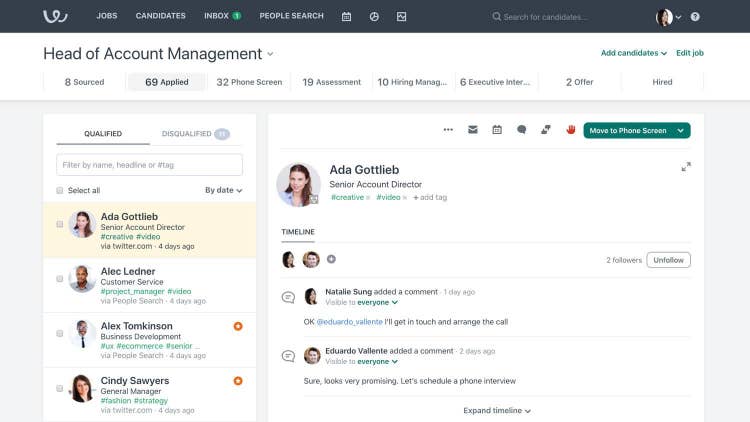
Best for: SMB and mid-market teams that want an established ATS, a wide job-board network, and sourcing in the same product.
Price: Standard starts at $299 per month billed annually for companies with 1 to 20 employees. Premier is $599 and Enterprise is $719 at that employee band. Pricing rises with headcount. A 15-day trial is available, but Workable Agent is excluded.
Workable combines applicant tracking, HR features, posting to 200+ job boards, candidate rediscovery, scheduling, screening assistance, and an autonomous sourcing agent. It is one of the better choices when top-of-funnel reach matters as much as pipeline administration.
Verdict: Watch the extras. Texting, assessments, video interviews, and Agent credits can change the total. Model the price at your current headcount and at the next pricing band before you compare it with a flat-fee ATS.
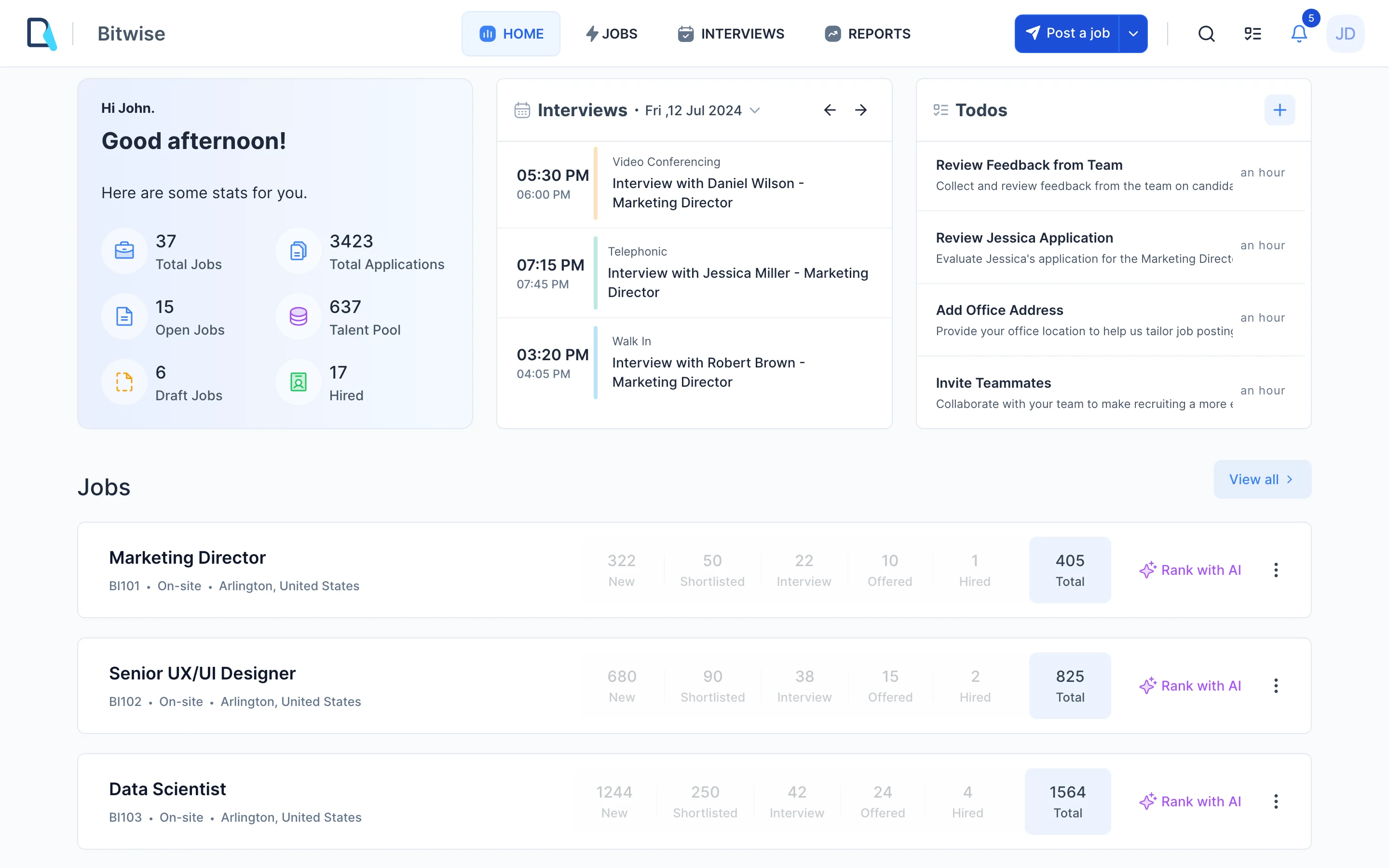
Best for: startups, SMBs, lean HR teams, and enterprises that want explainable AI, configurable workflows, and controls without a needlessly heavy user experience.
Price: Starter is $79 per month billed annually or $99 month to month, with five active jobs. Standard is $149 annually or $199 monthly with unlimited active jobs. Premier is custom. Every plan has a 15-day trial with no credit card.
Recooty now gives both small teams and large organizations the best balance of useful AI, control, pricing clarity, and speed to adoption. A small team can start without an enterprise implementation. A larger employer can standardize role-specific pipelines, job approvals, permissions, fair evaluations, reporting, locations, and collaborative hiring on the same platform.
Verdict: The old “easy for SMBs, too shallow for enterprises” trade-off no longer describes Recooty. Standard adds unlimited active jobs, customizable pipelines, multiple locations, real-time analytics, bulk actions, and priority job approval. Premier adds SSO, advanced reports, fair evaluations, a custom domain, priority support, and a dedicated account manager. Enterprise buyers should validate the exact configuration, integrations, data residency, and service commitments in the pilot and contract, as they should with every finalist.

Best for: cost-conscious in-house teams and agencies that want AI recommendations and a recruiting CRM.
Price: Professional costs $15 per user per month billed annually, Enterprise $35, and Enterprise Plus $55. Monthly billing is $19, $39, and $59. The trial lasts 14 days and needs no card.
Manatal is the cheapest full ATS in this comparison with AI scoring on its entry paid plan. It includes parsing, candidate recommendations, social enrichment, pipeline automation, career pages, and an agency CRM mode.
Verdict: The price is real, and the limits deserve equal attention. Advanced reporting sits higher in the range, and the trial excludes several production features, including normal-domain email, job-board posting, mass email, and AI job-description generation. Test the paid-plan workflow your team will use; the trial dashboard alone is not enough.

Best for: smaller corporate HR teams, staffing firms, and companies already committed to the Zoho ecosystem.
Price: Corporate HR has a free plan. Standard is $25 per recruiter per month billed annually, and Enterprise is $50. The staffing edition adds a $75 Enterprise tier. A 15-day Enterprise trial is available.
Zoho Recruit combines ATS and recruiting CRM functions with Zia, its AI assistant for matching, content, chat, sourcing, and shortlisting. It is most useful when candidate data needs to flow into other Zoho products.
Verdict: The cheapest paid plan is not the AI comparison price. Corporate AI candidate matching is marked for the $50 Enterprise tier. Zoho also has different corporate and staffing editions, so confirm job caps, automation, and add-ons against the edition you will buy.

Best for: small teams that want an easy pipeline, scheduling, scorecards, and a usable free plan.
Price: Bootstrap is free for one active position. Paid annual-equivalent prices are $157 per month for Startup, $273 for Growth, and $439 for Business. A 14-day full-feature trial is available.
Breezy is easy to understand because the pipeline looks like the work. Its AI layer supports evaluation, summaries, rediscovery, and resume-authenticity signals.
Verdict: The important detail is that Breezy Intelligence is metered separately, starting at $30 per 100,000 credits. SMS and onboarding can also add cost. The free plan is useful for a first role, but it should not be mistaken for unlimited AI recruiting.
Best for: small businesses moving from email and spreadsheets into a defined hiring process.
Price: Hero costs $1,000 per year, Plus $3,480, and Pro $5,508. The 14-day trial needs no card and allows unlimited users.
JazzHR covers posting, pipelines, interviews, messages, offers, and approvals without asking a small team to administer an enterprise suite. It works best when the main need is consistency, visibility, and basic automation.
Verdict: AI candidate matching begins on Plus, not the $1,000 Hero plan. Hero also limits job postings. If AI ranking is the reason for buying, compare the $3,480 annual price with Manatal, Recooty, and Zoho Recruit Enterprise.
Best for: growing in-house teams that want flexible pipelines, hiring-manager collaboration, and explainable screening.
Price: Pricing is quote-based, varies by employee count and plan, and carries a one-year minimum commitment. A free trial is advertised without a card.
Recruitee covers career sites, multiposting, pipelines, feedback, email and calendar sync, reporting, and more than 200 integrations. Its Advance plan includes a Screening Assistant with 100 credits per month and a Matching Assistant with three searches. Optimize expands both and adds stronger controls.
Verdict: This is a good example of why the quote matters more than a generic starting price. Ask how many AI screens and matching searches your real monthly application volume will consume, and what happens when you exceed them.
Best for: startups that want a free core ATS and the option to add recruiting help when a difficult role appears.
Price: The core ATS is free with unlimited users and jobs. Premium costs $199 per month and adds AI applicant scoring, AI notes, additional distribution, and premium support.
Dover combines candidate tracking, job distribution, email and calendar connections, and a recruiter marketplace. The paid tier adds the AI features that make it more relevant to this list.
Verdict: Its clearest difference is the operating model. A startup can use the software alone, then hire a fractional recruiter through the marketplace rather than move immediately to an agency retainer or add full-time recruiting headcount.
Best for: international employers, charities, and NGOs that want an ATS connected to broader workforce services.
Price: £50 per posted job or £350 per month. Both options advertise unlimited candidates and recruiter seats. Eligible charities and NGOs receive free access to core ATS features, while premium boards, e-signature, SMS, and some AI credits cost extra.
Transformify combines AI matching, global job distribution, collaborative hiring, candidate insights, careers pages, and connections to wider workforce operations. The unlimited-seat model is attractive when many hiring managers need access.
Verdict: This is a research addition, not one of my 26 hands-on products. Buyers should test what “AI matching” explains to the recruiter, confirm the credits included in their chosen plan, and separate core ATS value from the platform’s contractor and workforce services.
These products suit larger recruiting operations, complex permission models, multiple business units, or specialist requirements such as workforce analytics and internal mobility. Their depth usually comes with a sales-led purchase and a longer implementation.

Best for: mid-market and enterprise teams that want consistent interviews, scorecards, permissions, and a large integration ecosystem.
Price: Core, Plus, and Pro are custom-quote plans. Greenhouse offers a demo but does not advertise a self-serve trial.
Greenhouse remains the reference point for structured hiring. Its AI now includes interview notes, job-description help, scorecard summaries, anonymization, offer forecasting, keyword filtering, and report assistance. The product works best when a company is willing to define the process before asking software to automate it.
Verdict: My strongest reason to shortlist Greenhouse is not a flashy ranking model. It is the discipline created by candidate scorecards and structured interviews. The trade-off is administrative weight. Small teams can spend more effort maintaining the process than the hiring volume justifies.
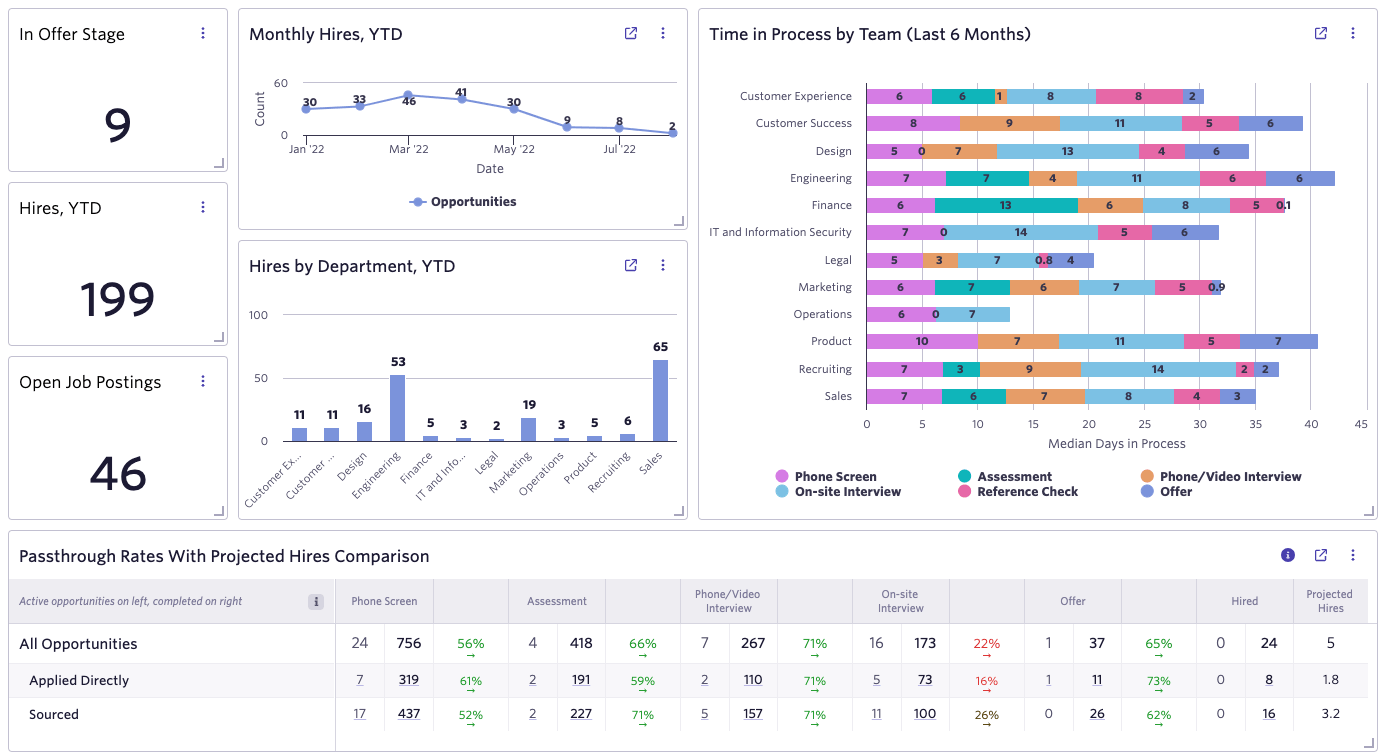
Best for: technology companies and recruiting operations teams that want ATS, CRM, scheduling, and analytics in one system.
Price: Foundations costs $400 per month for organizations with up to 100 employees, with a 10% annual-commitment discount. Plus, Enterprise, and the analytics product for an existing ATS are custom.
Ashby is strongest when recruiting is managed as an operating system. Its AI supports application review, natural-language search, rediscovery, outreach, fraud signals, assistants, and custom agents. The reporting is detailed enough to answer questions that simpler ATS dashboards cannot.
Verdict: That depth is also the risk. A recruiting operations specialist may love what an occasional hiring manager finds overwhelming. Before buying, ask a manager who opens the ATS twice a month to complete a real review, leave feedback, and find the next action. Analytics only work when the underlying team keeps the data complete. For a simpler view of the metrics worth collecting, see these recruiting metrics.
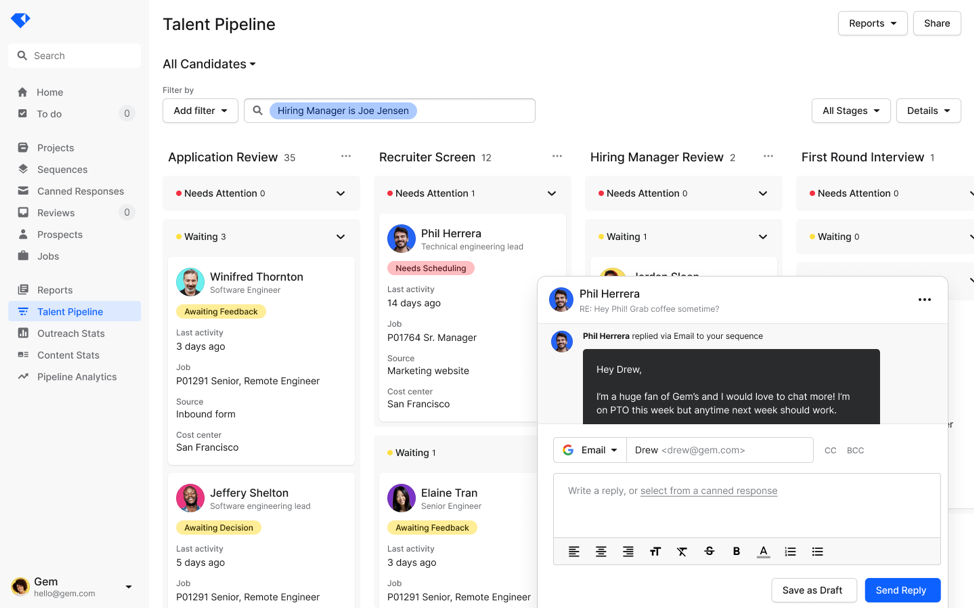
Best for: mid-market and enterprise teams that rely on sourcing, nurture campaigns, and pipeline analytics.
Price: Enterprise pricing is custom and based on company size. Eligible companies under 30 employees may receive the all-in-one ATS free for six months and a discount after that.
Gem began as a sourcing and talent CRM platform and now offers an all-in-one ATS. Its AI spans search across a large profile network, application review, rediscovery, fraud detection, outreach, scheduling, and analytics.
Verdict: I would choose Gem when proactive recruiting is central to the model, not when the team only needs a tidy inbound pipeline. Confirm whether you are buying Gem beside an existing ATS or as the system of record, then price the relevant AI seats and integrations. Otherwise, two overlapping systems can create the duplicate data and reporting gaps the purchase was meant to remove.
Best for: regulated or mature in-house talent teams hiring across brands, regions, role types, or business units.
Price: Custom quote based on organization size and hiring needs. Hiring-manager seats are not priced separately, but AI actions use prepaid credits included in the quote.
Pinpoint has one of the clearest AI-governance stories in this comparison. Its Hiring Copilot can find and rediscover candidates, prepare interviewers, summarize feedback, draft messages, build reports, and take approved actions. Match Score and criteria tools are designed to show why a candidate received an output.
The product deserves a serious look when explainability and permissions matter. It is less compelling for a small team that will not use its multi-brand, workflow, and governance depth. Ask for a quote that models real AI-credit consumption, and have the vendor demonstrate one high-volume role and one specialist role in the same account.
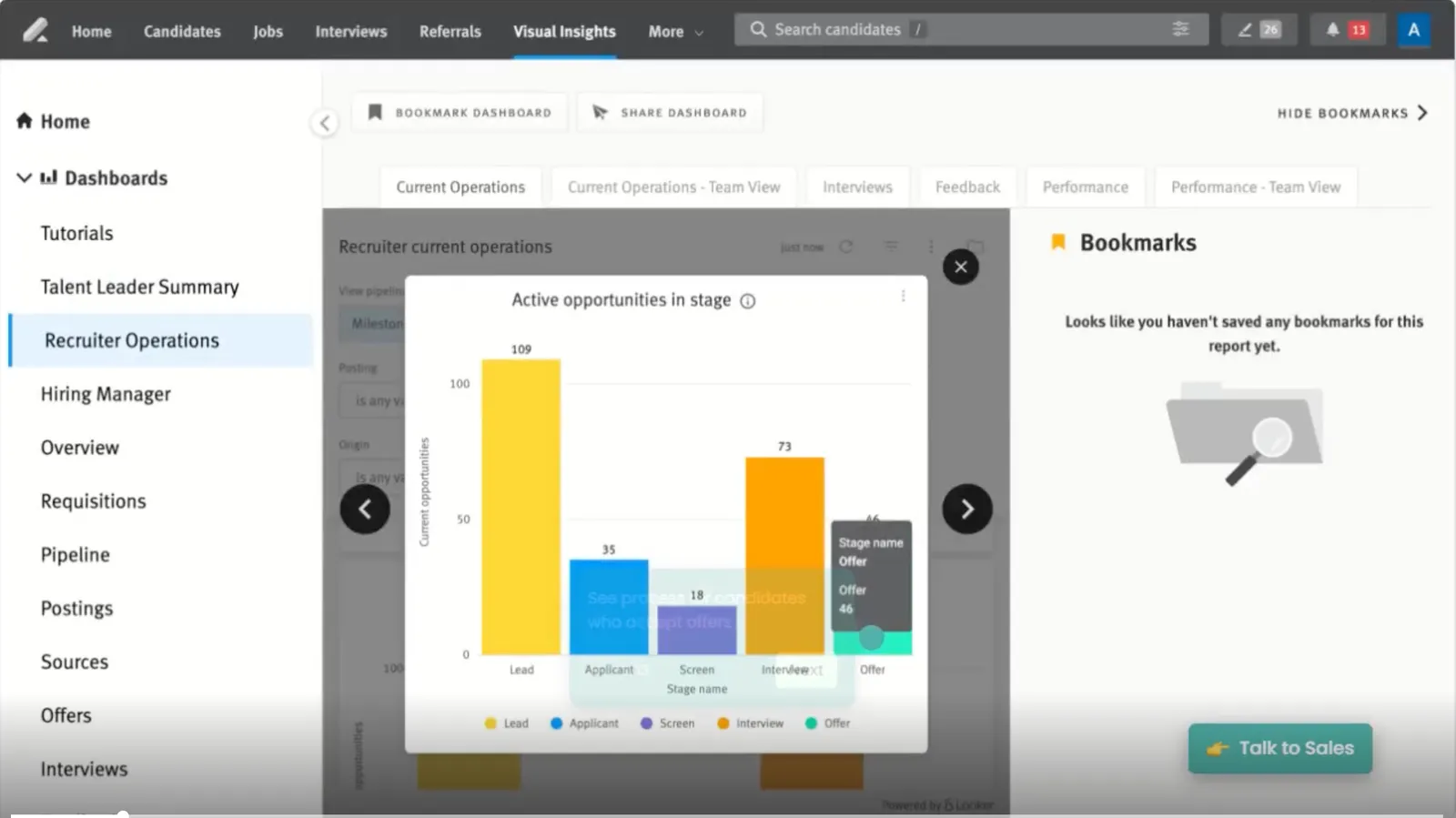
Best for: mid-market and enterprise teams that source passive candidates and maintain long-lived talent pools.
Price: Custom quote based on company size and hiring needs. AI screening and some candidate-insight or onboarding features may be separate add-ons.
Lever combines applicant tracking with candidate relationship management. That matters when the strongest person for a role is often someone your team contacted months ago rather than a new applicant.
Verdict: The product is at its best in relationship-led recruiting: nurture sequences, rediscovery, shared history, and a pipeline that does not reset with every requisition. In the demo, separate native Lever capability from paid partner or add-on functionality. “Included in the platform” and “available to the platform” can produce very different contracts.
Best for: in-house teams that treat the careers site and candidate communication as part of the recruiting product.
Price: Custom annual subscription with unlimited jobs and users. A demo and trial are advertised, but the public page does not state the trial duration.
Teamtailor pairs a polished career-site builder with candidate nurture, automation, collaboration, referrals, and an AI Co-pilot. The AI can help with criteria-based screening, resume summaries, meeting insights, job descriptions, messages, and natural-language questions.
Verdict: Its advantage is visible before a recruiter opens the back office: the candidate journey feels considered. That can matter more than another scoring feature when employer brand drives conversion. Teams with complex enterprise reporting or governance should test those requirements carefully. This guide to candidate experience with AI explains why speed alone is not enough.
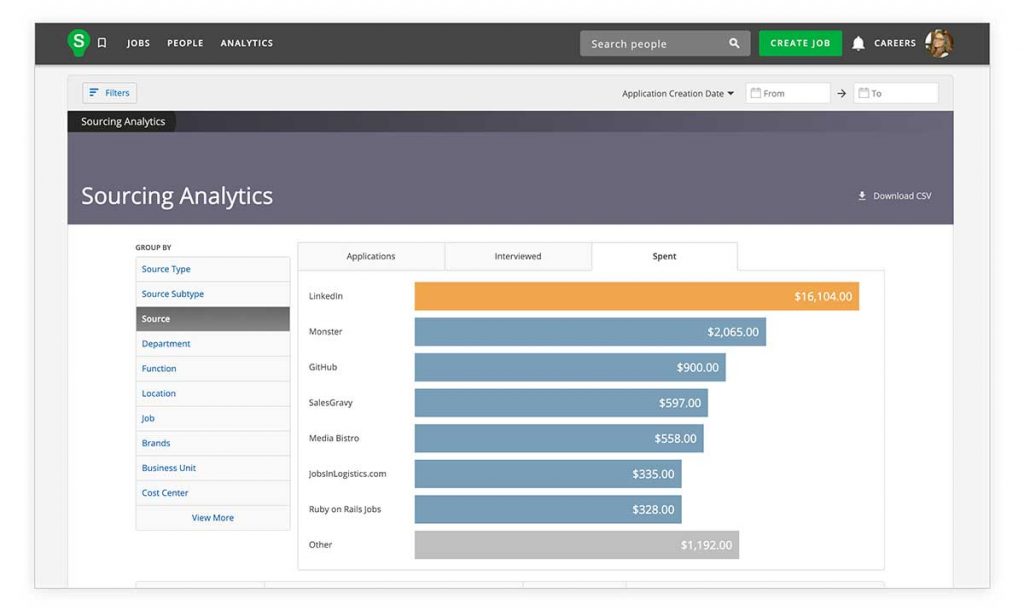
Best for: corporate organizations with 50+ employees, especially global and high-volume teams.
Price: Essential starts at $14,995, but the public page does not state the billing period beside that figure. Professional, High Volume, and Complete are quote-only.
SmartRecruiters combines ATS, CRM, onboarding, distribution, and enterprise workflows. Winston AI supports recruiters and hiring managers, while matching, screening, conversational hiring, interviewing, and fraud-related capabilities vary by package.
Verdict: Do not evaluate this platform from the Essential price alone. The AI most buyers want begins higher in the range. Ask for a line-item quote that shows the edition, AI units or limits, integrations, implementation, support, and renewal basis.
Best for: large organizations that need a modular talent acquisition suite across corporate, frontline, or global hiring.
Price: Custom quote. iCIMS offers demos but no public self-serve trial.
iCIMS covers ATS, CRM, career sites, onboarding, conversational engagement, matching, ranking, sourcing, and analytics. It is built for buyers who need a broad ecosystem and controls more than a lightweight launch.
Verdict: Modularity is both the strength and the budgeting trap. Frontline AI requires the iCIMS ATS, and other capabilities may come as separate subscriptions. Make the vendor draw the complete architecture and contract on one page, including which system owns each candidate record and which module produces each report.
Best for: large organizations that want recruiting, skills, internal mobility, and workforce data inside Workday.
Price: Custom quote. Workday Talent Acquisition combines Recruiting, Candidate Engagement, and HiredScore AI, but buyers should confirm whether each capability is licensed separately.
Workday supports the full talent acquisition lifecycle, high-volume workflows, internal mobility, candidate engagement, skills matching, and recruiter agents. The value comes from shared workforce data and governance across a large organization.
Verdict: This is a research addition. I would shortlist it first for an existing Workday customer, not for a small company shopping for its first ATS. The demo should show how recruiter tasks, hiring-manager feedback, candidate status, and HiredScore recommendations work in the actual Workday configuration you will buy.
Best for: international teams already using Deel for HRIS, payroll, or employer-of-record services.
Price: Find Talent starts at $14 per worker per month, but the ATS requires the Deel HRIS foundation. ATS Pro may also use monthly credits, so confirm the full platform and usage total.
Deel ATS supports AI job creation, compensation guidance, sourcing, criteria matching, screening, interview summaries, and a direct onboarding handoff. The value is continuity from candidate to global worker record.
Verdict: That $14 figure is not a standalone all-in ATS price. Buyers should include the required HRIS, any credits, worker count, and adjacent Deel services. If the company is not already standardizing on Deel, compare the recruiting workflow on its own merits.
Best for: companies already running HR, payroll, identity, or IT workflows in Rippling.
Price: Custom per-employee quote. The core Rippling platform is required before adding Recruiting.
Rippling Recruiting connects requisitions and applicants with headcount, onboarding, payroll, devices, and employee records. AI application review, match scores, interview recordings, transcripts, and summaries sit inside that wider operating system.
Verdict: The appeal is the handoff after “hire.” Calculate the foundation platform and recruiting module together. A low-friction internal data flow can justify the bundle, but it can also make the product expensive if you only need applicant tracking.
Best for: small and mid-sized companies that value a smooth handoff from recruiting to onboarding and employee records.
Price: Custom per-employee quote for Core or Pro. A trial and demo are available.
BambooHR offers recruiting inside a broader HR platform, with candidate management, self-scheduling, offer and onboarding workflows, and reporting. Bamboo AI is currently stronger in natural-language HR insights and workforce actions than in advanced resume ranking.
Verdict: Choose BambooHR when one employee system matters more than best-in-class recruiting AI. Do not buy it expecting a Greenhouse-style structured hiring program, an Ashby-style analytics operation, or a sourcing engine like hireEZ.
Best for: retail, hospitality, logistics, healthcare, and other employers that screen and schedule at high volume.
Price: Custom quote. A live demo is available, but no public trial is advertised.
Paradox’s Olivia handles candidate chat and text, job matching, screening, questions, scheduling, events, and onboarding. It can work beside an existing ATS or as a Conversational ATS.
Verdict: My reason to choose Paradox is narrow and practical: candidate communication and calendar coordination can become the bottleneck in frontline hiring. I would place it lower on a shortlist built around deep recruiting analytics or a small professional-hiring team. Judge it on completion rates, handoff quality, accessibility, escalation to a person, and the candidate’s ability to ask for help.
Best for: very large organizations using skills data for external hiring, internal mobility, and workforce planning.
Price: Custom quote. Demos and guided product experiences are available.
Eightfold is a talent intelligence suite rather than a lightweight ATS. Its agents can support sourcing, screening, matching, scheduling, and engagement, while its skills graph connects recruiting with internal opportunity and workforce planning.
Verdict: Its scope makes a direct comparison with an SMB tracker misleading. The buyer needs clean integrations, data governance, and organizational commitment. Eightfold states that its AI supports decisions rather than making final hiring decisions; the implementation should preserve that line in permissions, workflows, and training.
Best for: in-house recruiting teams at organizations with 1,000+ employees.
Price: Custom quote, with a trial available on request.
Zappyhire combines ATS and CRM functions with requisition workflows, parsing, predictive ranking, chatbots, scheduling, video interviews, offers, pre-onboarding, and configurable automation. It is aimed at complex enterprise hiring rather than recruitment agencies.
This is a research addition. Its breadth deserves a place on an enterprise shortlist, but buyers should ask the vendor to separate rules, statistical scoring, generative AI, and autonomous actions. Then test the reporting, integrations, human overrides, and candidate accessibility at your real hiring volume.
An in-house HR team manages candidates for one employer. An agency also manages clients, business development, submissions, placements, fees, and sometimes contractors or vendor programs. That is why a corporate ATS can be excellent software and still be the wrong agency system.
Best for: staffing and recruitment agencies that want a mature ATS, client CRM, automation, and an expanding AI layer.
Price: Starter costs $99 per user per month and Core costs $165. Amplify AI begins on the custom-priced Pro tier. Bullhorn says implementation is free on its small-agency plans.
Bullhorn manages candidates, jobs, clients, placements, communication, and reporting in one staffing-focused system. Amplify adds chat, data enrichment, matching, screening, outreach, candidate presentation, transcription, fraud signals, and other digital-worker tasks.
Verdict: This is a research addition. The advertised $99 starting point does not include the AI suite that makes Bullhorn relevant to this comparison. Ask for the Pro price, the exact Amplify skills included, usage limits, automation requirements, and the cost of every recruiter or manager who needs access.
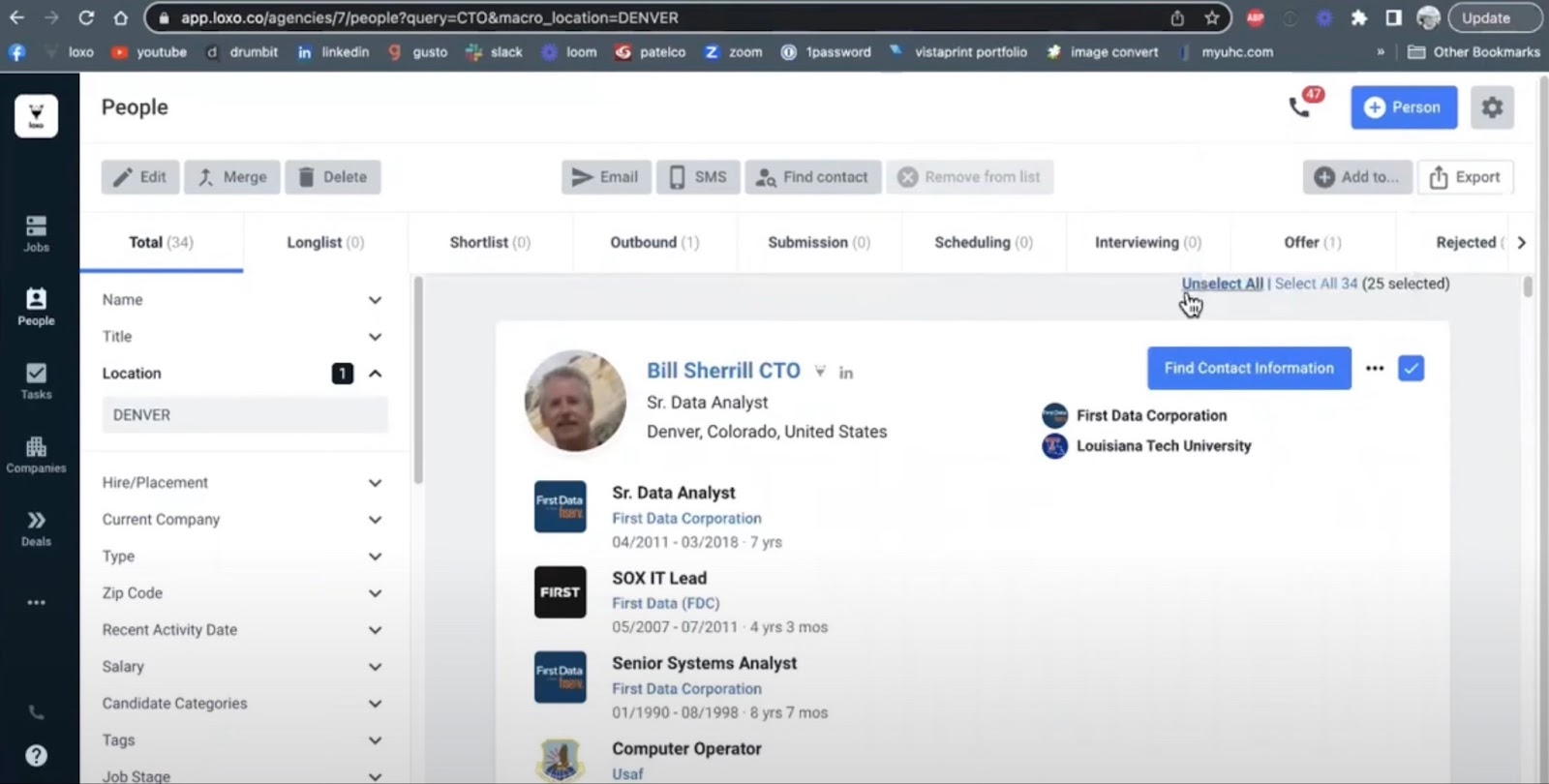
Best for: recruitment agencies and executive-search firms that want sourcing, contact data, ATS, CRM, and outreach in one product.
Price: Core costs $149 per user per month billed annually, and Professional costs $199. Enterprise is custom. A seven-day Professional trial is available without a card.
Loxo combines agency workflow with a large profile graph, natural-language search, matching, multichannel outreach, and AI chat. Professional includes pooled credits for contact and sourcing work.
Verdict: The value is stack consolidation. The caution is roadmap language: some advertised agents are still marked as coming soon. Build the buying case around functions you can use today, then treat future agents as upside rather than contracted value.
Best for: agencies that need candidate tracking, client sales, submissions, sourcing, and automation in one interface.
Price: US pricing starts at $95 per user per month billed annually or $109 monthly. Business is $135 annually and Enterprise $215. Prices are geolocated, so buyers in other markets may see local figures.
Recruit CRM includes ATS and client CRM workflows, sourcing, parsing, matching, GPT-assisted content, outreach sequences, candidate submissions, and resume-formatting agents. It is especially relevant when recruiters manage both relationships and placements.
Verdict: Check the usage ceilings behind candidate matching and AI agents, and distinguish base-plan features from enterprise add-ons. Its free access is a trial, not a permanent free plan.
Best for: staffing, executive search, and agency teams that need flexible ATS and CRM workflows.
Price: Custom quote based on users, volume, services, and features. A seven-day trial is available without a card.
iSmartRecruit combines ATS, CRM, semantic matching, content generation, chatbot or voice screening, and several AI agents. It can fit agencies that need more configuration than a simple pipeline product offers.
Verdict: The final price can include migration, training, customization, AI-credit overages, and transaction costs. Gmail connection is excluded from the trial. Ask for a production-like sandbox and a written total for year one and renewal.
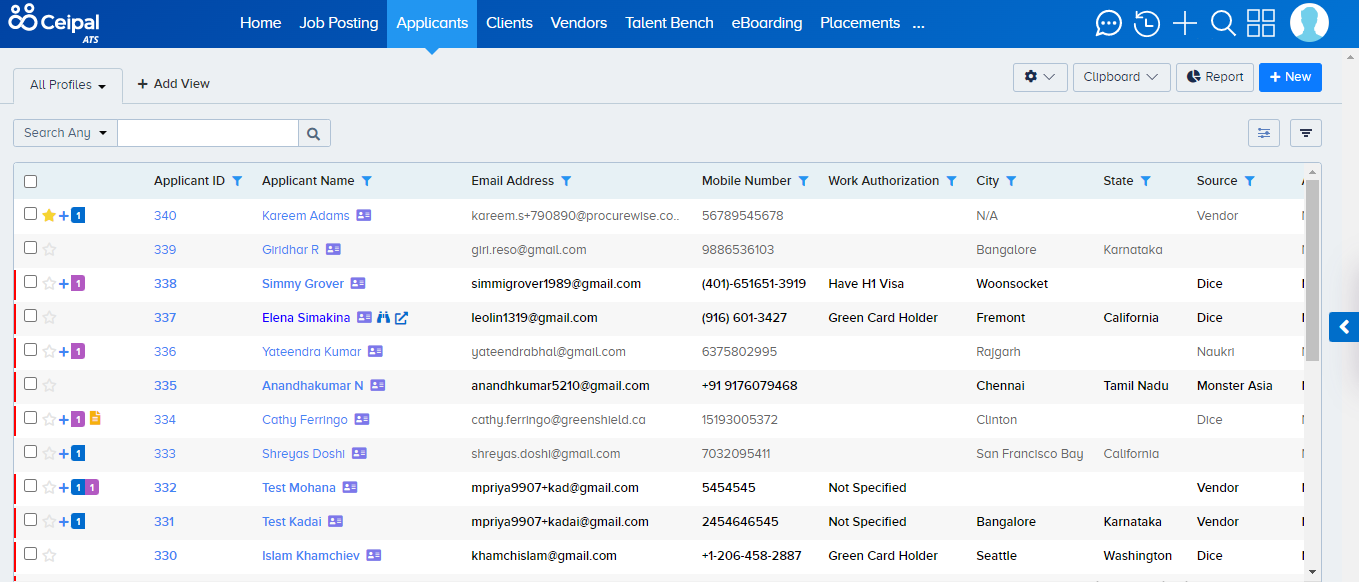
Best for: staffing firms, healthcare staffing, managed-service-provider programs, and teams that work across vendor management systems.
Price: Custom quote. A free ATS trial and self-guided tour are advertised, but the duration is not published. CEIPAL Copilot is described as an add-on.
CEIPAL combines ATS, CRM, VMS, workforce management, parsing, matching, ranking, chatbots, voice screening, and compliance workflows. Its operational coverage is the reason to buy it.
That same breadth can feel heavy for a small internal HR team. Ask the vendor to show one requisition from intake through placement, including VMS data, submittal, onboarding, compliance, reporting, and every paid module touched along the way.
These three products can be useful, but they do not belong in a direct full-ATS ranking. Use them when your system of record works and your real problem is finding, contacting, or rediscovering candidates.
Best for: founders, agencies, and lean recruiting teams that want automated sourcing and outreach.
Price: Free for one seat and one active position. Solo costs $99 per user per month billed annually. Professional is $135 annually or $179 month to month. Business is custom.
Pin searches a large profile index, ranks potential matches, runs multichannel outreach, and helps schedule interviews. It connects with more than 120 ATS products.
Pin is a strong top-of-funnel companion. Your ATS must still run the complete application, interview, offer, and compliance process. ATS integration is also an add-on on Solo and Professional, so include it in the budget.
Best for: enterprise teams that need sourcing, rediscovery, outreach, and automation on top of an existing ATS.
Price: The individual plan starts at $494 per month with a seven-day trial. Enterprise pricing is custom and validated through a guided verification period.
hireEZ searches across many profile sources, supports talent rediscovery, outreach, applicant review, voice screening, scheduling, CRM workflows, and analytics. Its current positioning is direct: agentic AI on top of your ATS.
Verdict: Treat hireEZ as an addition to the system of record. Compare the cost and lift of adding it to your current stack against replacing the stack with a platform that includes sourcing.
Best for: teams that want to describe a candidate in plain English, explore a large people database, and automate outbound research.
Price: Free plan available. Starter costs $99 per seat per month billed annually or $119 monthly. Growth is $179 annually or $199 monthly. Autonomous agents cost $199 per agent per month.
Juicebox, also known for PeopleGPT, combines natural-language search, AI filters, talent insights, outreach, and research agents. It is useful when a recruiter wants to move from a hiring brief to a candidate market quickly.
Verdict: ATS and CRM integrations are reserved for the Business plan. Like Pin and hireEZ, Juicebox should be judged as a sourcing investment, not as your system of record.
This matrix covers the products most likely to appear on a serious shortlist. “Strong” means the capability is central to the product. “Available” means it exists but may depend on a plan, add-on, credits, or configuration. “Limited” means the product’s current AI story is stronger elsewhere.
| Platform | Full ATS | AI match or review | Native sourcing or rediscovery | Interview AI | Agentic actions | Explainability or human-control emphasis |
|---|---|---|---|---|---|---|
| Recooty | Yes | Strong | Available | AI Interviewer and question generation | Hiring agent, AI tools, API, and MCP | Explainable scores, approvals, and recruiter control |
| Workable | Yes | Strong | Strong | Available | Strong through Workable Agent | Recruiter-defined operating boundaries |
| Manatal | Yes | Strong | Available | AI Interviewer add-on | Available | Recruiter reviews recommendations |
| Zoho Recruit | Yes | Enterprise tier | Available | Limited | Zia workflows | Plan and workflow dependent |
| Greenhouse | Yes | Available | CRM and rediscovery | Notetaker and summaries | Assistive | Structured human evaluation is primary |
| Ashby | Yes | Strong | Strong | Notetaker add-on | Assistants and custom agents | Links some outputs to source data |
| Gem | Yes or ATS companion | Strong | Strong | Available | Available | Confirm controls by workflow |
| Pinpoint | Yes | Strong | Strong | Notetaker | Strong through Hiring Copilot | Strong reasons, permissions, and approvals |
| Lever | Yes | Add-on | Strong CRM | Summaries | Assistive | Confirm add-on behavior |
| SmartRecruiters | Yes | Higher tiers | Strong | Available | Winston and agentic functions | Enterprise governance |
| iCIMS | Yes | Strong | Strong | Available | AI agents | Modular controls |
| Workday | Yes | Strong through HiredScore | Strong | Candidate Experience agent | Recruiting agents | Enterprise permissions and auditability |
| Paradox | Yes or companion | Conversational matching | Limited | Conversational screening | Strong for screening and scheduling | Escalation and human review must be designed |
| Eightfold AI | Suite | Strong | Strong | AI Interviewer | Strong | States that people make final decisions |
| Bullhorn | Yes | Amplify Pro | Strong | Voice and chat screening | Strong digital workers | Check edition, approval, and audit settings |
| Loxo | Yes | Strong | Strong | Developing | Agent workforce | Some agents remain roadmap items |
| Recruit CRM | Yes | Available with limits | Strong | Limited | Multiple task agents | Recruiter remains in workflow |
| Pin | No | Strong for sourced profiles | Strong | No | Strong sourcing and outreach | ATS owns final process |
| hireEZ | No, ATS layer | Strong | Strong | Voice screening | Strong | Existing ATS remains system of record |
| Juicebox | No | Strong for search | Strong | No | Research and sourcing agents | Existing ATS remains system of record |
Public prices in this market run from free to five-figure entry points, so an average is not useful. One vendor charges per recruiter, another per employee, another per open job, and another by AI credits. The pricing unit usually changes your bill more than the headline rate.
These products let a buyer see a meaningful rate without a sales call:
A public figure still leaves a larger dependency to price:
Greenhouse, Pinpoint, Lever, iCIMS, Workday, Rippling, BambooHR, Paradox, Eightfold, Zappyhire, iSmartRecruit, and CEIPAL require a sales conversation. “Custom quote” is the real public price. A confident third-party figure is still an estimate unless the vendor or a buyer contract supports it.
Before approving a purchase, calculate the ROI of an AI applicant tracking system against total year-one cost, not the first number in the pricing card.
Ask for these eight numbers in writing:
Start with the hiring problem, not the product list. The right AI ATS is the one that removes your current bottleneck without creating a bigger problem in cost, governance, or adoption.
Write down who you hire, how often, where candidates come from, and who participates. Separate professional, frontline, campus, executive, and agency workflows. If the stages and participants differ, the system must support more than one customizable hiring pipeline.
If applications, interviews, offers, and reporting still live in spreadsheets, buy the system of record first. If the ATS works but qualified pipeline is thin, improve your candidate sourcing strategy or add Pin, hireEZ, Juicebox, Gem, or another sourcing layer.
“We need to rank 500 applicants with clear reasons” is a useful requirement. “We need AI” is not. Choose the task: parsing, matching, sourcing, scheduling, interview notes, messaging, analytics, or an agent that completes approved actions.
Open a candidate who received a high and a low score. Ask what data produced the result, which criteria mattered, whether a recruiter can change it, and what the audit log records. A ranking without an explanation can move work faster in the wrong direction.
Recruiters can learn almost any tool because they live in it. The harder test is the hiring manager who signs in twice a month. Ask that person to review a candidate, complete a scorecard, request an interview, and find the next action without coaching.
Do not accept a marketplace logo as proof of a working data flow. Ask the vendor to demonstrate calendar, email, HRIS, background-check, assessment, e-signature, and identity connections. Recooty’s current ATS integrations show the range of systems a buyer should map before a pilot.
Use the busiest month, not the average. Count recruiter seats, hiring-manager access, active jobs, applications, AI actions, SMS, interviews, and sponsored posts. Then repeat the calculation at the next employee or usage band.
Ask where candidate data is stored, which model providers receive it, whether it trains any model, how long it is retained, how deletion works, and who can export it. Bring legal, privacy, and security colleagues in before the preferred vendor is emotionally “won.”
A polished demo proves that the vendor can present its product. A pilot should prove that your team can use it under ordinary hiring pressure.
Keep a one-page record with pass, fail, owner, and evidence for each step. That turns a subjective software demo into a buying decision the team can defend.
AI hiring law depends on jurisdiction and use case, so this section is practical buying guidance, not legal advice. The safe operating principle is consistent: AI may assist, but accountable people must understand the process and remain able to intervene.
New York City’s Automated Employment Decision Tools rules prohibit covered employers and employment agencies from using an AEDT unless it received a bias audit within the previous year, a summary is publicly available, and required notices are given to candidates or employees. Enforcement began on July 5, 2023.
Do not assume a vendor’s general statement of fairness satisfies your duties. Confirm whether the exact feature and workflow you use falls within scope, who supplies audit data, who publishes results, and how notice is delivered.
The EU AI Act lists AI used to recruit or select people, analyze and filter applications, or evaluate candidates as a high-risk use in Annex III. Under the current EU implementation timeline, the high-risk rules for these systems apply from December 2, 2027.
That date is not a reason to wait. Procurement, data mapping, documentation, human oversight, logging, training, and contract changes take time. A platform bought now may still be in use when the obligations apply.
The U.S. Equal Employment Opportunity Commission says existing employment discrimination laws apply when employers use automated systems in selection. Its AI and ADA resources also warn that a tool may screen out a qualified person with a disability and that an alternative or reasonable accommodation may be required.
A human review box is not enough if the reviewer automatically accepts every score. Train recruiters to challenge outputs, document overrides, and offer a clear accommodation path. Recooty’s guide to reducing discrimination in hiring covers the wider process around the software.
Pay for a feature when it solves a measured bottleneck. The following capabilities usually create more value than a generic chat box:
Do not pay extra for routine templates labeled as advanced AI. Job descriptions, emails, and summaries are helpful, but they are now baseline assistance. The higher-value work is better search, clearer decisions, reliable execution, and fewer manual handoffs.
After 2,200 hires, I judge an AI ATS by whether it gets useful evidence to the decision maker and keeps candidates moving without erasing the context a team may need later.
For an SMB or a large enterprise, I would put Recooty in the first demo slot. I would add Greenhouse or Pinpoint when structured governance is the main comparison, and Ashby when analytics is the deciding factor. For a staffing agency, I would compare Bullhorn, Loxo, and Recruit CRM. If the ATS already works and sourcing is the real problem, I would keep it and test Pin, hireEZ, or Juicebox beside it.
Choose three products, run the same two real-world workflows, price them at peak volume, and make the vendor explain one recommendation you disagree with. That final conversation will tell you more than another hour of polished feature slides.
These answers cover the pricing, product, implementation, and governance questions buyers ask most often when comparing an AI ATS.
Recooty is my best AI ATS overall for SMBs and large enterprises because it combines explainable candidate ranking, configurable workflows, approvals, reporting, permissions, SSO on Premier, and an accessible starting plan. Greenhouse remains a structured-hiring specialist, Ashby an analytics specialist, Bullhorn a staffing-agency specialist, and Paradox a high-volume conversational-hiring specialist.
For five different buying needs, start with Recooty as the strongest overall option across SMB and enterprise use, Greenhouse for a highly structured specialist process, Ashby for analytics-heavy recruiting, Workable for sourcing and broad job distribution, and Bullhorn for staffing agencies. The right order changes with workflow, budget, and whether you hire for one employer or external clients.
Recooty is the strongest all-round choice for a small business that wants useful AI and predictable pricing. Manatal is the lower-cost per-user alternative, Zoho Recruit is attractive inside the Zoho ecosystem, and Breezy HR is useful when a visual pipeline and free one-position plan matter most.
Yes, but check what “free” includes. Dover offers a free core ATS with unlimited jobs and users, while its AI scoring is on the $199 Premium plan. Zoho Recruit and Breezy HR have capped free ATS tiers. Pin and Juicebox also have free plans, but they are sourcing tools rather than complete applicant tracking systems.
The best match engine depends on the workflow. Recooty is a strong explainable option for both SMB and enterprise teams. Pinpoint emphasizes criteria and reasons for mature in-house teams. Ashby and Greenhouse connect matching to structured recruiting data, while Eightfold focuses on enterprise skills intelligence. Test each with the same job-related criteria and edge cases before deciding.
Some platforms flag authenticity or fraud signals, unusual patterns, or inconsistencies, but an ATS cannot reliably prove that AI wrote a resume from prose alone. Treat a flag as a lead for human verification, not grounds for automatic rejection. Structured questions, work samples, references, and a consistent interview are better evidence of a candidate’s actual ability.
Some systems can apply knockout rules or automated actions that reject candidates. Teams should be cautious about enabling them. Keep criteria job-related, distinguish simple eligibility rules from AI judgments, provide human review for consequential decisions, preserve logs, and check notice, accommodation, and bias-audit duties in the jurisdictions where you hire.
An ATS manages active jobs and applicants from application to offer. A recruiting CRM manages longer-term relationships with sourced and past candidates. Products such as Lever, Gem, Manatal, Loxo, Bullhorn, and Recruit CRM combine both, while Pin, hireEZ, and Juicebox mainly strengthen sourcing above the ATS.
An AI ATS can cost $0 on a capped free plan, $15 to $150 per user per month for smaller teams, and between $3,000 and $125,000+ per year on flat-rate or enterprise contracts, or a custom five-figure enterprise contract. The useful comparison is total cost at your seats, employee count, jobs, candidate volume, AI credits, add-ons, and implementation scope.
| Business Tier | Size Range | Estimated Annual Cost | Typical AI Features Included |
|---|---|---|---|
| Small Business | <100 employees | $250 – $3,000 | AI resume parsing, automated job description formatting, basic candidate tracking. |
| Medium Business | 100 – 500 employees | $3,000 – $15,000 | Predictive candidate scoring, automated email outreach sequences, basic chatbots. |
| Large Business | 500 – 5,000 employees | $15,000 – $50,000+ | Advanced AI sourcing agents, conversational multi-turn chat, customized evaluation tools. |
| Enterprise | 5,000+ employees | $125,000+ | Deep custom integrations, sandbox environments, global compliance automation, multi-year contracts. |
Implementing an AI-powered Applicant Tracking System (ATS) typically takes anywhere from 2 to 12 weeks, depending on your organization’s size, data cleanliness, and integration complexity. Self-serve products can often be piloted quickly, while enterprise systems may require data migration, security review, integrations, configuration, training, and change management. Ask each finalist for a written plan with owners, dependencies, test criteria, migration scope, and go-live support. Do not accept a timeline that excludes internal work.
No. A useful AI ATS removes repetitive work and improves access to evidence. Recruiters and hiring managers still define requirements, judge context, speak with people, handle accommodations, challenge weak recommendations, and remain accountable for hiring decisions.
It should show the job-related criteria used like skill, educational qualification, work experience, certification and awards, knockout questions answered by candidates, the candidate evidence matched to each criterion, missing or uncertain information, the source of the data, and any rules or weights that materially affected the result. Recruiters should be able to override the recommendation, record why, and retrieve that history later.
The answer depends on the vendor, feature, model provider, and contract. Ask which candidate fields leave the platform, whether customer data trains any shared or product model, how long prompts and outputs are retained, which subprocessors receive them, what opt-out controls exist, and how deletion requests flow through the AI layer.
Bullhorn is the strongest established choice for staffing agencies that need ATS, CRM, placements, and a growing AI layer. Loxo is compelling for executive search and stack consolidation. Recruit CRM offers a modern agency workflow with public regional pricing, while CEIPAL is better for VMS-heavy or healthcare staffing operations.

Shubham Joshi is a dynamic HR Business Partner with over 8 years of experience in aligning people strategy with business goals, driving high-performance cultures, and...
View Full Profile →