.webp)
.avif)
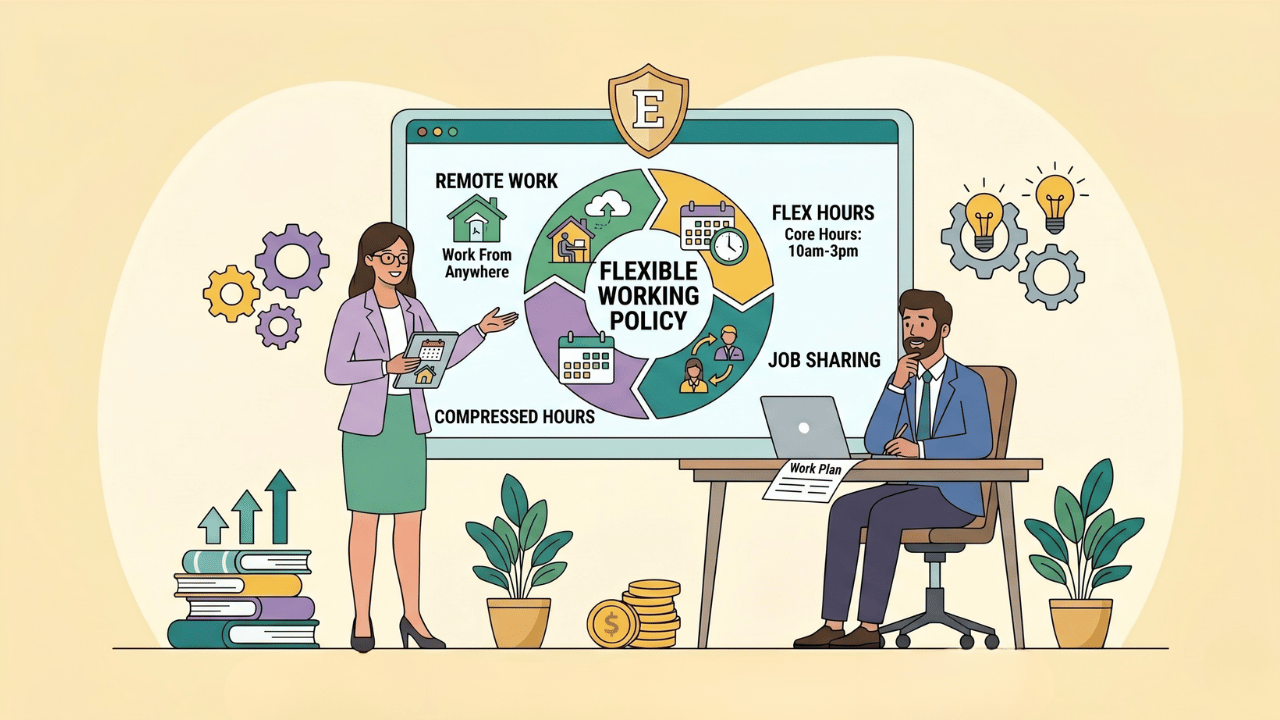
A flexible working policy is a written set of rules that defines how, when, and where employees can work outside a fixed nine-to-five, in-office schedule. It covers options like remote work, hybrid schedules, flexible hours, and compressed weeks, and it sets out who is eligible and how requests are handled.
I've seen flexibility done two ways. As an unwritten understanding that depends on your manager's mood, or as a clear policy that everyone can read. The first one breeds resentment. The second one is what this guide is about.
Below is what a flexible working policy is, the data on why it pays off, and a step-by-step way to write one. The key statistics are included throughout.
What Does a Flexible Working Policy Cover?
A flexible working policy turns flexibility from a favor into a system. It documents the arrangements the company offers and the rules around them, so the same standard applies to everyone.
The arrangements it usually covers:
- Remote work, where someone works fully away from a company site
- Hybrid work, splitting time between office and home
- Flexitime, choosing start and finish times around core hours
- Compressed weeks, like a four-day week with longer days
- Staggered hours and shift swapping, common for frontline roles
- Job sharing and part-time arrangements
A good policy also spells out the boundaries: who is eligible, how to request an arrangement, how decisions are made, what equipment and security rules apply, and how performance is judged. The arrangements are the offer. The rules are what make it fair.
Why Does a Flexible Working Policy Matter? The Statistics
Because flexibility is now one of the things employees value most, and the data shows it improves retention and productivity rather than hurting them.
A few numbers worth knowing:
- Surveys consistently show 72% to 83% of workers prefer a hybrid setup over fully remote or fully on-site.
- About 69% of employers reported retention improved after introducing hybrid policies, with some seeing retention rise by around 41%.
- Roughly 90% of hybrid employees say they are as productive or more productive than they were in the office.
- Employees say they would trade real money for flexibility: on average around 9% of salary for flexible hours and 8% for a flexible location.
- About 88% of U.S. employers now offer at least some hybrid option.
The takeaway is that a flexible working policy isn't a soft perk. It's a retention and recruitment tool with measurable returns, and one that most of your competitors already offer. A clear policy is also what protects you legally and operationally, since flexibility without rules creates inconsistency and risk.
What Are the Benefits and Trade-Offs?
Flexibility helps both sides, but only if it's managed. Here's an honest view of both columns.
| Benefits | Trade-offs to manage |
|---|---|
| Stronger retention and easier hiring | Risk of a two-tier culture between in-office and remote staff |
| Access to talent beyond commuting distance | Communication has to be more deliberate |
| Lower office-space costs | Harder to build culture and informal connection |
| Higher reported productivity and focus | Performance must be judged on output, not presence |
| Better work-life balance and wellbeing | Proximity bias can creep into promotions |
None of the trade-offs are reasons to avoid a flexible policy. They're reasons to write a good one. A vague policy creates every problem in the right column. A clear policy manages them.
How to Create a Flexible Working Policy: An 8-Step Plan
A flexible working policy works when it's specific, fair, and actually followed. Here's the process I'd run.
Step 1: Define your goals first
Decide what the policy is for before you draft it. Better retention? A wider hiring pool? Lower office costs? Improved wellbeing?
The goal shapes every later choice. A policy built to widen your talent pool looks different from one built mainly to cut real estate spend.
Step 2: Assess which roles can flex
Be honest about this. Some roles flex easily, some flex partly, and some can't. A frontline or hands-on role has different options than a desk role.
Map each role type to the arrangements that genuinely fit. Pretending every role is equally flexible just sets up unfairness and broken promises.
Step 3: Decide eligibility and how it's fair
This is the part that makes or breaks trust. Spell out who can request what, and the reasoning behind it.
If a role genuinely can't be remote, say so plainly and explain why. People accept honest constraints. What they don't accept is flexibility that seems to depend on who your manager is.
Step 4: Build a clear request and approval process
Document how someone asks for an arrangement and how the company decides. Include who approves, what criteria they use, and how long a decision takes.
A consistent process is what stops flexibility from feeling arbitrary. Also check your local employment law here, since many regions give employees a statutory right to request flexible working.
Step 5: Set the ground rules
Cover the practical details so there's no ambiguity later:
- Core hours when people need to be reachable
- Equipment, expenses, and who provides what
- Data security and acceptable home-working setups
- Communication norms and response-time expectations
- How and when arrangements get reviewed
Step 6: Make performance about output
Flexible work fails when managers still measure presence. If someone's value is judged by hours visible at a desk, remote staff lose by default.
Shift to judging results. This often means clearer goals, which is worth doing anyway. Recooty's guide to setting goals for remote teams is a practical starting point.
Step 7: Train managers to lead flexibly
A policy doesn't manage anyone. Managers do. And managing a distributed team is a different skill from managing a room.
Give managers guidance on running a remote team, keeping remote staff visible, and guarding against proximity bias. This is also where onboarding remote employees needs its own attention, since a remote new hire can't absorb the company by being in the building.
Step 8: Launch, review, and adjust
Communicate the policy clearly to everyone, then treat it as a living document. Gather feedback, watch the metrics, and adjust.
Review it on a set schedule, once or twice a year. A flexible working policy that never changes will drift out of step with how people actually work.
What Tools Support Flexible Working?
A flexible policy needs the right tools behind it, or it creates friction instead of removing it. Distributed teams depend on their technology far more than office teams do.
Recooty's rundown of must-have tools for remote teams covers the core categories: video calling, chat, and project management. The connected setup that holds it together is sometimes called a digital workspace, a cloud-based platform that lets people do their work without needing to be in one place.
The point isn't to buy more software. It's to make sure the tools people need to work flexibly actually work, because for a remote employee the tools are the workplace.
How Does Flexible Working Affect Culture and Hiring?
It cuts both ways, and the policy decides which way. A well-run flexible model widens your hiring pool far beyond commuting distance and signals to candidates that the company trusts its people. That strengthens your employer branding.
The risk is to culture. Connection that used to form by accident in an office now needs intent. A strong company culture doesn't survive flexibility on autopilot; it has to be designed for it. Recognizing people deliberately matters more too, which is why Recooty's notes on showing appreciation to remote employees are worth a read. Done well, flexibility is a hiring and retention advantage. Done carelessly, it quietly erodes the culture that held the team together.
What Should a Flexible Working Policy Document Include?
It helps to see the actual shape of the document, not just the process behind it. A clear policy usually has the same set of sections.
- Purpose and scope. A short statement of why the policy exists and who it applies to across the company.
- Definitions. Plain explanations of each arrangement: remote, hybrid, flexitime, compressed week, and so on. People can't request what they don't understand.
- Eligibility. Which roles and arrangements are open to whom, and the reasoning. This is the section that protects fairness.
- The request process. Exactly how an employee asks for an arrangement, who approves it, what criteria are used, and how long a decision takes.
- Core hours and availability. When people are expected to be reachable, regardless of where or when they work the rest of their hours.
- Equipment and expenses. What the company provides, what it reimburses, and what the employee is responsible for.
- Data security and home setup. Minimum requirements for working away from the office safely.
- Communication norms. Expected response times and how teams stay aligned across locations.
- Performance expectations. A clear statement that work is judged on output, not hours visible at a desk.
- Review and changes. How often the policy is reviewed and how arrangements can be adjusted or ended.
Two things are worth stressing. First, write it in plain language. A policy people can't follow is no policy at all. Second, have it checked against local employment law before it goes live, since many regions regulate how flexible working requests must be handled.
A document with these sections turns flexibility from a vague promise into a clear, fair, and defensible standard. That clarity is the whole point. It's what stops flexible working from depending on which manager an employee happens to report to.
Frequently Asked Questions
What is a flexible working policy?
It's a written set of rules defining how, when, and where employees can work outside a fixed in-office schedule. It covers arrangements like remote work, hybrid schedules, flexitime, and compressed weeks, plus who is eligible and how requests are handled.
What types of flexible working are there?
Common types include remote work, hybrid work, flexitime, compressed workweeks, staggered hours, shift swapping, job sharing, and part-time arrangements. A good policy maps each role type to the arrangements that genuinely fit it.
Why do companies need a flexible working policy?
Without a written policy, flexibility depends on individual managers, which feels unfair and creates legal and operational risk. A clear policy applies the same standard to everyone and turns flexibility into a reliable retention and recruitment tool.
Does flexible working improve productivity?
The data is largely positive. Around 90% of hybrid employees report being as productive or more productive than in the office, and about 69% of employers say retention improved after introducing hybrid policies. The key is judging performance on output, not presence.
Do employees have a legal right to flexible working?
It depends on your country and region. Many jurisdictions give employees a statutory right to request flexible working, with rules on how employers must respond. Always check local employment law when building your policy.
How do you make flexible working fair?
Define eligibility and the reasoning behind it clearly, build a consistent request and approval process, and be honest when a role genuinely can't flex. Unfairness comes from flexibility that depends on who your manager is.
What is the biggest risk of flexible working?
A two-tier culture, where in-office staff get more visibility, feedback, and opportunity than remote staff. This proximity bias is managed by judging work on output, running meetings as if everyone is remote, and watching that promotions don't skew toward the office.
How often should a flexible working policy be reviewed?
Once or twice a year. Working patterns and tools change quickly, and a policy that never updates drifts out of step with how people actually work. Treat it as a living document, informed by employee feedback and metrics.
What is the difference between remote work and flexible working?
Remote work is one type of flexible working, specifically about location, working away from a company site. Flexible working is the broader category, covering location, hours, and schedule. It also includes flexitime, compressed weeks, and staggered hours, not just remote arrangements.
Can frontline or hands-on roles offer flexible working?
Yes, though the options differ. A role that can't be done remotely can still offer flexibility through staggered hours, shift swapping, compressed weeks, or predictable scheduling. The honest move is to map each role type to the arrangements that genuinely fit it.

.jpg)
.png)

.webp)