.webp)
.avif)
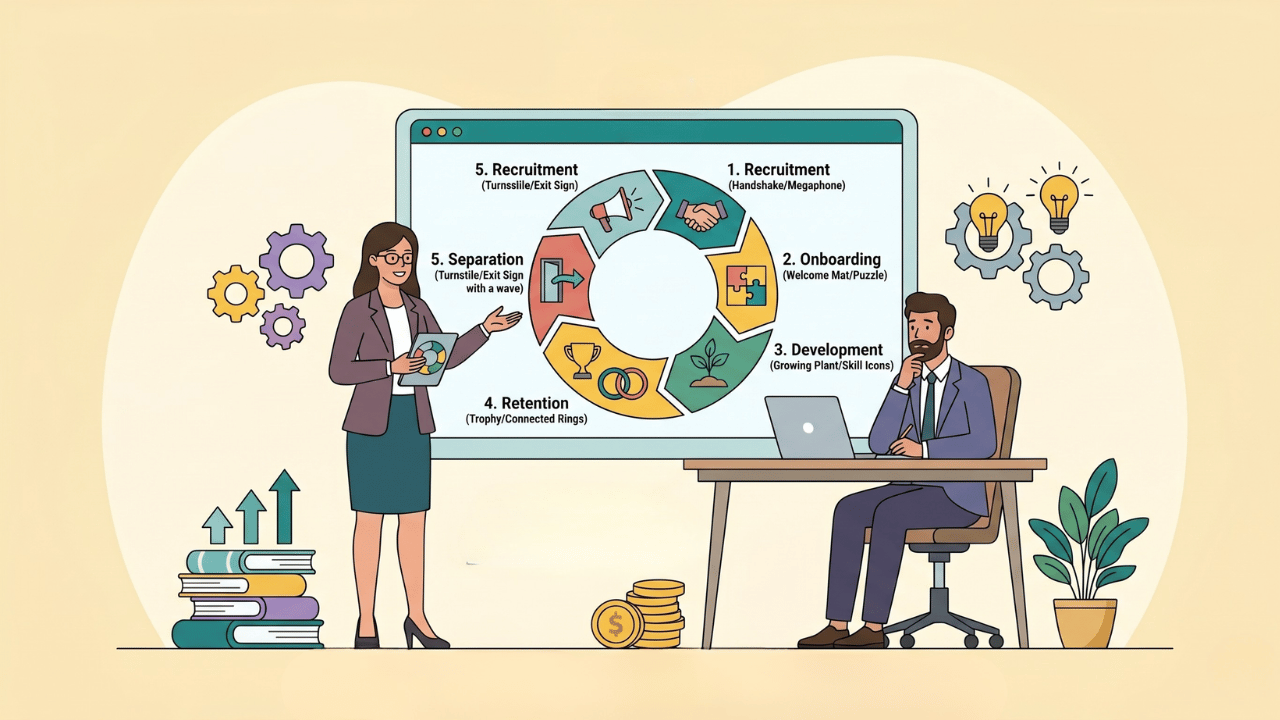
The employee lifecycle is the full set of stages a person moves through in their relationship with an employer, from first hearing about the company to leaving it. It's a model HR teams use to map, measure, and improve the whole experience of working somewhere, stage by stage.
I find the lifecycle useful because it stops you treating people problems as isolated. A retention problem usually isn't a retention problem. It's an onboarding problem, or a hiring problem, showing up late.
This guide explains what the employee lifecycle is, walks through each stage, and gives a practical way to manage it. The key statistics are included throughout.
What Does the Employee Lifecycle Mean?
The employee lifecycle is a framework that breaks a person's time with a company into distinct stages. Each stage is a chance to either strengthen the relationship or weaken it.
Think of it like the customer lifecycle. Marketers map a buyer from first ad to repeat purchase. The employee lifecycle does the same for the people who work for you, treating the employee relationship as something you design rather than something that just happens.
Most models use seven stages: attraction, recruitment, onboarding, development, retention, separation, and the alumni or advocacy stage that follows. Some collapse it into five or six. The exact count matters less than the idea: a person's experience is a connected sequence, and a weak link anywhere drags down the rest.
What Are the Stages of the Employee Lifecycle?
Here's each stage, what it covers, and the question that matters most at that point.
| Stage | What it covers | The question to ask |
|---|---|---|
| Attraction | Employer brand, reputation, why people want in | Do the right people want to work here? |
| Recruitment | Sourcing, applying, interviewing, the offer | Is the process fair, fast, and respectful? |
| Onboarding | First days, setup, early wins | Does the new hire feel set up to succeed? |
| Development | Training, growth, internal moves | Is this person still learning here? |
| Retention | Day-to-day work, manager, recognition | Is there a real reason to stay? |
| Separation | Resignation, exit, offboarding | Does the person leave with goodwill? |
| Advocacy | Alumni, referrals, boomerang hires | Will they speak well of us afterward? |
The stages feed each other. A great onboarding can't rescue a hiring process that treated the candidate badly. Strong development reduces the pressure on retention. How you handle separation decides whether advocacy happens at all.
Stage 1: Attraction
This is everything that happens before someone applies. It's your reputation as a place to work, and it's shaped by your employer branding.
Get this stage right and the rest gets easier. A strong employer brand pulls in better candidates at lower cost. A weak one means you're recruiting uphill from the start.
Stage 2: Recruitment
This is the hiring process itself, from sourcing to a signed offer. The whole recruitment process is a stage of the lifecycle, not a separate function.
It's also where candidate experience is formed. The way people are treated while applying tells them how the company treats its people. A useful way to picture this stage is the recruitment funnel, which maps how candidates move from awareness to hire.
Stage 3: Onboarding
Onboarding is where a candidate becomes an employee. It's also the stage with the highest stakes for how long they stay.
A strong employee onboarding process can lift new-hire retention by as much as 82% and boost productivity by more than 70%. Yet Gallup finds only about 12% of employees strongly agree their company onboards well. This is the lifecycle's biggest gap between how much a stage matters and how well it's usually done.
Stage 4: Development
Once someone is settled, the question becomes whether the role keeps growing them. This stage covers training, skill-building, and internal moves.
It's a make-or-break stage for retention. People leave when learning stops, so development isn't a perk. It's part of the deal.
Stage 5: Retention
This is the longest stage, the day-to-day experience of working at the company. It's shaped most by the direct manager, by recognition, and by whether the culture lives up to the promise.
Retention is best treated as an outcome of the stages before it. If attraction, recruitment, onboarding, and development were all done well, retention is far less of a fight.
Stage 6: Separation
Everyone leaves eventually. This stage is the resignation, the notice period, and the offboarding process.
How you handle it matters more than people think. A respectful, organized exit protects your reputation and keeps the door open. A messy one shows up in online reviews within a week.
Stage 7: Advocacy
The relationship doesn't end at the exit. Former employees become alumni, referrers, customers, and sometimes returning hires, often called boomerang employees.
A person who left on good terms is a recruiting asset for years. This stage is the payoff for handling all the others well.
Why Does the Employee Lifecycle Matter? The Statistics
Because managing the lifecycle as a connected whole produces better results than fixing stages in isolation. The numbers around the weakest stages show what's at stake.
A few data points:
- Strong onboarding can improve new-hire retention by up to 82%, yet only about 12% of employees say their company onboards well (Gallup). The onboarding stage is widely under-managed.
- Replacing an employee costs 50% to 200% of their annual salary (SHRM). Every stage that's done poorly raises the odds of an early, expensive exit.
- Companies with a strong learning culture see roughly a 57% retention rate versus 27% with weaker investment (LinkedIn). The development stage directly moves the retention stage.
The pattern is consistent. A weak stage doesn't just cost you at that point. It raises the cost of every stage after it.
How to Manage the Employee Lifecycle: A 6-Step Approach
Managing the lifecycle well is about treating it as one connected system. Here's the approach I'd take.
Step 1: Map your current lifecycle
Document what actually happens at each stage today. Walk it end to end and write down every touchpoint a person hits.
For each one, ask what's supposed to happen, what actually happens, and how it feels to the employee. The gaps are your work list.
Step 2: Find your weakest stage
Don't try to fix everything at once. Use your data, turnover by tenure, engagement scores, time to productivity, to find the stage that's costing you most.
For most companies the answer is onboarding or development. Start where the data points, not where it's most comfortable.
Step 3: Define what good looks like at each stage
For every stage, write down the experience you're aiming for and the metric that proves it. Vague intentions don't improve a lifecycle. Clear standards do.
Step 4: Connect the stages
The biggest lifecycle failures happen at the handoffs. Data gets lost between recruitment and onboarding. A development plan never reaches the new manager.
Make sure information and context flow across stage boundaries. This is where connected HR tooling earns its place, which I'll cover next.
Step 5: Measure across the whole lifecycle
Track stage-specific metrics, not just one annual number. Onboarding completion, time to productivity, engagement scores, regrettable turnover, exit sentiment.
Plotting these against the stages shows you exactly where the experience dips. That's lifecycle thinking in practice.
Step 6: Improve in cycles
The lifecycle is never finished. Fix the weakest stage, measure the effect, then move to the next weakest. It's a loop, not a project.
What Tools Support the Employee Lifecycle?
Managing a lifecycle well is far harder when each stage lives in a different system and nothing connects.
The early stages, attraction through onboarding, are well served by an applicant tracking system that carries a person from candidate to employee without anyone retyping data. When recruitment and onboarding share one platform, the handoff between those stages stops being a gap.
For the later stages, you want engagement and feedback tools that listen continuously. Regular employee engagement surveys give you the stage-by-stage signal you need to spot where the lifecycle is breaking. The principle is the same throughout: connected data lets you follow one person across every stage instead of guessing.
How Does the Lifecycle Connect to Employee Experience?
The two ideas are close, and worth keeping straight. The employee lifecycle is the stages. Employee experience is how each of those stages feels to the person.
You can think of the lifecycle as the map and the experience as the terrain. A strong employee value proposition is the promise that should hold true at every stage of the map. When the lived experience matches that promise from attraction through advocacy, the lifecycle is working.
What Mistakes Do Companies Make With the Employee Lifecycle?
The lifecycle is a simple idea, and it's easy to apply badly. These are the mistakes I see most often.
- Treating each stage as a separate department. Recruitment owns hiring, L&D owns development, a manager owns retention, and nobody owns the connections. The lifecycle is a chain, and the value comes from managing the links, not just the stages.
- Losing data at the handoffs. The biggest failures happen between stages. A candidate's information doesn't carry into onboarding. A development plan never reaches the new manager. The person experiences each gap as a small sign the company isn't organized.
- Obsessing over recruitment, neglecting the rest. Companies pour energy into attraction and hiring, then go quiet once the person is in the door. Hiring well and then under-managing the next forty years of stages is a poor trade.
- Skipping separation and advocacy. Many companies mentally end the lifecycle at the exit interview. But a respectful exit and a maintained alumni relationship turn former staff into referrers and returning hires. Ending early throws that away.
- Measuring one annual number. A single engagement score for the whole company hides which stage is broken. Lifecycle thinking means stage-specific metrics, so you can see exactly where the experience dips.
- Fixing the comfortable stage, not the weak one. It's tempting to improve the stage you already understand. The data usually points elsewhere, often to onboarding or development. Follow the data.
The common root is the same. The lifecycle delivers value only when it's treated as one connected system owned across the business. Managed as disconnected stages, it's just a diagram on a slide. Managed as a whole, it's a way to catch the real cause of a people problem instead of treating the symptom where it surfaces.
Frequently Asked Questions
What is the employee lifecycle?
It's a framework that breaks a person's time with an employer into distinct stages, from first hearing about the company through to leaving and beyond. HR teams use it to map, measure, and improve the whole employee experience.
What are the stages of the employee lifecycle?
The most common model uses seven stages: attraction, recruitment, onboarding, development, retention, separation, and advocacy. Some models use five or six. The exact count matters less than treating the stages as a connected sequence.
Why is the employee lifecycle important?
Because people problems are connected. A retention issue often traces back to weak onboarding or hiring. Managing the lifecycle as a whole catches the real cause instead of treating the symptom.
What is the difference between the employee lifecycle and employee experience?
The lifecycle is the set of stages a person moves through. Employee experience is how each of those stages actually feels to them. The lifecycle is the map; the experience is the terrain.
Which stage of the employee lifecycle is most important?
There's no single most important stage, but onboarding is the most under-managed relative to its impact. It strongly predicts retention, yet only about 12% of employees say their company does it well.
How do you measure the employee lifecycle?
Track stage-specific metrics rather than one annual score: onboarding completion, time to productivity, engagement scores, regrettable turnover, and exit sentiment. Plotting them against the stages shows where the experience dips.
What is the advocacy stage of the employee lifecycle?
It's the period after someone leaves, when former employees become alumni, referrers, customers, and sometimes returning hires. It's the payoff for handling the earlier stages, especially separation, well.
Who is responsible for managing the employee lifecycle?
It's shared. HR designs and coordinates the lifecycle, managers deliver most of the day-to-day stages, and leadership sets the culture. It fails when it's treated as an HR-only project.
What is a boomerang employee?
A boomerang employee is someone who leaves a company and later returns to work there again. They're a common payoff of the advocacy stage, since people who leave on good terms are far more likely to come back, often with new skills and experience.
How is the employee lifecycle different from the customer lifecycle?
They share the same logic: mapping a relationship into stages so each one can be improved. The customer lifecycle tracks a buyer from first ad to repeat purchase. The employee lifecycle applies that discipline to the people who work for you, treating their experience as something designed, not left to chance.
.jpg)
.png)

.webp)