.webp)
.avif)
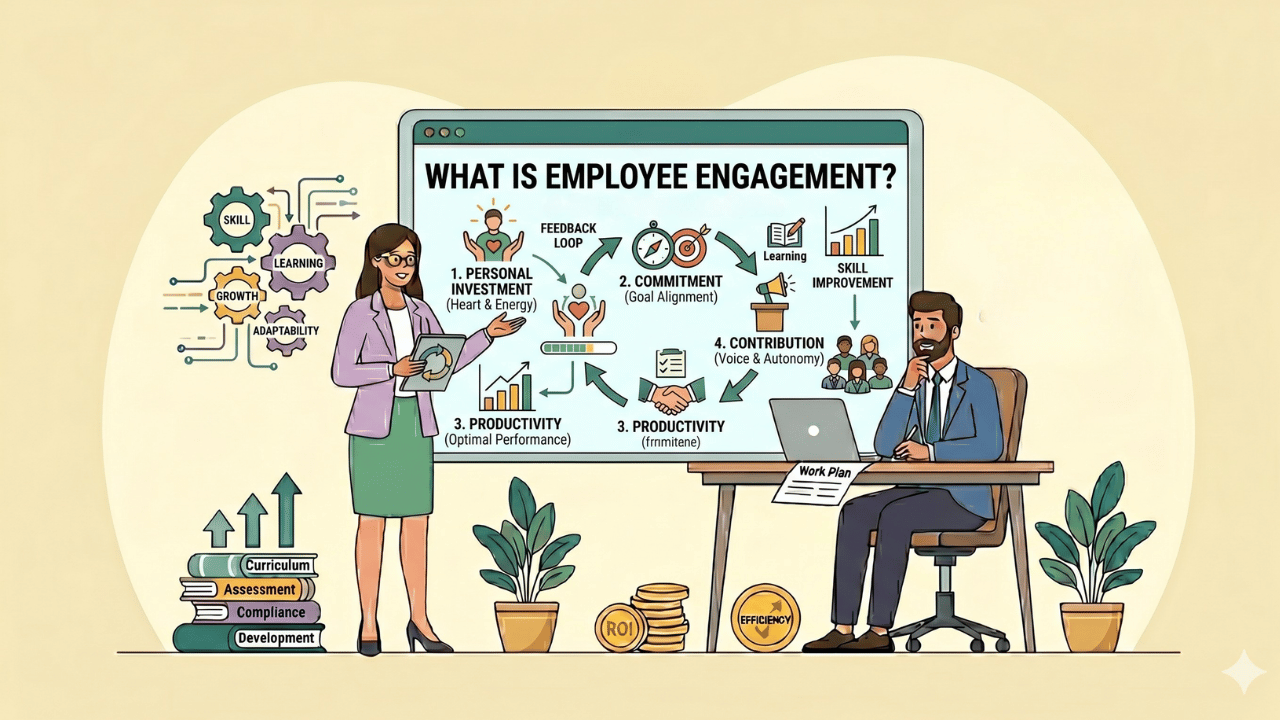
Employee engagement is the emotional commitment an employee feels toward their job, their team, and their employer. Engaged people put in discretionary effort because they want to, not because they have to. It is the gap between someone doing the minimum and someone going further.
I've sat through a lot of engagement reviews. The pattern is always the same: leaders treat engagement like a survey score they need to fix once a year. It isn't. It's the daily sum of how people feel about their manager, their work, and whether anyone notices what they do.
What Does Employee Engagement Really Mean?
Engagement is not happiness. A happy employee might still coast. An engaged employee cares about the outcome and acts on that.
Here's how I separate the terms people mix up:
- Employee satisfaction is whether someone is content with pay, hours, and conditions.
- Employee engagement is whether someone is emotionally invested in the work and the company's success.
- Employee experience is the full set of interactions a person has across their time at the company.
Satisfaction is a floor. Engagement is what you build on top of it. You can have one without the other, and that mismatch is where most retention problems start.
Gallup's research splits the workforce into three groups, and I find it a useful lens:
- Engaged employees are emotionally connected and drive performance.
- Not engaged employees do the job but hold back effort. This is the biggest group almost everywhere.
- Actively disengaged employees are unhappy and spread that unhappiness. They cost you more than their salary.
Why Does Employee Engagement Matter?
Because the numbers are hard to argue with. Engagement isn't a soft metric. It shows up in productivity, profit, and turnover.
A few data points worth quoting:
- Gallup found that highly engaged business units are around 21% more profitable.
- The same research links high engagement to a 41% lower rate of absenteeism.
- Engaged teams report lower turnover, fewer safety incidents, and higher customer scores.
The reverse is just as real. Disengagement shows up as quiet quitting, missed deadlines, and people leaving for a 5% raise they wouldn't have noticed if they felt connected.
I think of engagement as a leading indicator. By the time turnover spikes, the engagement problem is already a year old. If you measure engagement well, you see the trouble coming.
What Drives Employee Engagement?
After years of looking at this, I'm convinced engagement is mostly local. It's built or broken by a person's direct manager and their immediate work, not by a company-wide perk.
The drivers that matter most:
Notice that pay isn't on that list. Pay has to be fair, but once it's fair, more money doesn't buy engagement. The drivers above do.
A strong company culture sits underneath all of this. If the culture is broken, no single program will fix engagement.
How to Improve Employee Engagement: A 9-Step Plan
Here's the process I'd run. It's not a one-off project. It's a loop you keep cycling through.
Step 1: Measure where you actually stand
You can't improve a number you don't have. Run a baseline survey before you change anything.
Use a short, honest survey. A long one gets abandoned. I'd combine an annual deep-dive survey with quarterly pulse checks. If you want a primer on doing this properly, Recooty has a full breakdown of employee engagement surveys and what questions actually predict behavior.
Track at least these:
- Overall engagement score
- eNPS (would the person recommend working here)
- Scores by team, so you can see where the problem lives
- A few open-text questions, because the comments tell you more than the numbers
Step 2: Share the results, including the bad ones
The fastest way to kill future survey participation is to collect data and go silent. People assume the worst.
Within two weeks of a survey closing, share the headline results with everyone. Say what was good, what was not, and what you plan to do. Honesty here buys you credibility for everything that follows.
Step 3: Fix onboarding first
Engagement is set early. The first 90 days predict whether someone leans in or checks out.
A weak start is hard to recover from. A strong one compounds. If your employee onboarding is a laptop and a slide deck, that's your first project. New hires need a manager who's present, early wins, and a clear picture of what good looks like.
Step 4: Train managers to actually manage
Most managers were promoted for being good at the job, not for being good with people. Then we're surprised when their teams disengage.
Give managers a simple operating rhythm:
- A weekly or biweekly one-on-one with every direct report
- A habit of giving feedback close to the event, not saved for review season
- Clear goals each person can repeat back without notes
This is the single highest-return move on the list. Manager quality explains more engagement variance than anything else I've seen.
Step 5: Build a recognition habit
Recognition is cheap and most companies still ration it. That's a mistake.
The research is blunt here. Employees who don't feel recognized are about twice as likely to quit within a year, and roughly 70% say they'd work harder if their effort were better noticed. Recooty's piece on how to show appreciation to remote employees has practical formats you can copy.
Good recognition is specific, fast, and tied to a behavior you want repeated. "Great job team" is noise. "The way you handled that client escalation on Tuesday kept the account" is signal.
Step 6: Give people room to grow
People disengage when the role stops teaching them anything. Growth doesn't always mean promotion. It can mean a new skill, a stretch project, or mentoring someone else.
Sit down with each person twice a year and map what they want to learn next. Then actually fund it. A development conversation with no budget behind it makes things worse, not better.
Step 7: Protect autonomy and cut the noise
Micromanagement is engagement poison. So is a calendar with no white space.
Audit your meetings. Audit your approval chains. Every unnecessary check-in tells a capable person you don't trust them. For distributed teams, this matters even more. Recooty's tips to manage a remote team cover how to give autonomy without losing alignment.
Step 8: Connect the work to something bigger
People give more when they can see the point. Part of a manager's job is translating company strategy into "here's why your piece matters."
Do this in every one-on-one and every team meeting. Not as a speech. As a habit of always closing the loop on what happened after the work shipped.
Step 9: Close the loop and repeat
Engagement work fails when it's a project with an end date. It's a cycle: measure, act, communicate, measure again.
After each round, point to one or two visible changes that came directly from feedback. That's how people learn the survey is worth filling in honestly next time.
How Do You Measure Employee Engagement?
You measure it with a mix of survey data and behavioral signals. One number on its own lies. A combination tells the truth.
The metrics I'd watch:
- Engagement score from your survey, tracked over time, not in isolation
- eNPS, a quick read on whether people would recommend the place
- Participation rate in the survey itself, since a falling rate is its own warning
- Voluntary turnover, especially regrettable turnover of strong performers
- Absenteeism, which often rises before people quit
- Internal mobility, since engaged people apply for internal roles
A quick comparison of the main measurement tools:
The right HR tooling makes this far less painful. If your hiring and people data already live in one place, like an applicant tracking system, you can connect engagement signals to the full employee record instead of guessing.
What Are Common Employee Engagement Mistakes?
I've watched the same errors play out across very different companies.
- Treating the survey as the goal. The survey measures the work. It isn't the work.
- Perks instead of fundamentals. A games room doesn't fix a bad manager.
- One-size-fits-all programs. A 22-year-old and a 50-year-old want different things from work.
- Going quiet after the survey. Silence reads as "nothing will change."
- Owning engagement in HR alone. Engagement is built by managers. HR can only enable it.
The fix for all five is the same. Make engagement a management discipline, not an HR campaign.
How Does Engagement Connect to Retention and Employer Brand?
Tightly. Engaged employees stay longer, and they tell other people the company is worth joining.
That word-of-mouth feeds directly into your employer branding. Candidates trust current employees more than they trust your careers page. When your people are engaged, hiring gets cheaper and easier because referrals and reputation do part of the work for you.
So engagement isn't only a retention play. It's a recruitment advantage. The companies that win talent are usually the ones whose own people would recommend the place without being asked.
How Do You Keep a Remote or Hybrid Team Engaged?
Remote work removes the casual contact that used to carry engagement for free. The hallway chat, the shared lunch, the read of someone's body language in a meeting. None of that happens by default anymore, so you have to design it back in.
A few things I've found make the biggest difference for distributed teams:
- Default to over-communication. Write things down. Share context that used to travel by osmosis. Silence reads as bad news when people can't see each other.
- Protect the one-on-one. For remote staff it's often the only real check-in they get. Cancelling it sends a louder message than you think.
- Recognize in public channels. In an office, praise is overheard. Remotely, it has to be deliberate, or it never reaches anyone.
- Watch for isolation. Engagement and loneliness pull in opposite directions. A quick non-work conversation is not wasted time.
- Set goals people can run with. Clear outcomes matter more when you can't tap someone on the shoulder. Recooty's guide to setting goals for remote teams is a good starting point.
One trap worth naming: measuring activity instead of outcomes. Monitoring logins and green status dots tells a remote employee you don't trust them, and distrust is the fastest route to disengagement I know.
Hybrid setups have their own risk, which is a two-tier culture. The people in the office on a given day get the manager's attention and the informal information. The people at home get neither. If you run hybrid, the discipline is making sure remote-that-day staff aren't quietly second class.
How Is Engagement Different From Quiet Quitting?
Quiet quitting is the term that went mainstream for something engagement researchers have measured for decades. It describes an employee who does exactly their job description and nothing past it. No extra effort, no early exit, just the minimum.
In engagement terms, that's the "not engaged" group. They haven't left and they aren't actively hostile. They've simply stopped offering discretionary effort.
I think the panic over the phrase missed the real point. Quiet quitting is rarely a worker problem. It's usually a signal that the work stopped feeling worth the extra effort, and that's a management and design question.
Two responses I'd avoid:
- Surveillance. Watching people harder doesn't rebuild effort. It confirms why they pulled back.
- Guilt. Framing "doing your job" as a moral failure pushes the not-engaged group toward actively disengaged, which is far more expensive.
The actual fix is the same 9-step plan above. Reconnect the work to a purpose, give the person growth, recognize effort, and put a capable manager in front of them. Engagement is what you offer; discretionary effort is what you get back. Quiet quitting is just the receipt for an offer that wasn't good enough.
Frequently Asked Questions
What is employee engagement in simple terms?
It's how emotionally committed someone is to their work and their employer. An engaged employee puts in extra effort because they care about the result, not because someone is watching.
What is the difference between employee engagement and employee satisfaction?
Satisfaction is whether someone is content with conditions like pay and hours. Engagement is whether they're emotionally invested in the company's success. You can be satisfied and still disengaged.
How do you measure employee engagement?
Use a combination: an annual engagement survey, quarterly pulse surveys, eNPS, and behavioral signals like voluntary turnover and absenteeism. No single metric is reliable on its own.
What are the main drivers of employee engagement?
Meaningful work, a good relationship with the direct manager, regular recognition, growth opportunities, autonomy, psychological safety, and a culture where stated values match lived behavior.
How long does it take to improve employee engagement?
Expect 6 to 12 months to see a real shift in survey scores, assuming consistent action. Manager behavior changes faster than scores do, so watch leading indicators first.
Who is responsible for employee engagement?
Direct managers own the day-to-day reality of engagement. HR enables it with tools, training, and measurement. Senior leaders set the culture. It is not an HR-only job.
Can you improve engagement on a small budget?
Yes. The highest-return moves, better one-on-ones, faster recognition, clearer goals, and cutting unnecessary meetings, cost almost nothing. Budget mostly helps with growth and development.
What is an actively disengaged employee?
An actively disengaged employee is unhappy at work and acts on it, often spreading that unhappiness to colleagues. They cost a company more than their salary, and they're a separate problem from the larger "not engaged" group, who simply hold back extra effort.
How often should you measure employee engagement?
Run one deeper engagement survey a year, supported by shorter pulse surveys each quarter. The pulse checks catch trends early; the annual survey gives a benchmarked, detailed view. Measuring far more often than that usually causes survey fatigue.

.jpg)
.png)

.webp)