.webp)
.webp)
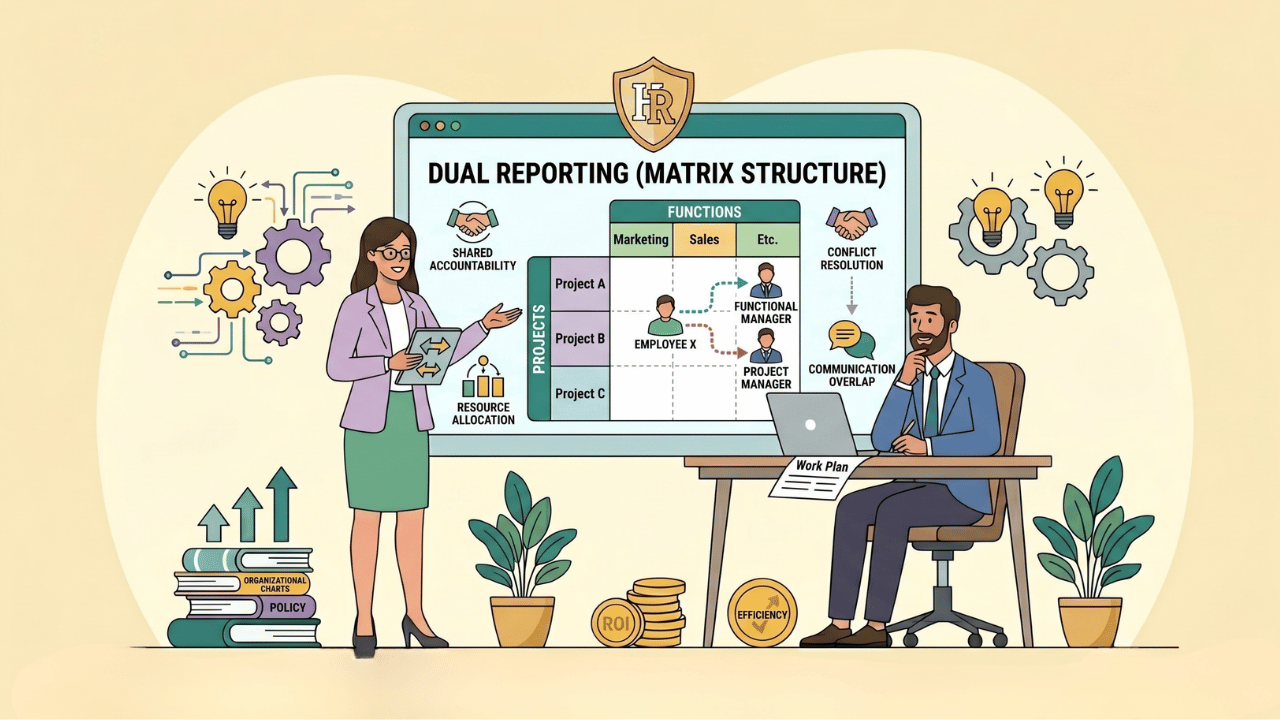
Dual reporting is an organizational arrangement where an employee reports to two managers simultaneously. One is typically a functional manager (responsible for skills development, career growth, and day-to-day operations) and the other is a project, product, or regional manager (responsible for specific deliverables, deadlines, and cross-functional work). This structure is a core feature of matrix management and is also known as having multiple reporting lines.
I've worked in dual reporting structures three times across my career. Twice it worked well. Once it was a disaster. The difference had nothing to do with the concept itself. It came down to whether the organization had clear roles, aligned priorities, and managers who actually talked to each other.
This guide covers what dual reporting means for HR, the organizational models that use it, how to manage performance and conflicts when employees have two bosses, and a step-by-step process for implementing it without creating chaos.
What Is the Difference Between Solid Line and Dotted Line Reporting?
In any matrix organizational structure, you'll hear two terms constantly: solid line and dotted line. Understanding the difference between solid line vs dotted line reporting is the first thing HR needs to get right.
The solid line manager is the employee's "home base." The dotted line manager borrows the employee's time for specific work. Both relationships matter, but the solid line carries more weight for career decisions.
I've seen companies blur this distinction, and it always creates problems. When both managers think they have solid-line authority, the employee gets caught in the middle. When neither takes ownership, the employee drifts without direction. Clarity on who owns what is not optional in dual reporting. It's the foundation.
Which Organizational Structures Use Dual Reporting?
Dual reporting doesn't exist in isolation. It's a feature of specific organizational designs. Here are the most common ones.
Matrix organizational structure
The matrix is the classic home for dual reporting. In a matrix organizational structure, employees belong to a functional department (engineering, marketing, finance, HR) while simultaneously working on cross-functional teams led by project or product managers. This creates functional and project reporting lines running at the same time.
There are three types of matrix:
- Weak matrix: The functional manager holds most authority. The project manager acts more like a coordinator. Dual accountability is limited.
- Balanced matrix: Authority is split roughly equally between functional and project managers. This is where true dual reporting lives.
- Strong matrix: The project manager holds most authority. The functional manager plays a supporting role.
The balanced matrix is the hardest to run but often the most productive. A Gallup study found that organizations with cross-functional collaboration saw 21% higher profitability, but only when roles and accountabilities were clearly defined.
Cross-functional teams
Cross-functional teams pull people from different departments to work on a shared project or initiative. The team members still report to their home department but also answer to the team lead. This creates a temporary dual reporting structure that dissolves when the project ends.
Project-based organization
In a project-based organization, work is organized around projects rather than departments. Employees may be assigned to multiple projects with multiple project managers while maintaining a functional reporting line for career development and skill building.
Agile team structure
Agile teams (squads, scrums, pods) often operate with dual reporting by default. A developer might report to an engineering manager for technical standards and career growth while also reporting to a product owner for sprint priorities and backlog management. The agile team structure is essentially a lightweight version of the balanced matrix.
Networked organization and flat hierarchy
In a networked organization or flat hierarchy, formal reporting lines are reduced in favor of project-based collaboration. Dual reporting can emerge organically as people contribute to multiple work streams. These structures require high trust and strong relationship management skills because formal authority is limited.
Why Do Companies Use Dual Reporting?
Organizations adopt dual reporting because single-chain-of-command structures can't handle certain types of complexity.
Better use of specialized talent. Instead of hiring a dedicated data analyst for every team, a matrix lets one analyst serve three teams. This is more efficient, and it keeps the analyst connected to their functional community for skill development.
Faster cross-functional decision-making. When a product launch requires engineering, marketing, legal, and sales to work together, dual reporting puts everyone on the same team with shared goals and metrics. Without it, requests bounce between department heads and take weeks.
Knowledge sharing across silos. Employees who work across teams bring insights from one project to another. A marketing specialist who works on both the enterprise product and the SMB product sees patterns that a siloed specialist would miss.
Global coordination. Multinational companies often need employees to report to both a regional leader and a global functional head. A marketing director in Germany might report to the VP of EMEA for regional strategy and to the global CMO for brand standards.
What Are the Biggest Challenges of Dual Reporting?
I'll be honest: dual reporting creates real friction. Knowing the problems in advance is the only way to manage them.
Conflicting priorities
This is the number one complaint from employees in matrix structures. When the functional manager wants you to focus on a process improvement initiative and the project manager needs you to deliver a client deliverable by Friday, you're stuck.
Conflicting priorities happen because managers don't coordinate. Each manager sees their work as the top priority. Without a shared prioritization process, the employee is left to negotiate between two bosses, which is unfair and unproductive.
Role conflict and role ambiguity
Role conflict happens when two managers give contradictory instructions. Role clarity and ambiguity becomes a problem when nobody defines the boundaries clearly. "Who decides my vacation request?" "Who approves my training budget?" "Whose meeting takes priority when they overlap?" These questions need answers before they come up.
Cognitive overload
Managing multiple bosses means managing double the context: two sets of goals, two communication styles, two meeting cadences, two sets of expectations. The cognitive overload is real, and research from the Harvard Business Review found that employees in matrix structures spend 20-30% more time in meetings than those in traditional hierarchies. That's time not spent doing actual work.
Power struggles between managers
When authority is shared, some managers compete rather than collaborate. I've seen functional and project managers turn an employee's workload into a proxy war for organizational influence. The employee suffers, and the work suffers.
Diluted accountability
When everyone is responsible, nobody is. Dual accountability sounds good in theory, but if both managers assume the other is handling a performance issue, the issue never gets addressed. This is one of the most common failure modes I've observed in matrix environments.
How Do You Set Up Dual Reporting the Right Way?
Here's the process I follow when implementing or fixing a dual reporting structure.
Step 1: Define the decision-making model with a RACI chart
A RACI chart maps every key decision and task to four roles: Responsible (does the work), Accountable (owns the outcome), Consulted (provides input), and Informed (kept in the loop).
For dual reporting, build a RACI chart that covers:
- Who sets the employee's goals?
- Who conducts the performance review?
- Who approves time off?
- Who decides task priorities when they conflict?
- Who handles compensation and promotion decisions?
- Who assigns day-to-day work?
When I implement this, I print it, share it with both managers and the employee, and revisit it quarterly. A RACI chart that lives in a forgotten Google Doc is useless.
Step 2: Create a dotted line reporting template
Document the dual reporting relationship formally. A dotted line reporting template should include:
- The employee's name and role
- The solid line manager's name and responsibilities
- The dotted line manager's name and responsibilities
- The percentage of time allocated to each reporting line (e.g., 60% functional, 40% project)
- The decision-making authority for each manager (reference the RACI chart)
- The escalation path for conflicts
This document becomes part of the employee's file and is reviewed whenever reporting relationships change.
Step 3: Align managers before telling the employee
Before an employee enters a dual reporting structure, the two managers need to meet and agree on:
- What success looks like for the employee
- How they'll coordinate on priorities
- How often they'll check in with each other (I recommend biweekly at minimum)
- How they'll handle disagreements
I've seen managers skip this step and assume they'll figure it out. They won't. Unaligned managers produce conflicting priorities, and the employee absorbs the chaos. Strategic alignment between managers isn't a nice-to-have. It's a prerequisite.
Step 4: Communicate clearly during onboarding
When a new hire enters a dual reporting role, the onboarding process should explicitly cover the reporting structure. Introduce both managers on day one. Walk through the RACI chart together. Answer every question about "who do I go to for what." Don't assume the employee will figure it out.
The same applies when an existing employee moves into a matrix role. Treat it like a mini-onboarding for the new reporting relationship.
Step 5: Build escalation paths for conflicts
Conflicts will happen. Build the resolution process before they do.
A clear escalation path looks like this:
- Employee raises the conflict with both managers directly
- Managers discuss and resolve between themselves within 48 hours
- If unresolved, escalate to the shared skip-level leader or the HR business partner (HRBP)
- The escalation point makes a binding decision within one week
Conflict resolution skills aren't optional for managers in dual reporting structures. If your managers can't handle disagreement constructively, the matrix will fail. Include conflict resolution in your leadership training.
Step 6: Run a pilot program rollout before going company-wide
If your organization is moving to a matrix structure for the first time, don't roll it out everywhere at once. Pick one department or one project team for a pilot program rollout. Run it for 3-6 months. Collect feedback. Fix the problems. Then expand.
I made the mistake of rolling out dual reporting across an entire division at once early in my career. The confusion was so severe that we had to pause and restart with a pilot. Lesson learned.
How Do You Manage Performance in Dual Reporting?
Performance management is where most dual reporting structures break down. If performance review processes aren't redesigned for the matrix, employees get inconsistent feedback, duplicated reviews, or (worst case) no meaningful evaluation at all.
Performance review in matrix structures
The solid line manager should own the formal performance review. But the dotted line manager must provide structured input. Here's the process I use:
- Before each review cycle, the solid line manager requests written feedback from the dotted line manager
- The dotted line manager rates the employee against project-specific key performance indicators (KPIs) and provides examples
- The solid line manager integrates this feedback into the overall review
- Both managers discuss the combined assessment before the review meeting
- The employee receives one unified review, not two separate ones
360-degree feedback
360-degree feedback works especially well in dual reporting environments because it captures input from multiple perspectives: both managers, peers, direct reports, and cross-functional collaborators. It compensates for the blind spots that any single manager has.
I run 360-degree feedback for all matrix employees at least once a year. It gives a more complete picture than a single manager's assessment ever could.
Shared goals and metrics
One of the most effective techniques I've used is setting shared goals and metrics that both managers are accountable for. If the functional and project managers share a common KPI (like "team delivers the product launch on time and on budget"), they have a structural reason to collaborate rather than compete.
Without shared goals, each manager optimizes for their own priorities. With shared goals, they optimize for the employee's success.
What Skills Do Employees Need to Succeed in Dual Reporting?
Working with two bosses requires a specific set of skills that most employees don't develop in traditional hierarchies.
Influencing without authority
In a matrix, you often can't rely on formal authority to get things done. Influencing without authority means persuading people through logic, relationships, and shared interest rather than positional power. This is the single most important skill for anyone operating in a dual reporting environment.
Stakeholder management
Managing multiple bosses is a stakeholder management exercise. You need to understand what each manager cares about, communicate proactively in both directions, and manage expectations before they become misalignments.
Negotiation skills
When priorities conflict, employees need negotiation skills to find workable compromises. "I can deliver the project report by Thursday if we push the process review to next week. Does that work for both of you?" This kind of proactive negotiation keeps things moving.
Effective communication channels
In dual reporting, information gets lost easily. Employees need to establish effective communication channels: which tools to use, how often to update each manager, when to loop both managers in simultaneously vs. separately. I recommend a shared project management tool and a standing weekly update to both managers.
Relationship management
Dual reporting is fundamentally a relationship management challenge. The employee's relationship with each manager, and the managers' relationship with each other, determine whether the structure works. Invest in all three relationships. Neglect any one, and the system breaks.
What Tools Help Manage Dual Reporting?
Matrix organizational chart
A standard org chart doesn't capture dual reporting. A matrix organizational chart shows both vertical (functional) and horizontal (project/product) relationships with solid and dotted lines. This makes reporting relationships visible to everyone.
Use org chart software (Lucidchart, Functionly, ChartHop, or even Miro) to build and maintain your matrix chart. Update it whenever project assignments change. An outdated matrix chart creates more confusion than no chart at all.
The role of the HR business partner (HRBP)
The HRBP plays a critical role in dual reporting structures. They mediate conflicts between managers, coach employees on matrix navigation, ensure performance reviews capture input from all reporting lines, and flag situations where role ambiguity is creating problems.
If your HR team doesn't have dedicated HRBPs, assign someone to be the go-to person for matrix-related issues. In my experience, matrix structures without HRBP support generate 2-3x more escalations to senior leadership.
How Does Dual Reporting Affect Hiring?
If your organization uses dual reporting, your hiring process needs to account for it.
Write it into the job description. If the role reports to two managers, say so. "This role reports to the VP of Engineering (solid line) and the Product Director (dotted line)." Candidates who thrive in ambiguity will self-select in. Candidates who need single-chain clarity will self-select out. Both outcomes are good.
Screen for matrix competencies. Use behavioral interview questions that test for influencing without authority, managing conflicting priorities, and stakeholder management. "Tell me about a time you had to balance competing requests from two stakeholders" is a direct signal of how they'll handle dual reporting.
Involve both managers in hiring. If the role has dual reporting, both managers should interview the candidate. This aligns expectations from the start and ensures both managers are invested in the new hire's success.
Track candidates efficiently. Your applicant tracking system should flag matrix roles so recruiters know to involve multiple hiring managers. Without this flag, one manager gets left out of the process and is surprised on the new hire's first day. That's a bad start for everyone.
Reflect it in your employer branding. Some candidates actively seek matrix environments because they value variety and cross-functional exposure. Highlighting your collaborative culture and employee value proposition around learning and development can attract these candidates.
Cover it in onboarding. Walk new hires through the RACI chart, introduce both managers formally, and set expectations for communication cadence in the first week.
Common Dual Reporting Mistakes HR Teams Make
Not defining authority clearly. If both managers think they're the solid line, you have a power struggle. If neither claims it, you have a vacuum. Define it in writing before the employee starts.
Skipping manager alignment. Two managers who don't talk to each other will give conflicting direction. Make regular manager-to-manager check-ins mandatory, not optional.
Using dual reporting when you don't need it. Not every role needs two bosses. If the functional work and the project work can be handled within a single reporting line, keep it simple. Dual reporting adds overhead. Use it when the cross-functional benefit justifies the coordination cost.
Forgetting to update org charts. When project assignments change (and they do, frequently), the matrix organizational chart needs to reflect it. Stale charts lead to stale assumptions about who reports to whom.
Ignoring the employee's experience. HR teams focus on the structural design and forget to ask: "How is this actually working for the person in the middle?" Run periodic check-ins with employees in dual reporting roles. Ask about role clarity, priority conflicts, and cognitive overload. Their feedback is your early warning system.
Not training managers for the matrix. Traditional management training assumes one boss, one team. Matrix management requires different skills: collaboration over control, influence over authority, shared accountability over territorial ownership. Invest in training specifically for managers who operate in dual reporting structures.
Frequently Asked Questions
What is dual reporting in simple terms?
Dual reporting is when an employee reports to two managers at the same time. Typically, one manager handles career development and functional skills (solid line), while the other manages project deliverables and cross-functional work (dotted line). It's a standard feature of matrix management.
What is the difference between solid line and dotted line reporting?
Solid line reporting is the primary management relationship. The solid line manager conducts performance reviews, approves time off, and makes compensation decisions. Dotted line reporting is a secondary relationship where the manager assigns project work and provides performance input but doesn't have direct authority over career decisions.
What is a RACI chart and why does dual reporting need one?
A RACI chart maps each task or decision to four roles: Responsible (does it), Accountable (owns it), Consulted (advises), and Informed (updated). In dual reporting, a RACI chart prevents confusion by specifying which manager owns which decisions. Without it, authority overlaps and gaps cause frustration.
How do you handle conflicting priorities from two managers?
Start by raising the conflict with both managers directly. Share the competing deadlines and ask them to agree on a prioritization process. If they can't resolve it, escalate to a shared skip-level leader or the HR business partner. The key is to surface the conflict early rather than trying to do everything at once.
What is the difference between a matrix and a traditional hierarchy?
A traditional hierarchy has a single chain of command: each employee reports to one manager. A matrix organizational structure has dual (or multiple) reporting lines, with employees answering to both a functional manager and a project or product manager. The matrix enables cross-functional collaboration but adds coordination complexity.
What skills help employees succeed in dual reporting?
The most important skills are influencing without authority, stakeholder management, negotiation, proactive communication, and relationship management. Employees who can manage competing priorities, communicate clearly with multiple bosses, and push back constructively tend to thrive in matrix environments.
When should a company avoid dual reporting?
Avoid dual reporting when roles are straightforward and don't require cross-functional collaboration, when the organization lacks the management maturity to handle shared authority, or when the coordination overhead outweighs the benefit. If a single reporting line can achieve the same result, keep it simple.
What is the role of an HR business partner in a matrix?
The HR business partner (HRBP) mediates conflicts between managers, coaches employees on matrix navigation, ensures performance reviews incorporate input from all reporting lines, and flags situations where role ambiguity is creating problems. In dual reporting structures, the HRBP is often the neutral third party that keeps the system functioning.

.jpg)
.png)