.webp)
.avif)
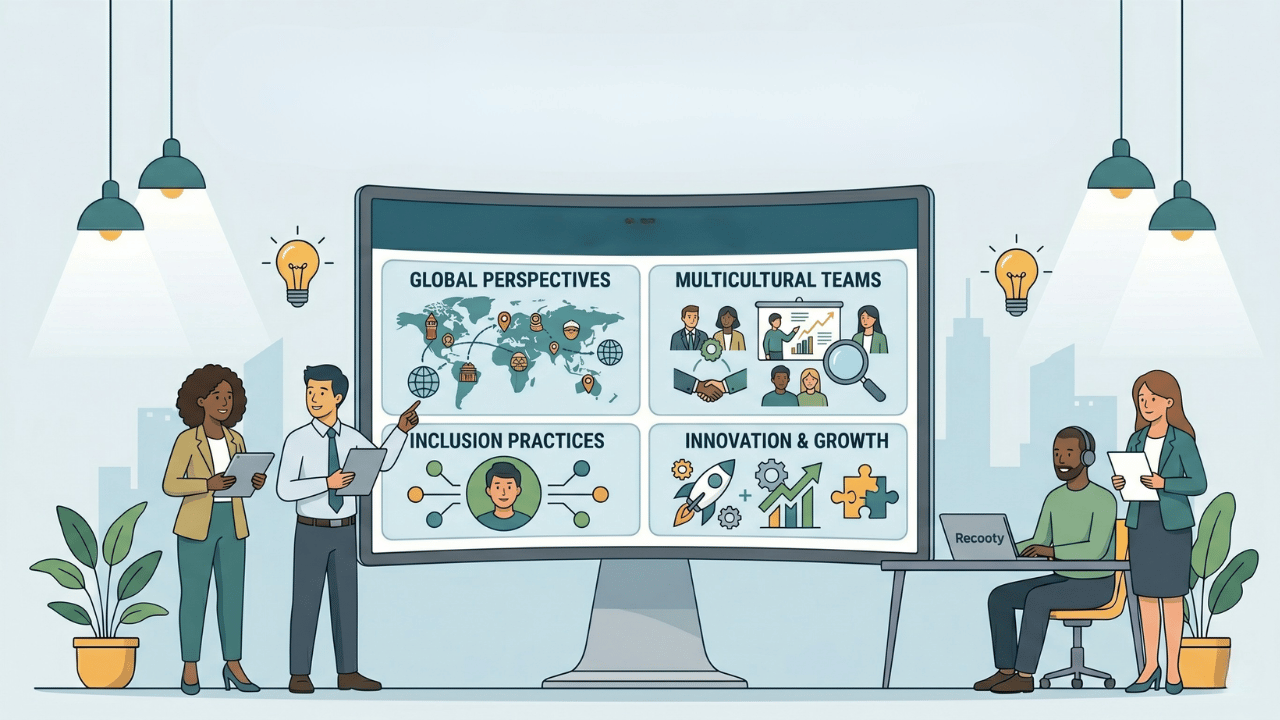
Diversity in the workplace is the presence of employees with different backgrounds, identities, experiences, and perspectives within an organization. It includes differences in race, gender, age, ethnicity, sexual orientation, disability, religion, socioeconomic background, education, and thought. A culture of diversity goes further: it's the active, intentional effort to recruit, retain, and support people from all backgrounds so everyone can contribute fully.
I've worked in organizations where diversity was a poster on the wall and organizations where it was built into every hiring decision, promotion cycle, and team meeting. The difference in innovation, problem-solving, and employee satisfaction was obvious. A McKinsey report found that companies in the top quartile for ethnic diversity were 36% more likely to outperform on profitability. That's not a feel-good statistic. That's a business case.
This guide covers what workplace diversity actually means for HR, the frameworks and laws behind it, and a practical process for building diversity into your organization's culture.
What Is the Difference Between Diversity, Equity, Inclusion, and Belonging?
These terms get used together so often that they blur. They shouldn't. Each one means something specific, and understanding the difference matters for building a real strategy.
Diversity, Equity, and Inclusion (DEI) is the most common framework. Some organizations use DEIB (adding Belonging) or IDEA (Inclusion, Diversity, Equity, Access) to signal specific priorities. The acronym matters less than whether you're actually doing the work.
I've seen companies spend months debating whether to use DEI or DEIB while doing nothing about the fact that zero women held leadership positions. The framework is the starting point, not the destination.
Why Does Workplace Diversity Matter for HR?
Workplace diversity directly affects business performance, legal compliance, and your ability to hire.
Better business outcomes. Companies with diverse leadership teams are 25% more likely to have above-average profitability (McKinsey, 2020). Diverse teams make better decisions 87% of the time compared to individual decision-makers (Cloverpop research). This isn't about checking boxes. Multiculturalism in the workplace produces better products, better strategies, and better results.
Talent attraction and retention. A Glassdoor study found that 76% of job seekers consider diversity an important factor when evaluating companies and job offers. If your employer branding doesn't reflect diversity, you're invisible to a significant portion of the talent market.
Legal compliance. Federal and state laws require equal employment opportunity. Failing to comply with Title VII, ADA, or EEOC guidelines exposes your company to lawsuits, fines, and reputational damage.
Innovation. Teams with cognitive diversity (different ways of thinking, not just different demographics) solve problems faster. A Boston Consulting Group study found that companies with above-average diversity on their management teams reported innovation revenue 19% higher than companies with below-average leadership diversity.
What Types of Diversity Should HR Consider?
Diversity isn't a single category. It includes multiple dimensions that HR should consider when building strategy and measuring progress.
- Demographic diversity: Race, ethnicity, gender, age, sexual orientation, disability, veteran status, religion
- Cognitive diversity: Different thinking styles, problem-solving approaches, educational backgrounds
- Experiential diversity: Industry backgrounds, career paths, life experiences, socioeconomic origins
- Functional diversity: Different departments, skill sets, and professional disciplines working together
I've seen companies focus entirely on demographic diversity (because it's the easiest to measure) while ignoring cognitive and experiential diversity. You end up with a team that looks different but thinks the same way. Real diversity means all four dimensions are represented.
What Laws Require Diversity and Equal Employment?
The legal framework behind workplace diversity is built on federal, state, and in some cases international law. Here's what HR needs to know.
EEO compliance is non-negotiable for every employer with 15 or more employees. Your anti-discrimination policy should cover all protected classes under federal and applicable state law. Review it annually and make sure every employee, especially managers, has read it.
Affirmative Action applies specifically to federal contractors. If your company holds government contracts above the threshold, you're required to develop and maintain an Affirmative Action Plan (AAP) and submit EEO-1 reports. OFCCP compliance audits can happen at any time, and the documentation requirements are detailed.
How Do You Build a Culture of Diversity?
Building a diverse culture isn't a single initiative. It's a system of hiring practices, internal policies, leadership behaviors, and measurement. Here's the process I follow.
Step 1: Audit your current state
You can't fix what you can't see. Start with representation data.
- What does your workforce look like by race, gender, age, disability, and veteran status?
- How do those numbers compare across levels (entry, mid, senior, leadership)?
- What are your retention rates by demographic? If you're hiring diverse talent but losing them faster than non-diverse peers, you have an inclusion problem, not a pipeline problem.
- Run a pay equity audit. Are people in the same roles with the same experience earning the same pay regardless of gender, race, or other protected characteristics? Gender pay parity isn't just a legal requirement in many jurisdictions. It's a credibility test for your entire DEI effort.
Build this data into a diversity dashboard that leadership reviews quarterly. If diversity reporting happens once a year in an annual report, it's performative, not operational.
Step 2: Create a DEI strategic plan
A DEI strategic plan is a documented, time-bound roadmap with specific goals, owners, and DEI metrics. It should answer these questions:
- What are our diversity goals for the next 1, 3, and 5 years?
- Which roles, departments, or levels have the biggest representation gaps?
- What resources (budget, headcount, tools) are allocated?
- How will we measure progress?
- Who is accountable?
Many companies assign this to a Chief Diversity Officer (CDO). If you can't hire a dedicated CDO, assign ownership to a senior leader who reports directly to the CEO. Diversity management that lives three levels below the C-suite doesn't have the authority to change anything meaningful.
Step 3: Fix your hiring process
This is where most HR teams can make the fastest impact. Your hiring pipeline determines who joins the organization, and if your pipeline is narrow, your workforce will be too.
Build a diverse talent pipeline. Don't post jobs on the same three job boards and wonder why you get the same applicant profile. Partner with HBCUs, Hispanic-serving institutions, disability advocacy organizations, veteran networks, and professional associations for underrepresented groups. Use your applicant tracking system to track source diversity so you know which channels produce the most diverse applicants.
Write inclusive job descriptions. Language matters. Research from Textio shows that job posts with gendered language receive up to 42% fewer applications from women. Your job description should use gender-neutral language, focus on skills rather than credentials (requiring a specific degree can exclude candidates from non-traditional backgrounds), and list only truly necessary qualifications.
Use blind recruitment where appropriate. Blind recruitment removes identifying information (name, gender, age, school name) from resumes during initial screening. It doesn't solve every bias problem, but it helps reduce unconscious bias at the top of the funnel.
Adopt inclusive hiring practices. Structure your interviews, use standardized scoring rubrics, and train interviewers on bias recognition. Use behavioral interview questions that assess skills and values rather than proxies for background.
Think culture add, not culture fit. "Culture fit" often means "people like us." That's how homogeneous teams stay homogeneous. Culture add asks: "What perspectives, experiences, or skills does this person bring that we don't already have?" This reframe has changed hiring outcomes at every company where I've seen it applied.
If you're hiring a dedicated diversity professional, a strong diversity recruiter job description should outline your organization's specific DEI goals and the measurable outcomes you expect.
Step 4: Build an inclusive internal culture
Hiring diverse people into a non-inclusive environment doesn't work. They'll leave. Inclusion is what makes diversity stick.
Launch Employee Resource Groups (ERGs). ERGs (also called affinity groups) are voluntary, employee-led groups organized around shared identities or experiences. Common ERGs include groups for Black employees, LGBTQ+ employees, women in leadership, parents, veterans, and employees with disabilities.
ERGs serve three purposes: community and support for members, advisory input to leadership on policy and culture, and professional development. The best-run ERGs have executive sponsors, dedicated budgets, and direct lines to decision-makers.
Train for cultural competence. Cultural competence is the ability to understand, communicate with, and work effectively with people from different cultural backgrounds. It's a skill, and it can be taught. Include cultural competence in your diversity training and development programs, leadership development, and onboarding processes.
Address microaggressions directly. Microaggressions are subtle, often unintentional comments or behaviors that communicate negative or dismissive messages to members of marginalized groups. "You're so articulate" (said with surprise to a Black colleague) or "Where are you really from?" (to an Asian-American employee) are common examples.
Don't ignore them. Train managers to recognize microaggressions, address them in the moment, and create channels for employees to report them safely. Ignoring microaggressions signals that the organization tolerates exclusion.
Reduce the emotional tax. The emotional tax is the added mental and emotional burden that employees from underrepresented groups carry when they feel they need to be "on guard" against bias, prove their competence more than peers, or represent their entire identity group. It's exhausting and it drives turnover.
Reducing the emotional tax requires psychological safety (people feel safe being themselves), inclusive leadership (leaders actively seek and value diverse input), and allyship in the workplace (colleagues speak up against bias even when they're not the target).
Step 5: Develop inclusive leaders
Inclusive leadership means leaders actively seek out and consider diverse perspectives, challenge bias (their own and others'), and create conditions where everyone can contribute. It's a specific set of behaviors, not a personality trait.
Invest in leadership development programs and executive coaching that include:
- Self-awareness of personal biases (every leader has them)
- Skills for facilitating inclusive meetings
- How to sponsor (not just mentor) employees from underrepresented groups
- How to give equitable feedback across different cultural communication styles
- Accountability for team diversity and inclusion outcomes
I've seen organizations where inclusive leadership was measured in performance reviews for every manager. Those organizations had measurably higher engagement scores from employees of color and women compared to organizations where diversity was "everyone's job" but nobody's metric.
Step 6: Build accountability into your systems
Diversity management without accountability is corporate theater. Here's how to make it real.
Set DEI metrics and track them. At minimum, track:
- Representation data by level, department, and role
- Hiring funnel diversity (applicants, interviews, offers, acceptances by demographic)
- Retention rates by demographic
- Promotion rates by demographic
- Employee engagement survey results segmented by identity group
- Gender pay parity and pay equity audit results
Report regularly. Some companies publish annual diversity reports externally. At minimum, review DEI metrics with leadership quarterly. Diversity reporting that leadership never sees doesn't change behavior.
Tie diversity outcomes to performance. When managers know that building diverse teams and creating inclusive environments affects their performance reviews, compensation, and promotions, behavior changes. Without this link, diversity stays in the "nice to have" category.
What Is a Supplier Diversity Program?
A supplier diversity program directs a portion of your company's purchasing to businesses owned by members of underrepresented groups: minority-owned, women-owned, veteran-owned, LGBTQ-owned, and disability-owned businesses.
This matters for two reasons. First, it extends your diversity commitment beyond your own workforce into your economic impact. Second, many government and enterprise contracts now require supplier diversity data as part of the RFP process.
If you're building a supplier diversity program for the first time, start by setting a percentage target (common starting points are 5-15% of addressable spend), certifying eligible suppliers, and tracking your progress. The National Minority Supplier Development Council (NMSDC) and Women's Business Enterprise National Council (WBENC) can help you identify certified suppliers.
What Is Equity-Mindedness and Why Does It Matter?
Equity-mindedness is the practice of examining your policies, systems, and outcomes through the lens of equity rather than equality. Equality means everyone gets the same thing. Equity means everyone gets what they need to succeed.
In HR terms, equity-mindedness asks: "Are our systems producing equitable outcomes, or are they replicating existing advantages?" For example, requiring a four-year degree for a role that doesn't need one disproportionately excludes candidates from lower-income backgrounds and certain racial groups. An equity-minded review would ask whether the requirement is actually related to job performance.
This approach connects directly to your employee value proposition. When employees feel the system is fair, when promotions, pay, and opportunities are based on merit rather than background, they stay longer and contribute more.
What Is Organizational Transformation Around Diversity?
Organizational transformation means fundamentally changing how your company operates to embed diversity and inclusion into every function, not just HR. It goes beyond programs and policies to change the underlying systems that determine who gets hired, promoted, paid, and heard.
This is hard, slow work. I've seen it take 3-5 years in mid-sized companies and 5-10 years in large enterprises. It requires sustained leadership commitment, ongoing investment, and honest measurement.
Signs that your organization is transforming rather than just programming:
- Diversity is discussed in strategy meetings, not just HR meetings
- Hiring managers are accountable for the diversity of their teams
- Employee Resource Groups have budgets and decision-making influence
- Pay equity audits happen annually and results are acted on
- Diverse employees are retained and promoted at rates comparable to majority employees
- Leaders publicly acknowledge gaps and share plans to close them
Common Diversity Mistakes HR Teams Make
Treating diversity as a hiring-only problem. Hiring diverse talent is step one. Retaining and promoting them is the real test. If your diversity numbers look good at entry level but drop sharply at each subsequent level, you have an inclusion and advancement problem.
Launching unconscious bias training and calling it done. Unconscious bias training is a single tool, not a strategy. Research shows that standalone bias training without structural changes (like blind recruitment, standardized interviews, and equitable promotion processes) has limited long-term effect on behavior. Pair training with systems change.
Not measuring what matters. Tracking "number of diversity events hosted" is not a DEI metric. Track representation, retention, promotion, pay equity, and engagement by demographic. Those are the numbers that tell you whether your efforts are working.
Ignoring intersectionality. A Black woman's experience is different from a white woman's experience and different from a Black man's experience. Looking at gender data alone or race data alone misses people who sit at multiple intersections. Segment your data by intersecting identities when possible.
Playing the blame game with the pipeline. "We can't find diverse candidates" is almost never true. It usually means you're looking in the same places you've always looked. Broaden your sourcing channels, reconsider unnecessary requirements, and build relationships with organizations that serve underrepresented groups.
Frequently Asked Questions
What is diversity in the workplace in simple terms?
Workplace diversity is the presence of people with different backgrounds, identities, experiences, and perspectives within a company. It includes differences in race, gender, age, disability, sexual orientation, religion, education, and thought. A diverse workplace reflects the makeup of the broader community it serves.
What is the difference between DEI and DEIB?
DEI stands for Diversity, Equity, and Inclusion. DEIB adds Belonging, which is the feeling of being accepted and valued as your full self at work. Some organizations also use IDEA (Inclusion, Diversity, Equity, Access). The frameworks are closely related. The specific acronym matters less than whether the organization is acting on each component.
What is blind recruitment and does it work?
Blind recruitment removes identifying information (name, gender, age, school name, photo) from applications during initial screening. It reduces unconscious bias at the top of the hiring funnel. Studies show it increases the likelihood that candidates from underrepresented groups advance to interviews. It's most effective when combined with structured interviews and standardized evaluation criteria.
What are Employee Resource Groups (ERGs)?
Employee Resource Groups are voluntary, employee-led groups organized around shared identities, experiences, or interests. Common ERGs include groups for Black employees, LGBTQ+ employees, women, veterans, parents, and employees with disabilities. Also called affinity groups, they provide community, professional development, and advisory input to leadership on policy.
What is the difference between culture fit and culture add?
Culture fit evaluates whether a candidate matches the existing team culture. Culture add evaluates what new perspectives, experiences, or skills a candidate brings that the team doesn't already have. Diversity-focused hiring emphasizes culture add because culture fit can reinforce homogeneity by favoring candidates who look and think like current employees.
What is a pay equity audit?
A pay equity audit is a systematic review of compensation data to identify and correct pay gaps based on gender, race, or other protected characteristics. It compares employees in the same or similar roles with comparable experience and qualifications to ensure they're paid equitably. Many jurisdictions now require or incentivize regular pay equity reviews. Gender pay parity is one of the most visible outcomes.
What is unconscious bias and how does it affect hiring?
Unconscious bias refers to automatic associations and assumptions people make about others based on group identity, without conscious awareness. In hiring, it can lead to favoring candidates who share the interviewer's background, undervaluing credentials from unfamiliar institutions, and making snap judgments based on names or appearance. Structured interviews, blind recruitment, and bias awareness training help reduce its impact.
How do you measure diversity progress?
Track DEI metrics including representation data by level and department, hiring funnel diversity at each stage, retention rates by demographic, promotion rates by demographic, pay equity audit results, and employee engagement surveys segmented by identity group. Review these metrics quarterly with leadership. A diversity dashboard that consolidates this data makes trends visible and drives accountability.
.jpg)
.png)

.webp)