.webp)
.avif)
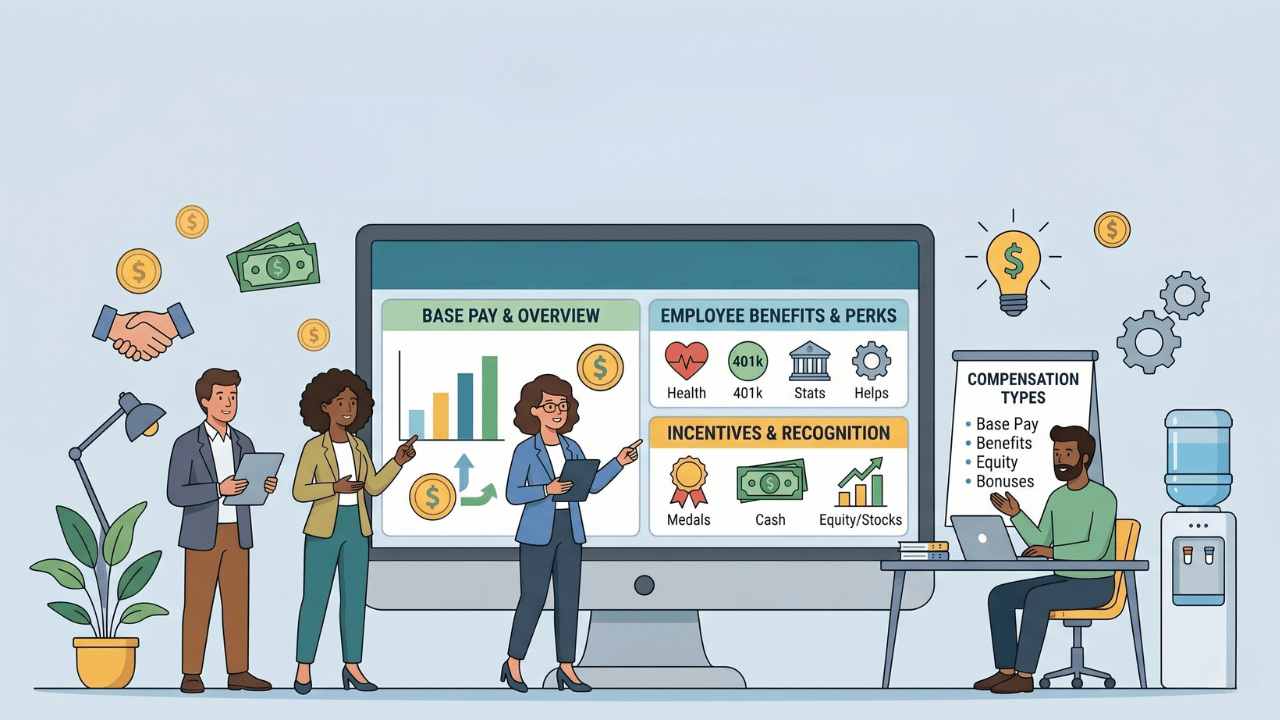
Compensation is the total package of pay, benefits, and rewards an employer provides to an employee in exchange for their work. It includes base salary, bonuses, commissions, health insurance, retirement contributions, equity, and non-monetary perks like flexible schedules or professional development.
I talk to HR professionals every week who say they "know what compensation means" but still struggle when it's time to put a number on a job offer. Knowing the definition is one thing. Knowing how to calculate total compensation, compare it against the market, and build an offer that actually wins candidates? That's where most HR teams need help.
This guide covers all of it: the types of compensation, the math behind total compensation, and a practical process for benchmarking pay during hiring.
What Are the Types of Compensation?
Compensation breaks down into three broad categories: direct, indirect, and non-monetary. Here's how each one works.
Direct compensation
Direct compensation is the cash that hits an employee's bank account. It's the most visible piece of the package and usually the first thing candidates ask about.
- Base salary: A fixed annual or monthly amount paid for the role. This is the foundation of every compensation package.
- Hourly wages: Pay calculated per hour worked, common for non-exempt employees.
- Bonuses: One-time or recurring cash payments tied to individual, team, or company performance.
- Commissions: A percentage of sales or revenue generated. Standard in sales, real estate, and financial services.
- Overtime pay: Extra pay for hours worked beyond the standard 40-hour workweek, legally required for non-exempt workers under FLSA.
- Profit-sharing: A portion of company profits distributed to employees, typically on an annual basis.
According to the Bureau of Labor Statistics, wages and salaries make up roughly 69% of total employer compensation costs in the US. So while benefits matter a lot (I'll get to those), cash is still the majority of what employees receive.
Indirect compensation
Indirect compensation is everything that has financial value but doesn't show up as cash in a paycheck. These are your benefits.
Benefits account for about 31% of total compensation costs. I've watched candidates choose a lower base salary because the benefits package was better, especially when it came to health coverage and retirement matching. When you write your job description, listing these benefits clearly can be the difference between getting an application and getting ignored.
Non-monetary compensation
This is the hardest category to put a dollar value on, but it often drives long-term retention more than a salary bump.
- Remote or hybrid work options
- Flexible scheduling
- Career development and mentorship programs
- Company culture and work environment
- Recognition programs
- Title and advancement opportunities
I've seen senior candidates turn down $20K more in base pay to stay at a company with a strong culture and real flexibility. Non-monetary compensation won't replace a competitive salary, but it absolutely tips the scale when two offers are close.
How Do You Calculate Total Compensation?
Total compensation is the full dollar value of everything an employee receives. Calculating it matters for two reasons: it helps you make competitive offers, and it helps employees understand what they're actually getting (which is almost always more than their paycheck suggests).
Here's the formula:
Total Compensation = Base Salary + Variable Pay + Employer-Paid Benefits + Equity + Perks Value
Let me walk through a real example.
That $85,000 salary is really a $124,538 package. When your offers keep getting turned down, showing total compensation instead of just the base number often changes the conversation.
The compa-ratio: a quick way to check pay competitiveness
The compa-ratio tells you how an employee's pay compares to the midpoint of their salary range. It's the single most useful number for benchmarking.
Compa-Ratio = (Employee's Salary / Midpoint of Salary Range) x 100
- A compa-ratio of 100% means the employee is paid exactly at market midpoint.
- Below 80% signals they're significantly underpaid.
- Above 120% usually means they're at the top of the range and may need a role change to keep growing.
I check compa-ratios every time I build an offer. If a candidate's ask puts them at 115% of the range before they've even started, I know I need to either adjust expectations or re-evaluate whether the range is outdated.
Why Does Compensation Matter for HR?
Compensation isn't just a finance question. It sits at the center of almost every HR function.
- Recruiting: 67% of job seekers say salary is the top factor when evaluating a job offer. If your compensation isn't competitive, your applicant tracking system won't matter because candidates won't apply.
- Retention: Employees who feel underpaid are 2x more likely to leave within 12 months. A solid compensation plan reduces turnover costs.
- Performance: Tying part of compensation to measurable outcomes gives employees a reason to push harder.
- Compliance: Getting pay wrong can lead to lawsuits, fines, and reputational damage. Pay equity laws are expanding in the US, EU, and beyond.
- Culture: How you pay people sends a message about what you value. Transparent pay builds trust. Secretive, inconsistent pay breeds resentment.
I've seen companies lose their best performers over a 5-10% salary gap because they refused to do a market adjustment. The cost of replacing that person was easily 50-200% of their annual salary. Compensation isn't where you cut corners.
How to Build a Compensation Structure
If you're starting from scratch or overhauling an existing system, here's the process I'd follow.
Step 1: Define your compensation philosophy
Before you set any numbers, decide what you're optimizing for. Do you want to pay at market rate, above market, or below market with stronger equity or benefits?
Your compensation philosophy is a one-paragraph statement that answers: "How do we think about paying people, and why?"
Step 2: Conduct market research
Use salary surveys, tools like Recooty AI Salary estimator, Glassdoor, Payscale, Salary.com, and LinkedIn Salary Insights to understand what competitors are paying for similar roles in your geography and industry.
Don't rely on job title alone. A "Marketing Manager" at a 20-person startup and a 10,000-person enterprise are doing very different jobs. Compare actual responsibilities, not titles.
Step 3: Create pay grades and salary bands
Group roles into pay grades based on skill level, responsibility, and market data. Each grade gets a salary range with a minimum, midpoint, and maximum.
For example:
The midpoint should roughly match the market rate. Employees typically start near the minimum and move toward the midpoint as they gain experience.
Step 4: Decide on variable pay
Will you offer bonuses? Commissions? Profit-sharing? Stock options?
Variable pay works best when it's tied to outcomes the employee can actually influence. A sales rep's commission makes sense. A customer support agent's bonus tied to company-wide revenue doesn't.
Step 5: Design your benefits package
Pick the indirect compensation elements that matter most to your workforce. For a young startup team, that might be student loan assistance and flexible PTO. For a team of experienced professionals with families, strong health insurance and retirement matching carry more weight.
Step 6: Document and communicate everything
Write it down. Share it with managers. Make sure every employee understands what they're being paid, why, and how they can earn more.
I've seen compensation plans fail not because the numbers were wrong, but because nobody explained them. Transparency is half the battle.
What Is Total Compensation?
Total compensation is the full value of everything an employee receives from their employer. It goes beyond base salary to include bonuses, benefits, equity, perks, and any other forms of financial or non-financial reward.
Here's a quick formula:
Total Compensation = Base Salary + Bonuses + Benefits + Equity + Perks
Most HR teams now create "total compensation statements" for employees. These documents show the full dollar value of what someone receives, not just their paycheck. An employee earning $80,000 in salary might actually receive $110,000+ in total compensation when you add health insurance, retirement contributions, PTO value, and other benefits.
If you're hiring and your offers keep getting turned down, showing total compensation instead of just salary often changes the conversation.
Compensation vs. Benefits: What's the Difference?
People use these terms interchangeably, but they mean different things.
The simple version: compensation is the umbrella term. Benefits sit underneath it, alongside salary and variable pay.
What Is a Compensation Analyst?
A compensation analyst is the person on your HR team who does the number-crunching. They research market pay rates, analyze internal pay data, build salary structures, and make sure your compensation plan stays competitive and compliant.
If your company has more than 200 employees, I'd strongly recommend having at least one dedicated compensation professional. Below that size, this work usually falls on the HR generalist or HR manager.
Key tasks a compensation analyst handles:
- Benchmarking salaries against market data
- Building and maintaining pay grades
- Running pay equity audits
- Analyzing the cost of proposed salary adjustments
- Preparing compensation reports for leadership
Common Compensation Mistakes HR Teams Make
I've made some of these myself early in my career. Here's what to watch for.
Not benchmarking regularly. Markets shift. If you set salary bands three years ago and haven't updated them, you're probably paying below market for at least a few roles.
Inconsistent pay for the same role. Two people doing the same job with the same experience should earn similar pay. If they don't, and you can't explain why, you've got a pay equity problem.
Ignoring internal equity. Sometimes the market pushes starting salaries up, but existing employees in the same role don't get adjusted. This creates compression, where new hires earn as much as or more than tenured employees. It's one of the fastest ways to lose good people.
Over-relying on salary alone. I've watched companies throw money at retention problems that were really about management, flexibility, or career growth. Salary fixes everything is a myth.
Not documenting pay decisions. Every compensation decision should have a documented rationale. If someone ever asks why Employee A earns more than Employee B, you need a clear, defensible answer.
How Does Compensation Fit Into the Hiring Process?
Compensation shows up at almost every stage of hiring.
- Job posting: Many states and countries now require salary ranges in job listings. Even where it's not legally required, posting ranges attracts more qualified applicants.
- Screening: You need to know your budget before you start reviewing candidates. An applicant tracking system can help you filter applicants efficiently, but the compensation range needs to be locked in first.
- Interviewing: Compensation expectations usually come up in the first or second conversation. If there's a mismatch, it's better to find out early.
- Offer stage: This is where your compensation package either wins or loses the candidate. A competitive total compensation offer, not just salary, closes deals.
- Onboarding: New hires should understand their full compensation from day one. Walk them through their benefits, bonus structure, and any equity components during the first week.
Compensation Trends HR Should Watch in 2026
A few things I'm paying attention to right now.
Pay transparency laws are spreading. The US, EU, UK, and Australia are all moving toward mandatory salary disclosure. If you're not already posting pay ranges, start now.
Skills-based pay is gaining traction. Instead of paying based on job titles and tenure, more companies are tying compensation to specific skills and certifications. This rewards continuous learning and gives employees a clear path to higher pay.
Total rewards thinking. The old model of "salary + basic benefits" is being replaced by total rewards strategies that include wellness programs, financial planning, caregiving support, and professional development. Companies using recruiting tools that highlight total rewards in job listings are seeing better application rates.
AI in compensation planning. AI recruiting tools are starting to inform compensation decisions too. AI can now analyze market data in real time, flag pay equity gaps, and model the cost of different compensation scenarios.
Geographic pay adjustments. With remote work here to stay, companies are rethinking how they adjust pay for location. Some pay the same regardless of location. Others use cost-of-living tiers. There's no consensus yet, but having a clear policy matters.
Frequently Asked Questions
What is compensation in simple terms?
Compensation is everything an employee receives in return for their work. This includes salary, bonuses, benefits like health insurance and retirement plans, and any other perks the employer provides.
What is the difference between salary and compensation?
Salary is the fixed amount paid to an employee, usually expressed as an annual figure. Compensation is broader. It includes salary plus bonuses, commissions, benefits, equity, and non-monetary rewards.
What are the four main types of compensation?
The four main types are: base pay (salary or hourly wages), variable pay (bonuses, commissions, profit-sharing), benefits (health insurance, retirement, PTO), and equity compensation (stock options, RSUs).
How do you calculate total compensation?
Add up the employee's base salary, any variable pay (bonuses, commissions), the employer's cost of benefits (health insurance premiums, retirement contributions), and the value of any equity grants. The total is their total compensation.
Why is a compensation strategy important?
A compensation strategy gives your organization a framework for making fair, consistent, and competitive pay decisions. Without one, you end up with salary inconsistencies, pay equity issues, and difficulty attracting and retaining talent.
How often should compensation be reviewed?
At minimum, once a year. Many companies do annual reviews tied to performance cycles. You should also do market benchmarking at least annually and adjust for any significant industry or economic changes.
What does a compensation analyst do?
A compensation analyst researches pay rates, builds salary structures, conducts pay equity audits, and ensures the company's compensation remains competitive with the market. They typically work within the HR department and report to the Head of HR or Total Rewards.
What is pay equity?
Pay equity means employees performing the same or similar work receive comparable pay, regardless of gender, race, or other protected characteristics. Pay equity audits help identify and correct gaps.

.jpg)
.png)

.webp)