.webp)
.avif)
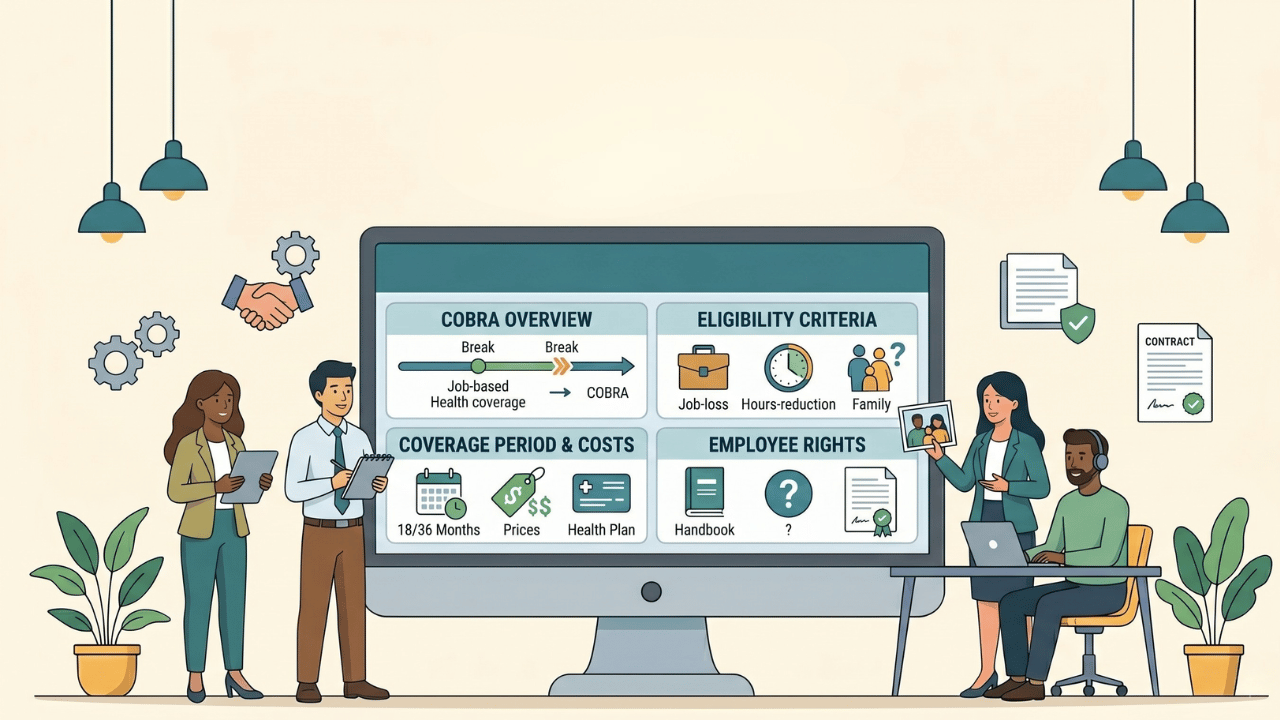
COBRA is a federal law that requires employers with 20 or more employees to offer continuation of health coverage to workers and their families after a qualifying life event that would otherwise end their group health plan. The full name is the Consolidated Omnibus Budget Reconciliation Act of 1985, but everyone calls it COBRA.
I've watched HR teams handle COBRA flawlessly and I've seen others make mistakes that triggered IRS excise tax penalties and Department of Labor investigations. The difference usually comes down to whether someone actually understands the rules or just assumes they do.
This guide covers everything an HR professional needs to know: who qualifies, what events trigger COBRA, how long coverage lasts, what it costs, the exact notice deadlines you need to hit, and how to avoid the most common compliance mistakes.
Who Does COBRA Apply To?
Federal COBRA law applies to group health plans sponsored by private-sector employers with 20 or more employees on more than 50% of typical business days in the prior calendar year. That's the 20 employee threshold, and it's the first thing HR needs to check.
COBRA also applies to state and local government plans. It does not apply to plans sponsored by the federal government, churches, or certain church-related organizations.
If your company falls below the 20 employee threshold, check your state's laws. Many states have mini-COBRA state laws that extend similar continuation rights to employees at smaller companies. California, New York, Texas, Florida, and about 40 other states have some version of these laws, each with their own rules on coverage duration and eligibility.
A group health plan under COBRA is any arrangement an employer makes to provide employees or their families with medical care. That includes medical, dental, vision, and prescription drug coverage. It does not include life insurance or disability benefits.
What Is a Qualifying Event?
A qualifying event is a specific life event that causes an employee or their dependent to lose coverage under the employer's group health plan. The type of event determines who qualifies and how long coverage lasts.
Here's the full list.
A few things I want to flag from experience.
The gross misconduct exception is narrower than most employers think. Federal law doesn't define "gross misconduct." Courts have generally interpreted it as conduct that is outrageous, flagrant, or willful. Firing someone for poor performance almost never qualifies. I've seen employers try to deny COBRA by claiming gross misconduct when an employee was simply fired for cause. That's a fast track to a Department of Labor complaint.
Voluntary resignation absolutely qualifies. I still meet HR managers who think COBRA only applies to layoffs or involuntary terminations. It doesn't. If someone quits, and they had group health coverage, they're a qualified beneficiary.
Who Is a Qualified Beneficiary?
A qualified beneficiary is any individual who was covered under the employer's group health plan on the day before the qualifying event. This typically includes:
- The covered employee
- The employee's spouse or former spouse
- The employee's dependent children
For divorce or legal separation, the employee is not a qualified beneficiary (they still have the job and the coverage). Only the spouse and dependent children who would lose coverage qualify.
For the death of covered employee, surviving spouses and dependent children are the qualified beneficiaries.
One detail that trips up HR teams: COBRA rights belong to each qualified beneficiary individually. A spouse can elect COBRA coverage even if the employee doesn't. A dependent child can elect coverage independently of either parent. Each person gets their own election decision.
How Long Does COBRA Coverage Last?
The standard coverage period depends on the qualifying event.
18-month coverage period. This is the default for employee-triggered events: involuntary job loss, voluntary resignation, and reduction in work hours.
36-month maximum coverage. This applies to dependent-triggered events: divorce or legal separation, death of covered employee, dependency aging out, and the employee becoming entitled to Medicare.
Can coverage be extended beyond 18 months?
Yes, in two specific situations.
Social Security disability extension. If a qualified beneficiary is determined by the Social Security Administration to be disabled at any time during the first 60 days of COBRA coverage, the 18-month period extends to 29 months for all qualified beneficiaries in that family. The disabled individual's premium increases to 150% of the plan cost during months 19-29.
Second qualifying event. If a second qualifying event occurs during an existing 18-month COBRA period, the coverage can extend to 36 months from the date of the original event. For example: an employee is terminated (18-month event), and during that COBRA period, the employee dies (second qualifying event). The spouse's coverage now extends to 36 months total.
When does COBRA coverage end early?
Coverage terminates before the maximum period if any of these happen:
- The qualified beneficiary fails to pay the COBRA premium by the end of the monthly grace period
- The employer stops maintaining any group health plan
- The qualified beneficiary becomes covered under another group health plan (with no preexisting condition exclusion)
- The qualified beneficiary becomes entitled to Medicare
- The qualified beneficiary engages in conduct that would justify termination for any other plan participant (like fraud)
That last point matters. Early termination of coverage for non-payment is the most common reason COBRA ends before the maximum period. The exhaustion of COBRA benefits happens when someone reaches the end of the maximum coverage window without any early termination.
How Much Does COBRA Cost?
This is usually the first question employees ask, and the answer is rarely good news.
Under federal law, the employer can charge up to 102% of the total premium cost, which is the 102% premium cost you'll see referenced everywhere. That 102% breaks down as 100% of the full plan cost (including the portion the employer used to pay) plus a 2% administrative fee.
Here's what that looks like in practice.
For the Social Security disability extension (months 19-29), the premium can be up to 150% of the plan cost.
I've had employees tell me they had no idea the employer was paying $450/month toward their health insurance until they got their COBRA premium notice. That's a strong argument for listing the employer's benefits contribution in your compensation communications and on your career page. When people understand the true cost of their benefits, the COBRA price feels less like a shock and more like the actual cost of insurance.
Payment rules
COBRA premium payments follow strict timelines:
- 45-day initial payment deadline. After electing COBRA, the qualified beneficiary has 45 days to make the first premium payment. This payment must cover all premiums due from the date coverage would have been lost.
- Monthly grace period. After the initial payment, each subsequent premium is due on the first of the month. There's a 30-day grace period. If payment isn't received by the end of the grace period, coverage can be terminated.
- Retroactive coverage. COBRA coverage is retroactive to the date the employee's coverage would have otherwise ended. If someone elects COBRA on day 55 of the 60-day election period, their coverage is retroactive. Any medical expenses incurred between the coverage loss date and the election date are covered once they pay.
The retroactive coverage feature is something I always explain to departing employees. If they're healthy and don't expect to need care in the next few months, they can wait to elect COBRA and only do so if they end up needing medical treatment during the 60-day window. It's not ideal, but it's a legitimate strategy for managing costs during a job transition.
Premium billing and collection
As the employer or plan administrator, you need a system for premium billing and collection. This includes generating monthly invoices, tracking payments, applying the grace period correctly, and documenting the paid through date for each participant.
I've seen HR teams try to manage this manually for 5-10 COBRA participants and do fine. Once you're past 15-20 participants, manual tracking gets risky. Missed payments, incorrect grace period calculations, and incomplete records create compliance exposure.
What Are the COBRA Notice Requirements?
The notice requirements are where most COBRA mistakes happen. There are multiple notices, each with its own deadline, and missing one can mean penalties.
General notice of COBRA rights
This is the first notice. Every new employee who enrolls in the group health plan (and their spouse, if covered) must receive a general notice of COBRA rights within 90 days of coverage beginning. This notice explains what COBRA is, when it applies, and how to get more information.
Most employers include this in the Summary Plan Description (SPD), which satisfies the requirement. If your SPD doesn't cover COBRA, you need a separate general notice.
Employer's notification to the plan administrator
When a qualifying event happens that the employer would know about (termination, reduction in hours, death, Medicare entitlement), the employer must notify the plan administrator within the 30-day employer notification window. That's 30 days from the date of the qualifying event.
For qualifying events the employer wouldn't know about (divorce, legal separation, dependency aging out), the qualified beneficiary is responsible for notifying the plan administrator within 60 days.
COBRA election notice
Once the plan administrator is notified of a qualifying event, they must send the COBRA election notice to each qualified beneficiary within the 14-day notice deadline. This notice explains the beneficiary's right to elect COBRA, the premium cost, the coverage options, and the deadlines for electing and paying.
The DOL has a model COBRA election notice that I'd strongly recommend using. It's been through multiple revisions and covers all the required content.
60-day election period
After receiving the COBRA election notice, each qualified beneficiary has a 60-day election period to decide whether to elect coverage. The 60 days start from either the date of the notice or the date coverage would be lost, whichever is later.
Notice of unavailability
If you receive a request for COBRA and determine the individual isn't eligible (for example, the termination was for gross misconduct), you must send a notice of unavailability within 14 days. This notice must explain why the individual is not entitled to COBRA.
Keeping proof of mailing
Every single COBRA notice should be sent with proof of mailing. First-class mail with a certificate of mailing is the minimum. Some employers use certified mail for election notices. Whatever method you choose, keep the documentation. If a qualified beneficiary claims they never received the notice, your proof of mailing is your defense.
Here's the full timeline at a glance.
What Are the Penalties for COBRA Non-Compliance?
The penalties are steep enough to get the attention of any CFO.
IRS excise tax penalties. Under IRC Section 4980B, employers who fail to comply with COBRA requirements face an excise tax of $100 per day per qualified beneficiary for each day of non-compliance. For a family of three, that's $300 per day. This accrues until the failure is corrected.
Department of Labor penalties. The DOL can impose penalties of up to $110 per day for failing to provide required COBRA notices under ERISA compliance requirements.
Lawsuits. Qualified beneficiaries can sue for coverage, damages, and attorneys' fees. Courts have awarded statutory penalties of up to $110 per day even when the beneficiary didn't suffer actual harm, simply because the employer failed to provide timely notice.
I knew a mid-sized company that forgot to send COBRA election notices to three former employees. They didn't catch the mistake for four months. The potential IRS excise tax exposure alone was over $36,000 before they even factored in DOL penalties and legal fees. They corrected it quickly and avoided the worst-case outcome, but it cost them legal counsel fees and a lot of stress.
How Does COBRA Connect to the Hiring and Offboarding Process?
COBRA sits at the intersection of benefits administration and the employee lifecycle. Getting it right requires coordination between HR, benefits, and payroll.
During onboarding. New employees who enroll in the group health plan must receive the general notice of COBRA rights within 90 days. Include this in your onboarding workflow alongside your benefits enrollment materials.
When writing job descriptions. If you're hiring an HR or benefits role, COBRA administration knowledge should be listed as a required or preferred qualification. Too many HR teams learn COBRA the hard way, through a compliance mistake.
During offboarding. The moment an employee's termination or separation is processed, the COBRA clock starts. Your applicant tracking system tracks hiring. Your HRIS or benefits platform should track COBRA triggers just as automatically. The 30-day employer notification window starts on the date of the qualifying event.
For employer branding. How you handle COBRA says something about your company. Former employees talk. If their COBRA experience was confusing, delayed, or poorly communicated, that reputation follows you. Clean COBRA administration is part of a professional exit experience.
How Should HR Manage COBRA Administration?
Small HR teams can handle COBRA manually when they have a handful of qualifying events per year. But as headcount grows, the risk of missed notices and incorrect timelines grows with it.
COBRA administration software
Dedicated COBRA administration software automates the most error-prone parts of the process: generating notices, tracking election deadlines, billing premiums, applying grace periods, and documenting everything for audit readiness. If you're processing more than 10-15 qualifying events per year, the cost of software is far less than the cost of a single compliance failure.
Third-party administrator (TPA)
Many employers outsource COBRA entirely to a third-party administrator. A TPA handles all notices, premium billing and collection, eligibility tracking, and reporting. This is a form of benefits administration outsourcing that makes sense for companies that don't have dedicated benefits staff.
I've used TPAs for COBRA at two different companies. The first one was excellent. Notices went out on time, premium tracking was accurate, and we never had a compliance issue. The second one missed a notice deadline and we had to deal with the fallout. The lesson: vet your TPA carefully. Ask for their error rate, their process for tracking deadlines, and whether they carry errors and omissions insurance.
Automated COBRA notifications
Whether you use software, a TPA, or handle COBRA in-house, automated COBRA notifications are the single biggest risk reducer. Automation removes the human error of forgetting to send a notice or calculating a deadline wrong.
At minimum, automate:
- General notice generation when an employee enrolls in benefits
- Qualifying event detection when an employee is terminated or has hours reduced
- Election notice generation within 14 days of notification
- Premium invoice generation on a monthly cycle
- Grace period expiration warnings
- Coverage termination notices
COBRA compliance audit
I recommend running a COBRA compliance audit at least once a year. Pull a sample of qualifying events from the past 12 months and check:
- Was the employer notification sent within 30 days?
- Was the election notice sent within 14 days?
- Is there proof of mailing for every notice?
- Were premiums billed correctly at the 102% premium cost?
- Were grace periods applied correctly?
- Is the paid through date accurate for each active participant?
If you find gaps, fix them immediately. Voluntary correction is always better than an audit finding from the DOL.
COBRA vs. Other Health Coverage Options
Employees who experience a qualifying event have more choices than just COBRA. Part of your job as HR is to make sure they know about all their options, even though you can't advise them on which to choose.
A qualifying life event (including job loss and reduction in hours) triggers a special enrollment period on the ACA Marketplace. Employees have 60 days from the coverage loss to enroll in a Marketplace plan. Being offered COBRA does not disqualify someone from Marketplace coverage or from premium tax credits.
I always tell departing employees to compare their COBRA cost to what's available on Healthcare.gov before making a decision. For many people, a Marketplace plan with subsidies is significantly cheaper than COBRA, especially for individual coverage. COBRA insurance tends to make more sense when someone is mid-treatment with a specific provider they don't want to change, or when the employer plan's coverage is unusually generous.
Common COBRA Mistakes HR Teams Make
Missing the 30-day notification window. The employer has 30 days from the qualifying event to notify the plan administrator. If your termination process doesn't automatically trigger this notification, it gets forgotten. Build it into your separation checklist.
Sending notices to the wrong address. COBRA notices must go to the qualified beneficiary's last known address. If an employee moves and you don't have updated contact information, the notice could be returned. Use the best address you have and keep proof of mailing.
Not tracking dependent qualifying events. Employer-side events (termination, hours reduction) are easy to catch because HR processes them. But divorce, legal separation, and dependency aging out happen without the employer's knowledge. Your SPD and general notice must clearly explain that beneficiaries are responsible for notifying the plan administrator within 60 days.
Confusing COBRA eligibility with benefits eligibility. An employee can be ineligible for benefits (part-time, probationary period) but still be at a company that's subject to COBRA. The 20 employee threshold applies to the employer, not to the individual employee's benefits status.
Failing to offer COBRA to all qualified beneficiaries. Each covered family member gets their own COBRA election. If an employee declines, that doesn't mean their spouse or dependent automatically loses the right. Send the election notice to every qualified beneficiary.
What HR Professionals Should Know About COBRA in 2026
State mini-COBRA laws keep expanding. More states are increasing coverage periods and adding requirements beyond federal COBRA. If you operate in multiple states, track each state's rules independently. A company using recruiting software to hire across state lines needs to stay current on each location's continuation coverage rules.
Integration with HR tech. Modern HRIS and benefits platforms are building COBRA triggers directly into termination workflows. When an employee is separated in the system, the COBRA notification process fires automatically. This is where AI recruiting tools and broader HR automation trends are heading: connecting every stage of the employee lifecycle, from hire to exit, into one automated workflow.
ACA Marketplace awareness. More employees are discovering that Marketplace plans can be cheaper than COBRA, especially with premium tax credits. HR should proactively share information about all coverage options during the separation conversation. You're not advising them on what to choose. You're making sure they have what they need to make an informed decision.
Frequently Asked Questions
What is COBRA in simple terms?
COBRA is a federal law that gives employees and their families the right to continue their employer-sponsored health insurance for a limited time after a qualifying event like job loss, reduced hours, divorce, or the death of the covered employee. The beneficiary pays the full premium plus a small administrative fee.
How much does COBRA cost?
COBRA premiums can be up to 102% of the total plan cost. That's the full premium (including the portion the employer previously paid) plus a 2% administrative fee. For a plan that costs $600 per month total, COBRA would be $612 per month.
How long does COBRA coverage last?
The standard period is 18 months for events like job loss or reduced hours. For events like divorce, death of the covered employee, or a dependent aging out, coverage can last up to 36 months. A Social Security disability determination can extend the 18-month period to 29 months.
Can you get COBRA if you quit your job?
Yes. Voluntary resignation is a qualifying event under COBRA. As long as the employee was covered under the group health plan and the employer meets the 20 employee threshold, quitting triggers COBRA rights.
What is the difference between federal COBRA and mini-COBRA?
Federal COBRA applies to employers with 20 or more employees. Mini-COBRA state laws provide similar continuation coverage rights for employees at smaller companies. The rules (coverage duration, premium limits, qualifying events) vary by state.
What happens if an employer doesn't comply with COBRA?
Non-compliance can result in IRS excise tax penalties of $100 per day per qualified beneficiary, DOL penalties of up to $110 per day for notice failures, and private lawsuits from affected individuals seeking coverage, damages, and attorneys' fees.
When does the 60-day COBRA election period start?
The 60-day period starts on the later of two dates: the date coverage would be lost, or the date the qualified beneficiary receives the COBRA election notice.
Should employees always choose COBRA over other options?
Not necessarily. COBRA keeps the same plan and doctors, but it's often the most expensive option. ACA Marketplace plans with premium tax credits can be significantly cheaper. Employees should compare COBRA costs to Marketplace options at Healthcare.gov before deciding.

.jpg)
.png)

.webp)