.webp)
.avif)
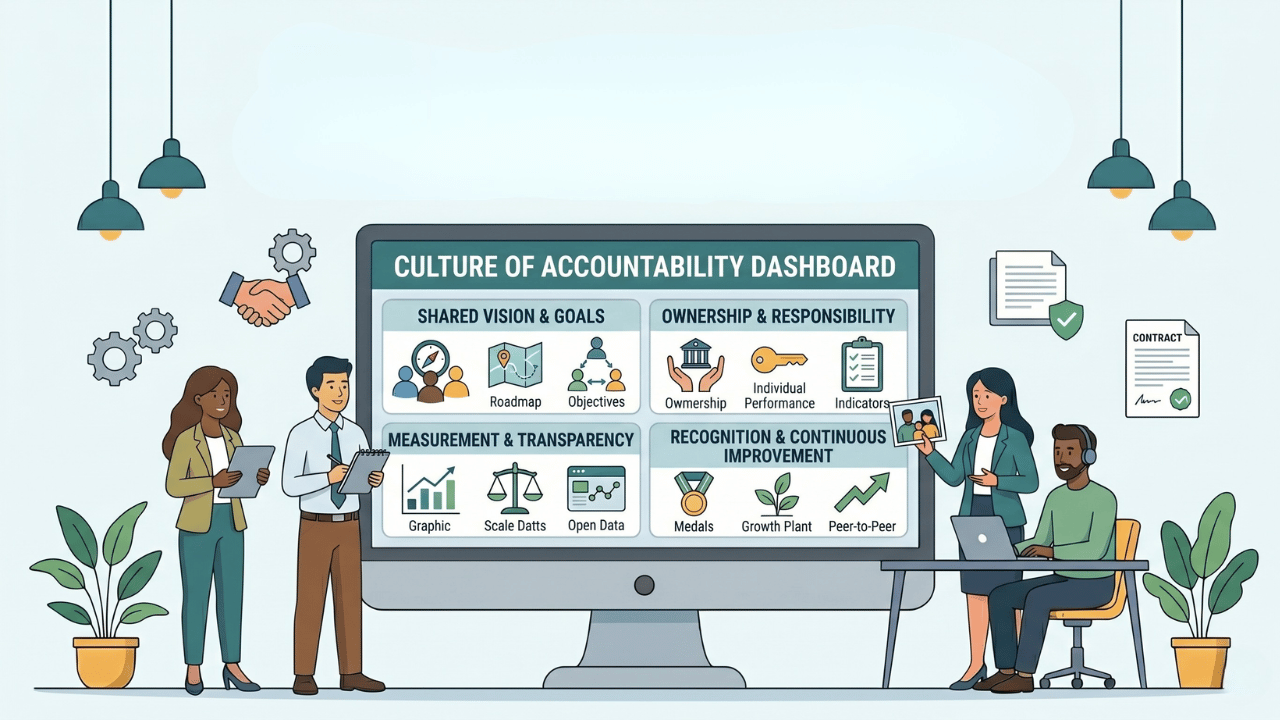
A culture of accountability is a work environment where every person, from the CEO to the newest hire, takes ownership of their actions, commitments, and results. It means people follow through on what they say they'll do, acknowledge mistakes openly, and hold each other to agreed-upon standards without waiting for a manager to step in.
I've worked in organizations with strong accountability and organizations without it. The difference is massive. In accountable cultures, problems get fixed fast because people own them. In cultures without it, the blame game runs the show. Deadlines slip, excuses pile up, and the best performers burn out because they're carrying the weight for everyone else.
This guide covers what workplace accountability actually looks like, why so many organizations struggle with it, and a practical step-by-step process for building personal responsibility and professional responsibility into your company's DNA.
What Does Workplace Accountability Actually Look Like?
Workplace accountability is the expectation that employees will take ownership of their tasks, decisions, and outcomes. It's the difference between "that's not my job" and "I'll figure it out."
Here's what I've observed in organizations that get this right.
Individual accountability doesn't mean people work in isolation. It means each person knows exactly what they're responsible for and doesn't need to be chased to deliver it. It's personal responsibility applied to a professional context.
Why Do Most Organizations Struggle with Accountability?
I've seen the same patterns across dozens of companies. The reasons accountability breaks down are predictable.
Unclear expectations. If people don't know what "good" looks like, they can't be held accountable for not delivering it. Vague goals produce vague results. This is the single biggest cause of accountability failures I've encountered.
Inconsistent consequences. When one employee misses deadlines repeatedly with no consequences while another gets called out for a single slip, people notice. Inconsistency kills accountability faster than anything else.
Lack of psychological safety. If admitting a mistake gets you punished, people stop admitting mistakes. They start hiding problems, deflecting blame, and practicing liability avoidance instead of taking ownership at work. You can't build accountability without trust-building first.
Leaders who don't model it. If the VP of Sales blames marketing for missed targets instead of owning their team's performance, that behavior cascades through the entire organization. Modeling accountability starts at the top.
No feedback systems. People can't improve what they can't see. Without regular feedback loops, employees operate blind. They think they're doing fine until a performance review tells them otherwise, six months too late.
How Do You Build a Culture of Accountability?
Building accountability is a systems problem, not a people problem. You don't fix it by hiring "more accountable people." You fix it by creating structures that make accountability the easiest path forward.
Here's the process I follow.
Step 1: Set clear goals using a proven framework
Accountability starts with clarity. If your goals are fuzzy, your results will be too.
I've seen three goal-setting frameworks work well in practice. Pick the one that fits your organization's size and style.
The framework matters less than the discipline. Whatever you choose, every employee should be able to answer two questions: "What am I responsible for?" and "How will we know if I've succeeded?"
Goal alignment is the connective tissue. Individual goals should ladder up to team goals, which ladder up to department goals, which ladder up to organizational goals. When this chain breaks, people work hard on things that don't matter.
Step 2: Define key performance indicators (KPIs) for every role
Goals tell people what to aim for. Key performance indicators (KPIs) tell them how they're tracking against those goals in real time.
Good KPIs are:
- Specific to the role (not generic company metrics copied across every position)
- Measurable without subjective interpretation
- Updated frequently enough to course-correct (monthly at minimum, weekly for fast-moving roles)
- Visible to the employee and their manager
I've seen organizations set KPIs once a year and never look at them again. That's not performance management. That's paperwork. KPIs only drive accountability when people actually review them on a regular cadence.
Step 3: Build a performance management strategy around continuous feedback
Annual performance appraisals are not enough to build accountability. If someone only hears about their performance once a year, you've given them 12 months to develop bad habits without correction.
A strong performance management strategy includes:
- Continuous feedback. Regular, informal check-ins (weekly or biweekly) where managers and employees discuss progress, blockers, and priorities. Not a formal review. A conversation.
- 360-degree feedback. Input from peers, direct reports, and cross-functional partners, not just the manager. This gives a fuller picture and removes the single-point-of-failure problem in traditional reviews.
- Performance appraisals. Formal reviews (quarterly or semi-annual) that summarize progress, recognize achievements, and set new goals. These document the ongoing conversations, they don't replace them.
- Performance improvement plans (PIPs). A structured, documented process for managing underperformance. PIPs aren't punishment. They're a clear, written agreement on what needs to change, by when, and what happens if it doesn't.
The shift from annual reviews to continuous feedback is the single biggest change I've seen improve accountability in real organizations. When feedback is constant, there are no surprises.
Step 4: Create psychological safety so people can own mistakes
This might sound counterintuitive. You want accountability, so you create safety? Yes. Exactly.
Psychological safety means people feel safe to speak up, admit errors, and ask for help without fear of humiliation or punishment. Google's Project Aristotle found that psychological safety was the number one predictor of high-performing teams.
Without it, you get the opposite of accountability. People hide mistakes, blame others, and avoid taking risks. The blame game thrives in environments where being wrong is dangerous.
How to build psychological safety:
- When someone raises a problem, thank them before anything else
- Share your own mistakes publicly as a leader (this is modeling accountability at its most powerful)
- Separate the person from the problem during conflict resolution
- Never punish someone for raising a concern, even if the timing is bad
Step 5: Hold leaders accountable first
I can't stress this enough. Leading by example is the foundation. If senior leaders aren't held to the same standards as everyone else, your accountability program is theater.
This means:
- Executives report their OKRs/KPIs alongside everyone else
- Leadership failures are addressed openly, not swept under the rug
- Leadership development programs include accountability as a core competency, not an afterthought
- Executive coaching includes honest feedback on how leaders model (or fail to model) accountability
I worked with a company where the CEO started every quarterly all-hands by sharing what they got wrong that quarter and what they learned. Within six months, the culture shifted noticeably. People started owning mistakes in team meetings because they saw the top leader doing it. Participatory management works because people follow behavior, not memos.
Step 6: Build recognition and rewards around accountability behaviors
People repeat what gets rewarded. If you only recognize results without recognizing the behaviors that produce them, you're telling people the "how" doesn't matter.
Recognition and rewards programs that support accountability:
- Recognize people who flag problems early (even if the news is bad)
- Reward teams that do honest root cause analysis after failures
- Celebrate people who deliver on commitments consistently, not just those who hit the biggest numbers
- Include accountability behaviors in promotion criteria
I've seen too many companies reward the sales rep who closes a huge deal through questionable promises while ignoring the one who consistently delivers exactly what they commit to. The first approach teaches people that results justify anything. The second builds a high-performance culture that lasts.
Step 7: Use the accountability ladder to move people up
The accountability ladder is a framework I've found useful for coaching individuals and teams. It maps the spectrum from total avoidance to full ownership.
Step 8: Address underperformance consistently
Accountability without consequences isn't accountability. It's a suggestion.
Managing underperformance requires:
- Early intervention. Don't wait for the annual review. Address performance gaps as soon as you see a pattern. The longer you wait, the harder the conversation.
- Corrective action that's documented. Verbal warnings, written warnings, and PIPs should follow a consistent process. The same standards apply to everyone regardless of tenure, title, or relationship with management.
- Root cause analysis before punishment. Sometimes underperformance is a training problem, not a motivation problem. Sometimes it's a workload problem, not a skill problem. Doing a root cause analysis before jumping to corrective action shows fairness and often reveals system-level issues.
- Conflict resolution skills for managers. Many managers avoid accountability conversations because they don't know how to have them. Invest in training managers on how to give direct feedback, handle defensiveness, and hold productive one-on-ones.
How Does Accountability Connect to Hiring?
You can build all the systems you want, but if you're hiring people who don't value accountability, you're fighting an uphill battle.
Screen for accountability in interviews. Use behavioral interview questions that reveal how candidates handle mistakes and commitments. "Tell me about a time you missed a deadline" or "Describe a project that failed and what role you played in the outcome." Listen for ownership language vs. blame language.
Write it into the job description. If accountability is a core value, say so. Phrases like "you'll own outcomes end-to-end" and "we expect proactive communication when things go off-track" tell candidates what they're signing up for.
Assess cultural fit during screening. Your applicant tracking system can help you standardize screening criteria, but the accountability assessment happens in the conversation. Ask candidates what accountability means to them. Their answer tells you a lot.
Reinforce it during onboarding. New hires should understand the company's accountability expectations in their first week. Include it in orientation, pair them with someone who models the behavior, and set clear 30/60/90-day goals from day one.
Make it part of your employer branding. Companies with strong accountability cultures attract people who want to work that way. When your employee value proposition includes ownership and personal growth alongside compensation and perks, you'll attract candidates who align with those values. Organizations that practice inclusive hiring alongside accountability standards build teams that are both diverse and high-performing.
What Is Strategic Alignment and Why Does It Matter for Accountability?
Strategic alignment means every person in the organization understands how their work connects to the company's bigger goals. Without it, accountability becomes pointless. People can be perfectly accountable for tasks that don't matter.
Here's the chain:
- Company sets a strategic direction (example: "grow revenue by 25% this year")
- Departments translate that into department goals (example: "marketing will generate 40% more qualified leads")
- Teams set team goals that support the department goal
- Individuals set personal goals tied to the team goal
When strategic alignment is strong, accountability has purpose. People aren't just meeting deadlines for the sake of it. They understand why their work matters and how their piece fits into the bigger picture. This connection is what turns compliance into genuine ownership.
What Are the Biggest Mistakes Organizations Make?
Confusing accountability with micromanagement. Accountability is about clear expectations and ownership. Micromanagement is about controlling every step of the process. If you're telling people what to do and how to do it at every turn, that's not accountability. That's the opposite. It's removing their ability to take ownership at work.
Skipping the foundation. You can't build accountability without first building trust, psychological safety, and clear expectations. Jumping straight to consequences and corrective action without these in place just creates fear.
Applying accountability inconsistently. If a senior director gets away with what a junior analyst would be reprimanded for, everyone sees it. Inconsistency destroys credibility. The rules need to apply to everyone, and especially to leadership.
Treating accountability as a one-time initiative. This isn't a training program you run once. It's a daily practice. Employee engagement strategies, feedback loops, performance systems, and recognition programs all need to reinforce accountability continuously. It's a system, not a project.
Ignoring employee morale. Accountability without care becomes punitive. If people feel like they're just being watched and measured, morale tanks. Balance accountability with genuine investment in employee development, recognition, and wellbeing.
Frequently Asked Questions
What is a culture of accountability in simple terms?
A culture of accountability is a workplace where everyone takes personal responsibility for their actions, follows through on commitments, and holds each other to agreed-upon standards. Mistakes are acknowledged and learned from rather than hidden or blamed on others.
What is the difference between accountability and blame?
Accountability is forward-looking: "I own this, here's how I'll fix it." Blame is backward-looking: "This is someone else's fault." Accountability focuses on solutions. Blame focuses on finding who to punish. The blame game erodes trust. Accountability builds it.
How do you measure accountability in an organization?
Track goal completion rates, response time to problems, frequency and quality of feedback (continuous feedback, 360-degree feedback), performance appraisal scores over time, and employee engagement survey results. A balanced scorecard approach that includes both results and behaviors gives the most complete picture.
What role does leadership play in building accountability?
Leadership sets the tone. When leaders practice modeling accountability, owning mistakes publicly, and holding themselves to the same standards as everyone else, the behavior cascades through the organization. Leadership development programs and executive coaching should include accountability as a core skill.
What is the accountability ladder?
The accountability ladder is a framework that maps eight levels of ownership, from total unawareness to full follow-through. It helps individuals and teams identify where they currently are and what level they need to reach. Levels 1-4 represent avoidance behaviors. Levels 5-8 represent ownership behaviors.
What is psychological safety and why does it matter for accountability?
Psychological safety is the belief that you won't be punished or humiliated for speaking up, making mistakes, or asking questions. It matters for accountability because people can only own their mistakes in environments where doing so feels safe. Without it, you get liability avoidance instead of genuine ownership.
How do you hold underperformers accountable without damaging morale?
Start with root cause analysis to understand why the performance gap exists. Use corrective action that's documented, consistent, and focused on improvement rather than punishment. Performance improvement plans (PIPs) should include clear expectations, timelines, and support resources. The goal is to help the person succeed, not to build a paper trail for termination.
How does accountability connect to employee engagement?
Engaged employees are more likely to hold themselves accountable because they care about outcomes. Strong employee engagement strategies, including recognition and rewards programs, continuous feedback, and meaningful work, create the conditions where accountability feels natural rather than forced. High employee morale and personal responsibility tend to move together.

.jpg)
.png)

.webp)