.webp)
.avif)
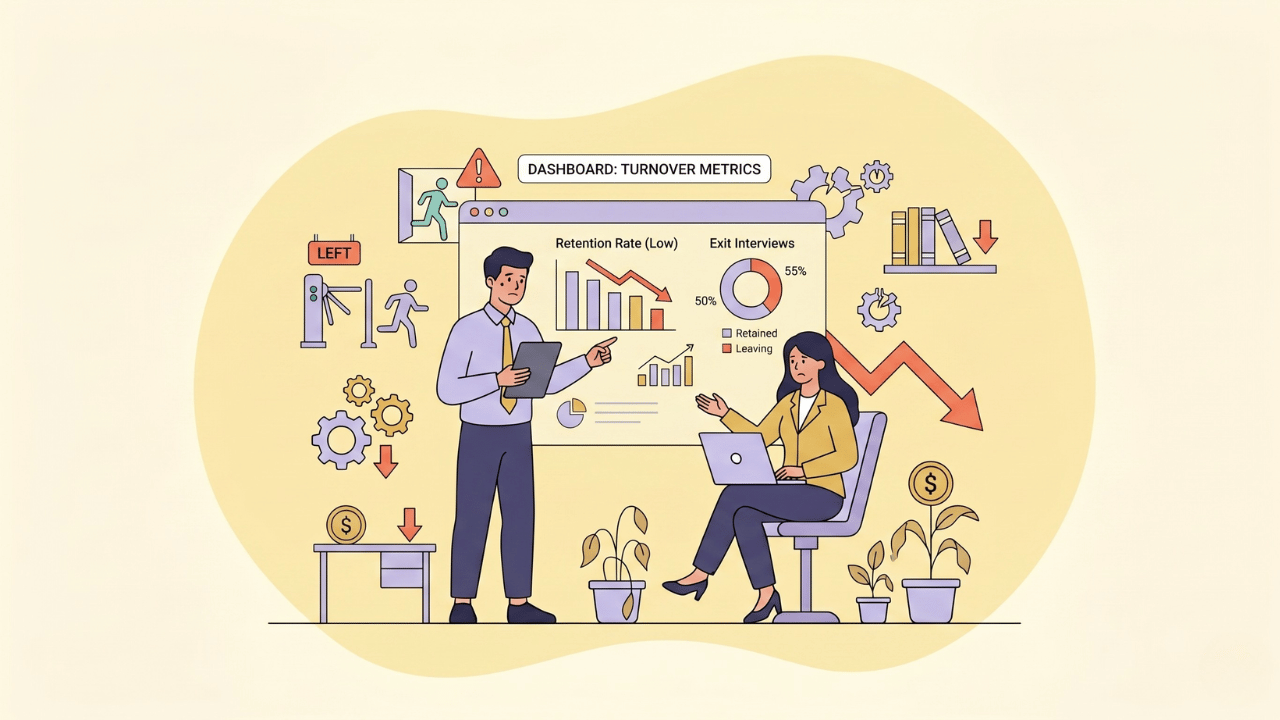
Employee turnover is the rate at which employees leave a company and have to be replaced over a given period. It's usually expressed as a percentage, and it covers everyone who exits, whether they quit, retire, or are let go.
I've watched leaders treat turnover as a fact of life, like weather. It isn't. Most of it is a result of decisions the company made, and most of it is measurable, predictable, and reducible.
This guide explains what employee turnover is, the different types, the real cost backed by data, and a step-by-step plan to bring it down. The key statistics are included throughout.
What Does Employee Turnover Mean?
Employee turnover is the share of a workforce that leaves and is replaced within a set time, usually a year. If your turnover rate is 20%, one in five of your people left over the period.
The standard formula:
Turnover rate = (employees who left during the period / average number of employees) x 100
Turnover is the mirror image of retention. If retention is 85%, turnover is roughly 15% for the same window. They describe the same reality from opposite directions.
What the headline number hides is the type of turnover, and that's where the real story is.
What Are the Types of Employee Turnover?
Not all turnover means the same thing. Treating it as one number is the most common analytical mistake I see.
| Type | What it means | Should you worry? |
|---|---|---|
| Voluntary | The employee chose to leave | Usually yes, especially for strong performers |
| Involuntary | The company ended the employment | A separate issue; review hiring and performance management |
| Regrettable | A good employee left voluntarily | Yes. This is the most important number |
| Non-regrettable | A poor fit left | Often healthy |
| Internal | The person moved roles inside the company | Generally a good sign |
The cut that matters most is regrettable turnover: people you wanted to keep, leaving on their own. A company can have a "normal" overall rate while quietly losing its best people. The average hides that. Always segment.
How Much Does Employee Turnover Cost? The Statistics
This is where the case for action gets concrete. The salary you stop paying is nothing next to what a departure actually costs.
The data:
- SHRM estimates replacing an employee costs between 50% and 200% of their annual salary.
- That often works out to six to nine months of the role's salary in total cost.
- Gallup puts the cost by role type at roughly 40% of salary for frontline staff, 80% for technical roles, and up to 200% for managers and leaders.
- Gallup has estimated voluntary turnover costs U.S. businesses around $1 trillion a year.
For a single employee on $60,000, that's a replacement cost somewhere between $30,000 and $120,000. The bill includes recruiting, onboarding, lost productivity while the seat is empty, and the months it takes a replacement to reach full speed.
There's a quieter cost too. Turnover is contagious. When good people leave, the people who stay start asking why, and some of them follow. High turnover damages morale, institutional knowledge, and customer relationships, none of which show up cleanly on an invoice.
Why Do Employees Leave? The Main Causes
After enough exit data, the reasons stop surprising you. People rarely leave over one thing. They leave over an accumulation, then a final trigger.
The most common drivers:
- Poor management. The direct manager is the single biggest factor in voluntary turnover.
- No growth path. The role stopped teaching them anything.
- Feeling unrecognized. Effort goes unnoticed for too long.
- Pay falling behind. The market moved and their salary didn't.
- Burnout. Sustained overload with no relief.
- Weak onboarding. They never felt set up to succeed in the first place.
- Culture mismatch. The workplace they were sold isn't the one they got.
Notice how few of these are about pay alone. Pay has to be competitive, but once it is, the reasons people leave are mostly about management, growth, and recognition.
How to Reduce Employee Turnover: An 8-Step Plan
Reducing turnover isn't one program. It's a set of habits across the whole employee lifecycle. Here's the plan I'd run.
Step 1: Measure and segment your turnover
Start with real numbers. Calculate your overall rate, then split it into voluntary, involuntary, and regrettable.
Then segment by team, by manager, and by tenure. The average lies. You'll usually find one or two teams driving a disproportionate share of the losses. That's where to look first.
Step 2: Find out why people actually leave
Run exit interviews, but don't fully trust them. People on the way out soften their answers to protect references.
The better signal comes from stay interviews: asking current employees what keeps them and what might tempt them away. You get honest answers while you can still act on them.
Step 3: Hire for fit, and be honest in hiring
A lot of turnover is created at the offer stage. Someone hired into the wrong role, or sold an inaccurate version of the job, is a turnover statistic waiting to happen.
Be accurate about the role during recruitment. A realistic job preview costs you a few candidates up front and saves you a first-year departure later.
Step 4: Fix onboarding
Turnover is often set in the first 90 days. A new hire who feels lost early is already half gone.
A strong employee onboarding process can improve new-hire retention by as much as 82%. Few interventions later in the lifecycle come close to that return.
Step 5: Invest in managers
Since most regrettable turnover traces back to the direct manager, manager quality is the highest-impact lever you have.
Give managers a simple operating rhythm: regular one-on-ones, clear expectations, feedback close to the event, and real career conversations. Hold them to it.
Step 6: Build a recognition habit
Feeling invisible is a quiet but powerful reason to leave. Recognition is the cheap fix most companies still ration.
Recooty's guide to showing appreciation to your team has formats that work in person and remotely. Make recognition specific, fast, and frequent.
Step 7: Keep pay competitive and create growth
Pay won't buy loyalty, but falling behind the market will cost you people. Benchmark salaries regularly and adjust before someone has to threaten to leave to get a raise.
Pair that with visible growth. People leave when the role stops growing them, so map a path and prioritize internal moves.
Step 8: Use data to predict turnover early
By the time turnover spikes, the problem is a year old. Engagement data is your early warning system.
Track engagement with regular employee engagement surveys, since scores dip months before resignations climb. Some teams now use predictive analytics, an area Recooty covers in its piece on AI in HR, to flag at-risk teams before anyone hands in notice.
How Do You Calculate a Healthy Turnover Rate?
You calculate the rate with the formula above, but "healthy" depends entirely on your industry. There's no universal good number.
Retail, hospitality, and call centers run high turnover by nature. Professional services and manufacturing run lower. Comparing your rate to a cross-industry average tells you almost nothing.
What matters more:
- Your trend over time. Is it rising or falling?
- Your sector benchmark. How do you compare to similar companies?
- Your regrettable rate. Are you losing the people you can least afford to lose?
A rising regrettable turnover rate is a problem even if the headline number looks normal. A falling overall rate driven by losing only poor fits can be a good sign. Read the components, not just the total.
How Does Turnover Connect to Engagement and Culture?
Closely. Turnover is downstream of engagement, culture, and management. People stay where they feel connected, valued, and fairly led.
A weak company culture raises turnover no matter what you spend on perks. A strong one lowers it without spending much at all.
There's a recruiting cost too. High turnover keeps your hiring pipeline permanently full and your cost per hire high. Companies with low turnover hire less, hire better, and spend the saved time getting each hire right. One of the most reliable ways to lower turnover is to fill roles through an employee referral program, since referred hires tend to stay longer than candidates from other sources.
Does Turnover Strategy Differ by Industry?
It does, and copying another industry's playbook is a common mistake. The right turnover strategy depends on what kind of turnover you're fighting.
Some sectors run high turnover by design. Retail, hospitality, fast food, and call centers have always had high churn, partly because the work is often seasonal, part-time, or a stepping stone rather than a career. In those settings the goal isn't zero turnover. It's reducing the turnover that hurts: early first-year exits and the loss of supervisors and skilled staff.
For high-volume, high-churn industries, the levers that work best are:
- Fast, simple hiring, so an empty seat is filled before it strains the team
- Strong, quick onboarding, since most churn happens in the first weeks
- Predictable scheduling, because erratic shifts are a top reason hourly staff quit
- A clear path to better roles, so good people see a reason to stay past the entry job
Lower-turnover sectors, like professional services, technology, and manufacturing, face a different problem. Turnover there is lower but each departure costs far more, because the knowledge is deeper and the replacement takes longer to find and ramp. For these industries the focus is regrettable turnover: keeping specialists and experienced staff through growth, recognition, and competitive pay.
There's also a tenure pattern that holds across industries. First-year turnover points back to hiring and onboarding. Mid-tenure turnover, in the one-to-three-year range, is almost always a management story. Long-tenure departures usually mean the role stopped offering anything new.
The practical rule is the same everywhere: segment your own turnover before you act. A retail manager and a software firm both have a "turnover problem," but the data underneath is different, and so is the fix. Benchmark against your own sector and your own history, never against a universal number.
Frequently Asked Questions
What is employee turnover in simple terms?
It's the rate at which employees leave a company and have to be replaced over a period, usually expressed as a yearly percentage. It's the opposite of retention.
How do you calculate employee turnover rate?
Divide the number of employees who left during the period by the average number of employees, then multiply by 100. If 15 people left from an average headcount of 100, turnover is 15%.
What is a good employee turnover rate?
It depends heavily on industry. Retail and hospitality run high by nature; professional services run lower. Compare your rate to your own sector and watch the trend, rather than chasing a universal number.
How much does employee turnover cost?
SHRM estimates replacing an employee costs 50% to 200% of their annual salary, often six to nine months of pay once you count recruiting, onboarding, and lost productivity. Senior roles cost the most.
What is regrettable turnover?
Regrettable turnover is the voluntary departure of employees you wanted to keep, usually strong performers. It's the most important slice of turnover data, because the overall rate can look healthy while you quietly lose your best people.
What is the main cause of employee turnover?
Poor management is the single biggest driver of voluntary turnover. After that come lack of growth, feeling unrecognized, pay falling behind the market, burnout, and weak onboarding. People usually leave over a combination, not one issue.
Can you predict employee turnover?
To a degree, yes. Engagement scores dip months before resignations rise, so they act as an early warning. Some companies use predictive analytics on engagement and performance data to flag at-risk teams before anyone resigns.
What's the difference between turnover and attrition?
They're often used interchangeably. Strictly, attrition sometimes refers to roles left unfilled after someone leaves, while turnover covers all departures that are replaced. In everyday HR use, the distinction is minor.
How does onboarding affect employee turnover?
A new hire's first 90 days strongly predict whether they stay. A weak start leaves people feeling unprepared and overlooked, and many leave within the first year. Strong onboarding can improve new-hire retention by as much as 82%, making it one of the best defenses against early turnover.
Is some employee turnover healthy?
Yes. Losing poor-fit employees is healthy and normal, and no company should aim for zero turnover. The danger is regrettable turnover, the loss of strong performers, which can climb quietly while the overall rate still looks normal.

.jpg)
.png)

.webp)