.webp)
.avif)
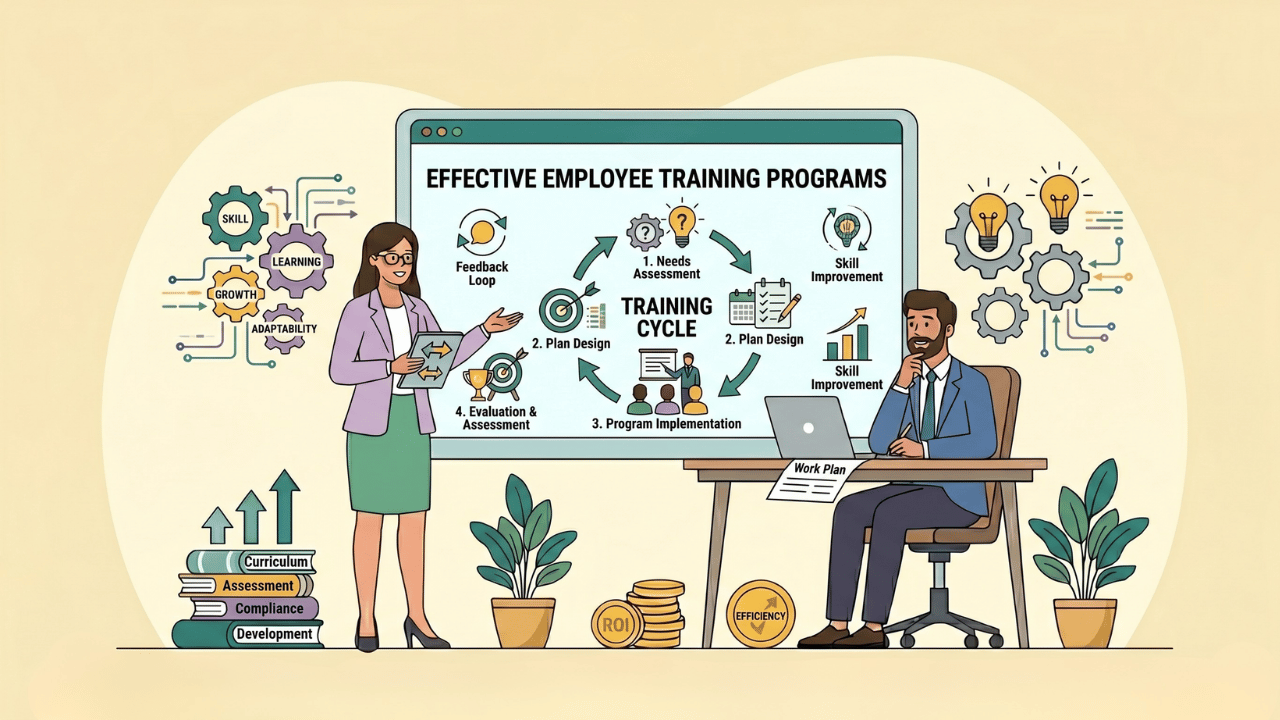
Employee training is the structured process a company uses to give its people the knowledge, skills, and behaviors they need to do their jobs well and grow over time. It runs from a new hire's first week through every stage of someone's career.
I think training is the most over-promised and under-delivered thing in HR. Every company says it invests in people. Far fewer do it in a way that actually changes how the work gets done.
This guide covers what employee training is, the types, the data behind why it matters, and a step-by-step way to run it well. The key statistics are included throughout.
What Does Employee Training Mean?
Employee training is any planned effort to improve how well people can do their jobs. The key word is planned. A colleague answering a one-off question is help. Training is a deliberate program with goals and a way to tell if it worked.
It usually sits inside a wider function called learning and development, or L&D. Training tends to mean building skills for the current job. Development means preparing someone for a future role. Most good programs do both.
Training covers a lot of ground:
- Teaching a new hire how the job is done here
- Bringing someone up to speed on a new tool or process
- Closing a specific skill gap on a team
- Required compliance and safety training
- Building leadership skills in future managers
The thread through all of it: training exists to change behavior, not to fill seats in a room.
Why Does Employee Training Matter? The Statistics
Because training is one of the few things that improves performance and retention at the same time. The data backs both claims.
A few numbers worth keeping in mind:
- Companies with a strong learning culture see roughly a 57% retention rate, against about 27% at companies with only moderate learning investment, per LinkedIn's research. Learning roughly doubles the odds people stay.
- Providing learning opportunities is consistently ranked the top retention strategy by HR leaders.
- U.S. organizations spent an average of about $1,254 per employee on learning in 2024, according to ATD.
- Around 49% of L&D professionals report a skills crisis, with executives worried their people lack the skills to execute strategy.
Here's why that matters. People don't just want a paycheck; they want to feel like the job is taking them somewhere. When the role stops teaching them anything, they leave. Training is how you keep the work growing the person.
There's a performance angle too. A skill gap on a team is a slow, invisible tax: work takes longer, quality slips, and mistakes cost money. Training closes the gap directly.
What Are the Types of Employee Training?
Training isn't one thing. Different goals call for different methods. The main types:
| Type | What it covers | Best for |
|---|---|---|
| Onboarding training | How the job and company work | Every new hire |
| Technical or hard-skills | Tools, systems, job-specific methods | Closing capability gaps |
| Soft-skills | Communication, teamwork, problem-solving | Collaboration and culture |
| Compliance and safety | Legal and regulatory requirements | Risk reduction |
| Leadership development | Managing people and decisions | Future and current managers |
| Reskilling and upskilling | New skills for changing roles | Adapting to automation and change |
Most companies over-invest in compliance training, because it's required, and under-invest in leadership and soft skills, because they're harder to measure. In my view that's backward. The training that's hardest to measure is often the one that changes the most.
How to Build an Employee Training Program: A 9-Step Plan
A training program works when it's tied to a real need and you can tell whether it landed. Here's the process I'd run.
Step 1: Run a training needs analysis
Don't start with a course. Start with a gap. Compare what people can do now against what the business needs them to do.
Pull from performance reviews, manager input, business goals, and direct observation. The gaps you find are your curriculum. Training built on anything else is a guess.
Step 2: Set clear, measurable objectives
"Improve communication skills" is not an objective. "Reduce customer complaint escalations by 20% in two quarters" is.
Write objectives you can measure. They tell you what to teach, and they're the only way you'll later know if the training worked.
Step 3: Prioritize by impact
You can't train everything at once. Rank the gaps by how much closing each one is worth to the business.
Start with the gaps that cost the most or block the most. A program that fixes one expensive problem beats a catalog of courses nobody asked for.
Step 4: Choose the right format for each goal
Match the method to the skill. Knowledge transfers fine through e-learning. Behavior change usually needs practice, coaching, or doing the real work with support.
Common formats:
- On-the-job training for practical, role-specific skills
- E-learning for knowledge, compliance, and anything self-paced
- Instructor-led sessions for complex topics and discussion
- Coaching and mentoring for leadership and judgment
- Blended learning, which combines several of the above
Step 5: Build or source the content
Decide what to make in-house and what to buy. Internal experts know your context; external content is faster and often higher quality for general skills.
Whatever you use, keep it close to the real job. Generic content that doesn't reflect how your people actually work gets ignored.
Step 6: Make time for it
This is where most programs quietly die. If training competes with daily work and always loses, it doesn't happen.
Managers have to protect training time and treat it as part of the job, not an extra. A program nobody is given time for is a program that fails. The same logic shows up in Recooty's work on improving employee efficiency: people need both the skill and the room to apply it.
Step 7: Deliver and support the transfer
The session is not the finish line. Most learning is lost if it's never applied.
Build in follow-up: practice on real tasks, manager reinforcement, and quick refreshers. The goal is the skill showing up in the work weeks later, not a completed course.
Step 8: Measure whether it worked
Go back to the objectives from Step 2. Did the metric move?
Track more than attendance. Look at skill assessments before and after, on-the-job performance, and business outcomes. The Kirkpatrick model is a useful frame: measure reaction, learning, behavior, and results, in that order of difficulty and value.
Step 9: Use the results to improve
Treat the program as something you refine, not a project that ends. Feed what worked and what didn't into the next cycle.
Training that improves each round compounds. Training that's run once and forgotten rarely justifies its cost.
How Does Employee Training Connect to AI?
AI is changing how training is built and delivered, and it's worth knowing where. Recooty's work on AI in HR covers this in depth.
The practical shifts:
- Skill gap analysis that reads performance data and flags gaps faster than a manual review
- Personalized learning, where the content adapts to a person's role, skills, and goals instead of one generic catalog
- Career pathing that shows an employee what skills they need for the role they want next
Around 71% of L&D professionals are now experimenting with or integrating AI into their work. I'd treat it as a tool that makes training more personal and better targeted, not a replacement for the human parts: coaching, practice, and a manager who cares whether the skill sticks.
How Does Training Connect to Retention and Hiring?
Tightly, in both directions. Training is one of the strongest retention levers there is, because it keeps the role growing the person. When learning stops, people start looking.
It also reduces hiring pressure. A company that reskills its own people can fill some roles internally instead of going to market, which cuts cost per hire and keeps institutional knowledge in the building. Internal mobility built on training is cheaper and faster than external hiring almost every time.
There's a brand effect too. A real commitment to development is something candidates notice, and it strengthens your employer branding. It also makes a strong company culture tangible, because "we invest in our people" stops being a slogan and becomes something employees can point to.
What Are the Most Common Employee Training Mistakes?
Most failed training programs don't fail because the content was bad. They fail because of how the program was run. These are the mistakes I see most.
- Training with no defined gap. A program built because "we should do training" rather than to close a specific, identified skill gap. It has no clear goal, so it can't have a clear result.
- Measuring attendance instead of outcomes. Counting how many people completed a course tells you nothing about whether the skill changed the work. Completion is an input, not a result.
- No time to actually learn. This is the quiet killer. When training competes with daily work and always loses, the program exists on paper only. Managers have to protect the time.
- One-and-done sessions. A single workshop with no follow-up. Most of what's taught in an isolated session is lost within weeks if it's never practiced or reinforced on the job.
- Generic, off-the-shelf content. Material that doesn't reflect how your people actually work gets tuned out. The closer training sits to the real job, the more of it sticks.
- Treating training as an event, not a habit. A program run once a year, disconnected from everyday work, signals that learning is a box to tick. Continuous, smaller learning beats an annual marathon.
- Ignoring managers. Managers decide whether a skill gets used after the course ends. If they don't reinforce it, the training quietly evaporates regardless of how good it was.
The thread running through all of these: training only counts when the behavior shows up in the work afterward. A program that's tied to a real gap, given real time, and reinforced by managers will change how the job gets done. A program that's run for its own sake just burns budget and people's patience.
Frequently Asked Questions
What is employee training?
It's the structured, planned process a company uses to give employees the knowledge, skills, and behaviors they need to do their jobs well and grow. It exists to change how work gets done, not just to deliver courses.
What is the difference between training and development?
Training builds skills for someone's current job. Development prepares them for a future role. Most good programs do both, and the wider function is usually called learning and development, or L&D.
What are the main types of employee training?
Onboarding training, technical or hard-skills training, soft-skills training, compliance and safety training, leadership development, and reskilling or upskilling. Each type suits a different goal and calls for a different delivery method.
Does employee training improve retention?
Yes, strongly. LinkedIn's research links a strong learning culture to roughly a 57% retention rate, against about 27% where learning investment is only moderate. Providing learning opportunities is consistently ranked the top retention strategy.
How do you measure training effectiveness?
Go back to the program's objectives and check whether the target metric moved. Track skill assessments before and after, on-the-job behavior, and business outcomes, not just attendance. The Kirkpatrick model is a useful framework.
How much should a company spend on training?
There's no single right figure, but ATD found U.S. organizations spent about $1,254 per employee on learning in 2024. What matters more than the amount is tying spend to real skill gaps and measuring the result.
What is a training needs analysis?
It's the process of comparing what employees can do now against what the business needs them to do. The gaps it identifies become the training curriculum, so the program is built on real need rather than guesswork.
Can small businesses run effective training?
Yes. Small teams can lean on on-the-job training, mentoring, and affordable e-learning. The discipline that matters is the same at any size: train against real gaps, protect time for it, and measure whether it worked.
What is the difference between upskilling and reskilling?
Upskilling teaches an employee new skills for their current role, deepening what they can already do. Reskilling teaches a different set of skills so a person can move into a new role, often one created or changed by automation. Both keep people employable and reduce hiring pressure.
How often should employee training happen?
Treat training as continuous rather than an annual event. Smaller, regular learning, reinforced on the job, sticks far better than one large yearly session. Onboarding training is intensive at the start, then development continues at a steady pace throughout someone's time with the company.
.jpg)
.png)

.webp)