.webp)
.avif)
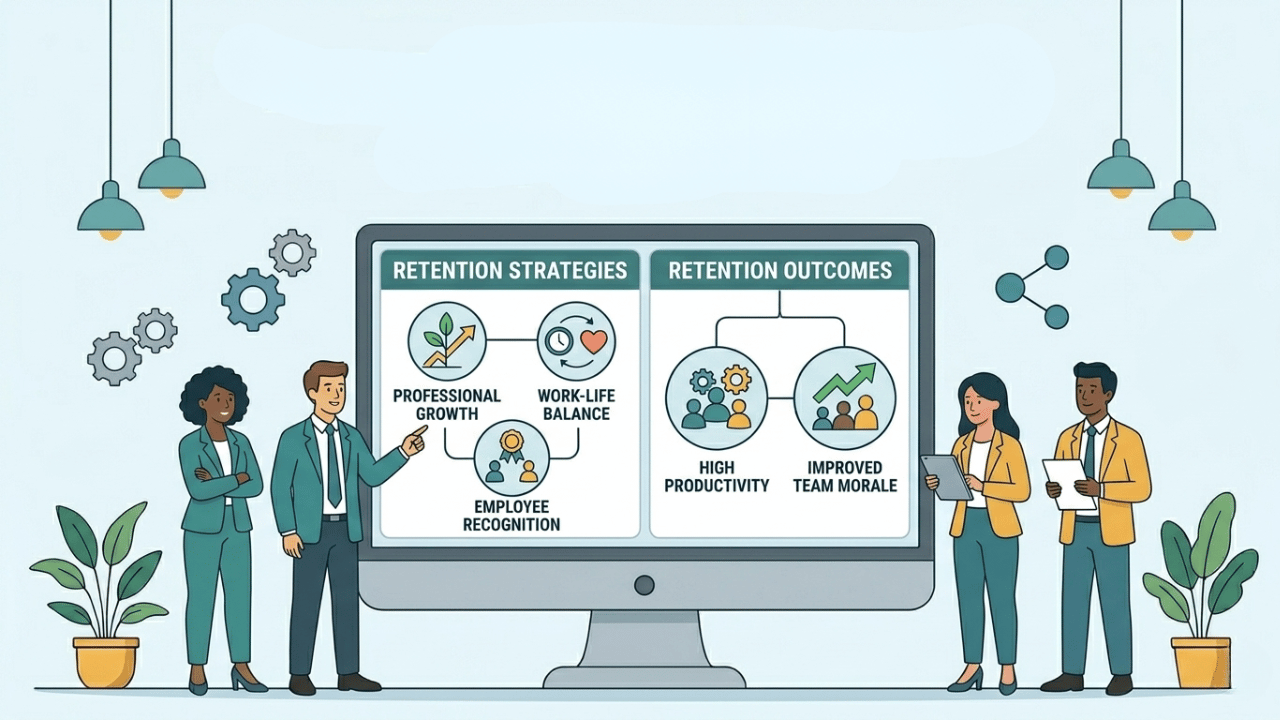
Employee retention is a company's ability to keep its employees and reduce how many leave over a given period. It's measured as a rate, and it's the flip side of turnover. High retention means people choose to stay. Low retention means you're constantly rehiring for the same roles.
I've watched companies pour money into hiring while ignoring the leak at the other end. It's like filling a bucket with a hole in it. You can be brilliant at recruiting and still lose, because every departure costs you money, knowledge, and momentum.
What Does Employee Retention Mean?
Employee retention is the rate at which an organization keeps its staff over time. A simple way to picture it: of the people who were here a year ago, how many are still here today?
The formula is straightforward:
Retention rate = (employees who stayed the whole period / employees at the start) x 100
If you started the year with 100 people and 88 of the original group are still on staff, your retention rate is 88%.
Two distinctions matter when you read the number:
- Voluntary turnover is people choosing to leave. This is the kind you can usually influence.
- Involuntary turnover is people you let go. This is a separate problem.
- Regrettable turnover is the one to watch hardest: strong performers leaving voluntarily. Losing a struggling employee and losing your best engineer are not the same event, even though both lower the rate.
A healthy retention rate depends entirely on your industry. Tech and retail look nothing alike. Compare yourself to your sector, not to a universal benchmark.
Why Does Employee Retention Matter?
Because turnover is one of the most underestimated costs in any business. The salary you save when someone leaves is dwarfed by what their departure actually costs you.
When someone leaves, you pay for:
- Rehiring: advertising, recruiter time, interviews, onboarding
- Lost productivity: the empty seat, plus the ramp-up time for the replacement
- Lost knowledge: everything that person knew that was never written down
- Team strain: colleagues covering the gap, sometimes deciding to leave too
- Customer disruption: relationships that walk out with the person
Estimates for replacing an employee commonly run from one-half to two times their annual salary, depending on the role's seniority. For a specialized role, the real figure is often higher once you count the months of lost output.
There's a quieter cost too. Turnover is contagious. When good people leave, the people who stay start asking why, and some of them update their resumes. Retention protects morale as much as it protects the budget.
What Causes Employees to Leave?
After enough exit interviews, the reasons stop surprising you. People rarely leave over one thing. They leave over an accumulation, and then a final trigger.
The most common drivers:
Notice how few of these are about money alone. Pay matters, and pay has to be competitive. But once it's fair, the reasons people leave are mostly about management, growth, and recognition.
How to Improve Employee Retention: A 9-Step Plan
Retention isn't a single program. It's a set of habits across the whole employee lifecycle. Here's the plan I'd run.
Step 1: Measure retention and turnover honestly
Start with real numbers. Calculate your retention rate, your turnover rate, and split turnover into voluntary, involuntary, and regrettable.
Then segment it. Retention by team, by manager, and by tenure. The averages hide the story. You'll often find one team or one manager driving a disproportionate share of departures.
Step 2: Find out why people actually leave
Run exit interviews, but don't fully trust them. People on the way out soften their answers to protect references.
The better signal comes from stay interviews: asking current employees what keeps them and what might tempt them away. You get honest answers while you can still act on them.
Step 3: Fix onboarding
Retention is won or lost in the first 90 days. Someone who feels lost early is already half gone.
A strong employee onboarding process is one of the highest-return retention moves available. Recooty's data shows a good onboarding plan can improve retention by as much as 82%. Few interventions later in the lifecycle come close to that.
Step 4: Invest in managers
Since most regrettable turnover traces back to the direct manager, this is the step that returns the most for the effort.
Give managers the basics and hold them to it: regular one-on-ones, clear expectations, feedback close to the event, and real career conversations. A manager who does those four things consistently will out-retain a manager who doesn't, every time.
Step 5: Build a recognition habit
Feeling invisible is a quiet but powerful reason to leave. Recognition is the cheap fix most companies still ration.
The data is direct: employees who don't feel recognized are about twice as likely to quit within the year. Recooty's guide to showing appreciation to your team has formats that work for in-office and remote staff alike. Make recognition specific, fast, and frequent.
Step 6: Create real growth paths
People leave when the role stops growing them. If the only way up is out, they'll take it.
Map a visible path for each person. Fund learning. Prioritize internal mobility, so an employee who's outgrown their role can find their next move inside the company instead of on a job board.
Step 7: Keep pay and benefits competitive
Pay won't buy loyalty, but falling behind the market will cost you people. Benchmark salaries regularly and adjust before someone has to threaten to leave to get a raise.
Reacting to a resignation with a counteroffer is the most expensive and least effective way to manage pay. Get ahead of it.
Step 8: Protect against burnout
Burnout is a slow-motion resignation. Watch workloads, respect time off, and treat sustained overload as a problem to fix, not a sign of commitment.
A burned-out top performer is a flight risk you created. Managing capacity is part of managing retention.
Step 9: Strengthen culture and engagement
Retention is downstream of engagement and culture. People stay where they feel connected, valued, and aligned with the place.
Keep measuring engagement with regular employee engagement surveys, and keep investing in company culture. Engagement scores are an early warning system. They dip months before turnover spikes.
How Do You Measure Employee Retention?
You measure it with a small set of metrics, read together. One rate alone won't tell you whether you have a problem worth acting on.
The metrics to track:
- Retention rate: the share of people who stayed over the period
- Turnover rate: the inverse, broken into voluntary and involuntary
- Regrettable turnover: departures of strong performers, the most important cut
- Average tenure: how long people typically stay
- First-year turnover: a direct read on hiring and onboarding quality
- Cost of turnover: the dollar figure that makes the case to leadership
A useful comparison of where each metric points:
This is where connected HR data helps. When hiring, onboarding, and employee records live in one place, like an applicant tracking system, you can trace turnover back to its source: a sourcing channel, a manager, or a stage in the process.
How Does Retention Connect to Recruitment?
Closely, and in both directions. Strong retention makes recruitment easier, because you have fewer holes to fill and more time to hire well for the ones you do.
It also feeds your reputation. People who stay and speak well of the company become your best employer branding. And your own staff become a hiring channel through an employee referral program, recommending others into a place they themselves chose not to leave.
The loop runs the other way too. Bad hiring causes bad retention. Someone hired into the wrong role or sold an inaccurate picture of the job is a turnover statistic waiting to happen. Retention starts at the offer stage, not on the exit interview.
Does Retention Strategy Change by Employee Tenure?
It does, and treating all turnover the same is one reason retention efforts miss. Someone leaving in month three and someone leaving in year six are telling you completely different things. The fix for each is different too.
Here's how I'd break it down by stage of tenure.
First-year turnover is the one I'd watch most closely, because it points straight back at hiring and onboarding. If a lot of people leave inside twelve months, the problem started before they joined. You either hired the wrong people or sold them a job that didn't match reality.
Mid-tenure turnover, the 6-to-24-month band, is almost always a management story. These people were good enough to keep past onboarding and then something in the day-to-day wore them down. That something is usually their manager.
Long-tenure departures are the hardest to prevent and the most expensive when they happen, because that person carries years of institutional knowledge. The retention move here isn't a perk. It's giving experienced people a genuinely new challenge before boredom does it for you.
The practical takeaway: segment your turnover by tenure before you design a single fix. The data tells you which lever to pull. A recognition program won't help if your real problem is first-year hires walking out because the job was mis-sold.
What Are the Most Common Myths About Employee Retention?
A few beliefs about retention are widespread and wrong, and they push companies toward the wrong fixes. Here are the ones I'd push back on.
- "It's all about pay." Pay has to be fair, and falling behind the market will cost you people. But once pay is competitive, more money won't keep a disengaged employee. The reasons people leave are mostly about management, growth, and recognition.
- "Some turnover is healthy, so don't worry about it." A little turnover is fine. The myth hides inside the average. Losing low performers is healthy. Losing your best people is not, and the overall rate can look normal while regrettable turnover quietly climbs.
- "A counteroffer solves it." By the time someone resigns, they've usually checked out emotionally. Counteroffers buy a few months and cost a lot. Retention is won before the resignation, not after.
- "Retention is HR's job." HR provides the tools and data. The day-to-day reality of whether someone stays is shaped by their direct manager.
- "Exit interviews tell you why people leave." They tell you a softened version. People protect their references. Stay interviews with current employees are far more honest.
The common thread: retention problems are rarely about one obvious thing, and the obvious fix is usually the wrong one. Read your own data before copying someone else's solution.
Frequently Asked Questions
What is employee retention in simple terms?
It's a company's ability to keep its employees over time and avoid losing them. It's measured as a retention rate, and it's the opposite of turnover.
How do you calculate employee retention rate?
Divide the number of employees who stayed for the whole period by the number you had at the start, then multiply by 100. If 88 of an original 100 employees remain after a year, retention is 88%.
What is a good employee retention rate?
It depends heavily on industry. Tech, retail, and healthcare have very different norms. Compare your rate to your own sector rather than to a universal number, and watch the trend over time.
Why do employees leave their jobs?
The most common reasons are poor management, no growth path, feeling unrecognized, pay falling behind the market, burnout, and weak onboarding. People usually leave over an accumulation of these, not one single issue.
What is the difference between retention and turnover?
They're two sides of one number. Retention is the share of people who stay; turnover is the share who leave. If retention is 85%, turnover is roughly 15% for the same period.
How much does employee turnover cost?
Replacing an employee commonly costs between one-half and two times their annual salary, and more for senior or specialized roles once you count lost productivity and knowledge.
What is a stay interview?
A conversation with a current employee about what keeps them at the company and what might tempt them to leave. Unlike an exit interview, it gives you honest information while you can still act on it.
Who is responsible for employee retention?
Managers carry the day-to-day responsibility, since most voluntary turnover traces back to the direct manager. HR provides tools, data, and programs. Leadership sets the culture. It is not an HR-only job.
What is regrettable turnover?
Regrettable turnover is the voluntary departure of employees a company wanted to keep, usually strong performers. It's the most important cut of turnover data, because the overall rate can look healthy while you quietly lose the people you can least afford to lose.
How does onboarding affect employee retention?
Onboarding shapes whether a new hire feels set up to succeed in their first 90 days, and that period strongly predicts whether they stay. A strong onboarding process can improve retention by as much as 82%, making it one of the highest-return retention investments available.
How can a small company improve retention on a budget?
The highest-return retention moves cost little: consistent one-on-ones, fast and specific recognition, clear expectations, realistic job descriptions at the hiring stage, and stay interviews. Budget mostly helps with pay benchmarking and formal development programs.
What is the difference between an exit interview and a stay interview?
An exit interview happens when someone is leaving and tends to produce softened answers. A stay interview happens with current employees and asks what keeps them and what might tempt them away, giving you honest information while you can still act on it.

.jpg)
.png)

.webp)