.webp)
.avif)
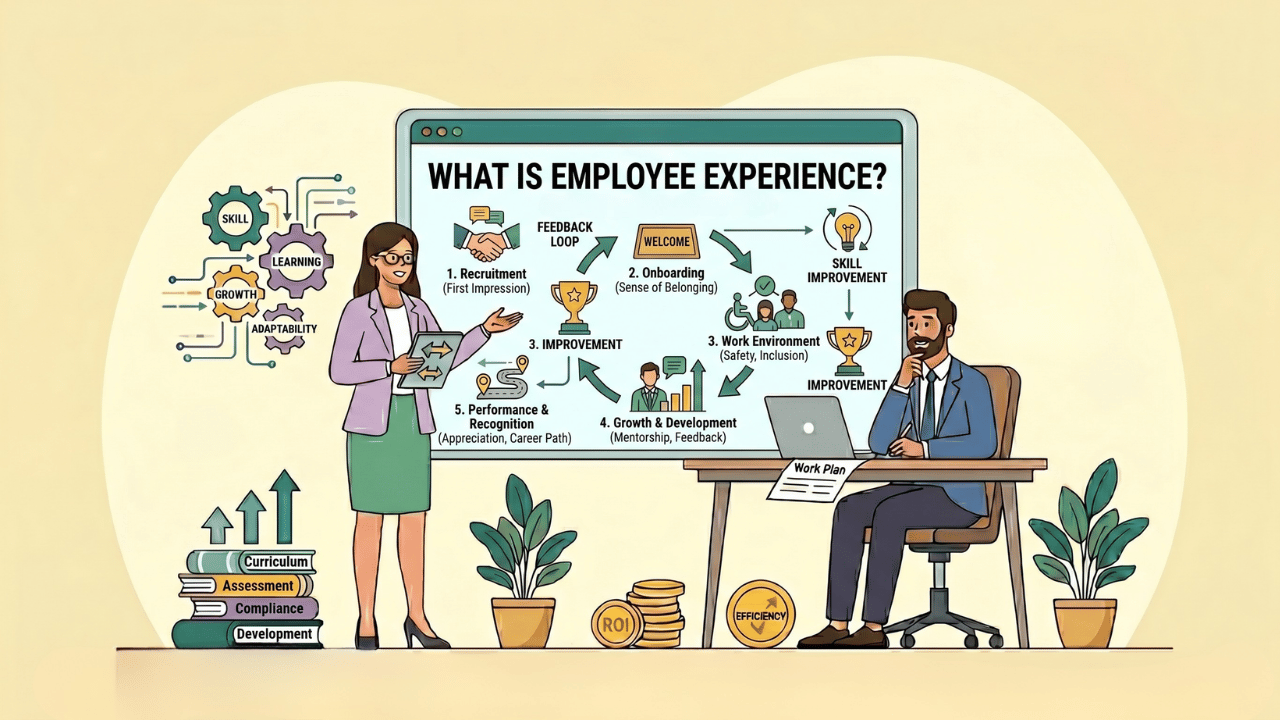
Employee experience is the sum of every interaction a person has with your company, from the first job ad they see to their last day and beyond. It covers the physical workspace, the tools they use, the people they work with, and the culture they live inside. In short, it's what working for you actually feels like.
I used to think employee experience was a rebranding of engagement. It isn't. Engagement is one outcome. Experience is the whole input. You design the experience, and engagement is part of what you get back.
What Does Employee Experience Actually Mean?
Employee experience, often shortened to EX, is the perception an employee forms based on every touchpoint with the organization across their full time there.
The cleanest definition I've come across: employee experience is the interactions employees have with each other, with systems and policies, and with the physical and virtual workplace. It includes the small details of everyday work and the occasional big events.
Two things make EX different from older HR concepts:
- It's end-to-end. It starts before someone is hired and continues after they leave. It isn't limited to the time they're on payroll.
- It's the employee's perception, not your intention. You can design a great onboarding plan. If it feels chaotic to the new hire, the experience was bad. Their read is the only one that counts.
I like to compare it to customer experience. Companies obsess over how a product feels to a buyer. EX is applying that same discipline to how a job feels to the person doing it.
Why Does Employee Experience Matter?
Because experience is the upstream cause of almost every people metric you care about. Get EX right and engagement, retention, and productivity tend to follow. Get it wrong and you're firefighting all three forever.
A few reasons it earns the attention:
- Talent has options. In a competitive market, the experience you offer is part of what you're selling to candidates.
- It compounds. A good first 90 days makes the next two years easier. A bad start is expensive to undo.
- It shows up externally. People talk. Glassdoor, LinkedIn, and group chats all carry your EX to the next candidate.
There's a hard number worth keeping in mind. Research shows that candidates who go through an exceptional onboarding are about 2.6 times more likely to feel happy in their job and stay. The experience you design pays you back in retention.
What Are the Stages of the Employee Lifecycle?
Employee experience is built stage by stage. Each one is a chance to either add trust or erode it. I think of the lifecycle in six stages.
A weak link anywhere drags the whole experience down. A brilliant onboarding can't rescue a hiring process that left the candidate feeling like a number.
That's why candidate experience is part of EX, not separate from it. The experience starts long before day one. Research from PwC found nearly 49% of job seekers have had a poor candidate experience, and about 78% say the way they're treated while applying reflects how the company values its people. They're not wrong to read it that way.
What Are the Three Environments of Employee Experience?
The lifecycle is the timeline. The environments are what the experience is made of at any given moment. Most EX frameworks, including the well-known one from Jacob Morgan, break it into three.
- The physical environment. The office, the desk, the equipment, or for remote staff, the home setup and how well it's supported.
- The technological environment. Every tool a person touches to do their job. Slow, clunky software is a daily tax on experience.
- The cultural environment. The feeling of the place. Leadership behavior, values, fairness, and whether people are recognized.
In my experience, the cultural environment carries the most weight and gets the least budget. You can give someone a great laptop and a nice chair, but if the company culture is political or unfair, the experience is still poor.
How to Design a Great Employee Experience: A Step-by-Step Plan
You don't fix EX with one initiative. You design it deliberately, the way you'd design a product. Here's the process I'd run.
Step 1: Map the current experience
Before you change anything, document what people actually go through. Walk the full lifecycle, stage by stage, and write down every touchpoint.
For each touchpoint, ask three questions. What is supposed to happen? What actually happens? How does it feel to the employee? The gaps between those answers are your project list.
Step 2: Find the moments that matter
Not every touchpoint is equal. A handful of moments shape how people feel far more than the rest.
The first day. The first paycheck. A promotion. A return from parental leave. A reorg. These "moments that matter" deserve real design attention. Fix the moments that carry emotional weight before you polish the routine ones.
Step 3: Build an experience-led onboarding
If I could only fix one stage, it would be this one. Onboarding sets the tone for everything after it.
A strong employee onboarding process gives a new hire clarity, early wins, and a manager who is present. Recooty's data on onboarding shows a good plan can lift retention by as much as 82% and boost productivity by more than 70%. Few other projects pay back like that.
Step 4: Fix the technology friction
Audit the daily tools. Sit with employees and watch them work. You'll find logins that fail, approvals that take a week, and systems that don't talk to each other.
Every one of those is a small, repeated message that says "your time doesn't matter here." Removing friction is unglamorous and one of the highest-return EX moves you can make.
Step 5: Define your employee value proposition
Your employee value proposition is the deal you offer: what people give you, and what they get in return. It's the promise behind the experience.
Write it down honestly. Then check whether the lived experience matches the promise. A gap between what you advertise and what people get is the fastest way to lose trust.
Step 6: Listen continuously, not annually
One survey a year can't keep up with how people feel. Build a listening system instead.
Combine a few channels:
- A deeper annual or biannual experience survey
- Short, frequent pulse checks
- Stage-specific surveys, like a 30-day onboarding check-in
- Open feedback channels and exit interviews
If you want the mechanics of doing this well, Recooty's guide to employee engagement surveys covers question design and cadence.
Step 7: Act visibly and close the loop
Listening without action is worse than not listening. People notice the silence.
After every round of feedback, pick a small number of changes, ship them, and tell people the change came from what they said. That loop is what makes the next round of feedback honest.
Step 8: Treat offboarding as part of the brand
How you treat people on the way out is part of the experience too. Leavers become alumni, referrers, and sometimes returning hires.
A respectful, organized exit costs little and protects your reputation. A messy one shows up in reviews within a week.
How Do You Measure Employee Experience?
You measure it across the lifecycle, not with a single year-end score. The point is to know where in the experience things break.
Metrics I'd track:
- eNPS, a quick read on whether people would recommend the place
- Stage-specific scores, like onboarding satisfaction or exit sentiment
- Engagement score, since engagement is a core EX outcome
- Retention and voluntary turnover, broken down by tenure
- Time to productivity for new hires
- Internal mobility rate, a sign people see a future inside
The structure that matters most is journey mapping: plotting scores against each lifecycle stage so you can see exactly where the experience dips.
This is also where good HR tooling earns its place. When recruitment, onboarding, and people data sit in one connected system, like an applicant tracking system, you can follow a person from first application onward instead of stitching together separate spreadsheets.
How Is Employee Experience Different From Engagement and Culture?
People use these three words interchangeably, and they shouldn't. Here's how I keep them straight.
Put simply: culture is part of the experience, and engagement is part of what a good experience produces. You design experience. You measure engagement. You live the culture.
Why Employee Experience Drives Your Employer Brand
A strong internal experience becomes your strongest external recruiting asset. People who feel well treated say so, and candidates believe employees far more than they believe a careers page.
That feedback loop runs straight into your employer branding. It also shapes the recruitment funnel, because a respectful candidate experience is where the employee experience begins. Get EX right and hiring gets cheaper, because reputation and referrals carry part of the load.
What Does Employee Experience Look Like for Remote and Hybrid Staff?
Remote work changed which environment carries the most weight. For office staff, the physical environment is something a company controls directly. For remote staff, it's a spare room, a kitchen table, and an internet connection the company has almost no say over.
That shifts the burden onto the other two environments. The technology has to be excellent, because the tools are now the workplace. And the culture has to be intentional, because none of it happens in a shared room anymore.
A few things I'd prioritize for a distributed workforce:
- Fund the home setup. A stipend for a decent chair, monitor, and connection is a direct EX investment, not a perk.
- Treat tooling as the office. A laggy app or a broken login is now a bad workplace, in the most literal sense.
- Make information equal. Decisions made in a meeting room have to be written down, or remote staff fall a step behind on everything.
- Design connection deliberately. The relationships that built culture by accident in an office now need a structure to form at all.
The risk in hybrid setups specifically is proximity bias. The people physically present get more visibility, more informal feedback, and, over time, more opportunity. Left unmanaged, that turns into a two-tier experience where being remote quietly costs you. The fix is a discipline: judge work by output, run meetings as if everyone is remote, and check that promotions don't skew toward whoever sits closest to the manager.
Recooty's piece on how to manage a remote team covers the operational side of this in more depth. The short version: a great remote employee experience doesn't happen by default. You design it, the same as everything else in EX.
What Technology Supports a Good Employee Experience?
Technology is one of the three EX environments, and for most teams it's the one employees touch most often. Bad software is a daily friction tax. Good software gets out of the way.
I don't think you need a huge stack. You need a few things that work well and connect to each other. The categories that matter:
- Hiring and onboarding systems that carry a person smoothly from candidate to employee without re-entering the same data five times.
- Communication and collaboration tools that make information easy to find, especially for remote staff.
- A listening tool for surveys and pulse checks, so feedback is continuous rather than annual.
- Self-service HR, so simple tasks like booking leave don't require an email and a wait.
The thread connecting these is integration. The worst EX tech problem isn't a missing tool. It's ten tools that don't talk to each other, so a new hire's information lives in disconnected silos.
This is why the hiring system matters more than people expect. When recruitment and onboarding run on one connected platform, the handoff from candidate to employee is smooth, and the experience starts well instead of starting with a data-entry mess. A tool that does its job quietly is itself an EX win. Employees rarely praise software that works, but they always remember software that wastes their time.
Frequently Asked Questions
What is employee experience in simple terms?
It's everything a person encounters and feels across their entire time with a company, from the job ad through onboarding, daily work, growth, and exit. It's what working for you actually feels like.
What is the difference between employee experience and employee engagement?
Employee experience is the full set of interactions you design. Engagement is the emotional commitment that results from it. Experience is the cause; engagement is one of the effects.
What are the stages of the employee lifecycle?
The six common stages are attraction, recruitment, onboarding, development, retention, and exit. Each stage is a chance to strengthen or weaken the overall experience.
What are the three environments of employee experience?
The physical environment (workspace and equipment), the technological environment (the tools people use), and the cultural environment (values, leadership, and how people are treated).
How do you measure employee experience?
Use eNPS, stage-specific surveys, engagement scores, retention data, and time to productivity. Map the results against each lifecycle stage so you can see where the experience dips.
Who owns employee experience?
It's shared. HR designs and coordinates it, managers deliver it day to day, IT and facilities shape the physical and tech environments, and leadership sets the culture. EX fails when it's treated as an HR-only project.
Where does employee experience start?
It starts before hiring, during the candidate experience. The way people are treated while applying is the first chapter of their employee experience, whether or not they're hired.
What are "moments that matter" in employee experience?
These are the high-emotion touchpoints that shape how people feel far more than routine ones: the first day, the first paycheck, a promotion, returning from leave, or a reorganization. Designing these moments well delivers a bigger return than polishing everyday processes.
How often should you survey employees about their experience?
Use a layered approach: a deeper experience survey once or twice a year, short pulse checks more frequently, and stage-specific surveys like a 30-day onboarding check-in. Continuous listening beats one annual snapshot, which goes stale quickly.
Is employee experience the same as HR?
No. HR is a function. Employee experience is an outcome that HR helps shape, alongside managers, IT, facilities, and leadership. Treating EX as an HR-only project is a common reason it fails.
.jpg)
.png)

.webp)