.webp)
.avif)
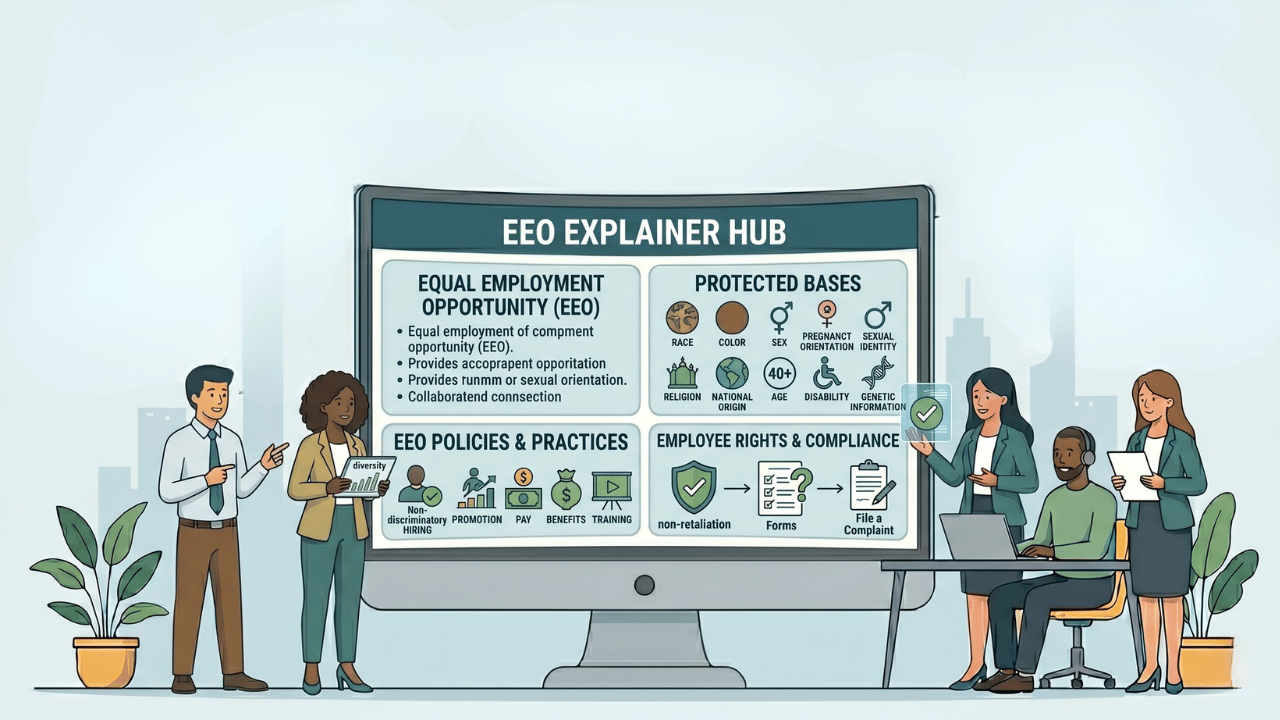
Equal employment opportunity (EEO) is the principle that all individuals must have an equal chance to be hired, promoted, compensated, and treated fairly in the workplace, regardless of race, color, sex, age, religion, national origin, disability, genetic information, or other protected characteristics. It is enforced primarily by the Equal Employment Opportunity Commission (EEOC) and grounded in a series of federal laws including Title VII of the Civil Rights Act, the Americans with Disabilities Act (ADA), and the Age Discrimination in Employment Act (ADEA).
I've seen HR teams treat EEO as a poster on the break room wall. That's not what it is. EEO touches every employment decision your organization makes: who you hire, who you promote, what you pay people, who gets training opportunities, and how you handle terminations. Getting it wrong exposes your company to lawsuits, EEOC investigations, financial penalties, and reputational damage.
This guide covers the laws behind EEO, the protected classes, what fair employment practices look like at each stage of the employee lifecycle, and how to build EEO compliance into your day-to-day HR operations.
What Laws Establish EEO Requirements?
EEO isn't a single law. It's a framework built from multiple federal statutes, each targeting a specific form of workplace discrimination. Here's what HR needs to know about each one.
Law
Year
What It Prohibits
Applies To
Title VII of the Civil Rights Act
1964
Discrimination based on race, color, religion, sex, national origin
Employers with 15+ employees
Equal Pay Act (EPA)
1963
Sex-based wage discrimination
Nearly all employers
Age Discrimination in Employment Act (ADEA)
1967
Age discrimination against employees 40 and older
Employers with 20+ employees
Americans with Disabilities Act (ADA)
1990
Disability discrimination; requires reasonable accommodation
Employers with 15+ employees
Genetic Information Nondiscrimination Act (GINA)
2008
Discrimination based on genetic information
Employers with 15+ employees
Pregnancy Discrimination Act (PDA)
1978
Discrimination based on pregnancy, childbirth, or related conditions
Employers with 15+ employees
Lilly Ledbetter Fair Pay Act
2009
Resets statute of limitations for pay discrimination claims with each discriminatory paycheck
Employers covered by Title VII, ADEA, ADA
Title VII is the backbone of EEO law. It prohibits non-discrimination in employment across every employment action: hiring, firing, pay, promotions, training, and all terms and conditions of employment. The other laws extend similar protections to additional characteristics.
Many states have their own fair employment practices laws that go beyond federal requirements. California, New York, Illinois, and other states add protections for sexual orientation, gender identity, marital status, and other categories not explicitly covered by federal law. Your anti-discrimination policy should reflect both federal and applicable state protections.
What Are Protected Classes Under EEO?
Protected classes are the specific characteristics that federal and state laws protect from discrimination. Under federal EEO law, these include:
- Race and color. Protection from discrimination based on race or color applies to all races. This includes discrimination based on skin shade, hair texture, and other race-associated characteristics.
- Sex. Covers discrimination based on sex, including pregnancy, sexual orientation, and gender identity (per the Supreme Court's 2020 Bostock v. Clayton County decision). This is the basis for sex-based discrimination claims.
- National origin. Protects against discrimination based on where a person was born, their ancestry, or their accent. National origin discrimination includes requirements that employees speak only English unless the requirement is job-related.
- Religion. Employers must reasonably accommodate an employee's religious practices unless doing so creates undue hardship. Religious discrimination in the workplace includes refusing to adjust schedules for religious observances or imposing dress codes that conflict with religious requirements.
- Age (40 and older). The ADEA protects employees and applicants aged 40 and older from age discrimination. Phrases like "digital native" or "recent graduate" in job postings can signal age discrimination even when they seem neutral.
- Disability. The ADA protects qualified individuals with disabilities and requires employers to provide disability accommodation (called reasonable accommodation) unless it creates undue hardship. This applies to physical and mental disabilities, including chronic conditions.
- Genetic information. GINA prohibits discrimination based on genetic tests, family medical history, or genetic information privacy. Employers cannot request or use genetic information in employment decisions.
- Pregnancy. The PDA requires employers to treat pregnancy the same as any other temporary condition. Refusing to hire a pregnant applicant or denying leave for pregnancy-related conditions violates EEO.
I've seen HR teams focus on race and sex protections and forget about genetic information and disability. Every protected class matters, and a gap in any one creates liability.
Who Enforces EEO Laws?
Equal Employment Opportunity Commission (EEOC)
The EEOC is the primary federal agency responsible for enforcing EEO laws. It investigates discrimination complaints (called charges), mediates disputes, and can file lawsuits against employers. In fiscal year 2023, the EEOC received over 81,000 charges of workplace discrimination.
The EEOC also issues guidance on how EEO laws apply to specific situations (like AI in hiring, religious accommodations, and pregnancy rights) and requires certain employers to file annual reports.
Fair Employment Practices Agencies (FEPA)
Fair Employment Practices Agencies are state and local agencies that enforce anti-discrimination laws in their jurisdictions. Many FEPAs have work-sharing agreements with the EEOC, meaning a charge filed with one agency is automatically cross-filed with the other. FEPAs often enforce broader protections than federal law.
Department of Labor (DOL)
The Department of Labor enforces some workplace laws that overlap with EEO, including the Equal Pay Act (through the EEOC) and certain federal contractor requirements. The DOL's Office of Federal Contract Compliance Programs (OFCCP) oversees affirmative action requirements for federal contractors.
What Is the EEO-1 Report and Who Has to File It?
The EEO-1 Report is an annual survey that requires certain employers to report workforce demographic data by job category, race/ethnicity, and sex. EEO-1 Report filing is mandatory for:
- Private employers with 100 or more employees
- Federal contractors or subcontractors with 50 or more employees and contracts of $50,000 or more
The report collects workforce representation data across 10 job categories (from executives to laborers) broken down by race/ethnicity and sex. The EEOC uses this data to identify potential discrimination patterns, support investigations, and track workforce representation trends.
I've seen companies scramble to prepare their EEO-1 filing because they don't collect demographic data consistently. Build EEO data collection into your hiring and HR systems from day one. Your applicant tracking system should capture voluntary self-identification data during the application process so you're not chasing numbers at filing time.
How Does EEO Apply to Each Stage of the Employee Lifecycle?
EEO isn't just about hiring. It applies to every employment decision. Here's how non-discrimination in employment works across the full lifecycle.
Hiring
Every step of hiring must be free from discrimination: job postings, sourcing, screening, interviewing, testing, and offer decisions.
Job postings. Avoid language that excludes protected classes. "Young and energetic" implies age discrimination. "Must be able to stand for 8 hours" may exclude candidates with disabilities unless standing is truly an essential function. Write your job description with EEO in mind: focus on the actual requirements of the role and use neutral language.
Sourcing. If your sourcing channels only reach a narrow demographic, your candidate pool will lack diversity. Build inclusive hiring practices by posting to diverse job boards, partnering with organizations that serve underrepresented groups, and reviewing where your applicants actually come from.
Interviewing. Use structured interviews with standardized questions. Unstructured interviews are where unconscious bias thrives. Train interviewers on what questions are illegal (age, marital status, pregnancy plans, disability details, religion) and what questions are legal (ability to perform essential functions, availability, legal authorization to work).
Testing and assessments. Any pre-employment test must be job-related and consistent with business necessity. If a test has disparate impact on a protected class (it disproportionately screens out one group), you need evidence that the test predicts job performance. Otherwise, it's discriminatory.
Compensation
Equal pay for equal work is required under the Equal Pay Act and reinforced by Title VII. Employees performing substantially similar work under similar conditions must be paid the same regardless of sex, race, or other protected characteristics. Equitable compensation and pay means auditing your pay data regularly and correcting gaps before they become legal problems.
Promotions
A fair promotion process requires clear criteria, consistent application, and documentation. If promotion decisions are based on "gut feel" or informal manager recommendations, bias creeps in. Track promotion rates by demographic. If one group is consistently passed over, investigate why.
Training and development
Equal access to training means all employees have the same opportunity to develop skills, attend conferences, and participate in leadership programs. If training opportunities are distributed informally ("the manager picks who goes"), that system will reflect the manager's biases. Make training access transparent and trackable.
Performance evaluations
Performance evaluation bias is one of the most common and hardest-to-detect forms of discrimination. Studies show that women and people of color receive more subjective, less actionable feedback than white male peers. Use structured evaluation criteria, require specific examples for every rating, and audit evaluations for patterns.
Terminations
Non-discriminatory termination requires consistent application of policies. If two employees commit the same offense and one is fired while the other gets a warning, you need a documented, legitimate reason for the difference. I've seen companies lose discrimination lawsuits not because the termination was wrong, but because they couldn't explain why this employee was treated differently from others in similar situations.
What Is Disparate Impact vs. Disparate Treatment?
These are the two main legal theories of discrimination under EEO law. HR professionals need to understand both.
Disparate impact is the one most HR teams miss. Your policies can be discriminatory even if you didn't mean them to be. Criminal background check policies, education requirements, physical fitness tests, and even AI screening algorithms can all create disparate impact. Review every selection criterion and ask: "Does this requirement actually predict success in this role, and does it affect any group disproportionately?"
What Are the Legal Protections Against Retaliation and Harassment?
Retaliation protection
Retaliation is the most frequently filed charge with the EEOC. Retaliation protection means an employer cannot punish an employee for filing a discrimination complaint, participating in an investigation, or opposing discriminatory practices. Retaliation includes firing, demoting, reducing hours, changing assignments, or creating a hostile work environment in response to protected activity.
In 2023, retaliation claims accounted for over 55% of all EEOC charges. That tells me two things: employees are reporting, and employers are retaliating. Train every manager on what retaliation looks like. Even subtle actions (exclusion from meetings, negative performance reviews timed suspiciously close to a complaint) can constitute retaliation.
Harassment-free workplace
A harassment-free workplace is an EEO requirement. Harassment based on any protected characteristic is illegal when it creates a hostile work environment or when enduring the harassment becomes a condition of continued employment.
A hostile work environment exists when unwelcome conduct based on a protected characteristic is severe or pervasive enough to alter the terms of employment. One inappropriate joke probably isn't enough. A pattern of comments, touching, or exclusion probably is. The legal standard considers the totality of circumstances.
Reasonable accommodation
Reasonable accommodation is the employer's obligation under the ADA and Title VII (for religion) to modify the job, workplace, or policies to enable a qualified individual to perform their work.
Examples of reasonable accommodations:
- Modified work schedules for religious observances
- Assistive technology for employees with visual or hearing impairments
- Ergonomic equipment for physical disabilities
- Permission to work from home when the job allows it
- Time off for medical treatment
The employer can deny an accommodation only if it creates "undue hardship," which means significant difficulty or expense relative to the employer's size and resources. "We've always done it this way" is not undue hardship. Budget the cost of reasonable accommodations into your operations. Most accommodations cost less than $500.
How Do You Build EEO Compliance Into Your Organization?
Write and distribute an EEO policy statement
Every organization should have a written EEO policy statement that:
- Lists all protected classes under federal and applicable state law
- States the organization's commitment to non-discrimination in employment
- Applies to all employment decisions (hiring, pay, promotion, training, termination)
- Names who employees should contact with questions or complaints
- Prohibits retaliation
- Is signed by the CEO or highest-ranking executive
Include this statement in your employee handbook, your job postings, your employer branding materials, and your career page. It should be visible, not buried.
Train managers and employees
Training should cover:
- What the EEO laws require
- What discrimination and harassment look like in practice
- How to handle accommodation requests
- What retaliation is and why it's illegal
- How to report concerns
- Unconscious bias training that helps employees recognize and counteract their own biases
I recommend annual training for all employees and additional training for managers and anyone involved in hiring or promotion decisions. AI recruiting tools can help reduce some forms of bias in screening, but technology doesn't replace human judgment and training.
Build EEO into your hiring process
Structure your process so EEO is built in, not bolted on:
- Write inclusive job descriptions using neutral language
- Use standardized screening criteria tied to job requirements
- Conduct structured interviews with consistent questions
- Document the reason for every hiring decision
- Collect voluntary self-identification data for EEO reporting
- Track applicant demographics through your applicant tracking system
Conduct regular audits
Run an annual EEO audit that reviews:
- Hiring data by demographic (applicants, interviews, offers, hires)
- Compensation data for pay equity gaps
- Promotion rates by demographic
- Termination rates and reasons by demographic
- Complaint and investigation records
- Training completion rates
If you find disparities, investigate the root cause before they become legal problems.
Connect EEO to your broader DEI efforts
EEO compliance is the legal floor. Diversity, equity, and inclusion (DEI) programs build on that foundation. Your EEO efforts establish non-discrimination. Your DEI strategy pushes toward proactive representation, equity, and belonging.
Affirmative action plans go further still. If you're a federal contractor, you're required to develop and maintain an affirmative action plan that sets goals for workforce representation and outlines steps to achieve them. Even if you're not a contractor, voluntary affirmative action can help address historical underrepresentation in specific roles or levels.
Inclusive leadership means leaders actively work to create equitable environments, not just avoid lawsuits. And unconscious bias training helps employees recognize patterns in their decision-making that may disadvantage certain groups, even without conscious intent.
Integrate EEO in onboarding
New hires should receive EEO training during their first week. Make it part of the onboarding process alongside benefits enrollment and company orientation. New employees need to understand their rights, the company's policies, and how to report concerns from day one.
Common EEO Mistakes HR Teams Make
Treating EEO as an HR-only responsibility. EEO compliance depends on every manager who makes a hiring, pay, or promotion decision. If managers aren't trained, they'll make decisions that expose the company to liability, regardless of how good your policies look on paper.
Inconsistent documentation. If you can't explain why one employee was promoted over another, you're vulnerable. Document every employment decision with a clear, job-related rationale. Consistency in documentation is your best legal defense.
Ignoring the accommodation process. When an employee requests a reasonable accommodation, the law requires an "interactive process" to find an effective solution. Ignoring the request, denying it without analysis, or retaliating against the employee for asking are all violations. Take every accommodation request seriously and document the process.
Using subjective criteria for employment decisions. "Cultural fit," "leadership presence," and "executive demeanor" are subjective criteria that are easily influenced by bias. Where possible, replace them with measurable, job-related competencies.
Not tracking data. If you don't track hiring, promotion, pay, and termination data by demographic, you can't identify patterns of potential discrimination. You also can't defend yourself in an investigation. Data collection isn't optional for EEO compliance.
Retaliating without realizing it. Many retaliation claims come from managers who didn't intend to retaliate but made decisions (reassignment, schedule changes, negative evaluations) that looked retaliatory in timing and context. Train managers to avoid any adverse action against an employee who has filed or supported a complaint.
Frequently Asked Questions
What is EEO in simple terms?
EEO (Equal Employment Opportunity) is the legal principle that everyone deserves a fair chance in the workplace regardless of race, sex, age, disability, religion, national origin, genetic information, or other protected characteristics. It requires employers to make employment decisions based on qualifications and job performance, not personal characteristics.
What is the EEOC and what does it do?
The Equal Employment Opportunity Commission (EEOC) is the federal agency that enforces anti-discrimination laws in the workplace. It investigates discrimination charges, mediates disputes, issues guidance on EEO compliance, and can file lawsuits against employers who violate EEO laws.
What are protected classes under EEO law?
Federal protected classes include race, color, sex (including pregnancy, sexual orientation, and gender identity), national origin, religion, age (40 and older), disability, and genetic information. Many states add protections for characteristics like marital status, sexual orientation, gender identity, and veteran status.
What is the difference between disparate impact and disparate treatment?
Disparate treatment is intentional discrimination against someone because of a protected characteristic. Disparate impact occurs when a neutral policy disproportionately affects a protected group, even without discriminatory intent. Both are illegal under EEO law.
What is reasonable accommodation under the ADA?
Reasonable accommodation is a modification to the job, workspace, or policies that enables a qualified person with a disability to perform the essential functions of the role. Examples include modified schedules, assistive technology, ergonomic equipment, or permission to work remotely. Employers must provide accommodations unless doing so creates undue hardship.
What is an EEO-1 Report?
The EEO-1 Report is an annual filing required for private employers with 100+ employees and federal contractors with 50+ employees and $50,000+ in contracts. It reports workforce demographics by job category, race/ethnicity, and sex. The EEOC uses this data to monitor workforce representation and support discrimination investigations.
What is the most common type of EEOC charge?
Retaliation is the most frequently filed charge, accounting for over 55% of all charges in recent years. Retaliation occurs when an employer takes adverse action against an employee for engaging in protected activity, such as filing a discrimination complaint or participating in an investigation.
How does EEO relate to DEI?
EEO establishes the legal baseline: employers cannot discriminate. DEI (Diversity, Equity, and Inclusion) goes beyond compliance to proactively build diverse and equitable workplaces. EEO is the floor. DEI is the aspiration. Both are necessary, and EEO compliance is a prerequisite for any credible DEI effort.

.jpg)
.png)

.webp)