.webp)
.avif)
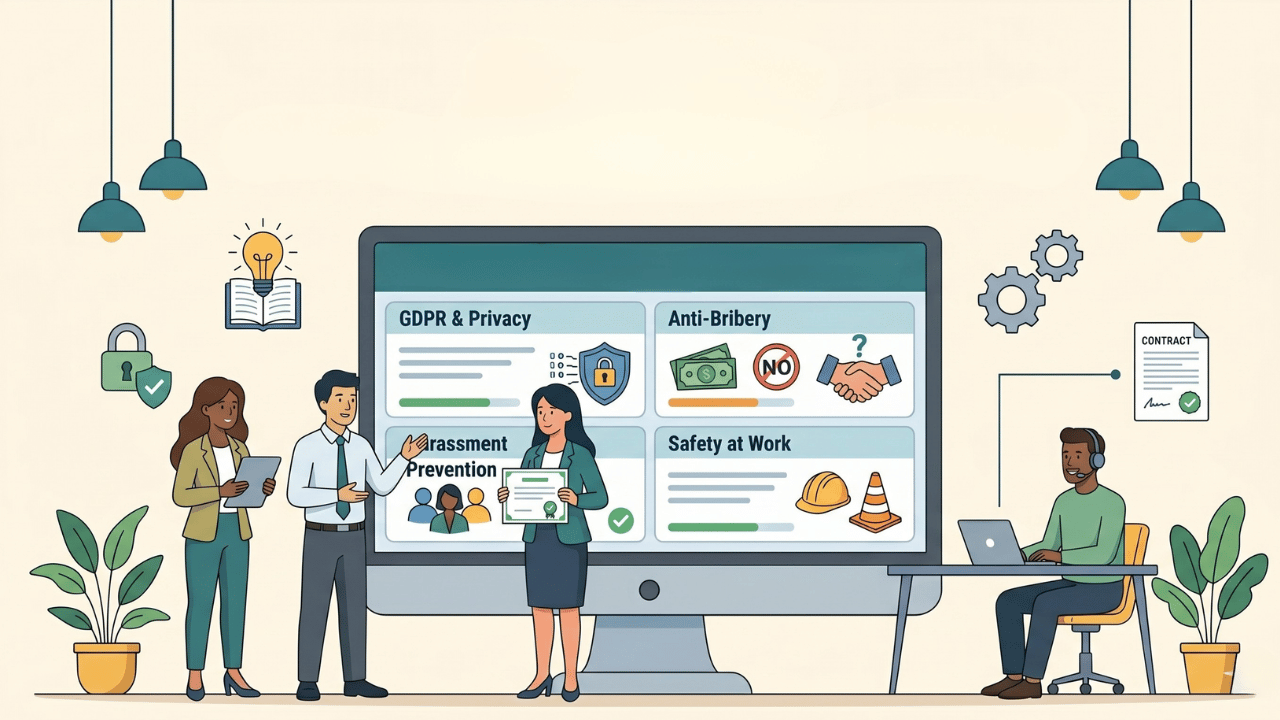
Compliance training is the process of educating employees on the laws, regulations, and internal policies they must follow in their roles. It covers areas like workplace harassment prevention, data privacy and security, workplace safety and OSHA compliance, anti-bribery and corruption, and ethics and code of conduct.
I've sat through terrible compliance training. You probably have too. A two-hour video with a monotone narrator, a quiz at the end, and nothing retained by the next day. But here's the thing: when compliance training is done right, it actually protects your company from lawsuits, reduces risk, and builds a workplace culture of accountability.
This guide covers what compliance training includes, the regulatory frameworks behind it, how to deliver it effectively, and the mistakes I see HR teams make when building their programs.
What Does Compliance Training Actually Cover?
Compliance training isn't a single course. It's a collection of mandatory employee training programs, each tied to a specific legal or ethical requirement. The exact topics depend on your industry, company size, and location, but most organizations need to cover these core areas.
Workplace harassment and sexual harassment training
This is the big one. Sexual harassment training is legally required in several US states, including California (SB 1343), New York, Illinois, Connecticut, Delaware, and Maine. California, for example, requires two hours of training for supervisors and one hour for non-supervisory employees every two years.
Even where it's not legally mandated, running harassment prevention training protects your company from liability. If an employee files a complaint with the EEOC, one of the first things they'll ask is whether your organization provided training. If you didn't, your legal exposure goes up significantly.
Diversity, Equity, and Inclusion (DE&I) training
Diversity, equity, and inclusion training helps employees understand unconscious bias, respectful communication, and equitable workplace practices. While not always legally mandated the way harassment training is, DE&I training has become a standard part of corporate compliance education for companies serious about building inclusive teams.
I've seen companies treat DE&I training as a checkbox exercise, and those programs consistently fail. The ones that work tie DE&I directly to hiring practices. If your inclusive hiring process doesn't match what you teach in training, employees notice.
Workplace safety and OSHA compliance
The Occupational Safety and Health Administration (OSHA) sets standards that employers must follow to keep employees safe. OSHA compliance training is mandatory for industries with physical hazards (construction, manufacturing, healthcare, warehousing), but even office-based companies need to cover basics like ergonomics, fire safety, and emergency procedures.
OSHA standards require that training be provided in a language and vocabulary workers can understand. That's a detail many HR teams miss. If 30% of your workforce speaks Spanish as their primary language, your safety training needs to be available in Spanish.
Data privacy and security (GDPR/HIPAA)
If your company handles personal data, and nearly every company does, employees need training on how to protect it. GDPR applies to any organization processing data of EU residents. HIPAA applies to healthcare organizations and their business associates in the US.
Data privacy training should cover what constitutes personal data, how to handle it, how to report breaches, and what the consequences of non-compliance look like. GDPR fines can reach 4% of annual global revenue or 20 million euros, whichever is higher. That's not a risk you can ignore.
Ethics and Code of Conduct
Ethics training covers your company's code of conduct, conflict of interest management, gift policies, whistleblower protection, and general expectations for professional behavior. It's the glue that holds the rest of your compliance program together.
I always recommend making ethics training part of the onboarding process. New employees should understand your company's standards before they start making decisions on behalf of the organization.
Anti-bribery and corruption
The Foreign Corrupt Practices Act (FCPA) in the US and the UK Bribery Act apply to any company doing business internationally. Anti-bribery training teaches employees what counts as a bribe, how to handle gifts and hospitality, and how to report suspicious activity.
This matters even for smaller companies. If your sales team operates across borders, or you work with international vendors, anti-bribery training is a regulatory requirement, not an optional add-on.
Equal Employment Opportunity (EEO)
EEO training covers federal protections under Title VII of the Civil Rights Act, the Americans with Disabilities Act, the Age Discrimination in Employment Act, and related EEOC guidelines. It educates employees and managers on what constitutes discrimination, how to prevent it, and how to handle complaints.
For HR professionals writing a job description or managing hiring, EEO knowledge isn't optional. Every stage of the hiring process, from the job post to the interview to the offer, carries discrimination risk if your team isn't trained.
What Laws Require Compliance Training?
The regulatory frameworks behind compliance training are a mix of federal, state, and international laws. Here's a quick reference.
State-specific training mandates are expanding fast. California, New York, Illinois, Connecticut, and Delaware all have their own requirements that go beyond federal law. If you operate in multiple states, you need to track these individually. There's no shortcut.
How Do You Deliver Compliance Training?
The format matters almost as much as the content. I've run compliance programs using every delivery method out there, and here's what I've learned about each one.
Learning Management System (LMS)
A Learning Management System is the backbone of most corporate compliance programs. An LMS lets you assign courses, track completion, manage deadlines, and generate reports for audits.
Good compliance tracking software does three things well: it automates assignment based on role and location, it sends reminders before deadlines, and it produces the completion records you need when an auditor or attorney comes asking. If you're managing compliance across more than 50 employees, doing this manually in spreadsheets is a liability waiting to happen.
Interactive training modules
Static slide decks don't work. I've watched completion rates jump by 40% when we switched from a PDF-and-quiz format to interactive training modules with scenario-based learning.
The best modules put employees in realistic situations: "Your manager asks you to skip a safety inspection to meet a deadline. What do you do?" This kind of decision-based learning sticks in a way that reading a policy document never will.
Microlearning modules
Microlearning breaks training into short, focused lessons of 5-10 minutes each. Instead of a single 90-minute harassment prevention course, you deliver it as a series of bite-sized modules spread over several weeks.
I started using microlearning for periodic refresher training, and the feedback from employees was overwhelmingly positive. People actually completed the modules without being chased. The short format also works well for mobile-friendly compliance training, which matters when you have field workers, remote employees, or frontline staff who don't sit at desks.
Gamification in compliance
Adding game elements (points, badges, leaderboards, scenario branching) to compliance training isn't just a gimmick. A 2023 study by TalentLMS found that 83% of employees who received gamified training felt motivated, compared to 28% who found non-gamified training boring.
I wouldn't gamify every compliance topic. Workplace safety and harassment prevention need to be taken seriously, and a leaderboard can feel tone-deaf there. But for ethics training, data privacy, and code of conduct modules, gamification significantly improves engagement and knowledge retention.
How Do You Build a Compliance Training Program?
Here's the process I follow when building or overhauling a compliance program.
Step 1: Run a knowledge gap analysis
Before you build anything, find out where the gaps are. Survey employees and managers. Review incident reports from the past 12 months. Check your audit findings. Look at which policies get violated most often.
A knowledge gap analysis tells you where to focus your budget and time. If your biggest risk is data privacy because you recently expanded into the EU, that's where your training investment should go first.
Step 2: Map training to roles
Not every employee needs the same training. A factory floor worker needs extensive OSHA safety training but probably doesn't need FCPA anti-bribery training. A sales executive working with international clients needs the opposite.
Role-specific learning paths make your program more efficient and more relevant. Employees pay more attention when the training applies directly to their work. Generic, one-size-fits-all training gets tuned out.
Step 3: Choose your delivery methods
Match the method to the content and the audience.
Step 4: Set schedules and automate recertification
Most compliance training isn't one-and-done. OSHA requires annual refresher training for certain hazards. California SB 1343 requires harassment training every two years. HIPAA requires periodic updates.
Build an automated recertification calendar into your LMS or compliance tracking software. When a certification expires, the system should automatically assign the refresher course and notify the employee and their manager. Manual tracking is how things fall through the cracks.
Step 5: Track completion and document everything
Training completion rates are your proof of compliance. If a harassment complaint leads to a lawsuit, the first question your attorney will ask is: "Can you prove this person completed the training?"
Track these metrics:
- Completion rates by department, role, and location
- Time to completion (are people rushing through in 3 minutes?)
- Quiz/assessment scores
- Overdue training by individual
- Policy acknowledgment records
Every employee should sign a policy acknowledgment confirming they received, understood, and agree to follow the training content. Digital signatures through your LMS work fine. Paper sign-offs work too, but they're harder to track at scale.
Step 6: Review and update annually
Laws change. Your business changes. Your compliance training needs to keep up. I do a full program review once a year and make spot updates whenever a significant regulatory change happens.
When California expanded its harassment training requirements in 2019, companies that had an annual review process were ready. Companies that treated their program as "set it and forget it" scrambled to catch up and risked non-compliance in the gap.
What Are the Risks of Skipping Compliance Training?
The risks fall into three buckets: legal, financial, and cultural.
Legal liability reduction. Without documented training, your company has a much weaker defense in discrimination, harassment, and safety lawsuits. Courts look at whether the employer took "reasonable steps" to prevent violations. Training is the most visible reasonable step you can take.
Financial penalties. OSHA fines for serious violations can reach $16,131 per violation (2024 rates, adjusted annually for inflation). Willful violations can hit $161,323. GDPR fines, as I mentioned, can reach 4% of global annual revenue. These numbers get attention in the C-suite.
Workplace culture. This one's harder to measure but just as real. Companies that skip or cut corners on compliance training tend to have more incidents, more complaints, and weaker audit readiness. Employees read the signal: "They don't take this seriously." That erodes the culture of accountability you need to keep your organization running cleanly.
How Does Compliance Training Connect to Hiring?
Compliance training starts earlier than most HR professionals think. It intersects with hiring in several ways.
Job descriptions. If you're hiring a compliance manager or compliance officer, the job description needs to reflect your organization's specific regulatory environment. A generic template won't attract candidates who specialize in your industry's compliance needs.
Screening and hiring tools. Your applicant tracking system should flag roles that require specific compliance certifications or background checks. If you're hiring for a HIPAA-regulated environment, you need to verify training history during the screening process, not after the person starts.
Onboarding compliance. New hire compliance training should happen in the first week, not the first month. I've seen organizations wait 30-60 days to schedule compliance training for new employees, and that's 30-60 days of risk exposure. Build it into your onboarding workflow from day one.
Employer brand. Companies known for strong compliance cultures attract better candidates. When your employer branding signals that you take legal compliance training and ethics seriously, it resonates with experienced HR and legal professionals who want to work somewhere that does things right.
Common Compliance Training Mistakes
Treating it as a checkbox. Assigning a course, collecting a completion certificate, and never thinking about it again. That's not a training program. That's a paper trail. Real compliance training changes behavior.
Using the same training for everyone. A blanket approach wastes time and money. Your warehouse team doesn't need the same GDPR training as your marketing department. Role-specific learning paths fix this.
Ignoring state-specific requirements. I've seen multi-state companies run a single harassment training course and assume it covers all their locations. It doesn't. California, New York, Illinois, and Connecticut each have different requirements for content, duration, and frequency. Check every state you operate in.
No refresher training. One-time training fades fast. Periodic refresher training, whether annual or biennial depending on the topic, reinforces the material and keeps employees current on regulatory changes.
Failing to document. If you can't prove training happened, it didn't happen. At least not in the eyes of a court, an auditor, or the EEOC. Documentation is your defense.
Compliance Training Trends for HR in 2026
AI-powered personalization. AI recruiting tools are already transforming how HR teams hire. The same AI capabilities are now being applied to compliance training, personalizing content based on an employee's role, past performance on assessments, and risk profile. An employee who scored 95% on data privacy last year gets a shorter refresher. One who scored 60% gets additional modules.
Mobile-first delivery. Mobile-friendly compliance training isn't a nice-to-have anymore. With distributed and frontline workforces, your training platform needs to work on a phone, period. Microlearning modules built for mobile are becoming the default format.
Continuous compliance vs. annual compliance. The old model of a once-a-year training dump is being replaced by continuous learning. Short modules delivered monthly or quarterly, tied to real incidents and policy updates, keep compliance top of mind instead of something employees forget the day after they complete it.
Integrated compliance and HR tech. The best compliance programs don't live in a silo. They're integrated with your HRIS, your LMS, and your hiring tools. When a new employee is added to the system, their required training is automatically assigned based on their role, location, and regulatory requirements. No manual intervention needed.
Risk-based training. Instead of giving everyone the same volume of training, smart programs assess which roles and departments carry the most risk and allocate training accordingly. Your finance team gets more anti-bribery training. Your HR team gets more EEO and harassment training. Your IT team gets more data privacy training.
Frequently Asked Questions
What is compliance training in simple terms?
Compliance training is mandatory employee education on the laws, regulations, and company policies that apply to their work. It ensures employees understand their legal obligations and know how to follow the rules that protect both the organization and its workforce.
What are the most common types of compliance training?
The most common types are workplace harassment prevention, workplace safety and OSHA compliance, data privacy and security (GDPR/HIPAA), ethics and code of conduct, anti-bribery and corruption, Equal Employment Opportunity (EEO), and Diversity, Equity, and Inclusion (DE&I) training.
Is compliance training legally required?
Yes, for many topics and in many jurisdictions. OSHA requires safety training for hazardous workplaces. Several US states mandate sexual harassment training. HIPAA requires data privacy training for healthcare workers. GDPR requires data protection awareness training. Federal anti-discrimination laws, enforced by the EEOC, also establish training expectations.
How often should compliance training be done?
It depends on the topic and jurisdiction. California requires harassment training every two years. OSHA requires annual refresher training for certain hazards. HIPAA requires periodic updates. As a general practice, I recommend at least annual refresher training for all core compliance topics.
What is a Learning Management System (LMS) and why does HR need one for compliance?
A Learning Management System is software that lets you create, assign, deliver, and track training courses. For compliance, an LMS automates course assignment, sends deadline reminders, tracks completion rates, stores policy acknowledgment records, and generates audit-ready reports. It replaces manual tracking with a system that scales.
What is the difference between compliance training and regulatory training?
They're closely related. Regulatory training specifically covers government-mandated requirements (OSHA, HIPAA, GDPR, FLSA). Compliance training is broader. It includes regulatory training plus internal policies like code of conduct, ethics, conflict of interest, and company-specific procedures. Regulatory training is a subset of compliance training.
What happens if a company doesn't provide compliance training?
The company faces increased legal liability, potential fines from regulatory agencies (OSHA, EEOC, data protection authorities), weaker defense in lawsuits, and greater risk of workplace incidents. Beyond legal consequences, skipping training erodes employee trust and weakens your ability to pass audits.
How do you measure compliance training effectiveness?
Track training completion rates, assessment scores, time-to-completion, incident reports before and after training, audit findings, and employee feedback. The goal isn't just completion. It's behavior change. If harassment complaints drop after training, that's a real signal. If completion rates are 100% but incidents stay the same, the training content or delivery needs work.
.jpg)
.png)

.webp)