.webp)
.avif)
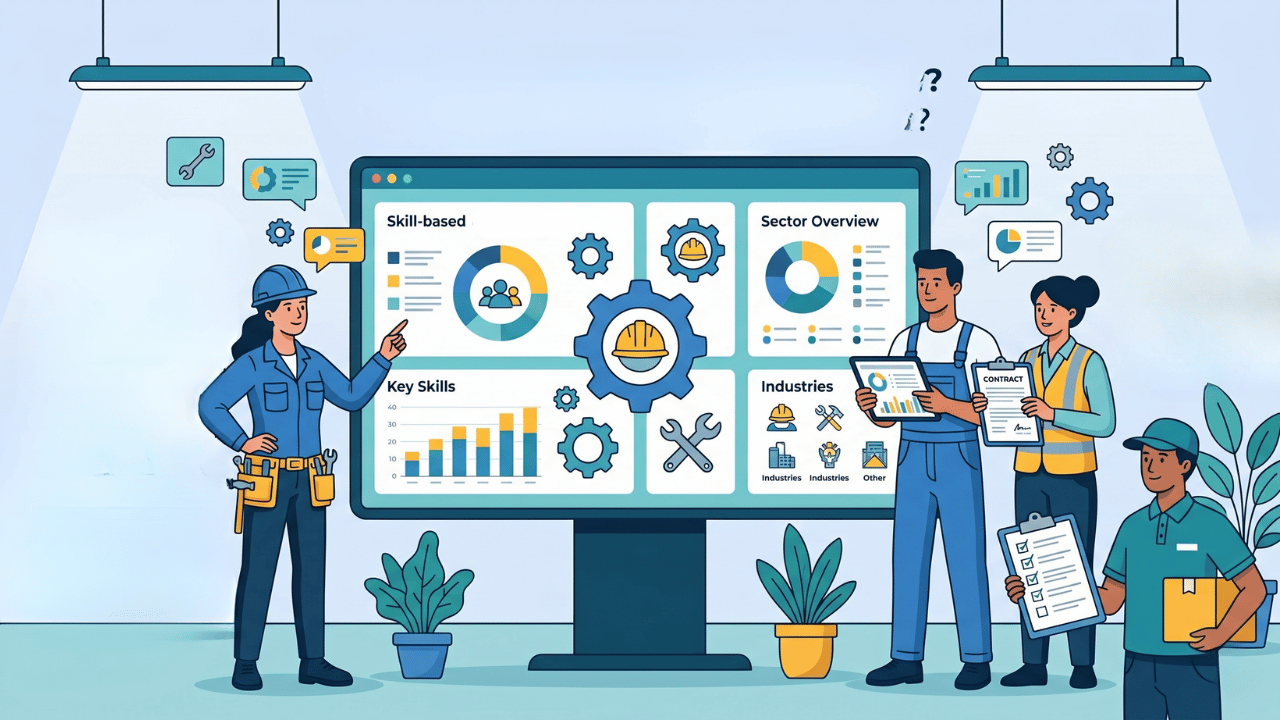
What Is a Blue-Collar Worker?
A blue-collar worker is someone who performs manual labor or skilled trades work, usually paid by the hour instead of a salary. Think electricians, welders, truck drivers, warehouse staff, HVAC techs, plumbers, machinists, and field service workers.
The name comes from the durable blue uniforms industrial workers wore back in the early 1900s. The clothes were designed to hide grease and grit. The label stuck.
But the meaning has shifted a lot since then. Today, the blue-collar workforce includes a whole new category called "new-collar jobs." These are roles that need technical training and certifications but not a four-year degree. Solar installers, advanced manufacturing techs, and data center operators all fit here.
If you run HR for a company with any field-based or hands-on roles, this is your workforce. And they deserve a real strategy, not a recycled office playbook.
White-Collar vs Blue-Collar: What HR Actually Needs to Know
The white-collar vs blue-collar split changes nearly every HR decision I make. Pay structure, legal classification, benefits design, scheduling, safety obligations. All of it.
Here's the cleanest comparison I can give you.
The line is blurring fast though. New-collar jobs sit in the middle. They blend the skill depth of trades with the digital tools of office work. I expect this middle category to keep growing.
Types of Blue-Collar Workers
Not all blue-collar work looks the same. I split it into four buckets when I'm planning workforce strategy.
Skilled trades. Electricians, plumbers, welders, HVAC techs, machinists, carpenters. Most have done formal apprentice programs or vocational training. They earn premium wages and they know it.
Semi-skilled. Equipment operators, assembly line workers, delivery drivers, maintenance staff. Training is required but not multi-year certification.
Entry-level. Warehouse associates, janitorial staff, packagers, general laborers. This is where most of my high-volume hiring lives.
Field service techs. Cable installers, appliance repair, telecom techs, solar installers. This group is growing fast and depends heavily on mobile tech.
Each bucket needs a different sourcing strategy, different pay benchmarks, and different retention levers. One-size-fits-all hiring plans fall apart inside a quarter.
How to Actually Recruit Blue-Collar Workers
I'll save you some pain. Most of what works for white-collar recruiting does not work here.
LinkedIn outreach? Mostly wasted effort. Six-page job descriptions? Nobody finishes them. Desktop-only application forms? You just lost 75% of your applicants.
Here's what actually works for me.
1. Use Specialized Job Boards for Trades
Niche platforms outperform general boards every time. I lean on Jobcase, Snagajob, Indeed's hourly segment, ConstructionJobs, and trade-specific boards like Roadmaster for trucking. Specialized job boards for trades signal that you actually understand the industry.
2. Invest in Local Community Recruitment
Hourly workers rarely relocate. So local community recruitment is where I spend real budget.
That means county fairs, regional Facebook groups, community center bulletin boards, and high school sports sponsorships. Sounds old-school. Works.
3. Build Vocational School Partnerships
The best pipeline I've ever built came from vocational school partnerships. I start the conversation 12 to 24 months before I need the hires.
We sponsor equipment, send our techs to guest-teach, and run paid internships that convert to full-time. By graduation, the student already knows our team.
4. Launch Apprentice Programs
Registered apprentice programs solve the skilled-trades shortage at its root. Workers earn while they learn. You get talent trained on your equipment, your methods, and your culture.
The U.S. Department of Labor's Office of Apprenticeship runs the registration process. It's worth the paperwork.
5. Run High-Volume Hiring the Right Way
When I need 50 warehouse associates in 30 days, the normal funnel breaks. High-volume hiring requires:
- Automated screening on the basics (availability, transportation, right to work)
- Group interviews instead of one-on-ones
- Same-day offers
- A streamlined day-one onboarding
- Cutting every step that doesn't actually predict performance
6. Build Mobile-First Job Applications
Over 75% of hourly candidates apply from a phone. If your application takes more than three minutes or requires a resume upload, you've lost them.
Mobile-first job applications with one-click apply doubled my completion rate the year I rolled them out.
7. Use Talent Assessment Tools for Trades
Resumes lie. Skills-based talent assessment tools for trades don't.
I use mechanical reasoning tests, spatial awareness quizzes, safety knowledge checks, and short hands-on demonstrations. Platforms like Wonderlic, Criteria, and Plum have pre-built assessments calibrated for industrial roles. They predict on-the-job performance way better than a polished resume.
Compensation, Benefits, and Labor Law
This is where I see HR teams get burned the most. The regulatory web around blue-collar pay is thick, and the penalties for getting it wrong are brutal.
Here are the rules I make sure my team knows cold.
FLSA Non-Exempt Status
Most blue-collar workers are FLSA non-exempt. That means they're entitled to minimum wage and overtime protections under federal law.
Misclassifying a non-exempt worker as exempt is one of the most expensive mistakes you can make. It triggers back-pay liabilities, penalties, and very often a class action. When in doubt, classify as non-exempt and call your employment lawyer.
Overtime Pay Regulations
Federal overtime pay regulations require time-and-a-half (1.5x the regular rate) for any hours worked beyond 40 in a workweek for non-exempt employees.
Some states go further. California requires daily overtime after 8 hours. Always apply whichever rule is stricter.
Track hours precisely. Estimates and "we usually work about 40" do not survive an audit.
Prevailing Wage
If you do federally funded construction work, the Davis-Bacon Act requires you to pay the prevailing wage for that trade and locality. The Department of Labor publishes the rates.
Many states have their own "little Davis-Bacon" laws for state-funded projects. Check before you bid.
Shift Differentials
Shift differentials are premium pay rates for evening, overnight, or weekend shifts. The range I see is 5 to 15% above base hourly rate.
These aren't required by federal law in most places. But in 24/7 operations, they're now an expectation. Skip them and you'll lose your night shift to a competitor offering them.
Retention Bonuses
Replacing an hourly worker costs me $4,000 to $7,000 every time. So retention bonuses pay for themselves fast.
I tier them: a bonus at 90 days, another at 6 months, another at 12 months. That structure rewards staying, not just showing up.
Piecework Basis
In some industries (agriculture, garment, certain assembly work), pay is structured on a piecework basis. Workers get a set amount per unit produced.
Big watch-out here: piecework arrangements still have to satisfy federal minimum wage compliance when total earnings are divided by hours worked. If a slow week drops a worker below minimum wage, you owe the difference. This trips up a lot of employers.
Federal Minimum Wage Compliance
The federal minimum wage is $7.25 an hour. But 30+ states and dozens of cities require higher rates.
Federal minimum wage compliance is the floor, not the ceiling. Always apply whichever rate (federal, state, or local) is highest for that worker's location.
Union Representation and Collective Bargaining
About 10% of U.S. workers belong to unions. In utilities, transportation, and manufacturing, the rate is much higher.
If your workforce is unionized, union representation and collective bargaining agreements set the rules for wages, benefits, grievances, layoff order, and work scheduling. HR in a unionized shop means learning contract administration. That's a skill set on top of regular policy work, not a replacement for it.
Health, Safety, and Workplace Compliance
Physical risk is the defining HR challenge in blue-collar work. One serious injury can mean OSHA citations, soaring workers' comp costs, productivity loss, and most importantly, real human harm.
Here's what I focus on.
OSHA Safety Standards
The Occupational Safety and Health Administration sets and enforces federal workplace safety rules. OSHA safety standards vary by industry (construction, general industry, maritime, agriculture).
Penalties are no joke. A serious violation now runs up to $16,131. A willful violation can hit $161,323. Per violation.
Workplace Hazard Mitigation
Effective workplace hazard mitigation follows the hierarchy of controls:
- Eliminate the hazard entirely
- Substitute a safer alternative
- Engineer protections into the process or equipment
- Use administrative controls (training, signage, rotation)
- Rely on PPE as the last line of defense
I document our hazard assessments, review them quarterly, and update them every time a process changes.
Personal Protective Equipment (PPE)
Personal Protective Equipment includes hard hats, safety glasses, steel-toed boots, hearing protection, respirators, and high-visibility vests.
Under 29 CFR 1910.132, employers must:
- Provide most PPE at no cost to the worker
- Train workers on proper use
- Replace worn or damaged gear promptly
Occupational Safety Training
Occupational safety training is mandatory under OSHA for hazardous tasks. But mandatory does not mean effective.
The training that actually changes behavior is role-specific, refreshed regularly, and documented with signed acknowledgments. I run new-hire safety orientation, lockout/tagout certification, forklift operator training, and HAZWOPER courses on a fixed calendar.
Incident Management Systems
Modern incident management systems digitize the whole response workflow. Near-miss reporting, root-cause analysis, corrective action tracking, OSHA recordkeeping for Forms 300, 300A, and 301.
Platforms I've used or seen work well: Intelex, EHS Insight, SafetyCulture. They replace paper logs with searchable, auditable databases. Worth the investment.
Safety Audits
Safety audits surface hazards before they cause incidents.
I run internal monthly walkthroughs plus annual third-party reviews. Every finding gets an owner, a deadline, and a closure date. I track closure rates as a safety KPI.
Workers' Compensation Claims
Workers' compensation claims are going to happen. Plan for it.
Best practice on my team: report incidents within 24 hours, maintain a transitional duty program to bring injured workers back safely, and partner closely with the carrier on case management. Quick reporting reduces claim costs by 20 to 35% on average.
Employee Relations and Retention
Turnover in blue-collar industries runs 30 to 60% annually. That's an order of magnitude higher than white-collar averages.
The drivers of engagement here are different too. Here's what I've seen actually move the needle.
Work-Life Balance in Trades
Work-life balance in trades is harder than in salaried roles. Schedules can be unpredictable. Overtime is often mandatory. Shifts are physically draining.
The foundations of retention are predictable scheduling, paid time off that workers can actually use, and reasonable overtime expectations. Get those three right and you're ahead of most employers.
The Four-Day Workweek
The four-day workweek (four 10-hour shifts) is gaining real traction in manufacturing and field services.
Results I've seen reported: 20 to 40% reductions in absenteeism, big improvements in recruitment yield, and no loss of total output. It's especially powerful for workers with long commutes.
If your operations allow it, test it. The data is consistent across industries.
Career Pathing for Technicians
Every worker eventually asks the same question: "What's next for me here?"
Career pathing for technicians answers it. I map out a clear progression: Apprentice, Journeyman, Master, Lead, Supervisor. Each step has documented requirements (certifications, hours, performance metrics).
Without a visible path, your best workers leave for competitors who show them one. I've watched it happen too many times.
Respect in the Workplace
Exit interviews tell a story that surprises new HR pros every time. The top reason blue-collar workers quit is not pay. It's lack of respect from management.
Respect in the workplace means:
- Treating frontline workers as the professionals they are
- Listening to their operational input
- Addressing safety concerns without retaliation
- Modeling courtesy from the top
This costs nothing. It changes everything.
Employee Recognition Programs
The recognition programs that work in this sector are tangible, public, and frequent.
What I've seen land well:
- Safety milestone rewards
- Perfect-attendance bonuses
- Peer-nominated "craftsman of the month"
- Tool allowances and boot stipends
- Anniversary recognition in front of the team
Abstract corporate awards (e.g., "Innovator of the Year") don't move the needle here. Tangible rewards do.
Upskilling and Reskilling
Upskilling and reskilling are no longer optional. Automation, electrification, and new materials are reshaping every trade.
I fund certifications. I pay for training time. I reimburse tuition for relevant programs. The workers who use these benefits stay longer, perform better, and become the internal trainers for the next generation.
Transparent Scheduling
Transparent scheduling means schedules posted at least two weeks in advance, predictable shift patterns, and easy swap mechanisms.
Several jurisdictions now require it by law. Oregon, New York City, Seattle, and Chicago all have predictable scheduling laws on the books.
Even where it's not required, last-minute schedule changes are the single most common engagement killer I see in hourly workforces. Fix this one thing and your turnover drops.
HR Tools for Blue-Collar Workforces
Office HR tech rarely works for dispersed or shift-based teams. The tools below were built for the operational realities I deal with every day.
Digital Attendance Tracking
Digital attendance tracking replaces paper time cards with biometric, badge, or app-based systems.
Accuracy improves. Payroll errors drop. Buddy punching becomes nearly impossible. The ROI shows up in the first payroll cycle.
Field Service Management Software
Field service management software (FSM) integrates scheduling, dispatch, time tracking, and customer management for technicians in the field.
Platforms I've seen work well: ServiceTitan, Jobber, FieldEdge, Housecall Pro. For HR, FSM systems give you rich data on technician productivity, route efficiency, and overtime patterns. That data is gold during workforce planning.
Mobile HR Apps for Frontline Workers
Mobile HR apps for frontline workers bring pay stubs, benefits enrollment, schedule access, and company communications straight to a phone.
Tools in this space: Beekeeper, WorkJam, Blink, UKG Ready. Adoption rates of 80% or higher are realistic when the app is well-designed and you actually communicate through it.
The mistake I see most often: companies roll out the app, then keep sending important info through email or break-room posters. The workers never get the message that the app matters.
GPS Time Clocks
GPS time clocks verify that workers clock in from authorized job sites instead of their couches.
Geo-fencing features (alerts when workers leave a defined area) are especially valuable in construction, landscaping, and home services. Be transparent with workers about what's being tracked. Surprise tracking destroys trust fast.
Automated Shift Scheduling
Automated shift scheduling tools generate compliant, optimized schedules in minutes instead of hours.
Platforms I've used or reviewed: Deputy, When I Work, Quinyx, Legion. They factor in employee availability, certifications, labor law constraints, and demand forecasting. They also handle shift swaps and time-off requests through worker self-service.
This is the single biggest time-saver I've added to my HR ops stack.
Wearable Safety Technology
Wearable safety technology is the new frontier in industrial safety.
What's available now:
- Smart helmets with built-in gas detection
- Exoskeletons that reduce lifting strain
- Fatigue-monitoring wristbands for shift workers
- Fall-detection sensors for working at heights
Early adopters report 30%+ reductions in recordable incidents within 18 months. The tech is expensive upfront and absolutely worth piloting if your workforce has consistent injury patterns.
Frequently Asked Questions
What is the difference between a blue-collar and white-collar worker?
A blue-collar worker performs manual labor or skilled trades, usually paid hourly. A white-collar worker does office-based knowledge work, usually paid an annual salary. The differences span pay structure, FLSA classification, educational path, and physical demands.
Are blue-collar jobs disappearing?
No. While some manufacturing has automated, demand for skilled trades is at historic highs. The U.S. Bureau of Labor Statistics projects 6 to 10% growth in skilled trades through 2032, faster than the overall job market average.
What are new-collar jobs?
New-collar jobs are technical roles that need certifications or vocational training but not a four-year degree. Examples include cybersecurity analysts, cloud techs, advanced manufacturing operators, and renewable-energy installers.
How do you actually retain blue-collar workers?
The proven retention levers are competitive hourly pay with regular increases, predictable scheduling, clear career paths, paid training, retention bonuses at tenure milestones, respect from frontline managers, and consistent recognition. Pay matters. But it's rarely the top reason people leave. Disrespect and unpredictability usually win that contest.
Are all blue-collar workers non-exempt under FLSA?
Almost always, yes. Most blue-collar roles fail every FLSA exemption test (executive, administrative, professional, computer, outside sales). Default to non-exempt unless your employment lawyer confirms otherwise in writing.
What benefits do blue-collar workers value most?
Health insurance with low premiums, paid time off, retirement plans with employer match, and disability coverage rank at the top in every survey I've seen. Tool allowances, boot stipends, and tuition reimbursement are also highly valued in trades-heavy environments.
How do you reduce turnover in high-volume hourly roles?
Focus on the first 90 days. That's when more than half of all turnover happens. Realistic job previews, structured onboarding, a buddy or mentor on day one, regular check-ins from the direct supervisor, and 30/60/90-day retention bonuses can cut early turnover in half.
Final Thoughts
Here's what I want every HR leader reading this to take away.
The blue-collar workforce runs the physical economy. Managing it well takes a different playbook than managing office teams. Generic strategies fail in field, factory, and warehouse settings.
What works:
- Master the regulations (FLSA, OSHA, prevailing wage)
- Respect the operational realities (shift work, physical demands, dispersed teams)
- Use the right tech stack (mobile-first apps, GPS time clocks, automated scheduling, wearable safety tech)
- Treat your frontline workers as professionals, because they are
The employers winning the talent war for skilled trades aren't necessarily paying the most. They're scheduling more predictably, training more seriously, listening more genuinely, and showing up with real respect for the work.
Do those things and your turnover charts start moving the right direction. Skip them and no comp budget in the world will save you.
About This Guide
I wrote this for HR professionals, talent acquisition leaders, and people ops managers who run blue-collar or hourly workforces. It reflects current U.S. regulatory frameworks as of May 2026. Always check with qualified employment counsel for questions specific to your jurisdiction.
Related reading worth your time:
- How to Build an Apprenticeship Program From Scratch
- FLSA Exempt vs Non-Exempt: A Compliance Walkthrough
- OSHA Recordkeeping Made Simple: Forms 300, 300A, and 301
Meta description (155 chars): A blue-collar worker performs manual labor or skilled trades, usually paid hourly. HR guide to hiring, paying, protecting, and keeping them long-term.
Suggested schema markup: Article + FAQPage (for the FAQ section) + Organization (for the publishing entity) + Person (for author attribution).

.jpg)
.png)

.webp)