.webp)
.avif)
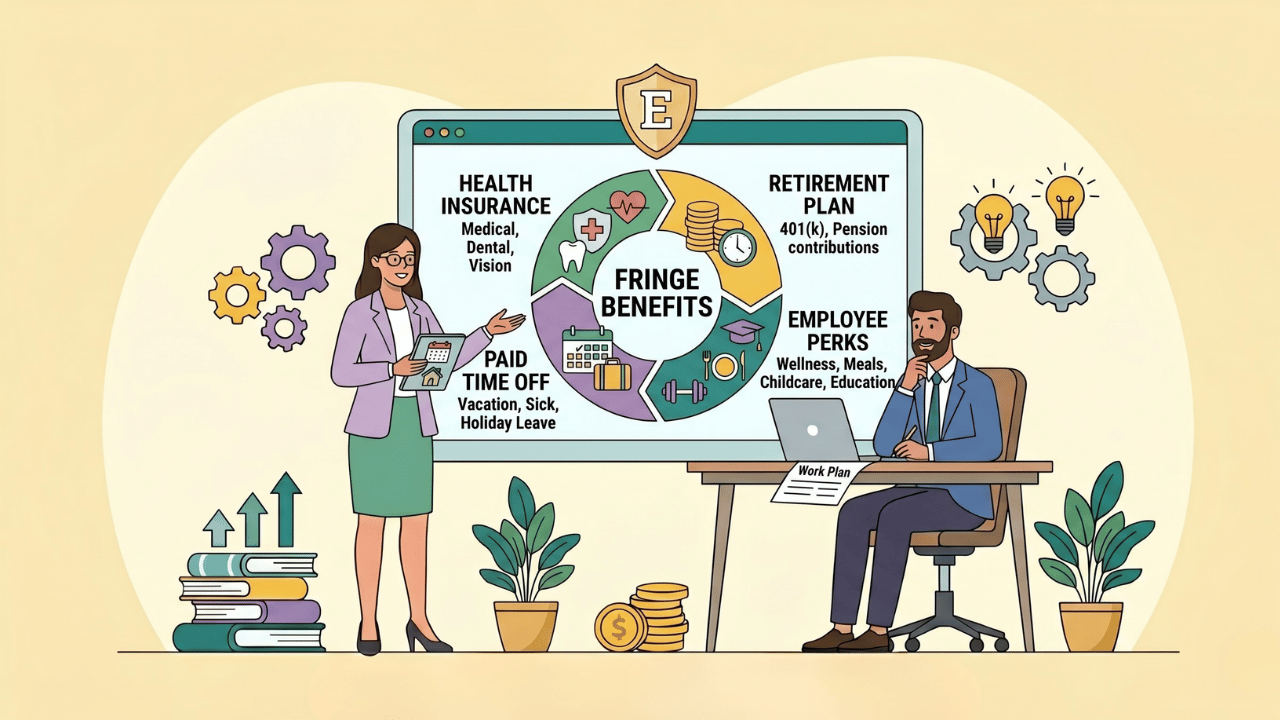
Fringe benefits are the forms of compensation an employee receives on top of their base salary or wages. They include things like health insurance, retirement contributions, paid time off, and perks such as flexible hours, meals, or learning budgets. In short, fringe benefits are everything of value the job gives you that isn't your paycheck.
I think benefits are one of the most misunderstood parts of pay. Companies treat them as a cost line. Employees treat them as a major reason to take or leave a job. The gap between those two views causes a lot of avoidable turnover.
This guide explains what fringe benefits are, the types, the data on why they matter, and a step-by-step way to build a benefits plan. The key statistics are included throughout.
What Are Fringe Benefits, Exactly?
Fringe benefits are non-wage compensation. The word "fringe" just means they sit at the edge of the core paycheck, but for many employees they're central to the value of the job.
They split into two broad groups:
- Required benefits, which the law obliges employers to provide. These vary by country, but often include things like social security contributions, unemployment insurance, and certain paid leave.
- Voluntary benefits, which the employer chooses to offer to attract and keep people. Health insurance, retirement plans, extra paid leave, and perks all sit here.
It's also worth separating benefits from perks, since people use the words loosely. Benefits are usually substantial, often financial, and frequently tied to security: health cover, retirement, insurance. Perks are smaller lifestyle extras: free snacks, a gym membership, a social budget. Both are fringe benefits in the broad sense, but they do different jobs.
One practical note: many fringe benefits have tax implications for both the employer and the employee. Some are tax-free up to a limit, some are taxable. The rules vary by country, so benefits planning should always involve someone who knows your local tax law.
Why Do Fringe Benefits Matter? The Statistics
Because benefits do real work in attracting, keeping, and motivating people, and the data shows employees weigh them heavily, sometimes above pay.
A few numbers worth knowing:
- When asked what perks they'd most want, employees rank better health insurance highly, with surveys showing it valued by around 73% of workers, ahead of more vacation at 71% and a four-day week at 68%.
- Employees say they would trade real salary for flexibility, on average around 9% of pay for flexible hours and 8% for a four-day week.
- Replacing an employee costs 50% to 200% of their annual salary (SHRM). A benefits package that keeps people is cheap next to that.
The pattern is clear. A competitive base salary gets you considered. The benefits package is often what tips the decision, and what makes someone stay when a competitor waves a slightly higher number. Benefits are a retention tool disguised as a cost line.
What Are the Main Types of Fringe Benefits?
Fringe benefits cover a wide range. Here's how the main categories break down.
| Category | Examples | What it's for |
|---|---|---|
| Health and wellness | Medical, dental, vision, mental health support | Security and wellbeing |
| Financial and retirement | Pension or 401(k) match, life insurance, stock options | Long-term security |
| Time off | Paid vacation, sick leave, parental leave, sabbaticals | Rest and life balance |
| Flexibility | Remote work, flexible hours, compressed weeks | Work-life balance |
| Development | Training budgets, tuition support, conferences | Growth and skills |
| Lifestyle perks | Meals, gym, commuter support, social budgets | Day-to-day quality of life |
The categories that move decisions most are usually health, retirement, time off, and flexibility, the ones tied to security and life balance. Lifestyle perks are nice and they help culture, but they rarely keep someone who is unhappy with the fundamentals.
How to Build a Fringe Benefits Plan: A 7-Step Plan
A benefits plan works when it reflects what your people actually value and what your business can sustain. Here's the process I'd run.
Step 1: Cover what's legally required first
Start with the non-negotiables. Identify every benefit the law obliges you to provide in each location you employ people.
This is your floor. Get it correct and documented before you design anything voluntary, and involve someone who knows local employment and tax law.
Step 2: Ask your employees what they value
Don't guess. The benefits leaders assume people want are often not the ones people would choose.
Survey your employees, or ask in stay interviews. A parent values parental leave and flexibility; an early-career employee may value learning support and time off. Match the plan to your actual workforce.
Step 3: Set a clear budget
Decide what you can sustainably spend on benefits as a share of total compensation. A plan you have to cut back next year does more damage than a smaller plan you can keep.
Be realistic. Benefits people come to rely on and then lose hurt morale more than benefits you never offered.
Step 4: Prioritize fundamentals over perks
Spend on the things tied to security and life balance first: health, retirement, time off, flexibility. These are what hold people.
Add lifestyle perks after the fundamentals are solid. A games room doesn't compensate for weak health cover. Get the order right.
Step 5: Consider flexible or choice-based benefits
People are different, so a fixed package will always fit some better than others. Flexible benefits, sometimes called a cafeteria plan, let employees choose from a menu within a set value.
This stretches every dollar further, because people pick what they actually want instead of getting a one-size package.
Step 6: Communicate the benefits clearly
A benefit nobody understands or remembers might as well not exist. Many companies spend real money on benefits and get little credit, simply because employees don't know what they have.
Explain the package plainly at hiring, during onboarding, and in regular reminders. Make the total value visible, since benefits are often a large share of a person's real compensation.
Step 7: Review the plan regularly
Benefits aren't set-and-forget. Costs change, the workforce changes, and what competitors offer changes.
Review the plan at least once a year. Check it against your goals, your budget, and what your people now value, and adjust.
How Do Fringe Benefits Affect Hiring and Retention?
Strongly, at both ends. A strong benefits package is part of what you sell to candidates. It's a core piece of your employee value proposition, the full deal of what someone gets in return for their work.
Benefits also feed your employer branding. Candidates compare packages, and a thoughtful one signals a company that takes care of its people. Since replacing an employee costs so much, a package that improves retention quietly lowers your cost per hire by reducing how often you have to hire at all.
There's a culture effect too. Benefits that genuinely reflect what employees need make a strong company culture tangible. They turn "we care about our people" from a slogan into something an employee can point to. The catch: benefits won't rescue a job that's broken in other ways. They support good pay, good management, and good work. They don't replace them.
How Do You Measure if Benefits Are Working?
You measure it by whether the benefits plan helps you attract and keep people, not by how much you spend on it.
The signals I'd track:
- Benefit usage rates, since a benefit nobody uses is wasted spend
- What candidates and new hires say about the package during hiring
- Retention and exit interview data, to see whether benefits are a reason people stay or leave
- Employee feedback from surveys on how the package is rated
- Cost per employee, tracked against the value employees report
If you're spending heavily and employees still rate the package poorly, the problem is usually fit or communication, not budget. You're either offering the wrong things or failing to explain the right ones. Listening, through surveys and tools like employee engagement surveys, is how you find out which.
What Are the Most Common Fringe Benefits Mistakes?
A benefits budget is easy to spend and easy to waste. These are the mistakes I see most often.
- Guessing what people want. Leaders pick benefits they personally value, or that look good on a careers page, without asking the workforce. The result is spend on perks nobody uses while the things people actually want go missing.
- Perks before fundamentals. Free snacks and a games room while the health cover is thin and the retirement match is weak. Lifestyle perks are pleasant, but they never compensate for shaky fundamentals.
- Poor communication. This is the quiet one. A company spends real money on benefits and gets almost no credit, because employees don't know what they have or how much it's worth. An unknown benefit may as well not exist.
- Offering benefits you can't sustain. A generous benefit introduced in a good year and cut in a leaner one does more damage than never offering it. People come to rely on benefits, and taking one away feels like a pay cut.
- A one-size package. A fixed package fits some employees well and others poorly. A diverse workforce wants different things, which is why choice-based or flexible benefits stretch the budget further.
- Ignoring tax rules. Some benefits are tax-advantaged and some create a tax liability for the employee. Designing a package without checking the rules can quietly hand your people an unexpected bill.
- Set and forget. A package that's never reviewed drifts out of step with what the workforce needs and what competitors offer.
The pattern underneath: benefits work when they reflect what your specific people value, when they're sustainable, and when employees actually know about them. Spending more isn't the answer. Spending on the right things, and communicating them clearly, is.
Frequently Asked Questions
What are fringe benefits?
Fringe benefits are forms of compensation an employee receives beyond their base salary or wages, such as health insurance, retirement contributions, paid time off, and perks like flexible hours or learning budgets.
What is the difference between benefits and perks?
Benefits are usually substantial and often financial, tied to security: health cover, retirement plans, insurance. Perks are smaller lifestyle extras like free meals or a gym membership. Both are fringe benefits in the broad sense, but they serve different purposes.
Are fringe benefits taxable?
It depends. Some fringe benefits are tax-free up to a limit, others are taxable to the employee, and rules vary by country. Benefits planning should always involve someone familiar with your local tax law.
What are examples of fringe benefits?
Health, dental, and vision insurance; retirement contributions; life insurance; paid vacation, sick, and parental leave; remote and flexible work; training and tuition support; and lifestyle perks like meals, gym access, or commuter support.
Why are fringe benefits important?
They do real work in attracting and keeping people. A competitive salary gets a company considered, but the benefits package often tips the decision and is a major factor in whether someone stays. Surveys show employees will even trade salary for benefits like flexibility.
What are required versus voluntary fringe benefits?
Required benefits are those the law obliges an employer to provide, which vary by country and can include items like social security contributions and certain leave. Voluntary benefits are extras the employer chooses to offer to attract and retain talent.
What is a flexible benefits plan?
A flexible benefits plan, sometimes called a cafeteria plan, lets employees choose benefits from a menu within a set value. It stretches the budget further because people select what they actually want rather than receiving a fixed package.
How often should a company review its benefits plan?
At least once a year. Costs, workforce needs, and competitor offerings all change, so a benefits plan that never updates drifts out of step with what employees value and what the market expects.
Do fringe benefits count as part of total compensation?
Yes. Total compensation is base pay plus the full value of fringe benefits. For many employees benefits make up a large share of what the job is really worth, which is why showing the total value clearly is part of communicating the package well.
Should small businesses offer fringe benefits?
Yes, within budget. Small companies may not match a large employer's package, but they can compete on benefits that cost less and are valued highly, such as flexible working, extra time off, and learning support. The key is choosing benefits the team genuinely values and can rely on.

.jpg)
.png)

.webp)