


Use an AI interview-question generator to create a first draft of behavioral, technical, and situational questions. Then map each question to a competency, define what strong evidence looks like, remove irrelevant or sensitive prompts, and give comparable candidates the same core assessment. A longer question list does not make an interview better.

Key takeaways
- Start with a role scorecard and job outcomes, not a generic prompt asking for interview questions.
- Use AI for breadth and wording. Keep competency definitions, follow-up judgment, scoring, and final decisions with trained interviewers.
- Soft skills interview questions should ask for a specific situation, action, and result rather than a self-rating.
- Structured interviews reduce inconsistency when candidates receive the same core questions and are scored against the same anchors.
- Review questions for accessibility, cultural assumptions, unnecessary personal information, and job relevance before using them.
- Recooty’s view: the generator should make interview preparation easier, while the scorecard makes the decision defensible.
Soft skills interview questions: make AI-generated prompts structured and fair
The strongest generators help a recruiter connect a question to a competency, a realistic job situation, a follow-up prompt, and a rating anchor. The U.S. Office of Personnel Management defines structured interviews around job-related competencies and consistent inquiry into past or hypothetical behavior. GOV.UK guidance similarly recommends standardized questions and scoring to reduce bias.
| Competency | Strong prompt pattern | Follow-up | Evidence anchor |
|---|---|---|---|
| Communication | Tell me about a time you explained a complex issue to a non-specialist. | How did you check understanding? | Clear framing, adaptation, and outcome |
| Collaboration | Describe a disagreement that affected a project. | What did you do next? | Listening, trade-off, and shared result |
| Ownership | Tell me about a missed commitment. | What did you change afterward? | Early communication, recovery, and learning |
| Adaptability | Describe a time priorities changed suddenly. | How did you decide what to stop or defer? | Replanning and stakeholder judgment |
| Customer judgment | Tell me about a difficult customer or internal partner situation. | What would you do differently now? | Empathy, boundaries, and practical resolution |
Ask the generator to label the competency, intended evidence, and risk of each question. Delete questions that reward a particular accent, education path, personality style, or cultural background rather than the capability required by the role.
A safe prompt for an AI interview-question generator
Give the tool limited, approved information:
- role title and level;
- three to six measurable outcomes;
- must-have and trainable skills;
- interview duration and format;
- competencies to assess;
- prohibited topics and accommodation route;
- expected output, including question, intent, follow-up, and scoring anchor.
Do not paste confidential candidate data into an unapproved tool. If a question is based on a resume, confirm that the candidate knows how the information will be used and ensure every candidate is assessed against the same job-related standard.
From generated questions to a structured interview kit
Turn the draft into an interview kit with a clear sequence:
| Kit element | What to include | Why it matters |
|---|---|---|
| Opening | Welcome, format, duration, and accommodation contact | Reduces uncertainty and supports candidate experience |
| Core questions | Same questions for comparable candidates | Improves consistency |
| Follow-ups | Short prompts that clarify evidence | Prevents improvisation from changing the standard |
| Rating anchors | Observable examples for low, solid, and strong evidence | Makes scores more meaningful |
| Evidence notes | Facts, actions, results, and concerns | Separates evidence from impression |
| Decision rule | How the panel will discuss and decide | Prevents moving the goalposts for a favorite candidate |
Store the kit and scorecards in your applicant tracking system or approved HR workspace. Connect the interview to recruiting metrics and candidate feedback so you can improve the process over time.
Top 5 AI-Powered Interview Question Generators
1. Recooty’s Interview Question Generator

Recooty’s AI Interview Questions Generator creates questions tailored to a job role, skill level, and industry. Enter the job title, choose the seniority level, select question types, and generate questions in multiple languages. The source description also says that suggested answers are provided. You can also check Recooty’s job description generator and HR email template generator.
2. GoHire

GoHire provides an interview-question generator that uses the job title to create questions aimed at relevant skills and competencies. The source description notes that it does not supply suggested answers, so recruiters need to define the expected evidence themselves.
3. Workable

Workable’s AI interview question generator creates competency-based and experience-driven questions for different jobs. The source description notes that it lacks a direct copy and export option, which may add work when transferring questions into an existing hiring process.
4. Kickresume
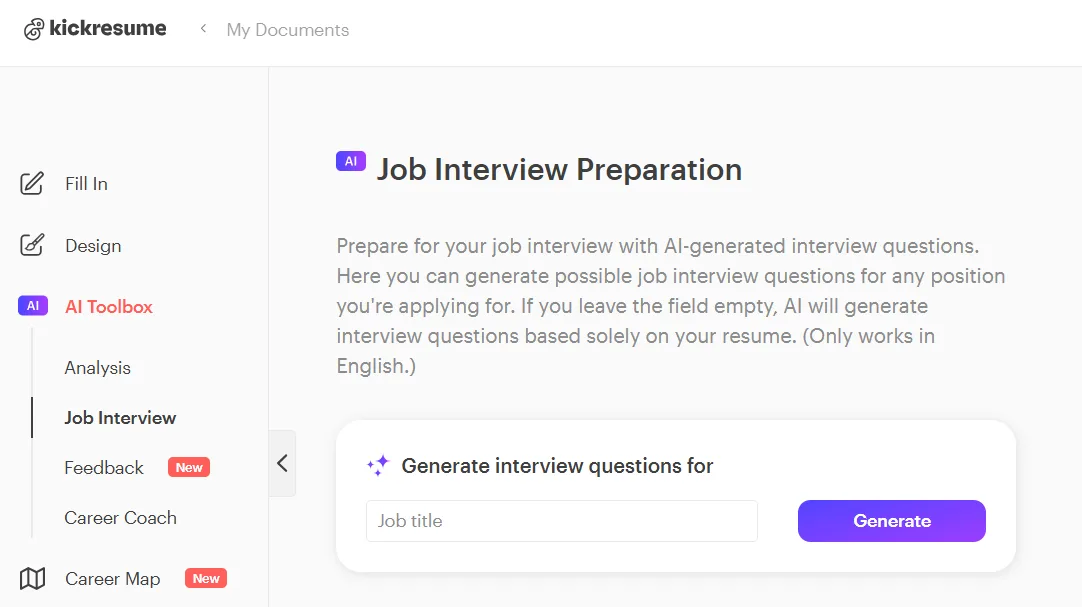
Kickresume personalizes questions based on an uploaded resume. The source description notes that registration is required and that a paid plan may be needed for the full feature set. Resume-based prompts still need a relevance and privacy review.
5. Reed.com

Reed.com’s Interview Question Generator asks for a job title, seniority level, and soft skills. It focuses on soft skills, so recruiters may need to add technical questions. The source description also notes that changing the set requires manually reordering, refreshing, or locking questions.
Measure whether generated questions improve the interview
Most comparison pages evaluate tools by speed, question count, or language options. A more useful test is whether the guide improves decision quality without adding noise.
Run a small evaluation with the same job brief:
- Generate a guide from the job description alone.
- Generate a second guide from the job scorecard and 30/60/90-day outcomes.
- Ask two experienced interviewers to rate each question for relevance, clarity, fairness, and answerability.
- Pilot the stronger guide on comparable interviews.
- Compare scorecard completion, interviewer agreement, time per interview, candidate feedback, and the quality of evidence captured.
If the questions sound polished but cannot distinguish strong from weak evidence, the prompt or job design needs work. If interviewers disagree because the rating scale is vague, generating more questions will not fix the process.
A practical next step for interview teams
Choose one open role and create a short kit with five core questions, a follow-up for each, and rating anchors. Test it with the hiring panel before generating a larger set. Review candidate feedback and interviewer agreement after the first few interviews, then adjust the prompt and scorecard together.
Research sources
- U.S. Office of Personnel Management structured interview guidance on job-related competencies and consistent behavior-based questions.
- GOV.UK fair and structured interview guidance on standardised questions, scoring, and reducing interview bias.
- OPM Structured Interview Guide on common rating scales and question design.
- NIST AI Risk Management Framework for managing risk in AI-assisted assessment workflows.
- EEOC guidance for job applicants and the ADA on interview accommodations and prohibited pre-offer disability questions.
- Research on AI-assisted interview-question generation on using automated methods to support interview preparation.
Source: https://recooty.com/blog/top-ai-powered-interview-question-generators/
Frequently Asked Questions
The best tool is the one that turns an approved role scorecard into relevant questions, follow-ups, and usable rating anchors while protecting candidate data. Compare the output with a human-written guide using the same role and evaluation criteria.
Yes. Ask for behavioral questions tied to communication, collaboration, ownership, adaptability, or customer judgment. Review every question for job relevance and score answers using observable evidence rather than personality impressions.
They can use them to speed up question drafting, but the tool should remain one part of the interview workflow. Interviewers still need to define the evidence, review questions, and make the decision.
They can reduce inconsistency when comparable candidates receive the same core questions and interviewers use the same rating anchors. Structure does not remove all bias, so teams should still review questions, outcomes, accessibility, and selection patterns.
Every comparable candidate should receive the same core questions and assessment standard. Interviewers can ask limited follow-ups to clarify an answer, but the follow-up should not introduce a different bar or an unrelated personal topic.
Some tools can conduct parts of an interview, but the decision depends on the role, candidate expectations, privacy rules, accessibility, and governance. Keep human oversight for sensitive cases, accommodations, final evaluation, and decisions with significant employment consequences.
Jump To Section
Author's Profile

Hardik Vishwakarma


Hardik Vishwakarma – AI Recruitment Strategist | HR Automation Expert | Applicant Tracking Software Specialist Hardik Vishwakarma is a recognized leader in HR automation and...
View Full Profile →