All Recooty Articles, HR Tutorials and Tips, Trending Topics
Guide to Diversity Equity and Inclusion in the Workplace 2026


 All Recooty Articles, HR Tutorials and Tips, Trending Topics



Effective diversity, equity, and inclusion (DEI) work changes the systems that shape who can apply, progress, contribute, and stay. A statement or training session cannot show whether those systems are fair. You need clear definitions, stage-by-stage evidence, responsible owners, and a safe way to act when the data shows a gap.
This guide explains the three terms, how they connect across the employee lifecycle, and the practical steps a team can take in hiring and day-to-day work. It also covers measurement, technology, and legal guardrails so your DEI program supports fair decisions without turning protected characteristics into automatic selection rules.
a credible DEI strategy changes hiring and workplace systems, measures outcomes at each stage, and assigns an owner to act on gaps. Use HR analytics and recruiting software to make the evidence easier to review, not to turn protected characteristics into automatic selection rules.

Government guidance points to the same practical conclusion: DEI works best when it changes a process and has an owner. The Government of Canada’s evidence-based guide says employers should “debias systems, not people” and evaluates actions across hiring, development, promotion, flexibility, and leadership. The UK government’s gender-equality review also groups actions across the employee lifecycle rather than treating recruitment as the whole DEI strategy.
Use this operating model to turn a broad goal into a practical plan:
| DEI question | What to measure | Action when the data shows a gap |
|---|---|---|
| Are we reaching a broad candidate pool? | Applicants by source, job family, location, and lawful demographic category compared with the relevant labour market | Review sourcing channels, job-ad language, flexibility information, accessibility, and the employer value proposition |
| Are candidates progressing fairly? | Pass-through rates from application to screen, interview, offer, and hire | Audit the stage with the largest difference, then review criteria, interview structure, and decision notes |
| Are decisions consistent? | Scorecard completion, reasons for rejection, calibration results, and panel feedback | Use pre-agreed criteria, structured interviews, and a second review for outlier decisions |
| Are opportunities equitable after hiring? | Pay at hire, promotion, development access, performance ratings, and retention by comparable role and level | Publish criteria, check access to projects and mentoring, and investigate unexplained gaps |
| Do employees experience inclusion? | Belonging, psychological safety, accommodation access, complaints, and response time | Give managers clear behaviours to practise and provide a safe, documented route for concerns |
| Is leadership accountable? | Owners, review dates, completed actions, and results against the baseline | Put progress in regular people reviews and close the loop with employees |
This is more useful than a single “diversity score” because a workplace can look balanced overall while one hiring stage, department, location, or career level creates the barrier.
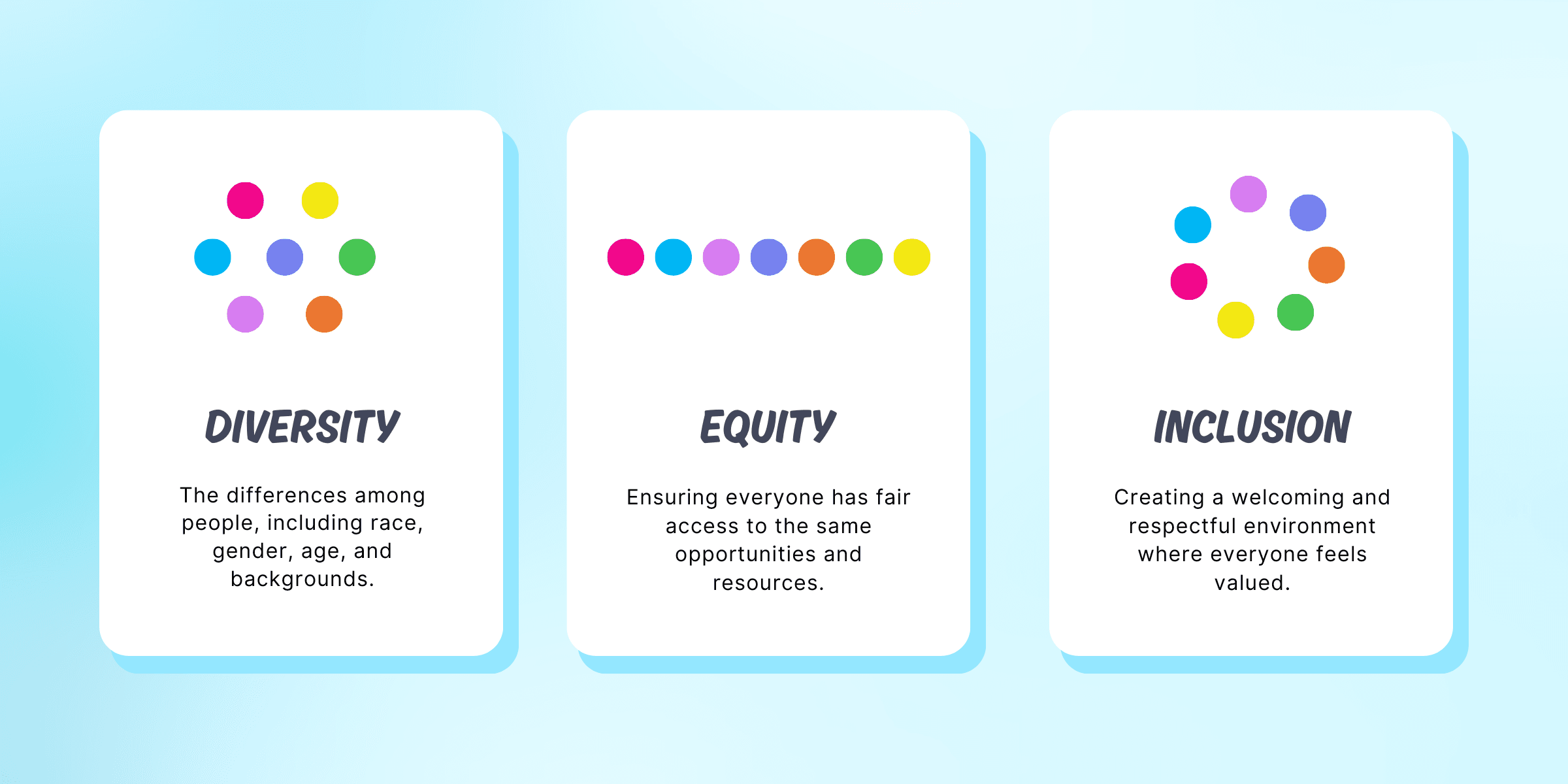
Diversity refers to the differences among human beings. These differences can include, but are not limited to, race, gender, age, experiences, talents, skills, and opinions.
According to Glassdoor, 2 out of 3 job candidates seek companies that have diverse workforces.
As such workforce can bring different perspectives, ideas, and experiences to the table. This helps improve decision-making and boosts innovation and creativity.
Inherent: Characteristics such as age, race, and gender that are intrinsic to an individual.
Acquired: Attributes such as skills, experience, and education that can be developed over time.
An example of diversity in the workplace is Sodexo. With a strong focus on gender parity, it has been included in Bloomberg’s gender equality index.
37% of the company’s executive committee are women, and 60% of its board of directors consists of women. Sodexo has found that when there is an optimal gender balance within an organization, employee engagement increases by 4 percentage points, gross profit increases by 23%, and the brand image strengthens by 5 percentage points.
Equity refers to providing the required support and career advancement opportunities to employees to help them succeed. It ensures that each employee has unique needs and provides them resources accordingly.
Often, equity and equality are used interchangeably. But they are different.
Equality means providing equal resources to everyone, while equity provides resources according to specific needs.
For instance, consider training and professional development opportunities. An equal approach might involve offering the same training sessions to every employee, assuming that the same content will benefit everyone in the same way.
However, this perspective fails to consider that employees have different skill sets, career goals, and learning styles.
Accenture has a strong commitment to creating a culture of belonging and equity. Voted #1 in Refinitiv’s Diversity and Inclusion Index, the company has invested $1.1 billion in learning and development opportunities for its employees.
Accenture’s Vaahini Network supports women’s career development by providing access to mentorship, networking opportunities, and leadership development programs. The company also has a strong commitment to pay equity and regularly audits its compensation practices.
Inclusion refers to an environment where diverse employees have equal involvement and access in community and decision-making. Inclusive companies make better business decisions up to 87% of the time.
A great example of inclusion is Warby Parker. They focus on listening to different points of view and then taking real action based on what they hear. Warby Parker works hard to create an atmosphere where employees feel comfortable being themselves and sharing their unique stories. They believe that when people feel included in one part of the company, it can spark new ideas in other areas.
Let’s understand the relationship between diversity inclusion and equity with an example.
Imagine a software company launching a new app. Here’s how diversity equity and inclusion plays a role in the project’s success:
However, what happens when only two of 3 are considered.
A diverse team that feels included can generate many ideas, but if equity is absent, not everyone may have equal access to resources or decision-making power. Some may dominate conversations while others remain silent.
A diverse group that receives fair support can thrive, but without inclusion, team members might not feel comfortable sharing their thoughts. This could lead to valuable insights being overlooked.
A workplace that ensures fair access and promotes a welcoming environment can support its members effectively. However, without diversity, the group may miss different perspectives, limiting creativity and innovation.
Thus, components strengthen the overall workplace environment. When all three are present, they create a culture that values diverse viewpoints, promotes fairness, and ensures everyone feels welcomed and heard. Each aspect supports the others, making them essential for a successful workplace.
When planning to create workplace diversity policies for organizations, it’s important to include DEI in your hiring practices. This means hiring individuals from different ethnicities, genders, and races.
One important point to note is that diversity equity and inclusion policy does not mean giving any specific person or group special benefits or chances in the hiring process. Instead, it means providing all candidates with equal opportunities and then selecting the best-suited candidate for the specific job role.
As Karen Draper said, “Diversity doesn’t look like anyone. It looks like everyone.”
A DEI hire refers to someone brought on board to enhance the diversity of a team or organization. However, the term has recently been misused in a negative light. Some people use the term to imply that a candidate was chosen solely based on their background rather than their qualifications or abilities.
This perspective is misleading and damaging, as it can undermine the hard work and talent these individuals contribute.
In reality, hiring with DEI is about making thoughtful decisions to build stronger teams. Diverse management teams can achieve 19% higher revenue due to increased innovation. So, is not a negative approach, but a way to bring a diverse range of voices and experiences.
So till now you learned the diversity equity and inclusion definition and basics; now let’s see how it impacts organizations and their importance.
At the core of why DEI matters, it’s really because people matter. All of your employees feeling a high sense of belonging and empowerment and inclusion is important because your people working for you should matter. And beyond that, your customers matter. So if you’re building a diverse team that represents a diverse set of identities, experiences, and abilities, you’re setting yourself up to build a product that services more people across those differences.
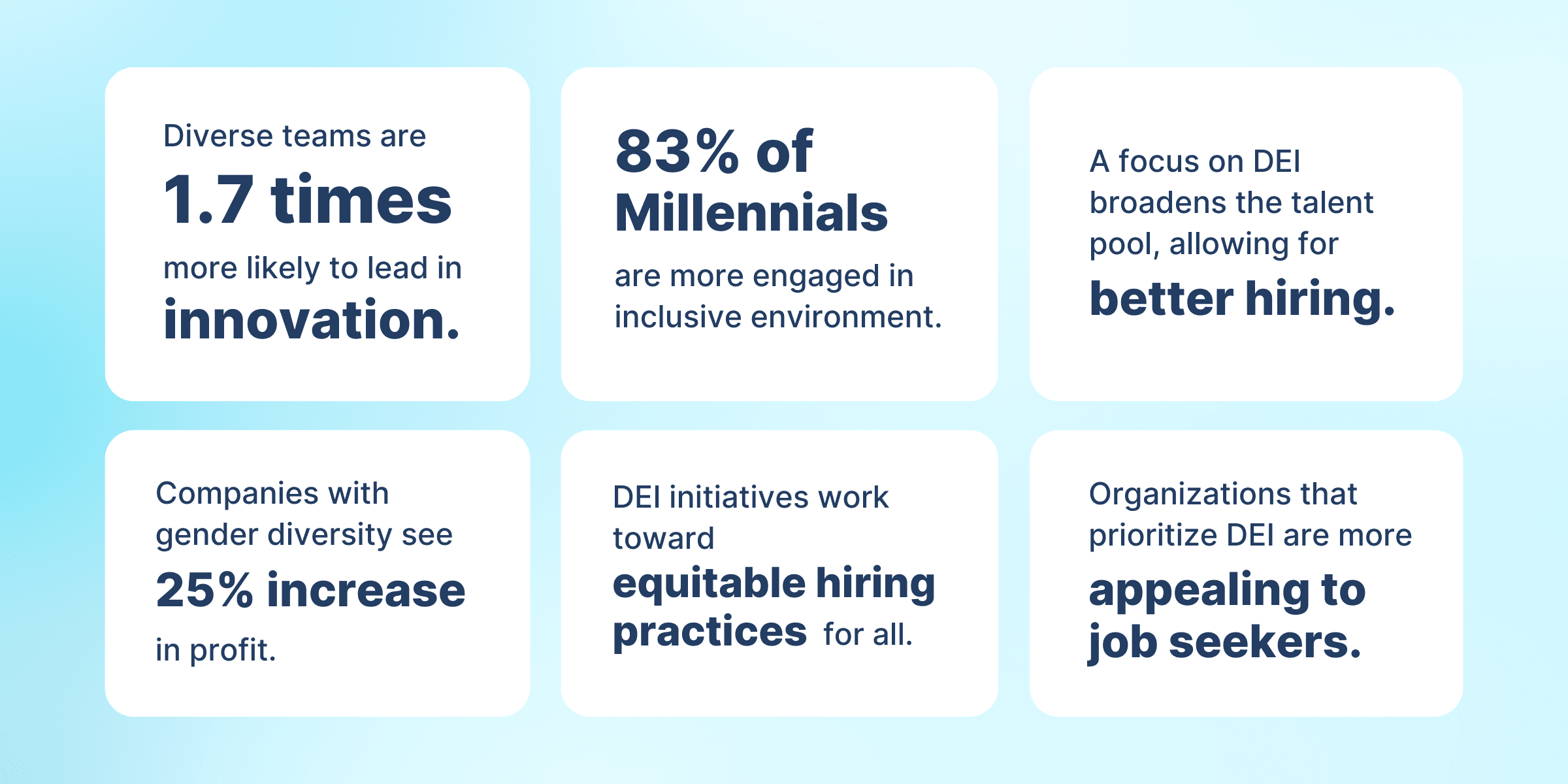
Studies say that companies with diverse teams are 1.7 times more likely to be leaders in innovation.
So, diversity equity, and inclusion in the workplace helps enhance innovation and creativity. When people from different backgrounds work together, they share unique ideas. This mix of perspectives leads to better problem-solving.
Having a diverse workforce can improve financial performance. It also increases profitability. For instance, businesses in the top group for gender diversity are 25% more likely to earn higher profits than their competitors.
Also, companies with racial and ethnic diversity are 35% more likely to perform better financially than similar businesses. This shows that DEI in workplace is not just good for fairness; it also helps the bottom line.
DEI boosts employee engagement and satisfaction, too. When everyone feels included and valued, they tend to be happier at work.
Indeed’s DEI training showed that employees who feel included are more engaged in what they do. Plus, 83% of Millennials say they are more engaged when they work in inclusive environments.
Happy, engaged employees are likely to stay with the company and do their best work.
Focusing on DEI allows organizations to expand their talent pool. This means they can find and hire the best people for the job, no matter their background.
For example, Nuuday saw great improvements in employee satisfaction when they emphasized creating a safe and welcoming work environment.
Companies with diverse leaders not only attract better talent but also help ensure everyone’s voice is heard and valued.
Strong DEI practices also help improve a company’s reputation. When organizations are known for valuing diversity and inclusion, they get noticed positively by the public.
This can open up more business opportunities. In fact, 75% of job seekers say they think about a company’s DEI efforts when deciding where to apply.
Finally, such initiatives work to address long-standing inequalities. These programs aim to provide fair chances for everyone.
Many businesses are starting equitable hiring practices to help correct past unfairness. Companies that focus on DEI often see an increase in hiring underrepresented candidates, making workplaces more equal for all.
Organizations today face several challenges when trying to implement diversity equity and inclusion initiatives.
Many organizations face backlash against their Diversity, Equity, and Inclusion (DEI) initiatives. Employees from dominant social identity groups, such as white individuals and men, may feel threatened by such programs.
They might see these initiatives as unfair because they highlight existing inequalities. For example, when companies try to promote gender equity to help women in leadership roles, some men may perceive that as unfair to them.
President Trump issued executive orders aimed at ending federal DEI programs. Though these target DEI initiatives in the public sector, it made it unclear how private companies should handle their own efforts.
While the orders do not require private companies to make changes right away, they encourage firms to rethink their practices. Many companies, like Target, that have scaled back DEI initiatives faced boycotts that hurt their reputations and financial standing.
For example, under the new rules, federal contractors will need to eliminate DEI-related offices and stop DEI training. They also have to make sure their hiring and promotion practices follow strict merit-based standards. If they don’t comply, they could face legal risks, like lawsuits claiming unfair treatment.
Despite these challenges, it remains critical for organizations. Because a recent Resume.org survey found that only 5% of companies have completely eliminated their DEI programs, while 22% are increasing their DEI budgets.
This means that many organizations still see it as essential for long-term success.
Here are some suggestions:
Instead of viewing DEI in workplace as just rules to follow, companies should present them as chances for employees to learn and grow.
This approach helps reduce feelings of threat. For instance, a company can hold workshops where employees share their experiences and learn together about its importance.
Organizations should create safe spaces for employees to talk about such topics. Open dialogue about different experiences can help build understanding and reduce defensiveness.
For example, a company can have regular discussion groups where employees can talk about their feelings and thoughts about DEI efforts.
Change takes time. Companies should celebrate small wins in their efforts. Recognizing progress, like increasing diverse hiring, can inspire employees to keep working toward inclusion.
Companies must regularly review DEI programs to make sure they align with current laws. This includes conducting audits of hiring, promotion, and training practices.
For example, a company might hire a legal expert to review their DEI practices and ensure they are following the new regulations.
Transparency is vital. When organizations inform employees about changes to programs, it helps everyone understand the reasons behind these adjustments. For instance, if a company decides to alter their DEI training, they should explain the changes and why they are necessary.
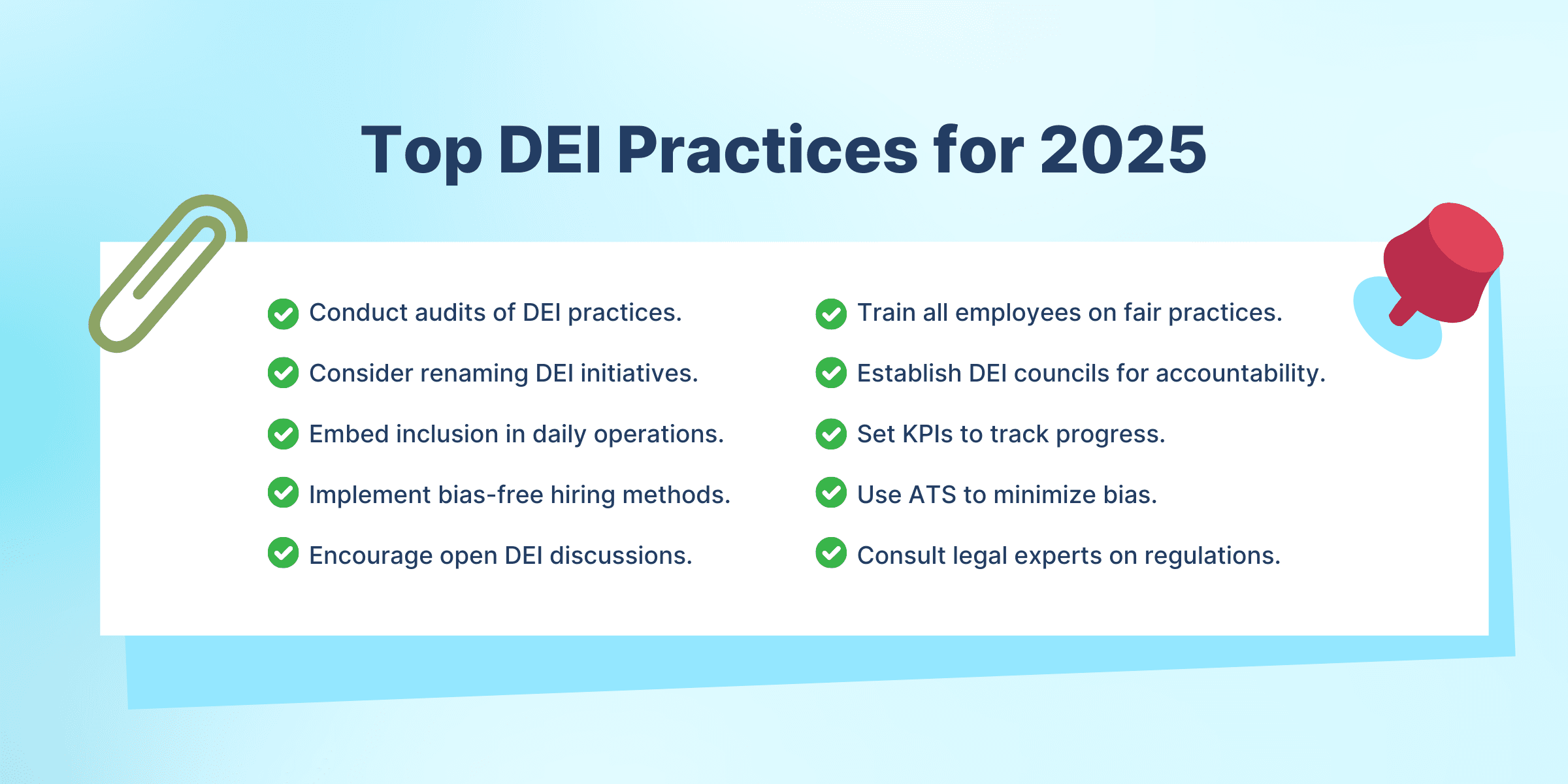
In 2026, organizations must adapt their Diversity, Equity, and Inclusion (DEI) practices to keep up with new rules and changes. Here are some easy-to-follow best practices that can help your organization create a welcoming and fair workplace.
Start by reviewing your current practices. It’s smart to do an audit under attorney-client privilege to keep findings confidential. This will help ensure that you’re following the new rules and also see how well your current initiatives are working.
Some companies are thinking about changing the names of their DEI initiatives. If you decide to make this change, be ready to explain why. Clear communication is important, so employees don’t think you’re stepping back from your commitment to diversity.
Inclusion shouldn’t be just a program; it should be part of how your organization operates. This means making sure that every hiring and promotion decision is based just on merit. For example, you can broaden the definition of diversity to include people like veterans or those from disadvantaged backgrounds.
To build a diverse workforce, start with your hiring practices. This means using methods that remove bias, like blind resume reviews. Also, look to hire from underrepresented communities and train recruiters to recognize biases. This will help you build a fairer hiring process.
Having open conversations among employees is super important! Create opportunities for team members to share their thoughts and stories. This helps everyone feel included and builds a sense of community, especially when things are changing.
Training should focus on making fair decisions in hiring and promotions. This helps everyone understand that DEI efforts include a variety of experiences without compromising on skills. Make sure all managers get trained to understand the importance of these ideas.
Start a DEI council or group to ensure accountability. These councils, filled with diverse people, can guide your strategy, keep track of progress, and suggest improvements. This makes sure that everyone is on the same page.
Tracking your efforts is crucial. Set key performance indicators (KPIs) for diversity, inclusion scores, and retention rates. Regular employee surveys can help you understand how inclusive your workplace really feels.
Technology can really help with DEI initiatives. Use applicant tracking systems that reduce bias and tools that support employee resource groups (ERGs). AI analytics can help you find gaps in diversity and track improvements.
The laws around DEI are always changing, so you should always seek legal advice. Consulting experts will help ensure your practices follow current rules. Staying informed about changes helps your organization avoid any legal issues.
Training, employee resource groups, and representation targets can support DEI, but they do not show whether people are receiving fair access to work and progression. A stronger measurement set includes four layers:
Pin’s 2026 framework uses these same four categories and recommends looking at pass-through rates at every hiring stage, rather than reporting only the demographics of the final workforce. The diagnostic step matters: a sourcing gap calls for better reach, while a late-stage offer gap calls for a review of interview evidence, calibration, and decision criteria.
AI does not remove this responsibility. If an applicant tracking system or screening tool ranks candidates, retain the job-related reason for the recommendation, monitor outcomes by stage where lawful, and give recruiters a way to challenge an obviously irrelevant or incomplete result. The U.S. Department of Labor’s AI and Inclusive Hiring Framework is a useful starting point for disability-inclusive technology checks.
The legal context also matters. The U.S. Equal Employment Opportunity Commission states that DEI is a broad term, but Title VII continues to apply when an employment action is motivated in whole or in part by race, sex, or another protected characteristic. This does not mean employers should stop removing barriers or measuring outcomes. It means selection criteria should remain job-related, consistently applied, documented, and reviewed with qualified local counsel. Employers operating in the UK, EU, Canada, or another jurisdiction should use the rules that apply where the work is performed.
Start with the hiring system itself. Write requirements that describe observable skills, state flexibility and salary expectations clearly, ask the same core questions, score evidence against pre-agreed criteria, and record why a decision was made. Then use an ATS to make that process visible and repeatable. A structured interview guide and an inclusive hiring guide can support this work, but neither replaces manager accountability or local legal review.
The test for every DEI initiative is practical: what barrier is it addressing, which stage of the employee lifecycle does it change, how will you know whether it worked, and what will you do if the result does not improve?
The best HR analytics software for tracking DEI metrics in a hiring funnel is the system that preserves stage definitions, denominators, role context, privacy controls, and an action owner. Current diversity-recruiting comparisons from People Managing People, SelectSoftwareReviews, and WorkTech Desk emphasize analytics, structured hiring, anonymisation, and candidate experience. Those feature lists are a starting point, not proof that a tool produces fair outcomes.
| DEI measurement layer | Useful metric | Denominator or comparison | Action when a gap appears |
|---|---|---|---|
| Reach | Qualified applicants by source and job family | Relevant labour market or approved target pool | Review channels, job language, accessibility and location rules |
| Progression | Pass-through at application, screen, interview, offer and hire | Same role family, level and time window | Audit the stage with the largest unexplained difference |
| Decision quality | Scorecard completion, override reasons and rejection reasons | Same rubric and interviewer plan | Calibrate interviewers and remove vague criteria |
| Experience | Belonging, accommodation access, response time and candidate feedback | Comparable teams, stages and survey periods | Assign an owner and close the feedback loop |
| Outcomes | Pay at hire, promotion, retention and internal mobility | Comparable role, level, location and tenure | Review access, manager practice and policy barriers |
When comparing HR and recruiting software for inclusive hiring, ask whether the product can:
Structured interviews can reduce variation because candidates receive the same core questions and answers are rated against defined job-related anchors. They do not eliminate bias by themselves. The useful test is whether the team submits independent feedback before the debrief, uses the same scorecard, separates evidence from preference, and reviews disagreement rather than averaging it away.
The U.S. Department of Labor’s AI and Inclusive Hiring Framework supports checking technology for disability inclusion, while GOV.UK structured interview guidance connects standardised processes with fairer decision-making. Use those sources as implementation prompts, then obtain local legal advice for the jurisdictions where hiring occurs.
The strongest DEI analytics dashboard is the one that helps a team identify where a job-related process is losing qualified people, protect sensitive data, assign an owner, and verify whether the next intervention changed the outcome.
For implementation, connect this framework to Recooty’s inclusive hiring guide, candidate scorecard guide, recruiting metrics guide, and ATS guide.
Diversity, equity, and inclusion improve when teams connect each goal to a real process, a named owner, and a review date. Start with one hiring or workplace barrier, document the change, and check whether people experience a fairer process over time. Recooty can help organize job descriptions, applications, and candidate records, but teams remain responsible for the criteria and decisions they use.
It also helps you generate concise job descriptions and post them to job boards in one click.
Measure reach, pass-through at every stage, scorecard and decision consistency, candidate experience, accommodation access, offer acceptance, pay at hire, promotion, retention and internal mobility. Define the denominator and review the data by comparable role, level and location.
Compare job-related criteria, anonymisation options, audit logs, source evidence, accessibility, data minimisation, reporting definitions, human override and export controls. Do not treat a vendor’s “unbiased” label as an outcome or compliance guarantee.
It has a clear definition, denominator, baseline, review date, responsible owner and action threshold. A metric becomes useful when the team can change a process after seeing the result and later check whether the change helped.
They can reduce variation when interviewers ask consistent job-related questions, use anchored ratings, submit independent feedback and receive calibration. They cannot remove bias if the rubric is vague, the process is not followed or the debrief is dominated by one voice.
Confirm the data quality and privacy basis, locate the stage where the gap appears, review the job criteria and interviewer evidence, speak with affected stakeholders, assign an intervention owner and set a follow-up date. Do not change selection standards informally or use protected data as an automatic quota.
Diversity, Equity, and Inclusion in the workplace means taking clear and thoughtful steps to create a team that includes different kinds of people. Diversity is about recognizing and valuing different backgrounds. Equity means fair access to opportunities and support. Inclusion focuses on creating a space where people can participate, contribute, and progress.
The “Golden Rule” is simple: treat others how you want to be treated. This rule helps organizations make choices that are fair and caring. It involves respecting different viewpoints and backgrounds. It also means making sure everyone understands their roles and how pay is determined. When this rule is followed, it helps create a workplace where everyone feels listened to and valued.
Inclusion and Diversity Trainings: These programs teach employees about things like unconscious biases and cultural awareness.
Employee Resource Groups (ERGs): These are groups made up of employees who share similar backgrounds or experiences, like a group for women or people of color.
Recruitment and Hiring Practices: Companies often work hard to make sure they are fairly hiring people from different backgrounds.
Policy Changes: Many organizations create new rules to prevent discrimination and to support things like family leave and accommodations for people with disabilities.
Employee engagement and Retention programs: These initiatives help create a supportive workplace where employees feel valued.
Community: Building a supportive culture through groups that connect employees, like affinity groups and DEI committees.
Measure representation, stage-by-stage hiring and promotion outcomes, pay and development access, employee experience, retention, and whether agreed actions are completed. Segment results by job family, level, location, and other categories only where lawful, safe, and statistically meaningful.
Diversity is representation, equity is fair access and support, and inclusion is the day-to-day experience of being able to participate and contribute. A strong DEI strategy checks all three because representation without fair progression or belonging is incomplete.
Start with repeatable hiring and management practices: clear job requirements, inclusive job descriptions, structured interviews, consistent scorecards, transparent pay and promotion criteria, flexible work options, accessible applications, and a documented route for concerns. Assign an owner and review a small set of meaningful metrics regularly.
They can support consistency and reduce manual work, but they can also reproduce historical patterns. Keep human review, use job-related criteria, document recommendations, test outcomes for harmful differences where lawful, and provide a way to correct missing or inaccurate candidate information.
DEI is a broad term and legality depends on the specific policy, action, and jurisdiction. The EEOC states that Title VII prohibits employment discrimination and that a DEI-labelled practice can still be unlawful if a decision is motivated by a protected characteristic. Obtain qualified legal advice for a program that affects hiring, promotion, pay, training access, or termination.
Source: https://recooty.com/blog/diversity-equity-and-inclusion-in-the-workplace/

Hardik Vishwakarma – AI Recruitment Strategist | HR Automation Expert | Applicant Tracking Software Specialist Hardik Vishwakarma is a recognized leader in HR automation and...
View Full Profile →