


AI in recruitment is most useful when it removes repetitive work and leaves people responsible for the decision. Start with a clear bottleneck, such as scheduling, search, job-description drafting, or candidate updates, and define what a good result looks like before choosing a tool.
The recruitment news around AI can make the options feel larger than they are. Your team still needs to recruit candidates from a crowded market, align with the hiring manager, and protect the candidate journey. AI can support that work in recruitment, while the human qualities and technology connection remains central to a fair recruitment process.

Key takeaways
- Use AI in recruitment to remove repetitive work, improve search and communication, and give recruiters more time for judgment and candidate relationships.
- Match the AI use case to the bottleneck: sourcing, job-description drafting, screening support, scheduling, interview notes, candidate communication, or reporting.
- Current recruiter research reports growing adoption, but also shows that writing, communication, and workflow support are often safer first uses than fully automated selection.
- Require explainable outputs, human review, privacy controls, bias testing, candidate communication, and an override path before using AI in a high-impact hiring decision.
- Measure time saved and hiring outcomes together. Faster processing is not a success if qualified candidates drop out or the quality and fairness of decisions decline.
Use the sections below to choose a practical starting point, understand the limits of AI, and set review checks before an automated output affects a candidate.
What is the Role of AI in Recruitment?
In the past few years, there has been a continued push for automation, and the recruitment industry is overshadowed by it. AI is strongly rooted in the recruitment industry and its role is quite dynamic. Here’s how.
- Enhancing Conversational Interactions: AI, particularly Generative AI, is transforming recruitment by enabling highly interactive and conversational interfaces. It allows for automated chat-based conversations with candidates, hiring managers, and recruiters. This enhances engagement and communication throughout the hiring process.
- Streamlining Recruitment Technology: AI-driven tools such as conversational applicant tracking systems can support interview scheduling, candidate interactions, and workflow management. This reduces administrative work while keeping the hiring team in control.
- Personalization at Scale: AI facilitates personalized interactions in recruitment. By analyzing candidate profiles and job requirements, AI can generate tailored messages and content. This personalization improves the candidate experience and helps match candidates with suitable job opportunities.
- Efficiency and Time Reduction: AI-driven automation significantly reduces the time it takes to complete various recruitment tasks. For example, it can shorten the time to hire by automating repetitive processes, making recruitment more efficient and responsive to business needs.
- Transparency and Candidate Experience: AI can contribute to a transparent and candidate-centric recruitment process. It ensures that candidates receive relevant information about job roles, company culture, and expectations early in the process. This transparency allows candidates to make informed decisions and enhances overall satisfaction.
The benefits of AI in recruiting
1. AI improves hiring
Enhancing the quality of your hires relies on attracting top-tier candidates from the outset. If your job postings fail to excite high-caliber applicants, you’ll likely sift through less-qualified candidates, hoping to find a suitable match.
Incorporating AI into your recruitment process can significantly elevate applicant quality in various ways.
In the initial phase, AI aids in crafting precise and informative job descriptions. This clarity helps convey your specific requirements, resulting in a greater influx of candidates aligning with your needs and fewer who are either overqualified or underqualified.
Moreover, AI can employ “programmatic job advertising” to pinpoint the perfect candidates online. Programmatic advertising, based on demographic and behavioral factors, ensures your message reaches the right individuals at the right time. This targeted approach attracts the ideal candidates and, akin to crafting an impeccable job description, elevates your conversion rates.
“One of the best uses that I have found of AI in the hiring process is summarizing CVs. When you get lots of applications for a role, it can be quite overwhelming and sifting through them to make sure that you find the right candidate can take up a lot of time. Using Chat GPT or a summary generator, we can summarize all the information and save hours of work. It also helps to clarify what the candidates’ main skills are, making the decision process a lot easier.”
-Martin Desmond, Managing Director of Wizer Energy
2. Leverage AI as your unpaid intern
No one wants to get bogged down with mind-numbing manual chores like interview scheduling, candidate screening, and deciphering your team’s ever-changing demands.
But fear not, because AI can step in like a trusty sidekick for recruiters. Think of it as your personal assistant, swooping in to rescue you from these mundane tasks. With scheduling software and automated resume checkers in your arsenal, you can conquer these to-dos without sacrificing your precious time.
In other words, let AI handle the drudgery while you focus on the exciting stuff.
3. Taking Customer Experience to Next Level
AI isn’t just a win for your team; it’s a game-changer for candidates too! You might think, “Wait, how does less human interaction equal a better experience for candidates?” Well, it’s all about making the recruiting journey smoother and more user-friendly for everyone involved.
See, the candidate experience is a pivotal part of the recruitment process. Many AI tools in the recruiting realm are crafted to make life easier for all parties. When job seekers can swiftly access the info they need, they’re more likely to stay engaged with your organization.
Take chatbots, for instance. They’re like virtual guides, leading candidates through the interview process with finesse. This doesn’t just save time and cut costs; it ramps up the overall candidate experience. No more pesky barriers or confusing steps that might deter applicants from completing their journey.
So, when you’re considering bringing AI into your recruitment process, remember it’s not just about you and your team. It’s about creating a stellar experience for candidates too.
For example QuEra, the US based atom technology. They introduced Recooty into their recruitment process and went all-in on enhancing candidate experience. The result? A whopping 97% of applicants gave a big thumbs-up, saying they had a positive experience applying at Recooty. Now that’s how AI can transform the game!
4. Maximize efficient of recruitment process
To secure top-tier talent, your recruitment process must run seamlessly. Any glitches along the way could lead those star candidates right into the database of your competitors. To keep the process efficient and ensure that the right applicants make it through, you’ve got to keep your eye on the big picture.
This is where AI steps in as your trusty lookout. You see, AI is synonymous with data. Many AI tools gather and present data in a way that’s incredibly insightful. It’s like having a well-organized dashboard for your recruitment funnel data, allowing you to pinpoint and fix any hiccups.
So, if your recruitment process is a machine, AI is the grease that keeps it running smoothly. It helps you optimize every step of the journey, ensuring you don’t miss out on the best talent out there. With AI, you’ve got your finger on the pulse of your recruitment process, and that’s a game-changer.
Closing candidate hiring in a few days
Efficient hiring can sometimes feel like a tightrope walk. On one hand, you want the perfect candidate for your job opening. On the other, you’re under pressure to fill that spot swiftly and cost-effectively. Plus, if you’re stretching your team thin to cover the workload, it might not do wonders for their job satisfaction.
But here’s the catch: You can’t rush the hiring process and settle for the first person who strolls in. It’s like that classic project management dilemma where you had to choose between ‘good,’ ‘cheap,’ and ‘fast,’ but could only pick two. Recruitment faces a similar challenge.
That’s where AI steps in to restore balance. We’ve already covered how AI can enhance the ‘good’ and ‘cheap’ aspects, but it’s also a turbocharger for the ‘fast’ part. By drastically slashing the time you’d spend sifting through resumes or screening candidates, AI accelerates your interview process without sacrificing candidate quality. It’s a win-win scenario.
AI tools in recruitment
Based on our experience of AI in recruitment industry these are most commonly used AI tools and application. Companies entrust and leverage these AI tools to hire the right candidate. Here they are:
Recooty
Recooty has been a trusted partner in modern recruitment, offering fast and flexible integrated solutions that have made hiring a breeze. Their platform ensures fair and transparent hiring practices, making it easy to engage with candidates through text and automated processes. With their video interview platformand structured interview builder, they have helped organizations reach top talent efficiently. Whether hiring graduates, professionals, or technical experts, HireVue streamlines the process, saves time, and allows organizations to focus on finding the best candidates for their teams. Many renowned brands have trusted HireVue for their recruitment needs.
Some myths about AI in recruiting
Myth 1: AI is Just a Chatbox
AI in recruiting can support many workflows beyond chat. Depending on the product, it may search candidate records, draft a job description, summarize evidence, schedule interviews, answer routine questions, or surface a reporting pattern. The useful question is whether the tool solves a defined hiring task and shows a reviewer what it did.
Myth 2: AI Will Replace Human Recruiters
AI isn’t here to steal the limelight from human recruiters. It’s not plotting to take over your job; it’s more of a trusty sidekick. Think of it as your secret weapon, designed to make your life as a recruiter easier. AI is all about handling the heavy lifting, like sifting through resumes and screening candidates. This leaves you free to focus on the juicy, human-centric tasks that truly make a difference. You’ll still be the star of the show, making those personal connections that AI can’t match. The result? A well-balanced recruitment dream team.
Myth 3: AI Increases Bias
Yes, there have been some infamous cases where AI showed bias. Take Amazon, for instance, with its not-so-subtle bias against women, as revealed by its AI software. But here’s the kicker – those cases are pretty darn rare. In fact, AI is more likely to be your trusty sidekick in the fight against bias. A whopping 59% of recruiters believe that AI can kick unconscious bias to the curb. It does this by focusing on the cold, hard facts – skills and experience. It’s a champion of diversity hiring, helping you build a more inclusive workforce.
Myth 4: AI Is Only for Big Corps
Don’t buy into the myth that AI is only for the big players. Whether you’re a massive corporation or a scrappy startup, AI can be your secret weapon. It’s not just about fancy tech – it’s about saving time and money. Smaller businesses can benefit big time by using AI in recruitment. How? By reducing the cost per hire. AI optimizes job ads, making them super effective, so you can attract the right candidates without breaking the bank. It’s a game-changer for businesses of all sizes.
Myth 5: AI Is a Tech Nightmare
Don’t be intimidated by the tech wizardry behind AI. It might seem like a complex beast, but it’s actually designed to be user-friendly. Sure, you might stumble a bit when you first start using it – we all do with new software. But here’s the kicker: you don’t need a tech guru by your side. Setting up automation with AI is a breeze. It involves a little pre-planning, a few clicks, and maybe a test or two. That’s it. No need to fret about tech nightmares – AI’s got your back.
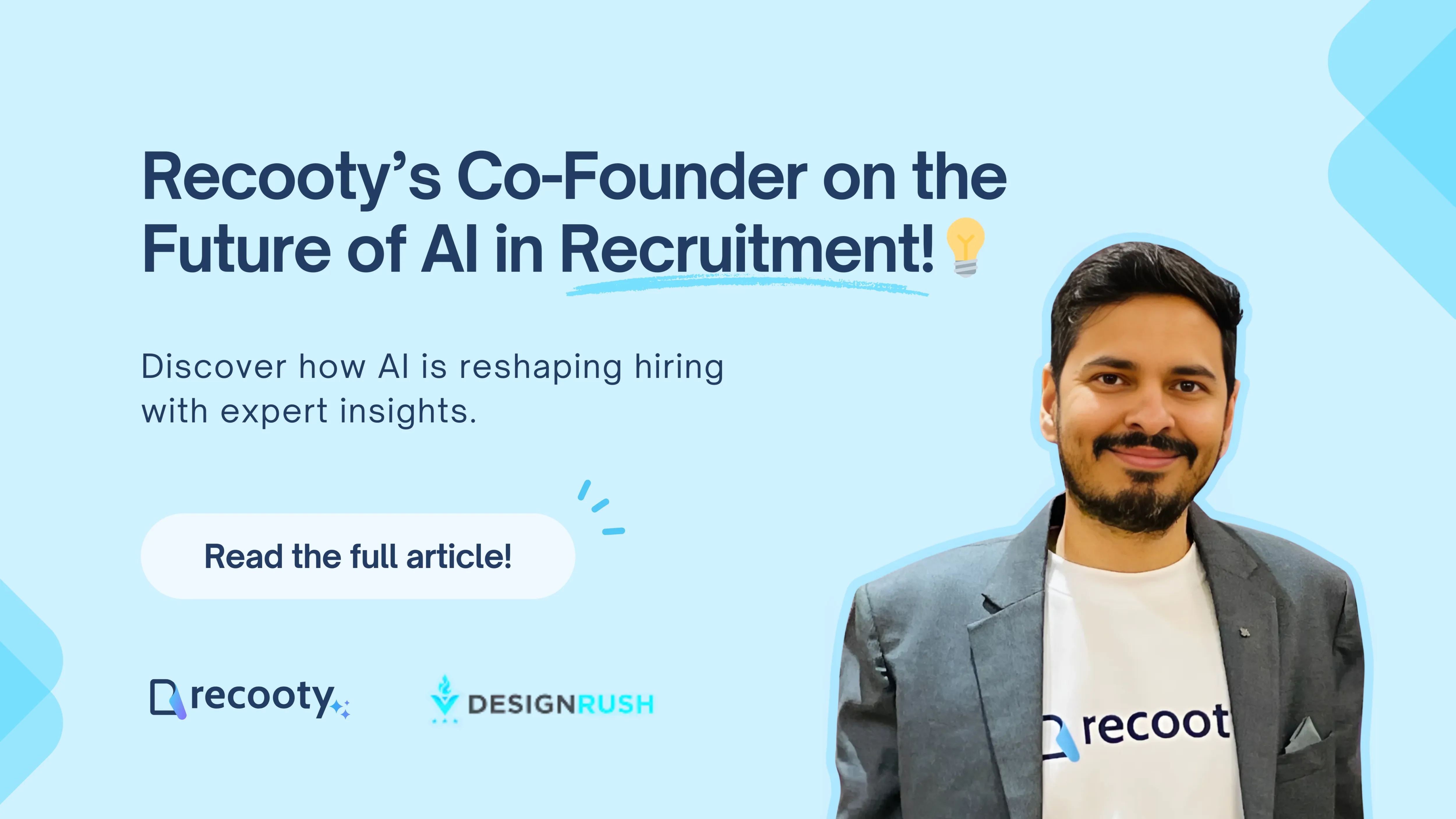
In line with the growing importance of AI in recruitment, our co-founder, Avdhesh Solanki, shares his insights in a recent article published by DesignRush. He discusses how AI is transforming the hiring process by enabling proactive recruitment and enhancing decision-making. Utilizing AI tools like Recooty not only boosts efficiency but also personalizes the candidate experience.
To explore more about Avdhesh’s thoughts on this subject, read the full article here. Special thanks to DesignRush for their commitment to connecting businesses with top design and tech solutions that help them succeed in today’s competitive landscape.
How AI improves sourcing and screening in talent acquisition software
AI is most useful in recruitment when it reduces search and coordination work while leaving hiring criteria and accountability with people. Start with a specific bottleneck, define what a good output looks like, and test the workflow on real roles before expanding it.
Use AI by hiring task, not by hype
| Hiring task | Useful AI assistance | Human responsibility | Success measure |
|---|---|---|---|
| Job description | Suggest structure, clarify requirements, flag vague or exclusionary language | Confirm the role is accurate, realistic, and inclusive | Qualified application rate and completion rate |
| Sourcing | Expand searches, match skills, rediscover past candidates, draft outreach | Validate relevance, consent, and message accuracy | Qualified reply and screen rate |
| Screening | Summarize evidence, compare answers with predefined criteria, flag missing information | Review evidence, exceptions, accommodations, and borderline cases | Agreement with human review and adverse-impact checks |
| Scheduling | Offer time slots, coordinate calendars, send reminders | Handle accessibility, time zones, rescheduling, and sensitive situations | Scheduling time and candidate drop-off |
| Interview support | Capture notes, summarize themes, organize scorecard evidence | Score candidates against the role and correct inaccurate notes | Scorecard completion and decision time |
| Candidate communication | Answer routine questions, draft updates, route requests | Approve sensitive messages and maintain a human escalation path | Response time, satisfaction, and resolution rate |
| Reporting | Find bottlenecks, summarize funnel movement, identify source patterns | Interpret context and decide what process change to make | Time to hire, quality of hire, and candidate experience |
Leading AI-powered platforms for global HR automation: what to compare
Compare leading AI-powered platforms for global HR automation by the problem they solve, not by whether they advertise an AI assistant. A sourcing tool, screening layer, conversational chatbot, interview notetaker, and full ATS may all use AI but operate at different stages and carry different risks.
Check these capabilities before buying:
- Use-case boundaries: Is the product assisting a recruiter, ranking candidates, making a recommendation, or taking an action automatically?
- Evidence visibility: Can the reviewer see the job-related evidence behind a summary or match?
- Correction and override: Can a recruiter correct an output, record the reason, and prevent a known error from repeating?
- Data controls: Where is candidate data stored, how long is it retained, and is it used to train a model?
- Workflow integration: Does the output return to the ATS with source, stage, consent, and decision history intact?
- Candidate experience: Are candidates told when automation is used and offered a route to ask for help or request accommodation?
- Monitoring: Can the team inspect outcomes by role, location, stage, and relevant candidate groups?
The current Lever comparison of AI recruiting tools organizes tools by use case and evaluates AI capability, governance, sourcing depth, automation, integrations, adoption, pricing, and candidate experience. That is a better buying model than a universal “best AI recruiting tool” ranking because different systems solve different bottlenecks.
Best hiring software with AI job description generator and auto-publish to careers page
If the first goal is faster job creation and distribution, choose a tool that can draft a job description, publish it to the careers page, and send it to selected job boards while preserving the canonical job record. The workflow should still include these checks:
- The hiring manager confirms the responsibilities, must-have skills, location, work arrangement, pay range, and success measures.
- The AI draft is reviewed for invented requirements, inflated claims, biased wording, and unclear application instructions.
- The careers page shows the same role details as the ATS and job-board feed.
- Closing or editing the role updates every downstream copy and removes stale listings.
- Source and conversion data return to the same candidate record.
Auto-publishing saves time only when the source record stays accurate. A faster way to distribute an incorrect job description creates more low-fit applications and more screening work.
Current AI recruitment statistics: adoption is not proof of effectiveness
The 2026 Employ Recruiter Nation report reports that 65% of respondents use AI to augment recruiting technology. It reports 43% using AI features built into recruiting platforms and 32% combining those tools with free or low-cost generative AI. The most common reported uses included job-description recommendations at 41%, communication with candidates or new hires at 41%, and recruitment marketing content at 39%.
The same report says teams reported faster time to hire at 55%, better candidate quality at 53%, and improved candidate experience at 46% after using AI. These are survey results, not causal proof that AI created the improvement. Use them as a measurement prompt. Record a baseline, run a limited pilot, compare similar roles, and check whether time savings came from a real bottleneck or simply moved work to candidates and hiring managers.
Responsible AI in recruitment: the minimum control set
The UK Department for Science, Innovation and Technology’s Responsible AI in Recruitment guidance covers sourcing, screening, interviews, and selection. It warns that AI can perpetuate existing bias, create digital exclusion, and enable discriminatory advertising or targeting. Use a documented control set:
- Define the job-related criteria before configuring the model or prompt.
- Test outputs with representative examples, including nontraditional career paths and accessibility needs.
- Keep a human decision-maker accountable for progression and rejection.
- Make it possible to review, correct, and override a recommendation.
- Check whether error rates or selection patterns differ across relevant groups.
- Explain the use of automation in plain language where required or where it affects candidate trust.
- Minimize candidate data, set retention rules, and restrict access by role.
- Log model version, prompt or rule changes, reviewer decisions, and incidents.
- Review vendors for security, privacy, audit rights, accessibility, and support before procurement.
AI should not be used to infer sensitive traits, personality, emotion, honesty, or “culture fit” from weak signals. If a tool cannot show the evidence for its recommendation or cannot be challenged, do not treat its score as a hiring decision.
What current AI recruitment competitors cover, and what they leave to buyers
Current comparison pages split the market into ATS plus CRM platforms, sourcing layers, structured interview tools, chatbots, assessment products, and candidate rediscovery systems. Lever lists those categories by use case. TechRadar’s recruitment platform comparison highlights broader platforms with AI matching, candidate communication, scheduling, and analytics. The government guidance covers assurance and risk rather than vendor rankings.
The practical gap is the operating layer between the tool and the decision. Before choosing a platform, write the exact task, input data, expected output, reviewer, escalation path, fairness check, and success metric. This prevents a company from buying an AI sourcing tool when the real bottleneck is hiring-manager feedback or candidate scheduling.
Recooty editorial view: automate admin, not accountability
Our editorial view is to start with low-risk assistance such as drafting, search expansion, scheduling, summaries, and reporting. Move toward recommendations only after the team has defined criteria and can audit the outputs. Keep the recruiter visible to candidates when the decision is sensitive, and never use AI to avoid a difficult human conversation.
For implementation, connect this article with how AI is used in applicant tracking systems, how AI transforms candidate matching, how to reduce time-to-hire with an ATS, how to avoid discrimination in hiring, and how to choose the right ATS.
Frequently Asked Questions
How is AI used in recruitment?
AI can help write and distribute job descriptions, search for candidates, match evidence to job criteria, summarize applications, schedule interviews, draft communication, support interview notes, and report on funnel patterns. Human reviewers should remain accountable for criteria and decisions.
Can AI replace recruiters?
AI can automate repeatable administration, but it does not replace relationship building, context, judgment, stakeholder alignment, candidate care, or accountability for fair decisions. It changes where recruiters spend time more than it removes the need for recruiters.
What is the safest way to start using AI in hiring?
Start with a narrow, low-risk workflow such as job-description drafting, scheduling, candidate FAQ responses, or note summarization. Define quality checks, keep human approval, and measure the result against a baseline before expanding.
Does AI reduce bias in recruitment?
It can help standardize criteria and reveal inconsistent decisions, but it can also reproduce or amplify bias in data, job advertising, matching, or screening. Test outcomes, inspect the evidence, and keep a documented human override process.
What should an AI recruiting tool explain?
It should explain the job-related evidence used, the limits of the output, the data source and date, the confidence or uncertainty where applicable, and how a reviewer can correct or challenge the recommendation.
How should companies measure AI recruiting tools?
Measure time saved, qualified applicant rate, screen-to-interview conversion, time to hire, candidate satisfaction, quality of hire, retention, override rate, and fairness signals. Compare similar roles before and after implementation and review the results by relevant groups.
Jump To Section
Author's Profile

Hardik Vishwakarma


Hardik Vishwakarma – AI Recruitment Strategist | HR Automation Expert | Applicant Tracking Software Specialist Hardik Vishwakarma is a recognized leader in HR automation and...
View Full Profile →