


Introduction
An employee value proposition (EVP) explains what people can expect in return for the skills and work they bring to your company. A credible EVP covers the full work experience, including pay, benefits, flexibility, growth, management, purpose, belonging, and the conditions that help people do good work.
Build it from evidence rather than slogans. Audit what employees receive today, ask what they value, tailor the message to the roles you need to fill, and repeat the same promise in job ads, interviews, offers, and onboarding.
Key takeaways
- Find current offerings: document what employees actually receive today.
- Define needed qualities: connect the EVP to the talent and business outcomes required.
- Survey employees: use employee evidence to identify what is valued and what needs improvement.
- Direct the EVP to candidates: tailor proof to the role while keeping the promise truthful.
- Circulate the EVP: repeat the same evidence across job ads, interviews, offers, onboarding, and employment.
- Measure the gap between the promise and attraction, acceptance, engagement, retention, and exit experience.
What is EVP?
EVP stands for Employee Value Proposition which simply is a balance of the benefits and rewards that employees receive in exchange for the skills, qualities, and experience they can offer to the position.
These benefits include financial rewards, career advancement opportunities, work-life balance, and any other perks. It also presents employees with the values, mission, social purpose, and workplace culture in the most appealing way.
The major aim of the employee value proposition is to figure out and convey all of the benefits and experiences employees can expect if they come to work in their company.
It tells them why your company is the perfect place for them to thrive allowing you to attract the right candidates who align with all of that you offer.
In addition, it also gives companies a steady platform for employer branding and experience management.
Main Elements of Employee Value Proposition (EVP)
A solid EVP is the one which sets your company apart from your competitors and is in line with what your candidates might be expecting from their dream company.
There are a few elements that make an EVP impactful which are mentioned below:
- “Compensation/Financial Rewards:” It includes salary, stock options, bonuses, raises & promotions, and more.
- “Employee Benefits:” Things like time off, holidays, insurance (health), retirement plans, flexible work, etc.
- “Career Advancement Opportunities:” This has leadership training, mentorship programs, college education, paid courses, travel opportunities, and others.
- “Work Environment:” It is made up of recognition, work-life balance, autonomy, and the likes.
- “Company Culture:” The presence of understanding of the company’s goals and values along with support, trust, collaboration, and team unity makes this element.
How to Create Employee Value Proposition (EVP)?
As mentioned earlier, the role of EVP is to attract and promote loyalty in employees. You can build a robust Employee Value Proposition in 5 simple steps:
Step 1: Find out your current offerings
To begin with, you need to answer questions like:
- What are your organization’s USPs or unique selling points?
- What things matter the most to your employees about your company?
(This includes things such as compensation, benefits, work-life balance growth and development opportunities, and more)
- What are your company’s values and goals?
- What practices does your competitors are doing?
- How to make your EVP stand out from the crowd?
Having these questions answered, you will get a clear idea of what your employees value and what are the things that make your company an ideal place to work. After this, you can start with the development of an effective Employee Value Proposition (EVP).
Please note that your values might get changed over time so reviewing your company’s EVP is required to make sure it keeps representing your business correctly as your business grows.
Step 2: Enlist the qualities you seek in your ideal employees
Now it’s time to consult your leadership team and outline the qualities you want your ideal candidates (you like to hire) to possess. Write down any specific characteristics, skills, and traits of these ideal candidates. With this, you’ll be able to craft your employee value proposition centering your candidates. The qualities you might consider to add can be:
- Responsible
- Motivated
- Self-driven
- Adaptability
- Emotional Intelligence
For instance, if you’re looking for motivated employees, you can offer potential candidates with career development/advancement opportunities. This exercise will let you attract candidates with the qualities you wish in your future employees.
Step 3: Survey your current employees to know their needs and wants
Not only hiring new candidates is crucial but also retaining your existing people is necessary for overall business success. Ask your employees about things they appreciate about your company and the aspects that need improvement by preparing a list of questions. Utilize this list to determine the opportunities that benefit the most for your employees.
With your employee value proposition centered around your employees, they will feel find a genuine reason to stay at your company. This makes your employees satisfied and they also demonstrate the same publicly. And when candidates see the positive energy of your employees and the passion they have for it, it makes them attracted to join your organization.
Here are a few questions for your reference that you can add to your survey:
- What do you like the most about working in this company?
- Which of the perks and benefits we currently provide do you consider your favorites?
- Which opportunities would you like us to offer?
- Do you find the career paths at your company clear?
- Are you find the work you’re doing meaningful?
- What support do you expect to receive from our company that will aid your career growth?
- In your perspective, what things make this company unique?
Pro tip: To collect some useful feedback you can also leverage exit interviews. You can then leverage this feedback to craft a solid EVP.
Step 4: Direct your EVPs toward every candidate
For attracting the right set of audience (applicants), you need to customize your messaging towards the candidates you wish to hire.
For example, if you’re hiring for entry-level roles with candidates with a passion to learn and grow, you would want your EVP to highlight benefits that support their drive like any kind of growth, career development, or tuition reimbursement opportunities.
Even if you’re setting your messaging around a specific audience, each EVP needs to reflect your company’s overall values and career goals.
Step 5: Circulate your Employee Value Proposition (EVP)
Once your EVP is defined, sharing it with your potential candidates becomes obvious. But how would you do it?
To spread your EVP effectively you can incorporate it into job descriptions, the company website, at the time of interviews, your social media channels, offer letters, and other aspects of your hiring process.
You need to note that your EVP’s goal is to let you attract, hire, and retain your ideal candidates for your business. That’s why it’s crucial for the candidates to be aware of the things that set your company apart.
What’s the Importance of Employee Value Proposition?
Putting efforts in your employee value proposition can have substantial benefits over your business. Let’s see how it benefits your organization with the points below:
Attract & retain exceptional talent
An genuine and well-defined EVP lets you concentrate the unique things you offer as an employer by bringing the benefits and opportunities present for employees in your company.
It makes attracting and retaining people who can relate with your offerings and can thrive in your organization.
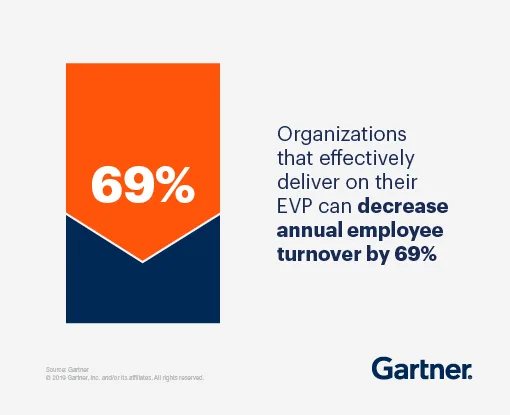
According to Gartner – “Organizations that effectively deliver on their EVP can decrease annual employee turnover by 69%”
Help engage your workforce
An effective EVP can give your employees the clear understanding of your company’s mission, vision, and goals. This eventually results in engaging your employees better and increase their commitment to work.
Elevate your company’s performance & growth
When your workforce is engaged, productive, and satisfied, the company’s business will get a boost which thus will result in profitability and growth. To support this notion a survey from Gallup shows that teams that are highly engaged can increase profitability by 23% and customer loyalty by 10%
Cut down costs on recruitment
When you successfully retain your best people, the frequency of spending money on hiring and retention will become quite less.
Enables better transparency
EVP lets your company to be effectively communicate openly and honestly (increasing transparancy) about the expectations from employees and what you promise them in return. This translates into establishing mutual trust and respect between the company and its people.
How to measure and activate your employee value proposition
An EVP becomes useful when each pillar has an owner, a candidate-facing proof point, an employee experience signal, and a review date. Use a simple quarterly scorecard:
| EVP stage | Metrics to review | What a gap may mean |
|---|---|---|
| Attraction | Qualified applications, source conversion, careers-page engagement, and candidate questions | The promise is unclear, generic, or reaching the wrong audience |
| Hiring | Offer acceptance, decline reasons, time in stage, and candidate experience | The message does not match the role, manager, pay, process, or flexibility reality |
| Onboarding | New-hire role clarity, access readiness, first contribution, and 30/90-day feedback | The promise is not being delivered from day one |
| Employment | Engagement, recognition, workload, development access, manager support, and flexible-work experience | The daily experience differs across teams or levels |
| Retention | Voluntary turnover, regretted exits, internal mobility, and exit themes | The value exchange is not strong or credible for a key segment |
Do not turn these measures into one “EVP score” without context. A strong offer-acceptance rate can coexist with poor retention, and high engagement can hide unequal access to flexibility or development. Compare the same workforce segment over time and investigate the gap between employee groups.
Employee value proposition research: match the promise to the lifecycle
EVP priorities can change after someone joins. The 2026 State of Rewards from WorldatWork reports that competitive base pay was selected as important by 87.6% of respondents for joining, 87% for staying engaged, and 92.8% for long-term retention. Flexibility rose from 68% for attraction to 85% for engagement and 88% for retention. For long-term retention, the study reports pay in 70% of respondents’ top three, flexibility in 60%, benefits in 40%, and meaningful work in 36%.
These figures are not a universal ranking for every country, role, or workforce segment. They do show why an EVP should not be written as a static candidate slogan. Use a lifecycle test:
| Lifecycle moment | EVP question | Evidence to review |
|---|---|---|
| Attraction | Does the message make the right people understand the work and offer? | Qualified application rate, candidate questions, source quality, and careers-page behaviour |
| Offer | Does the promise survive detailed questions about pay, flexibility, manager expectations, and growth? | Offer acceptance, decline reasons, and candidate experience comments |
| Onboarding | Did the employee receive what the job description and interview implied? | Access readiness, role clarity, manager support, and 30-day feedback |
| Employment | Is the value exchange visible in daily work? | Engagement, recognition, workload, development access, and flexibility experience |
| Retention | Is the EVP still relevant as needs and life stages change? | Voluntary exits, internal mobility, stay interviews, and exit themes |
Gartner’s EVP design guidance recommends pressure-testing the proposition with employees, candidates, leaders, and the labour market. Recooty’s recommendation is to keep a claim only when an owner can show its proof, explain its limits, and fix the experience when delivery falls short.
Recooty editorial view: an EVP should help candidates self-select
Our view is that an honest EVP should make the right people more interested and help the wrong-fit people make an informed decision before they apply. Explain the work, manager expectations, growth reality, flexibility, compensation approach, and constraints in plain language. Recooty’s branded careers page guide and career page conversion guide can help turn those proof points into a candidate-facing experience.
How do you create an employee value proposition that employees believe?
Current EVP guidance from Gartner, Gallagher, Randstad, and CIPD is converging on one point: the proposition must be experienced, not just communicated. Gartner describes EVP as the attributes that internal employees and external talent perceive as the value of working for an organisation. Gallagher’s 2026 analysis highlights the gap that appears when polished EVP language is not reflected in daily work. CIPD’s 2026 reward survey also notes that employers need clear objectives and better assessment of whether benefits are relevant and effective.
Gartner’s May 2026 survey of 10,055 employees found that total-reward preferences had shifted toward financial stability and protection against unexpected costs. That does not mean every employee values the same package. It means a generic “wellbeing and perks” message should not replace evidence about what the target workforce actually needs.
Use this promise-to-proof map when refining your EVP:
| EVP promise | Proof employees and candidates should see | Warning sign |
|---|---|---|
| Fair reward | Pay range or compensation explanation, benefits eligibility, review process, and clear total-reward information | The job ad uses “competitive pay” but no one can explain the range or review rules |
| Flexible work | Actual location, hours, core collaboration expectations, equipment, and how flexibility works in the role | Flexibility is advertised but managers reward constant availability |
| Growth | Examples of development, internal mobility, mentorship, and how people qualify for opportunities | The EVP promises growth but employees cannot name a path or recent example |
| Meaningful work | Customer or community impact, role outcomes, and how the work connects to strategy | Purpose appears only in brand copy and not in priorities or decisions |
| Supportive culture | Manager behaviours, recognition, feedback, inclusion, and ways employees can raise concerns | Culture is described with adjectives instead of observable practices |
| Sustainable performance | Workload expectations, staffing, time off, tools, and recovery norms | Wellbeing language is used to cover chronic overload |
The warning-sign column turns a broad promise into something a team can check. Keep an EVP claim only when a policy, manager behaviour, employee story, or measurable experience supports it.
Put the employee value proposition into practice
Choose a small set of promises that your company can prove today. Assign an owner to each one, show candidates what the promise looks like in the role, and review the employee experience when the evidence changes.
Frequently Asked Questions
A proof point is something a candidate or employee can verify, such as a published pay range, a real flexible-work rule, a named development path, a manager practice, or an employee story that matches the role. Replace broad adjectives with evidence and state any limits clearly.
The underlying value exchange should be truthful and consistent, but the emphasis can differ by talent segment. An early-career role may need clearer learning and support proof, while a senior role may need decision scope, strategic impact, and leadership expectations. Do not promise a benefit that the role cannot receive.
Describe the actual work location, core hours, travel, collaboration norms, manager discretion, equipment, and exceptions. Explain what flexibility means in this role instead of using “flexible” as a standalone claim.
Ask the recruiter and manager for a typical week, examples of development, how decisions are made, how performance is supported, and what flexibility looks like in practice. Compare those answers with the job description, offer, onboarding plan, and employee reviews without treating any single source as complete.
Treat the gap as an operating issue, not a copywriting issue. Identify which promise is failing, segment where it fails, assign an owner, communicate the change or limitation, and update the public message only after the underlying experience is accurate.
Review it at least annually and whenever pay, benefits, work models, leadership, strategy, or employee expectations change. Review it sooner when evidence shows that candidates or employees experience the promise differently from how it is described.
Interview employees and recent candidates, identify what is genuinely distinctive, document role conditions honestly, choose a few proof-backed promises, and use the same language across job ads, interviews, onboarding, and manager conversations.
Source: https://recooty.com/blog/employee-value-proposition-a-complete-guide/
Jump To Section
Author's Profile

Amay Bakshi
Amay Bakshi is a content writer at Recooty, where he breaks down complex hiring trends and HR tech innovations into clear, actionable insights. His work...
View Full Profile →